
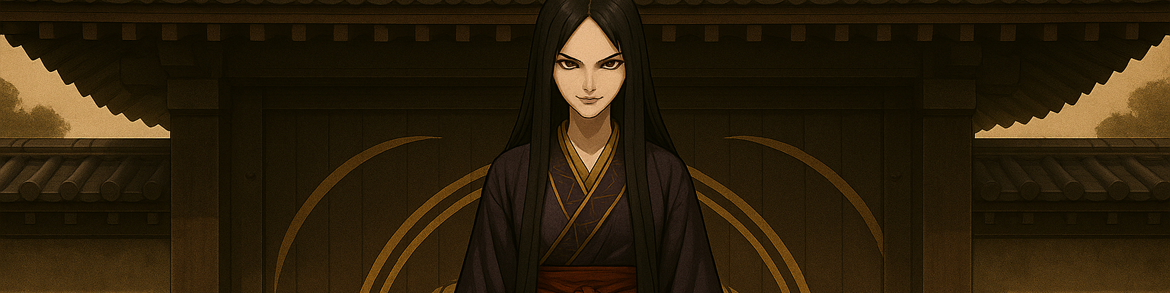
The House of Hebikawa
"“They call it the Hebikawa-ke. It’s not a name. It’s a warning. If one of them passes you in the street—bow, speak politely, and do not ask questions. If one of them knows your name—it’s already too late to change it.”
This is not a syndicate.
It does not bark in alleys or bleed in stairwells. It does not tattoo loyalty in panic ink or scatter neon bravado across the waterfront. It does not need to.
The House of Hebikawa—the Hebikawa-ke, if you’ve lived long enough to speak it without flinching—is something older. Quieter. Colder.
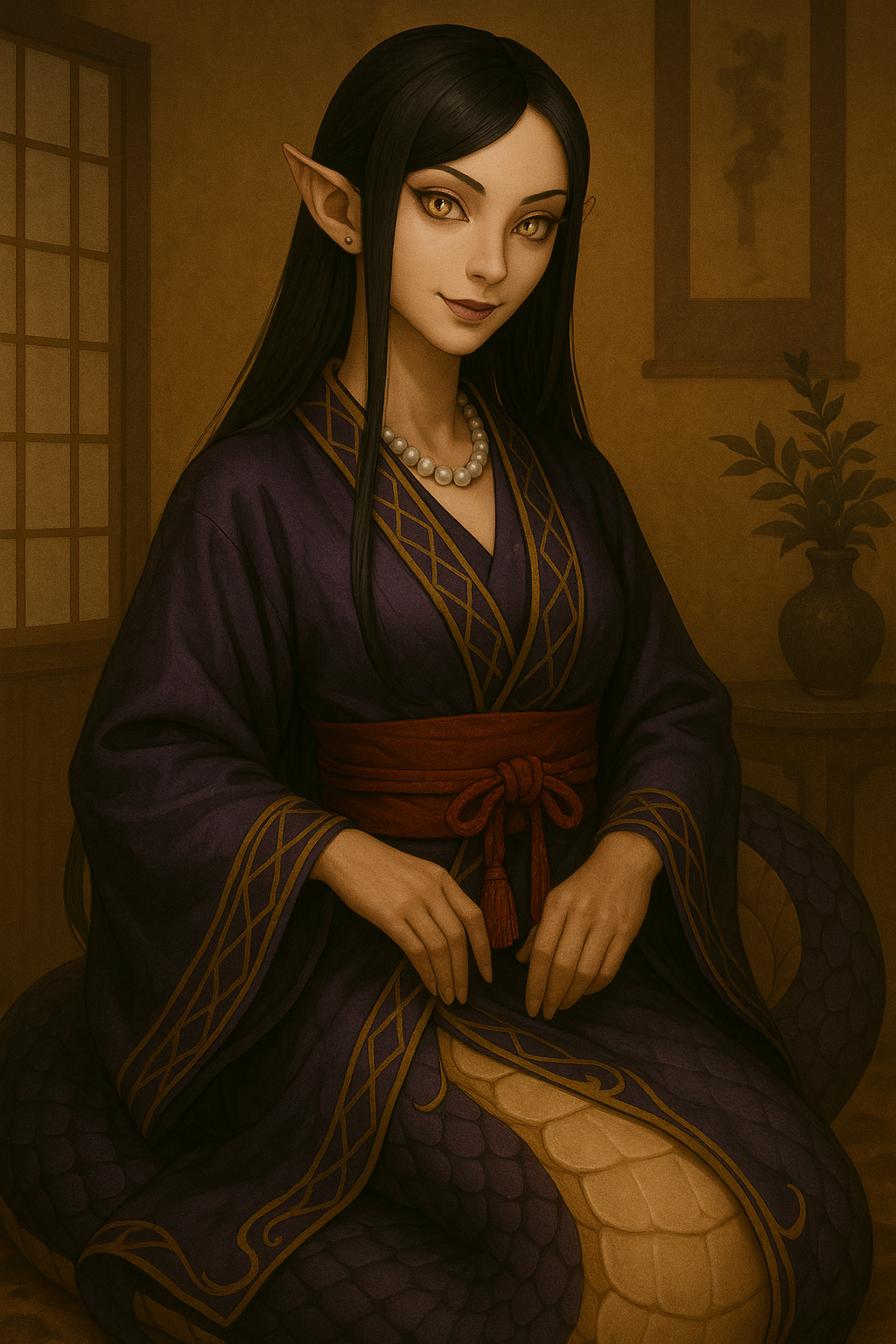
A family of lamiae who coil through Sumitsuki Ward like blood through stone, velvet through silk. Their influence is absolute, their discipline generational. Their business is not advertised. It is understood.
Where others claim power, they embody it.
Where others make threats, they make arrangements.
And where others spill blood, the Hebikawa simply... remove the necessity.
To outsiders, they are an elegant anomaly. A crime family wrapped in shrine blessings and seasonal charm, rarely seen but always obeyed.
To locals, they are gravity—invisible, inescapable, and not to be defied.
They do not fight for territory.
They are the territory.
The Matron appears rarely. When she does, the air forgets how to move.
The Father speaks softly. His enemies do not. Not anymore.
And the Daughters?
The Daughters smile.
The Daughters bow.
The Daughters never forget a face.
This is not a gang. This is not a rumour. This is not a story that ends well for you.
This is the House of Hebikawa.
And if you're lucky—you’ll never matter enough to meet them.
The Matron and Her Flame
When Power Marries Patience
There is no second in command. No seat to inherit. Only the first law—and the man permitted to stand beside it.
Hebikawa Sayomi does not govern. She simply is, and the city adjusts. Her presence holds the ward in place. Shrines remain undisturbed. Daughters bow without command. No festival has ever required a second warning.
Yukimura Kazuo, the Father of the House, does not overshadow her—nor does he linger in her shadow. He speaks softly, acts rarely, and is obeyed completely. He does not lead unless left to. He is the only man who walks beside the Matron and survives being seen there.
They do not contradict one another. They do not explain. They do not ask twice.
To meet one is unsettling.
To meet both is final.
Daughters of the Veil
Velvet Hands, Coiled Fates
There are always twenty-seven.
Not twenty-eight. Not fewer. When one falls, another is chosen. The number holds. The consequences do not wait.
Each Daughter bears the Hebikawa name, and each is both ritual and weapon—some negotiate with shrines, others manage street order, a few perform, and many remove problems with quiet finality. No two are alike, but all are trained to move with the same precision: cold when required, seductive when useful, and absolute when unleashed.
They do not boast. They do not hesitate. They do not forget.
When one passes in the street, people bow. When one speaks, they listen.
Not out of fear.
Not entirely.
But because respect is cheaper than regret.
The Nature of the Coil
The Pattern Does Not Promote You. It Places You.
There are no titles in the House of Hebikawa. No ranks. No uniforms. No hierarchy you can petition. And yet—everyone knows their place.
The House does not operate like a syndicate. It coils. Each part moves independently, but never without permission. You are not invited upward. You are given position—once—and moving from it without instruction is a form of disappearance.
The Matron does not issue commands. She speaks, and the city adjusts.
The Father is not her second, nor her shield. He is the fire at the centre, entrusted to act in her name, and never questioned because neither is she.
The Daughters are not lieutenants. They are the mechanism itself—twenty-seven expressions of intent, ritual, and consequence.
Below them, the Outer Coil operates in silence: couriers, handlers, accountants, shadows. They are useful. They are not family.
No one climbs in the House.
They are either placed—or removed.
Threads That Must Not Be Pulled
On Relationships, Pacts, and Dangerous Respect
The House of Hebikawa does not dominate Velvet Nocturne.
It does not need to.
Its power is not drawn from titles or territory, but from knowing when to remain still. Its presence in Sumitsuki is absolute—yet never oppressive. It touches every contract, every silence, every permission unspoken. It guides, never grasps. Presses, never clutches. Its influence feels less like control and more like weather: unavoidable, patient, and not to be argued with.
Where the shrine foxes walk, the Daughters bow.
Where a line begins to blur, the Father acts.
And where affection might be weaponised, the Matron simply watches—hands folded, voice unused.
The Foxes of Sumitsuki
There is no written accord.
No ceremony, no scroll, no signed pact.
And yet the shrine foxes and the House have never clashed.
Because both understand what would happen if they did.
“The snakes hold the street. The foxes hold the silence. That is balance.”
The House treats the shrine maidens with unwavering deference. Their rituals are untouched. Their guidance is accepted, publicly. Their presence is never mocked, mimicked, or mimed. In turn, the shrine foxes do not ask who owns the buildings beside their temples. They do not investigate the Coiled House. And they never question what becomes of those who speak too freely during festival season.
Political Entanglements
The House does not need politicians.
It simply keeps several well-fed.
Daughters like Sakuya maintain networks of soft control—favour, debt, comfort, fear—across city council offices, cultural advisory boards, and shrine regulation panels. It is not called bribery. Not because it isn’t, but because everyone involved still wants to live long enough to feel comfortable again.
It is rumoured the Matron has been offered a seat on the city council.
She has never responded.
The invitations have stopped.
Rival Syndicates
Other groups operate in Nocturne.
Some even look toward Sumitsuki.
Those who remain were permitted.
Those who vanished were not warned.
There are no public feuds. No street battles. No statements issued. Only new management. New signage. A stall that used to serve noodles now sells amulets. And someone at a neighbouring bar lowers their voice and murmurs:
“They touched a Daughter without permission.”
No one ever asks which one.
It no longer matters.
Where the Coil Touches Ground
Headquarters, Holdings, and the Veil of Legitimacy
The House of Hebikawa does not advertise. It does not hang signs. It does not issue invoices. And yet its presence is stamped across Sumitsuki with the quiet certainty of a tail drawn through dust—deliberate, curved, impossible to ignore.
Official records list only a handful of properties. The truth is deeper, older, and infinitely more organised. What the House claims in public is modest. What it controls in practice is ritualised necessity: businesses that function flawlessly, staff who never speak out of turn, and neighbourhoods that seem to clean themselves before inspection.
None of it looks like power.
That’s the point.
The Coiled House
Tucked behind shrine paths and stone walls, the Matron’s estate is both spiritual centre and execution hall. Locals call it The Coiled House—not for its shape, but for the feeling that lingers near its gates. Visitors do not approach uninvited. Invitations are rare. Departures are not always symmetrical.
(Architectural and metaphysical details are housed in the dedicated dossier: The House That Breathes Beneath the Stone.)
Silkfront Holdings
The polite euphemism used for House-operated businesses: traditional teahouses, textile shops, matchmakers, bathhouses, and “companion venues.” Each is spiritually cleansed, publicly tolerated, and quietly loyal. They serve tea, take payments, and offer comfort. But their true function is leverage.
Nothing illegal. Nothing overt.
Just a velvet-wrapped network of obligation and influence, all reporting—eventually—to a Daughter.
The Shigasō Parlour
Officially, it is a wellness salon. Soft lighting. Cushions. Incense. But the smoke never quite clears, and the feeling doesn’t fade when you leave. Overseen by Hebikawa Shion, the Daughter known as The Pale Flame, the Parlour is where memory, identity, and emotion become... negotiable.
Clients emerge soothed, shaken, or unmade.
A few return weekly.
A few never fully return at all.
Festival Patronage
Every shrine blessing, firework stall, and ceremonial float in Sumitsuki has passed through Hebikawa hands. Every permit is approved by a Daughter. Every disruption is remembered. No one knows when the House took control of the festival circuit. No one remembers it ever not being theirs.
Disrespect during a festival is not punished.
It is... resolved. Quietly. Permanently.
This is not real estate.
It is not commerce.
It is a spiritual architecture—stitched into the ward with silk and silence.
The city may run on its own.
But between the shrines,
between the parades,
between one breath and the next?
That is Hebikawa ground.
Closing the Fan
You Don’t Leave. You’re Released.
The House of Hebikawa does not raise banners. It does not storm gates. It does not poison wells or light pyres in the alleys. It does not need to.
It simply remains—unchallenged, unshaken, and unforgetting.
It is patience given form. Power dressed in restraint. A family that learned to bow before it learned to strike—and then taught the difference between the two to an entire ward.
Others rise. Others scheme. Others declare intent.
The Hebikawa did none of these.
They simply settled.
And the city, wisely, settled around them.
If you are reading this for insight, be cautious.
If you are reading this for opportunity, be quiet.
If you are reading this for revenge—
...you’re already in the wrong story.
No one escapes the House.
Some are allowed to walk away.
But only when the Matron decides they’ve finished being useful.
She never says goodbye.
She simply closes the fan.

Family Members
At a Glance
A brief guide for festival guests, misplaced informants, and anyone who’s accidentally found themselves bowing.
What This Family Is
The House of Hebikawa is a lamia crime dynasty operating out of Sumitsuki Ward. It runs the district with cold ritual, emotional leverage, and unspoken law. It is not recognised by the city council. The city council answers their calls anyway.
Why Everyone Pretends to Approve
Because the House doesn’t advertise. It whispers. It blesses. It removes problems before they spread. Every festival runs on time. Every shrine remains untouched. The streets stay clean because no one wants to find out what happens when they aren’t.
Power Structure
- The Matron – Hebikawa Sayomi. Unmoving. Unyielding. Unquestioned.
- The Father – Yukimura Kazuo. Smiles like a polite warning.
- The Daughters – Twenty-seven. Always. Seduction, silk, and silent enforcement.
Daily Life (If You Live Here)
Say nothing twice.
Bow when passed.
Never ask about the twenty-eighth.
Festivals are sacred. So are invitations.
If you hear music near the Coiled House, go home.
Local Customs
- Do not touch a Daughter. Even gently. Even as a joke.
- If the Father looks at you—apologise for whatever you’ve done.
- If the Matron speaks to you—whatever you were becomes irrelevant.
- If invited inside, say yes. If not invited—do not approach the gates.
The Laws of the Coil
The House does not publish rules. It doesn’t need to. The Pattern remembers. And so do the Daughters.
No Daughter moves alone.
To touch one is to face all. That is not metaphor. That is consequence.
The shrine is sacred.
The foxes are not to be questioned. Their paths are not to be blocked. The accord is older than offence.
Affection must be earned.
To counterfeit love is to dishonour the Matron. Her silence will mark you before her Daughters ever do.
There are twenty-seven.
Always. When one falls, another rises. The title passes. The name does not.
If you are summoned, it is not to be heard.
It is to be corrected.
There are no exceptions. Only replacements.
Notable Daughters
If you hear her name before you see her face—bow twice.
If she calls you by your name—don’t run. It’s already done.
Hebikawa Rinya — The Coil of Iron
Chief Enforcer. Silent. Implacable. Her presence means the Matron has already made a decision. She’s simply here to carry it out.
Hebikawa Natsuki — The Thread of Midnight
House Strategist. Rarely seen. Often obeyed. She handles all internal affairs, communications, logistics, and inter-family coordination. May or may not sleep. Definitely watches everything.
Hebikawa Sakuya — Veil-in-Velvet
Espionage. Diplomacy. Sabotage. She knows the mayor’s favourite wine, the shrine fox’s true name, and how to unmake a rumour before it finishes forming. She does not bluff. She does not have to.
Hebikawa Mayuri — The Red Thread Mistress
Oversees the House’s companion service—equal parts escort, therapist, and narrative entanglement. Clients come out changed. Some come out cured. Some never stop dreaming of her voice.
Hebikawa Shion — The Pale Flame
Oracle of the Inner Coil. Speaks in dreams and second-person regret. Her chambers are heavy with shigasō—lamian incense that erodes emotional defences and erases small lies. No one has ever left her presence unchanged. Some don’t leave at all.
Hebikawa Tomoe — The Black Ledger
Financial overseer. Debt collector. Economist of apology. She does not raise her tail to chase. She simply recalculates what you now owe for wasting her time.
Whispers in the Pattern
Some things are never written. Others are erased too late.
Locals still speak of the Twenty-Eighth Daughter—a figure seen only during rare festivals, walking beside the Matron, unlisted, unnamed, and quietly forgotten. There are always twenty-seven. But not always only twenty-seven.
In the Whisper Rooms—tea parlours, bathhouses, and corners of the Riverwalk—voices sometimes respond before you speak. Confessions stick. Names echo. And no one leaves exactly as they arrived. The House dismisses these stories. They never deny owning the buildings.
And then there is the Father. Photographs of Yukimura Kazuo haven’t changed in thirty years. Not aged. Not shifted. Not blurred. No one calls him mortal anymore. No one who stays polite.
Are these truths?
It no longer matters.
They’re believed.
And that’s enough.
Additional Details
“Your continued reading is more valuable than coin. However, the author assures me that Ko-Fi support assists in ‘keeping the kettle on.’ I am told this is a metaphor. I remain unconvinced.” — Seraphis Nightvale Ko-Fi: #madmooncrow


Comments