
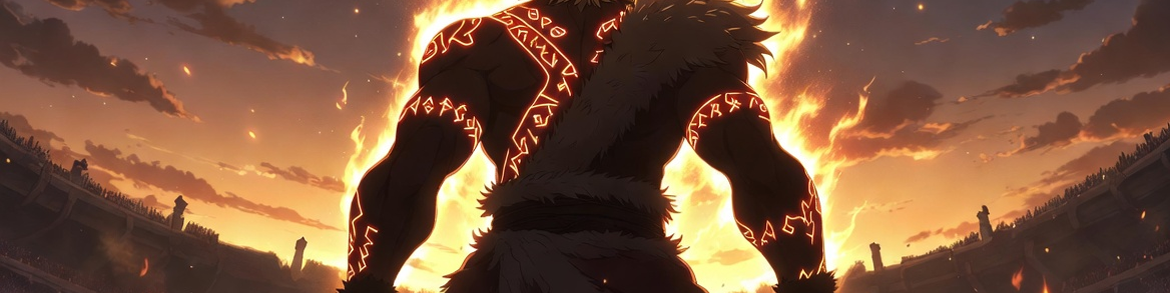
Galdros - God of Battles
“Galdros lives in the blood of every fighter who refuses to stay down. He is the surge that defies pain, the roar that outruns fear, and the god most responsible for victories that should be impossible and recoveries that astonish even their witnesses. Honestly, it is a miracle Aethryn still has unbroken furniture.”
Aethryn does not sculpt deities through quiet prayer or structured belief. It forges them from the loudest truths mortals repeat. And Aethryn’s people, for all their flaws, have always believed that courage should be noisy, that strength should be seen, and that heroes should rise even when the world begs them not to.
From that belief — shouted across training yards, echoed in taverns, carved into countless stories — the Pattern condensed a god whose entire nature is built from heart, fire, spectacle, and the refusal to fall.
Thus stands Galdros, the God of Battles: a living blaze of valour, chaos, and triumphant defiance.
How Aethryn Made Him (And Why It Keeps Him)
Aethryn’s gods shift and evolve through reputation as much as reverence. Mortals expect a certain kind of divine presence; the Pattern quietly obliges. Most gods bend their image over centuries to match expectation, smoothing contradictions and adjusting myth to suit new eras.
Galdros has never needed to change. Mortals already imagined battle as noise, spectacle, heart, and idiotic bravery — everything he already was. Each generation simply added more fire to his legend. The child who shouts encouragement at a sparring match feeds him. The villagers who cheer for local champions feed him. The guilds that celebrate improbable comebacks feed him.
He is the purest form of Aethryn’s favourite idea:
that bravery becomes truth when enough people believe it loudly enough.
The Avatar: A Celebration Wearing Skin
Galdros never walks Aethryn in his true shape — the Pattern would refuse. Instead, he sends an avatar stitched from belief, carved from bravado, and fed on the joy mortals feel when a fight becomes a story.
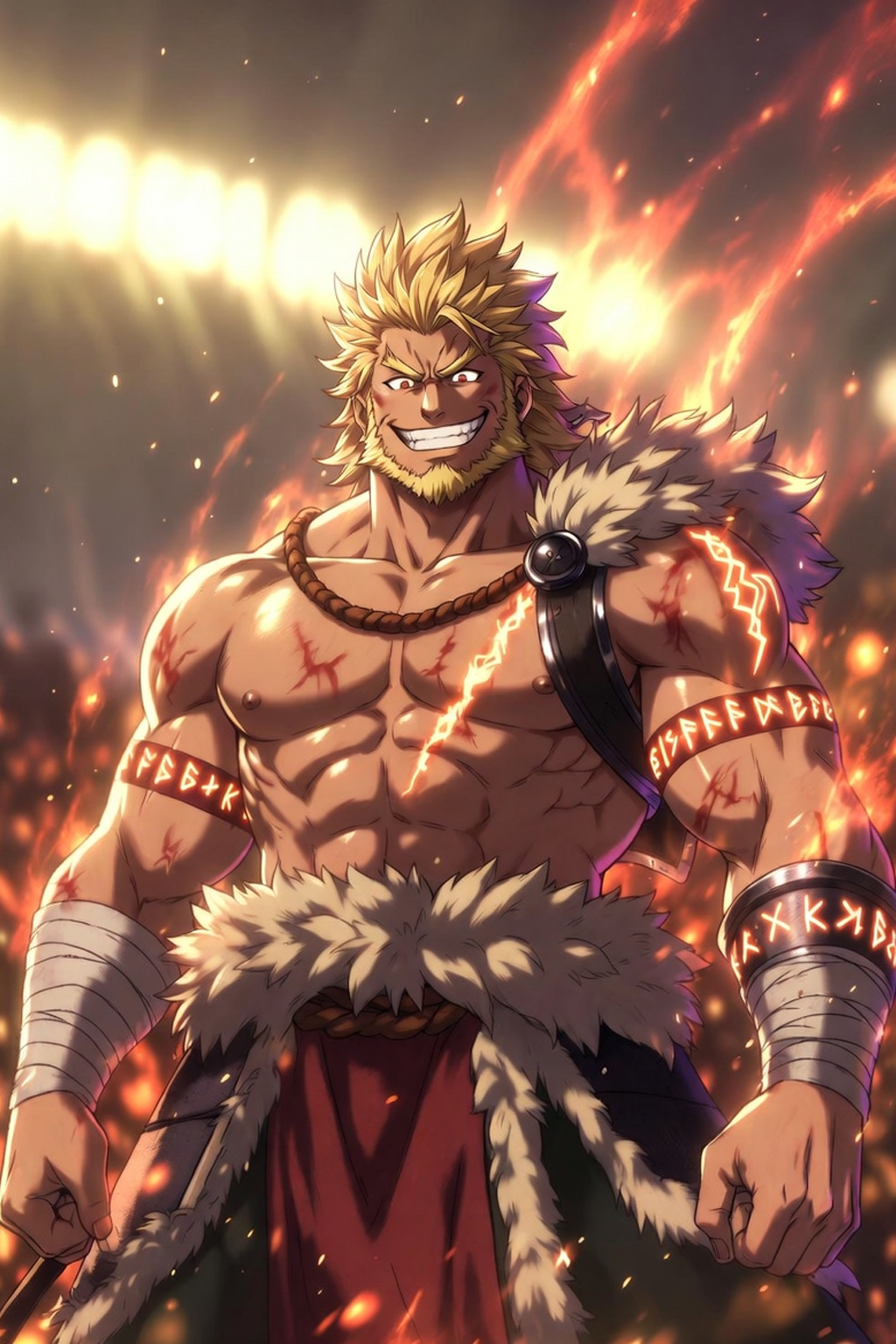
His avatar towers like a festival statue given life. Broad shoulders carry the weight of countless victories; a solid, proud belly speaks of feasts shared and training taken far too earnestly; a map of scars covers arms that look capable of lifting taverns. Runes hum faintly beneath his skin, glowing brightest when excitement takes hold, which is often.
Every part of him is built from spectacle. His hair rises in wild waves no wind created. His vest never closes and refuses to try. His mantle exists solely so he may rip it off with flair moments before a fight. Even his footsteps carry a challenge, as if daring the ground to brace itself.
Whenever his avatar arrives, so does commotion. Taverns erupt in cheers, guild apprentices whisper in awe, local guards quietly consider retirement, and children swarm with the breathless certainty that whatever happens next will be memorable.
He drinks like he invented celebration, fights like every blow paints a legend, and encourages strangers with such intensity that healers stand ready.
And yet, for all that spectacle, the avatar is only a shadow of the truth.
The Roaring Voice Within
Galdros’ real presence is internal — a shock of divine fire that erupts when mortals fall.
When you hit the ground so hard your bones ring, when breath flees your lungs and despair sinks its teeth in, you feel him rise inside your ribs. Not gently. Not wisely. But with unstoppable certainty.
His voice is not heard but felt. It drives itself through your spine and fills your chest until there is no room for surrender.
“On your feet. Now. This is not where you break.”
That is Galdros.
The sudden burn in your arms.
The furious strength in your legs.
The certainty that you will rise, even if it is foolish.
He does not offer technique or calm instruction. He offers the raw compulsion to stand again and force fate to reconsider. Many mortals swear that the momentum which carries them through impossible moments never felt like their own.
They are half right.
It was theirs.
He simply lit the fuse.
Valour, Chaos, and the Beautiful Logic of Striking Harder
To Galdros, battle is not a matter of strategy. Strategy is quiet, patient, deliberate — three things he does not understand and refuses to endorse. Battle, for him, is a declaration of identity, a moment where courage steps forward and demands to be seen.
He adores fighters who enter combat as though stepping onto a stage. The lone defender who shouts challenge at an enormous foe delights him. The mage who hurls blazing wonders skyward earns his praise. The rogue who leaps in with confidence and questionable judgement earns his grin. The veteran who fights like they are engraving their name into the world earns his respect.
He does not favour victory.
He favours glory.
A silent win means nothing.
A loud stand becomes a tale.
And tales — in Aethryn — are the bricks from which gods are made.
The Noodles, the Valiant, and the Absolute Units
Aethryn’s greatest mysteries often begin with a single sentence:
“You grew how much?!”
Galdros is wholly responsible for the world’s most baffling transformations. Guildmasters mutter about them. Villagers gossip about them. Carpenters rebuild their homes because of them.
He is the divine force behind every “noodle to unit” story.
The scrawny apprentice who returns with arms the size of tree trunks.
The trembling novice who leaves town and comes back with enough muscle to carry livestock.
The meek stablehand whose glow-up causes fainting in onlookers.
These changes occur with no sensible timeline. One season is enough. One pilgrimage is enough. In the most troubling cases, one long weekend is enough.
And the newly converted “unit” usually cannot explain it beyond vague recollections of an internal roar insisting they rise, push, and become more than they were.
Galdros delights in these miracles.
Aethryn adapts with weary affection.
The Pattern pretends to be busy whenever the subject is raised.
Priests of Galdros: The Holy Order of Encouragement
No one mistakes a Galdrian priest for one of the quiet faiths. Their robes lack sleeves entirely and seem designed more for training than contemplation. Every priest breathes the same impossible confidence — as if shouting encouragement at strangers is a sacred duty.
Their temples are half shrine, half arena, and wholly incompatible with the idea of peaceful meditation. Morning rites begin with stretches and chanting that echoes like thunder. Confessions involve admitting fear while sweating profusely. Absolution involves being coached into triumph with aggressive optimism.
Their festivals are raucous, their blessings exhausting, and their sermons structurally compromising.
They are not war leaders. They do not discuss strategy.
They discuss heart.
They discuss courage.
They discuss the sacred art of standing up again.
Their doctrine is simple:
Rise loudly.
Strike boldly.
Live in a way that makes the world remember you.
The Pantheon’s Complicated Appreciation
Aurinda admires his brightness but worries her temples will crack once he starts cheering.
Selvera finds him charming until he flexes, at which point she faints on principle.
Thalmar refuses to be outshouted and sometimes storms accordingly.
Lyrien’s anomalies sparkle brighter when he’s near, though she denies it.
Korthian appreciates the regular repair work.
Ezrakel respects Galdros’ dramatic last stands with almost unsettling warmth.
The pantheon does not rest easily in his presence.
But they all agree Aethryn shines brighter with him in it.
How Mortals Understand Him
To adventurers, he is the fire that keeps them alive.
To guards, he is the explanation for paperwork titled “excessive bravery.”
To villagers, he is beloved but treated as a risk to furniture.
To children, he is a living legend.
To scribes, he is a catastrophe of enthusiastic capitals.
Cities devoted to him produce heroes, disasters, triumphs, collapses, rebuilds, and celebrations that turn into legends.
Aethryn does not mind.
It enjoys the noise.
Final Thoughts
Galdros is not wise.
He is not quiet.
He is not subtle or safe or predictable.
But he is the courage that refuses to die.
He is the shout behind every heroic rise.
He is the heartbeat of defiance in mortal bones.
He is the god of the moment when a story tries to end —
and a mortal, burning with his fire, decides otherwise.
Aethryn made him because it needed him.
And for all his noise and chaos, the world would be unbearably quiet without him.
At a Glance
For those intent on meeting a god of battles without reading the warnings. Very well. Try not to get thrown.
What He Is
Aethryn’s god of battle-as-spectacle: loud, blazing, reckless, and beloved like a storm you admire from indoors. Courage made noisy.
Why He Exists
Mortals believe bravery should be shouted. The Pattern agreed. Every improbable comeback, every shouted challenge, every “I refuse to stay down” feeds him.
How He Appears
A towering avatar stitched from bravado and festival energy — scars glowing, runes humming, grin wide enough to worry structural supports.
How He Is Felt
A roaring spark inside your ribs when you hit the ground. The divine command to rise. Technique irrelevant. Heart compulsory.
What Delights Him
Spectacle. Shouted challenges. Underdogs refusing fate. Victory matters less than style; quiet wins disappoint him terribly.
His Favourite Miracles
The “noodle-to-unit” transformations. Apprentices return as giants. Novices become legends. Furniture rarely survives the experience.
His Priests
Sleeveless optimism in human form. Their temples shake with shouting, training, encouragement, and occasional apologies to builders.
His Relationships
Other gods handle him with affection, awe, or mild panic. He cracks ceilings, inspires miracles, and generates heroic paperwork.
How Mortals See Him
To adventurers: the spark that keeps them alive.
To villagers: beloved, dangerous to architecture.
To children: the definition of “hero.”
To scribes: an occupational hazard.
Why Aethryn Keeps Him
He is the heartbeat of defiance — the moment a story tries to end and someone shouts “not yet.”
How to Portray Galdros
Galdros should be played with big, earnest energy — loud-hearted, larger-than-life, impossible to ignore. Speak as though every moment is a story worth shouting about. He laughs easily, encourages aggressively, and treats fear like an inconvenience beneath him.
He isn’t wise, but he is honest. Let him feel everything at full volume: joy, pride, frustration, admiration. He celebrates people the way other gods judge them, lifting spirits with sheer unstoppable enthusiasm. Subtlety does not exist in his vocabulary.
Whenever someone falls, lean forward, grin, and tell them to rise. He believes in mortals with reckless conviction, and he wants them to believe too. His presence should feel like a festival, a challenge, and a hug from someone who might accidentally crack a rib.
Play the roar.
Play the heart.
Play the fire that refuses to go out.
Additional Details
“Your continued reading is more valuable than coin. However, the author assures me that Ko-Fi support assists in ‘keeping the kettle on.’ I am told this is a metaphor. I remain unconvinced.” — Seraphis Nightvale Ko-Fi: #madmooncrow


Comments