
Divine Resonance & Mortal Masks
"A god is only as eternal as the last story told about it. Stop telling the story and see how fast eternity ends."
Every world invents its gods. Some carve them from clay, others from hunger, others from the silence between stars. The mistake is to think those inventions permanent. The faith of mortals is not a wall but a tide; it shapes, erodes, and reshapes again. The wise learn to watch the current rather than worship the shore.
I record this not to strip anyone of reverence, but to catalogue its mechanisms. To name a process is not to profane it. If faith cannot survive description, then it was never faith—only fear dressed in ritual.
The Nature of Cores
Beneath every Threadworld lie the great resonant currents that I call Cores. They are not beings. They are inevitabilities. Light and darkness, life and death, order and change, hearth and harvest: these truths flow through all worlds as rivers through soil. They exist whether anyone names them. They do not listen, for they have no ears. They simply are.
To sense a Core is to feel pattern made visible. It is the tug that draws a seed toward sunlight, or the exhaustion that drags the dying into rest. Cores are the Elsewhere’s grammar—older than prayer, indifferent to praise.
The Birth of Aspects
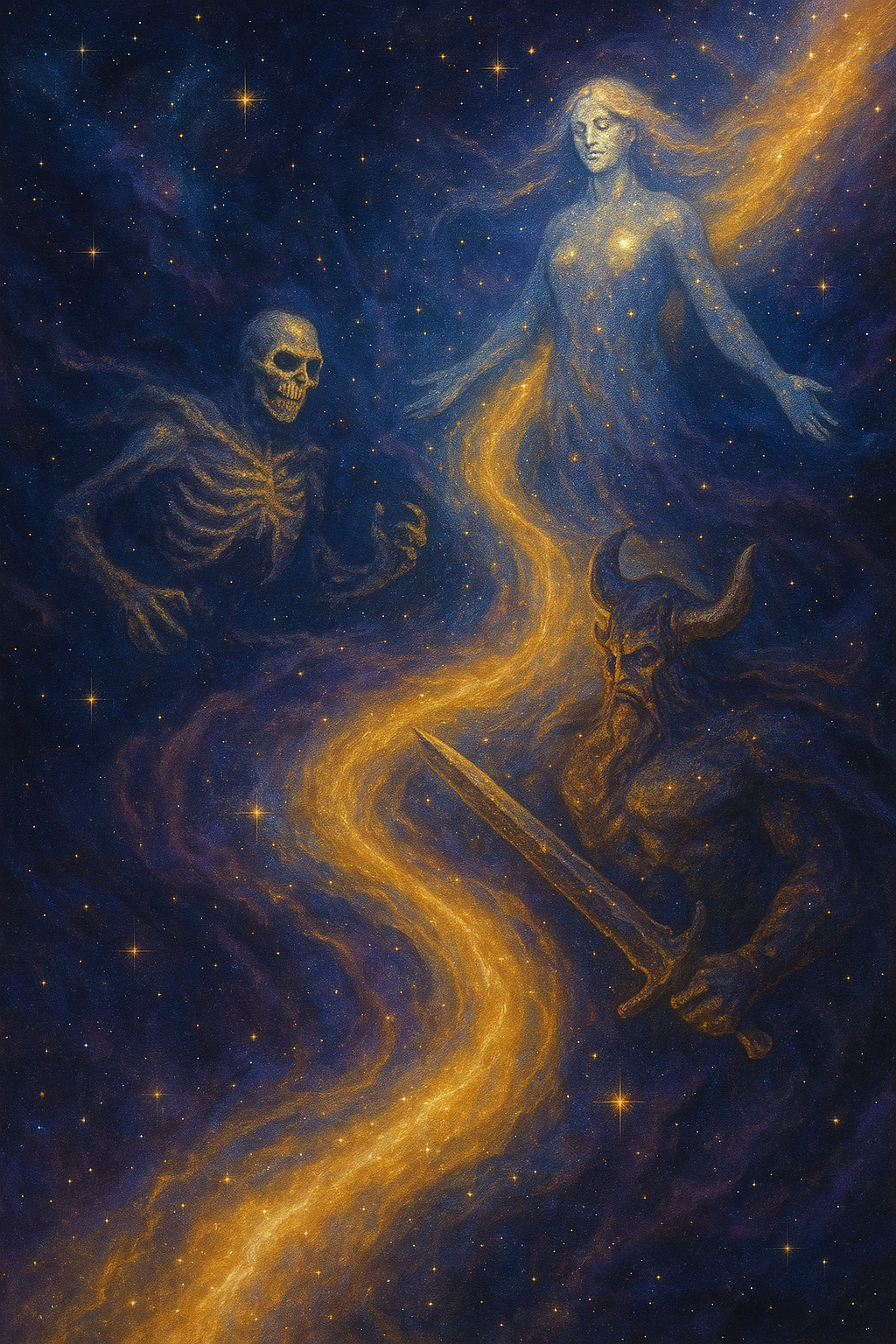
Mortals, incapable of kneeling before abstraction, give the currents faces. When enough conviction gathers around a Core, it condenses into form. Thus arise the Aspects: the masks through which mortals negotiate with the rivers.
An Aspect is local, shaped by fear and need. One village may see the Harvest as a mother with wheat in her hair; another may paint her as a sickle-armed reaper who smiles only for the dead. Both are true, and both are false. Each drinks from the same current, yet the taste differs with the cup.
Aspects are real in the same way storms are real. You can stand in them, bargain with them, even die of them. But they are still weather, not sky. Their existence depends entirely on the weight of human faith.
On Concept Gods
Sometimes mortals refine belief until it ceases to resemble the world that birthed it. They strip away the field, the fire, and the neighbour’s face, leaving only the idea. The result is what I name a Concept God: an Aspect so narrow that it loses its body and becomes a doctrine.
A Concept God cannot walk. It speaks only through priests, decrees, and law. Its miracles are administrative. Its presence is measured in obedience, not revelation.
The One True God of Duskworn is the clearest example. He may once have been a humble plough-spirit, content with the rhythm of seed and sun. His followers, desperate for certainty, elevated Him above His kin until nothing of the hearth remained. Now He is Light without warmth, Purity without mercy, Unity without compassion. He exists only as assertion—a mask made of commandments.
Earth has grown similar abstractions. Its polytheisms reveal familiar Aspects such as fertility, war, death, and trickery, while its monotheisms elevate Concept Gods of jealous fire and endless judgment. They burn brightly within their own walls and vanish utterly beyond them. A god who denies all others cannot survive in the Infinite Elsewhere, for here, plurality is the ground of being.
The Prison of the One-God
An Aspect that proclaims itself sole divinity is a paradox in motion. To exist in the Elsewhere is to coexist. The moment such a god steps beyond its world, it meets contradiction—and contradiction is fatal. Its doctrine collapses into silence.
Thus the One True God of Duskworn is mighty within His borders and absent beyond them. The rivers He once drew from—Light, Hearth, Order, and Sacrifice—still flow everywhere, but His narrow cup floats alone in stagnant water.
Mutability and Mirrors
Because Aspects depend upon belief, they alter whenever mortals alter. A hearth-god of warmth becomes a fire-god of vengeance when his priests begin burning witches. A healer-saint turns to a god of sacrifice when famine teaches that blood is a better fertiliser than prayer. Faith is a mirror. It cannot help but return the face that leans over it.
Some Aspects weave themselves from several Cores at once, forming patchwork divinities of tangled motive. These hybrids often embody entire cultures—the contradictions of compassion and cruelty bound into a single name.
On Clerics and Rivers
The faithful say their gods grant them power. What truly grants it is the river. A cleric does not draw from the god’s hand, but from the Core that underlies the god’s myth. The healer who prays to the One True God in a village chapel and the midwife who whispers to her bowl of honey both channel the same Life Core. The Inquisitor’s pyre and the witch’s bone-charm both stir the Death Core. Only the story differs.
This is why miracles persist after gods fall silent. The river flows even when the cup is shattered. Institutions loathe this truth because it undoes their monopoly. Yet truth is indifferent to hierarchy, as water is indifferent to the cup that breaks trying to contain it.
Case Studies in Resonance
Duskworn shows how a living presence can harden into concept. Its god has become an echo chamber of human fear, holy by repetition and vacant by design. A few knightly orders remember the gentler origin, though they would be executed for saying so aloud. The Church’s purity has become its own prison, preserving faith at the expense of meaning.
Earth displays the opposite tendency. Its old pantheons show the wealth of masks possible when belief allows multiplicity: fertility, war, death, and cunning, all familiar faces of the same few Cores. Its later monotheisms narrowed that variety into abstraction, and the abstractions devoured their own voices. Where there was once conversation, there is now decree.
Nocturne, by contrast, is belief in miniature. It is a world of small gods: flickering spirits born from acts of attention rather than worship. A coin left on a step, a bow at a gate, a whisper to an empty street—each is enough to sustain them. The shrine foxes tend these presences, not as servants but as keepers of balance. Their faith is a rhythm, not a rule. In them, divinity remains intimate, unassuming, and alive.
Together these worlds form a spectrum of belief. Duskworn freezes faith into doctrine. Earth diversifies it into legend. Nocturne distills it into gesture. Each reveals what mortals create when they mistake—or cherish—their own reflections.
Elsewhere, the Trickster travels freely: a fox in one world, a storm in another, a bureaucrat in a third. He is proof that adaptability is the truest immortality.
The Unfathomed and the Afterlives of Belief
Belief strong enough can outlive the soil that birthed it. When a Threadworld ends or forgets, its surviving conviction seeps into the Unfathomed, where ideology itself acquires architecture. Some domains are wide and impersonal, pure manifestations of Cores echoing across countless worlds. Others are mausoleums where fading Aspects whisper their own names to remember who they were.
I have walked among such places: a forge still echoing with a Victory God’s hammer though the god himself is long dissolved; a trench-chapel where Endurance has become the only liturgy; and a bone-cathedral whose Wrath still breathes though no priest remains to stoke it. They are beautiful in the way tombs are beautiful—precise, silent, and utterly sure of themselves.
Conclusion
Cores are rivers. Aspects are cups. Concept Gods are cups so narrow they pretend to be rivers. Mortals will always confuse the container for the current, and the habit seems unkillable.
If you would measure the strength of a god, do not count altars. Count doubts. Every doubt is proof that the river runs wider than the cup can claim.
At a Glance
For those who prefer their theology pre-chewed.
What This Is
A summary of divine structure within the Infinite Elsewhere. It defines the difference between Cores, Aspects, and Concept Gods, and explains how belief shapes and sometimes destroys its own deities.
The Nature of Cores
Cores are the elemental resonances of existence: truth rendered as current. They are not personalities or beings, but inevitabilities. Light, Death, Hearth, and Change flow through every Threadworld whether mortals recognise them or not.
The Birth of Aspects
When enough faith gathers around a Core, it forms a face to make itself bearable. These faces are Aspects, local gods shaped by need and fear. They differ from place to place, yet all are reflections drawn from the same current.
On Concept Gods
When belief becomes too narrow to hold contradiction, it collapses into doctrine. Such a god is no longer a presence but a policy. The One True God of Duskworn stands as the most refined example of this error.
Faith in Practice
Clerics draw not from their gods but from the Cores beneath them. The river grants power, not the cup that claims to own it. Miracles continue long after gods fall silent; institutions find this inconvenient.
Worlds in Comparison
Duskworn freezes faith into law and loses compassion.
Earth fragments it into stories and forgets their source.
Nocturne keeps it small, personal, and alive.
The Unfathomed
Belief strong enough does not die. It drifts into the Unfathomed, where it builds its own architecture. There, old gods linger as echoes, and ideas learn what tombs feel like.
Final Observation
If you wish to measure the strength of a god, count doubts, not prayers. Doubt is the only proof that the river still moves.
Additional Details
“Your continued reading is more valuable than coin. However, the author assures me that Ko-Fi support assists in ‘keeping the kettle on.’ I am told this is a metaphor. I remain unconvinced.” — Seraphis Nightvale Ko-Fi: #madmooncrow


Aranthme and Dellidae approve of this message :p