Deep in the Icy Reaches of
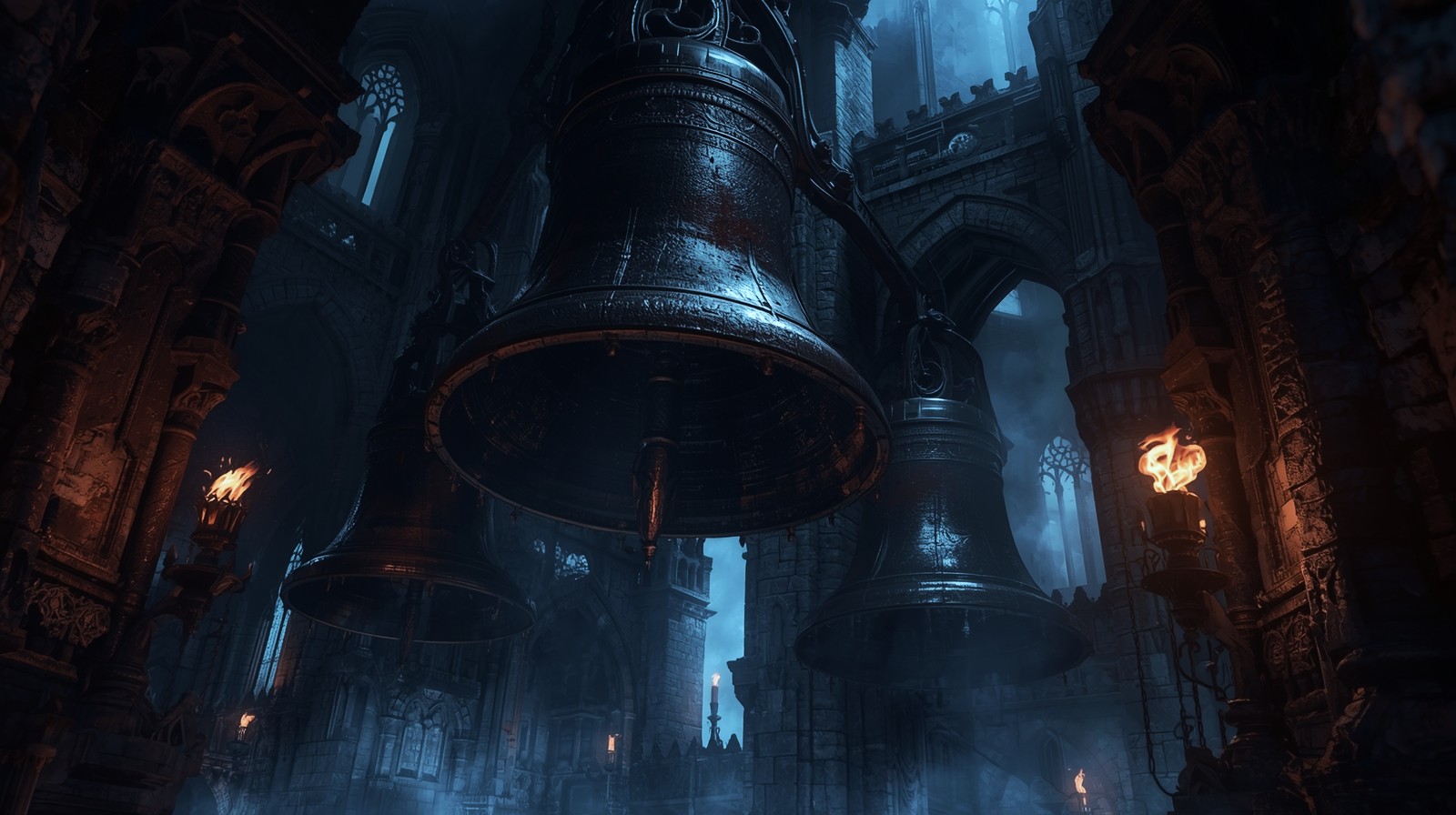
Idalka, where the frost never melts and the horizon is a pale knife of ice against black skies, stands the fortress-basilica of Angaron. The building is a relic of an age when men dared to bind powers older than gods, raising stone against storm and shadow. Its towers are jagged, its windows narrow and blind, and at its heart rises a belfry higher than the surrounding mountains. Suspended within are the Black Bells, three in number and of colossal size. Their sacred names are Gang, Gend and Gomb. The skin of the bells is corroded and mottled, bearing a hue like old blood on iron. They are said never to have been touched by snow, though the winds scream past them endlessly.
Their Forging
The bells were cast not by mortal smiths but by the Silent Foundry, a conclave of sorcerer-artificers who laboured in secret during the Era of Ash. Legends whisper that the molten ore was mixed with the bones of the defeated warriors of that strange race that now only survives as the last solitary
Marsh Harrow and tempered in lakes of blackened quicksilver. When the hammers fell for the last time, the sound alone slew all beasts within ten leagues, leaving the land sterile for centuries.
The Chroniclers of Angaron wrote that the world itself was not safe from the Wailers Beneath, entities that stirred in the deep ice and struck at human minds with dreams of madness. The bells were intended as a weapon: when rung, they would drive back the voices beneath and seal the fractures in the fabric of thought. But their craft was too potent, too foul. Rather than defend the soul, the bells shattered it. The ward became a curse.
Their Tolling
The bells are rung only at times of cosmic necessity, when the seams of the world strain to breaking. The priests of Angaron, gaunt, pale men who have had their tongues cut out to resist the bells’ whispering, climb the belfry with chains and spiked hammers. They strike the iron throats with deliberate rhythm.
Each toll rolls across the tundra like a collapsing mountain, carrying not only sound but dread itself. The living who hear it are seized with despair: soldiers abandon ranks, mothers weep over their children as though already dead, and the sane claw at their ears until blood runs. Some do not survive. Some survive but wander witless thereafter.
And yet, to ring them is not without reason. For every strike of the bells is also heard beneath the ice, and the Wailer, whatever nameless, formless hunger they are, shrink from it as though from fire. If not for the bells, say the priests, the cracks would have widened long ago and all the world would be lost.
The Record of Ringings
In the last thousand years, the bells have tolled fewer than a dozen times. Each tolling coincided with calamity:
In the Year of Hollow Moons, when auroras turned blood-red and drove entire villages to murder.
During the Siege of Harlsk, when the glaciers split and voices rose from the abyss below.
And most recently, one generation past, when a star fell into the northern seas, and its impact summoned a tide that threatened to swallow the coast.
The bells rang, the tide subsided… but those who heard the sound have never slept soundly again.
Their Omen
The Black Bells of Angaron do not ring for human wars, nor for famine, nor for plague. They ring only when the walls of reality strain. And each toll, it is said, carries a price: the despair they sow is not a side-effect but a feeding. Some believe the bells themselves are not weapons, but mouths. Vast iron mouths that drink the sanity of humankind in exchange for a brief stay against the abyss.
Thus, to hear them is to know two things:
That the world is threatened by something beyond mortal ken.
That the world is now weaker than it was before.
The next ringing may yet be the last.

Comments