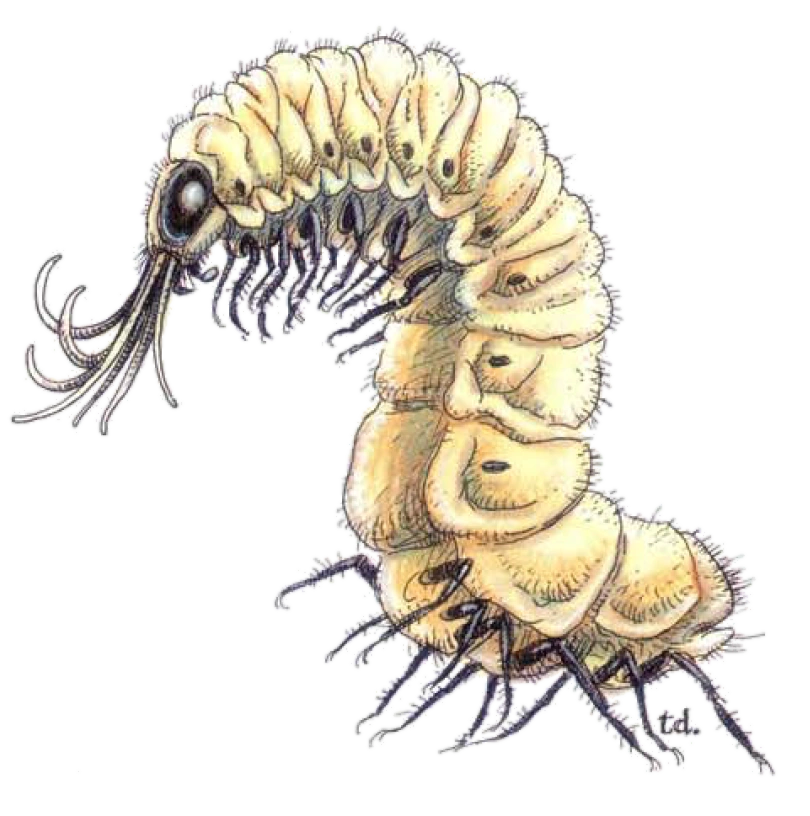
Carrion Crawler
Resembling little more than a cross between a maggot and a centipede, carrion crawlers carry the stink of the decomposed corpses they feed on.
Basic Information
Anatomy
Carrion crawlers have bulbous, segmented bodies that average between nine and ten feet long in adults. Their heads are neckless, and feature large, compound eyes and sharp mandibles capable of stripping rotting meat from bones or tearing aside intervening armour.
Few behold these mandibles, however, as the crawler's tentacle-like antenna are much more prominent, extending eight to ten feet from their bodies. These antennae are completely prehensile, and have sensory organs along their entire length to help the crawler detect food.
Its antennae are also a key part of this carrionite's defense tactics. The point of each of them is equipped with thousands of tiny, needle-like barbs, which can pierce most pelts and scales to apply a paralytic poison to attacking creatures. The paralysis is temporary, but allows more than enough time for the defending crawler to escape. Crawlers have been observed to paralyze creatures much larger than them.
Genetics and Reproduction
Carrion crawlers lay massive clutches of several dozen, most of which would not survive to hatching, being eaten by other creatures. When the young hatch, they are ravenous, enough to eat live prey rather than waiting for a convenient corpse, which explains why the parents are both far away by the time their newborn feeding frenzy upon each other begins.
Growth Rate & Stages
A newly hatched carrion crawler is about the size of a terrier, but they grow swiftly over the first few weeks of life. The poison of juveniles is weaker than that of adults, and seems to increase in potency as the crawler feeds. This is thought to be related to the differences between decomposing flesh and fresh meat in its diet.
Ecology and Habitats
Carrion Crawlers are commonly found in midden heaps, poorly-maintained graveyards, and anywhere else that a lot of bodies or rotting meat can be found.
Dietary Needs and Habits
Carrionites, adult crawlers do not hunt, seeking the smell of decay, instead. A sufficiently-starved crawler may attack live creatures, but will return to preferring the dead as soon as its caloric needs are met.