I got too complacent. When walking the path passing through the edge of the Jungle, I walked hundreds of times; instead of being careful and observant, I followed my memory. The moment I heard the roar, it was too late to react. There was a new plant on the path I've never seen, a white flower, that was pointed straight at me. Then there was the roar, and I felt as if a wall crashed into me. The next thing I remember, I was lying on the ground, blood spilling like a stream from my mouth. I don't think I even started to feel anything the moment my consciousness left me forever.
In its hatred of humanity and other animals, the
Jungle anomaly managed to produce plants that can kill in many creative ways. From things as basic as thorns, traps, strangulation, and poisons, through acids, burning, and projectiles, to even sound. One of the species that represents the last group of deadly plants is the one known as the horn lilies.
Appearance
While they might have started out as something similar to calla lilies or Easter lilies, the appearance of horn lilies changed to better serve the function of using the sound to damage or kill animals. The plants can grow anywhere between 40 cm and 3 meters tall. They have a single, thick stem with a few oval leaves growing out from the base near the ground that can reach half the length of the rest of the plant. Underground, they have multiple long roots.
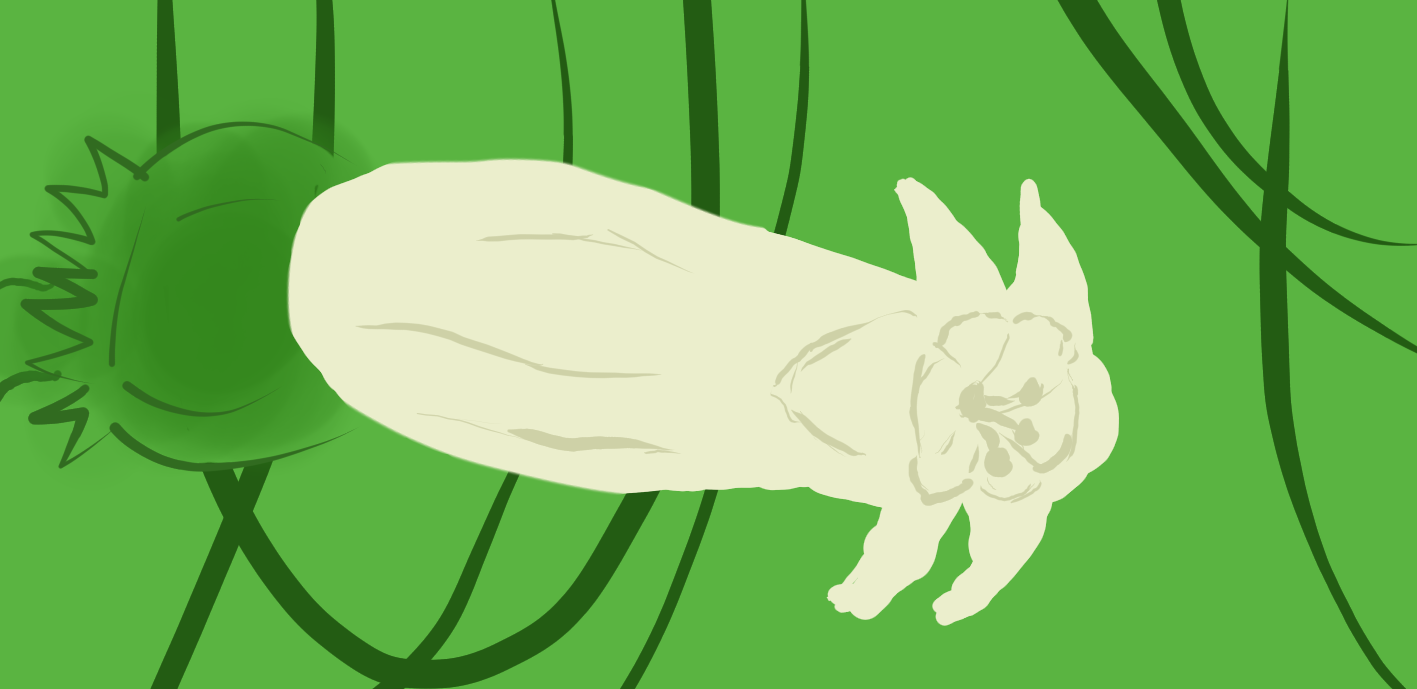
Horn lilies have long, cone-shaped, white flowers that can reach a length that makes up for one-third of the whole length of the plant. The flowers are slightly curved up, giving them the shape that inspired their name. Flowers consist of six overlapping petals. The stamens and pistils of this species are flat and can move against the petals when the plant uses the flower to attack. Just underneath the flower, there is a thick spherical bulb. Some of the horn lilies can grow two separate but connected stems at the base, each with its own flower at its end.
Killed by sound
Horn lilies developed quite a few abilities that let them hunt down animals. Among their roots, there are some that are filled with water on the inside. Those roots are used to detect the vibrations. Should the plant detect some vibrations that are getting closer to it and are not a part of the ones it usually detects, the whole specimen will start to jitter, building the resonance within the small pouch underneath its flower. Should the source of the vibrations enter the range of the horn lily once it fully builds the resonance within itself, it will turn the flower towards it and open the separator between its resonance pouch and the flower, using its petals as the speaker, focusing the sound.
The resulting shockwave hits with the strength of a speeding car, most likely causing internal damage that depends on how big the flower is and how long it charged its "attack". In best-case scenarios, the target will suffer from burst eardrums and will be left disoriented. In worst cases, the sound can be so destructive that it tears apart the internal organs and damages the body even on the outside, leading to death. Some of the horn lilies either grow in pairs or can create multiple shockwaves in a row, so even if the victim survives the first blast, they may not be strong or quick enough to escape the next ones.
The attack can easily damage other plants in the area if aimed poorly.


Sounds (ha) like an unpleasant way to die.
Explore Etrea | WorldEmber 2025