Arc Sprinter
Basic Information
Anatomy
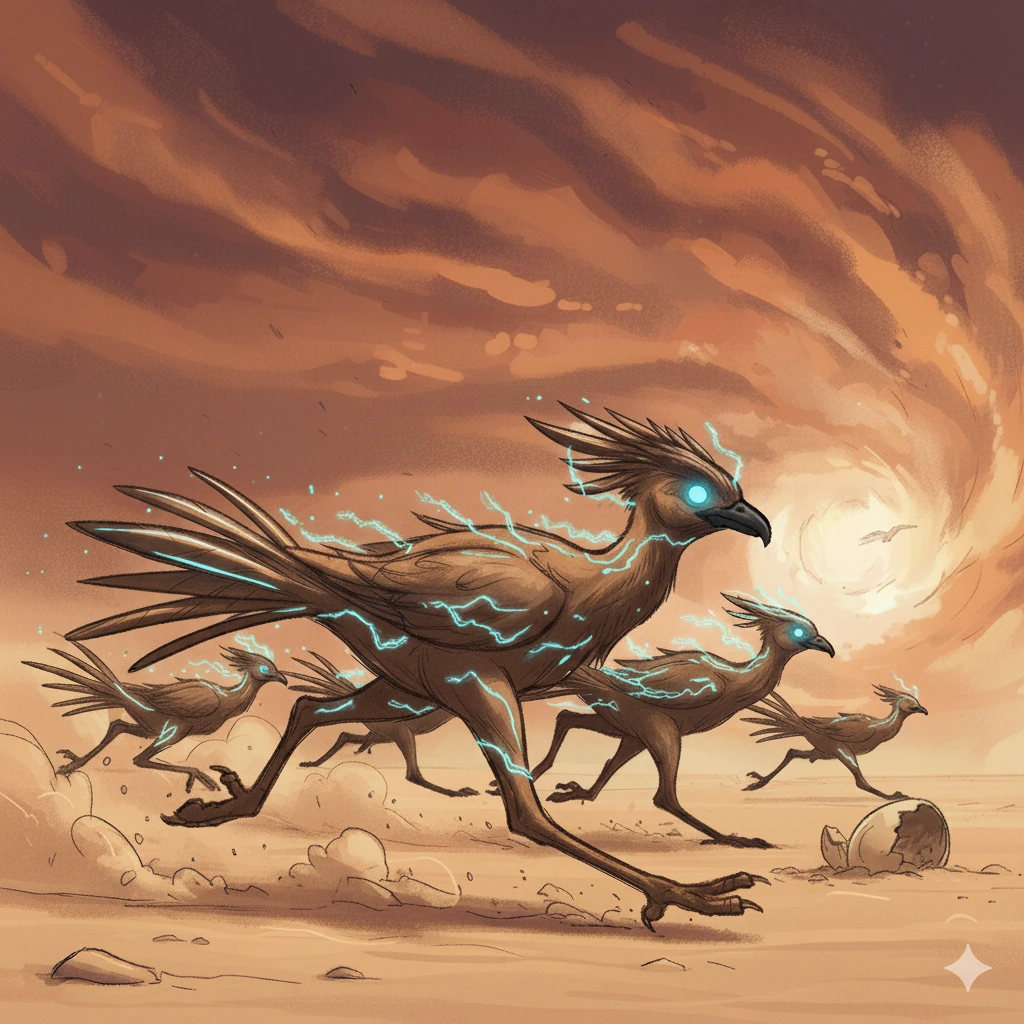
Arc sprinters run along the desert on their two long legs, each ending in two paddle-like toes which allow them to make wide contact with the shifting sands without sinking as they run.
Genetics and Reproduction
Arc sprinters lay around 10 - 12 eggs at a time, forming communal nests of up to 70 eggs, which members of a flock take turns warming and guarding. They tend to mate during more temperate dry seasons, normally some time Anrydyn through Gurdyn. After incubating for about a month, a new brood emerges, at a 50-60% hatch rate. The remaining eggs are left behind for scavengers as the flock resumes their runs across the Al'Biq Desert, training their young in navigating the sands and storms.
Ecology and Habitats
Arc sprinters have adapted to the unique conditions of the Al'Biq Desert. On the physical side - their efficient metabolism allows them to deal with the sparse food, and their lightweight but heat absorbing layers of plumage allow them to adapt to the temperature fluctuations from day to night. They have nictitating membranes that can close over their eyes, protecting them from sand as they travel at high speeds through the desert.
On the magical side - their plumage and bodies have evolved magically conductive properties, allowing them to not only withstand, but benefit from prolonged exposure to Weavestatic Sandstorms. The slightly more conductive plumes on their heads and tails act as a sort of lightning rod for magic, causing the magical energy to arc from the denser sand flows into their bodies. From there, some of the magical energy is stored, while the rest is dispersed into the ground.
The energy channeled through them into the ground causes a localized hardening of the sand and a burst of magical force, allowing them to sprint at higher speeds under these storm conditions. As they store the remaining energy throughout their bodies, their plumage starts to glow and appear to crackle and spark. Since this magical energy can also act as a form of sustenance, offsetting their more material dietary needs, they often make their way to the eye of these storms. Here, they can encounter and absorb a more raw magical energy, while avoiding the physical inconveniences of the sandstorm itself.
Nomads and other savvy adventurers have been known to use the glowing, comet-like appearance of a stampede of arc sprinters in order to orient themselves in these otherwise chaotic storms. More than likely, depending on the vibrance of the flock, they're making their way to or from the eye of a given storm.
Dietary Needs and Habits
Arc sprinters have very efficient metabolisms, stocking energy during a short grazing period for a prolonged period of migratory running and nesting. They primarily feed on burrowing insects and small lizards, drinking from various desert fruit or the occasional oasis.
Supplementing their material sustenance, they also have specially evolved glands for absorbing and storing magical energy from the charged particles within Weavestatic Sandstorms, which they frequently sprint through on their migration paths.