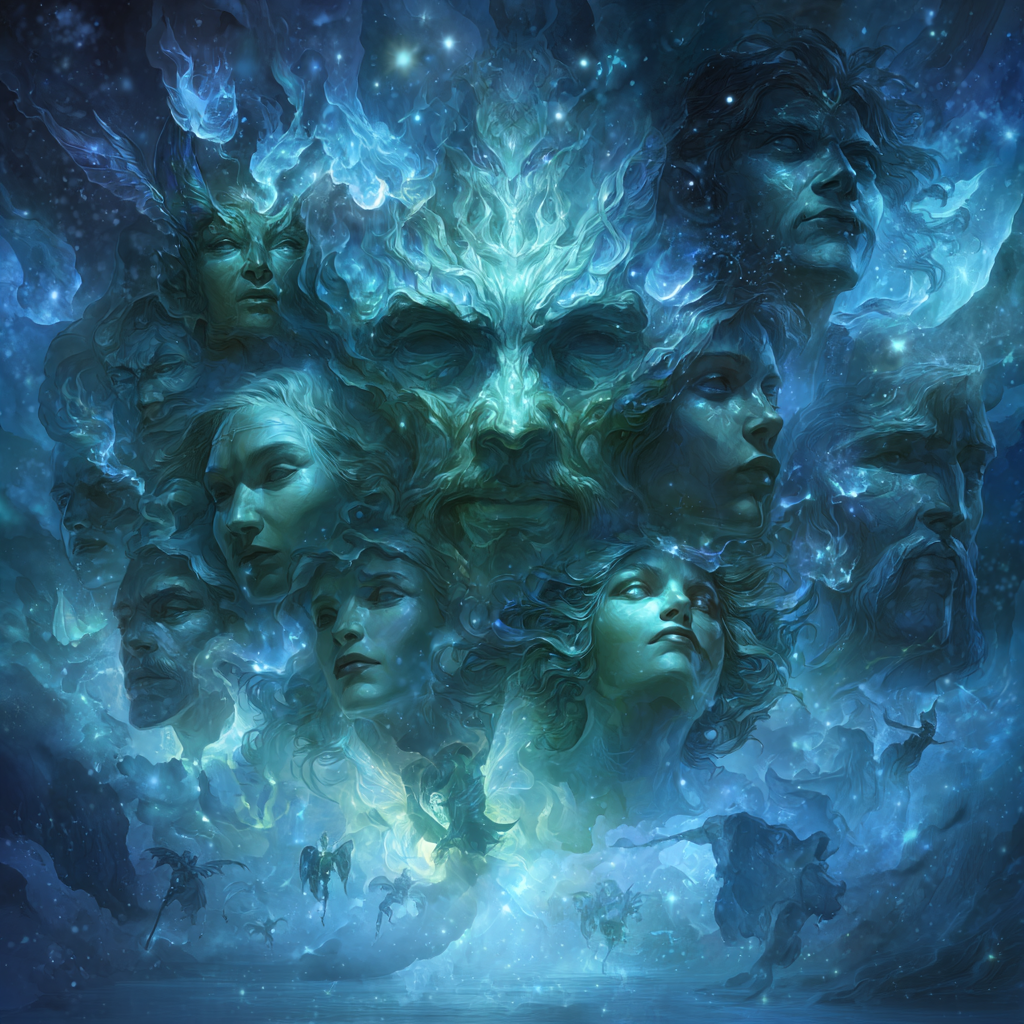
Old Gods of Arcadia
Gods cannot die easily, but in the absence of belief they can suffer a fate far worseBefore the Arcadians fled the downfall of their homeworld, they had beings they prayed to, just like any other culture. It was a faith that suited their mercurial nature, with gods who embodied dreams and instinct rather than codified morality. These were not gods of domains, edicts, and unshakable ideals; instead, they were beings of mood and urge. Gifts, bargains, and sacrifice formed the core of Fae religious practice during this ancient time. For many outsiders, this chaotic appeasement would fall short of the sort of faith most seek out, but for beings such as they fae, this was precisely the pantheon they sought. Unfortunately, little can be said of Arcadia's Old Gods. This seems to be a purposeful choice on the part of all Arcadians who chose to call Tairos home. When they arrived, it was without icons of faith, holy books, or priests. So purposeful was this decision that not a one among their people possessed so much as a single spell from their repertoire of Druids or Clerics. Many suspect they lost their gods to the disaster that claimed Arcadia, and as part of their mourning, they left behind all the spells and prayers that belonged to them. While plausible, it's worth noting that the youngest generation, the New Arcadians, have no knowledge of the gods their people used to commune with. And, the True Arcadians never speak of them. This is a significant portion of the culture that seems to have been surgically extracted from daily life, rather than mourned in solitude. Information on the Arcadian gods comes from dubious secondhand accounts. Some scholarly officiants proclaim, rather boldly, to have gleaned information from chatty fae willing to speak off the record. Others cite the use of Divination spells such as Legend Lore or Commune. If any stable footing for this arcana can be found anywhere, it's within the fae's own bardic traditions. Some of these magic songs, dances, and painted spells contain slivers of ancient truths that speak to the nature of the old gods, but only in the most veiled and allusive ways.
The Arcadian Pantheon- The Dul Duana
The murky origins of these gods are difficult to ascertain. Still, several sources suggest they were each originally mortal, members of the earliest tribes of proto-fae, who discovered the secrets of godhood. Their demeanor seems entirely different from the gods of Tairos, perhaps most comparable to the Totem Spirits rather than the gods known to us. They seem to be beings consumed with their own whims, desires, and agendas rather than the tending to of an organized religion. They could be appeased, petitioned for favor, or their counsel sought, but they offered little in the way of moral structure or guidance. Prayer, in a fashion that a Tairosian citizen would understand, would be alien to the Arcadians. Prayer to the old gods of Arcadia would have taken the form of revelries, sacrifices, pacts, and gifts given. This is a mirror, reflecting the ways New Arcadians show fealty to True Arcadians. From the many disconnected sources, it's believed the Arcadian gods formed a pantheon similar to a family unit. In many versions of their origin, these gods are a family of immortals who plucked godhood from some primordial source. In fact, the name they are collectively known by, the Dul Duana, is said to be of the language of the first tribes of fae, and its translation is heavenly parents or star family. Each of these gods is often referred to simply by their star title, such as Dagadra, the King of Stars, or Aengus, the Cerise Star. Generally, this nomenclature follows a similar pattern for all gods: a color plus the word 'star'. Sometimes there are additional descriptors, such as Camulus being the Red Star of Suffering or Clioneha the Orange Star of Accord. These gods, as best as the records can agree, are as follows: Dagadra, the King of Stars This is reasoned to be the patriarch of the family. Common details include precious magical symbols such as a powerful club or walking stick, and a cauldron from which any spell could be brewed and bottled. After the Queen's War, Hag lairs seized by surviving Tairosians would often possess cauldrons that bore the word Dagadra upon them, among many other words of power. This figure seems to have held some domain over prophecy, stars, potions, and the night sky. Some stories talk about his importance to navigators, cartographers, and those traveling the trods between realms. There are a rare few instances of him being associated with doorways, the creation of magical trods to cross between worlds, and the power to see into other realms. There are many references to him as a candlemaker as well, using fat cooked in his cauldron to create candles that protected all who stood close to their light from the dark of night. Of this figure's personality, little is agreed upon. There are typical references to a heavenly all-father figure, stern and domineering. Yet some bardic songs also reference a playful, indulgent side, including a love of musical instruments. Aife, Mother of Night Uniquely, the Dul Duana appears to have corulership, with its second lord being Aife. There are accounts, fragmented as they are, that speak of entire versions of the Arcadian deity myths that omit Dagadra entirely, in place of Aife. Others make no mention of Aife at all. A slim majority seems to reckon that Aife and Dagadra are either co-rulers of the gods, or simply interchangeable facets of the same being. She shares many domains with Dagadra, suggesting she is a goddess of prophecy, night, and potions. Much of her representation seems to be a more kindly opposite to what Hags have become. She is depicted as a crone with a cauldron, doling out magic secrets, insights into the future, and guidance. Other descriptions of her are as an imperious queen lording other the rest of the divine family. Scholars, looking to fill in the gaps with conjecture, often label Aife as Dagadra's twin sister, which is as likely as anything else. There are some areas of differentiation with Dgadra - Aife seems to have an affinity for winds, mirrors, and concealment or darkness. Morrigan, Queen of Crows This is Dagadra's wife and the queen of the Arcadian pantheon. The pieces of information that mention this figure portray her in a typical early deistic tradition, as a fertility and matronly figure overseeing domains such as motherhood and living energy. Uniquely, outside of traditional matronly roles often assigned to such figures, Morrigan seems to have some connection to undeath, specifically spirits such as ghosts, wraiths, and, most often, banshees. Crows seem to be her messengers and the shepherds of dead souls in the original Arcadian traditions. These creatures are frequently used to represent her in art or musical lyrics as well. Morrigan's role in many of the known stories is as an ambitious meddler, a trickster, and a teacher of hard lessons, but the canonicity of any tale about the Arcadians is dubious. For example, in versions where Aife is the head of the pantheon, Morrigan plays a jealous younger sister role, unhappy with her seat beneath the Mother of Night. Aengus, Lord of Love Aengus, or often written as Aengeon or Enagreus, seems to be the brother of Morrigan in most tales and is of particular prominence among the bardic traditions of the fae. This god is the overseer of passion, romance, and sexual delights. Much that's written about him seems to align with writings about any god of jubilation - wine, parties, reckless abandon, and carnal indulgence. What seems noteworthy for this otherwise common deific trope is this: Food and Memory. Aengus' many stories feature food heavily, and deep overindulgence in eating. Second, he seems to have some domain over memory or the perception of events. Stories reference fae who are burdened with terrible or traumatic memories that Aengus was able to take away. Because of this ability to alleviate pain and to spread love, he is often cited as the God of the Heart. Clioneha, Lady of the Harvest So many conflicting accounts attribute everything from control of the seasons, to beauty, to fruit, birds, healing, and dance to her. She seems to be a goddess strongly associated with celebration, like Aengus, but often it's a celebration more focused on the culmination of task well done versus the Lord of Love's reckless revelries. She seems to be one of Dagadra's or Aife's children, and depending on the story, she was either born from the union between Morrigan and Dagadra or sprang fully formed from a pumpkin. Clioneha's place in the pantheon reflects responsibility, holding peace among family members, and aiding others in times of need. She seems to be a prominent character in the tales of other gods, often being the one to intercede and save them from their own whims or indulgences. Taranis, The Driftwood God This figure is a violent and cruel overseer of open oceans, shipwrecks, storms, and watery domains. This deity, like many such water gods, is depicted as isolationist, caring only for its unique realm rather than the greater world. Similarly, Taranis is a god who dwelt in the deep waters of Arcadia with no concern for the happenings of dry land. He demanded great tribute of those who crossed through his borders and cracked the bows of all ships that spurned him. Interestingly, the Driftwood God is also a god of temptation. In the few snippets of stories, Taranis is often trying to lure wayward travelers into his deep waters so that he may drown them. His lure is promises of power or wealth from his infinite hoard of shipwrecked riches. His minions are said to be alluring sirens and sea hags, all who pay tribute to their master with the souls of the drowned. His symbol is that of the shark and his favored weapon a great fishing spear or trident, as is often common in such tales of sea gods. Camulos, The Red Star of Suffering The fae have a very dreadful view of war. The very concept of organization and orderly coordination is already drenched in disdain for them. Combining that with the idea of suffering on a mass scale, it is no wonder that they would cast the most dour and hateful of their number as the God of War. Camulos, often depicted as a ball of fire, a burning skull, or a red star, is a joyless figure sought out only when fae had to turn to the most unthinkable of options - war. This armor-clad behemoth, always shrouded by helmet and bloodstained cloak, is sometimes said to be Clioneha's older brother. Other times, the Red Star is brother to Dagadra himself or the consort of Aife. Regardless of the exact version, Camulos' nature is consistent: no one likes him. He is brooding, awkward to he point of comedy, and often used in fae tales as a perilous and wicked straight face to be paired with a trickster or deeply warm and loving counterpart. Depictions of the God of Suffering are so frequent in fae comedies as to almost be requisite. Cerunnos, The Horned God of the Woods Prophecy, mystery, and isolated places seem to be cornerstones of their cultural heritage, and no god better represents this than Cerunnos. This quiet, dangerous, and enigmatic figure seems to live apart from the other Dul Duana in silent contemplation. It is equal parts nature deity, god of wisdom, and lord of beasts, all of which were pivotal to the life of early fae. Many piecemeal scraps of lore about this figure say he was likely to appear as a great horned, green giant, weathered and ancient, like an old oak. In other tales, he would take the form of a forest beast, but always horned. In these stories, fae would treat with this god where the forest and the rest of the land met, a safe place for mortals. The woods belonged to darker things, and those who dared to enter a forest without offerings were said to never return. Those who bargain with the Horned God were said to do so for secret knowledge of lost things, glimpses into the future, or regarding matters of summoning. Baylor, The Black Star of Desolation The prototypical great adversary figure, like many faiths are famous for, is Lord Baylor in the case of the Arcadian pantheon. Fae ballads that reference natural disasters, plagues, and long stretches of dark times all seem to personify these things as Baylor himself, or his works. Versions of the Arcadian mythos will cast Baylor as a jealous usurper eager for the pantheon's crown, or as the last mortal member of a tribe different from the one that the other Dul Duana came from, who seized the same gifts they found but for ruinous purpose. Oftentimes, he is represented by a terrible monster, usually a dragon, manticore, or snake. In other works he is a burning bull or minotaur. Whatever his aesthetic, his role in such tales is that of a deceiver, often trying to lead fae into breaking their oaths or acts of betrayal. Like so many other myths, there is a reference to a great battle called the Starfall, where many of the gods will perish to Baylor, before he himself is smited by Dagadra or Aife.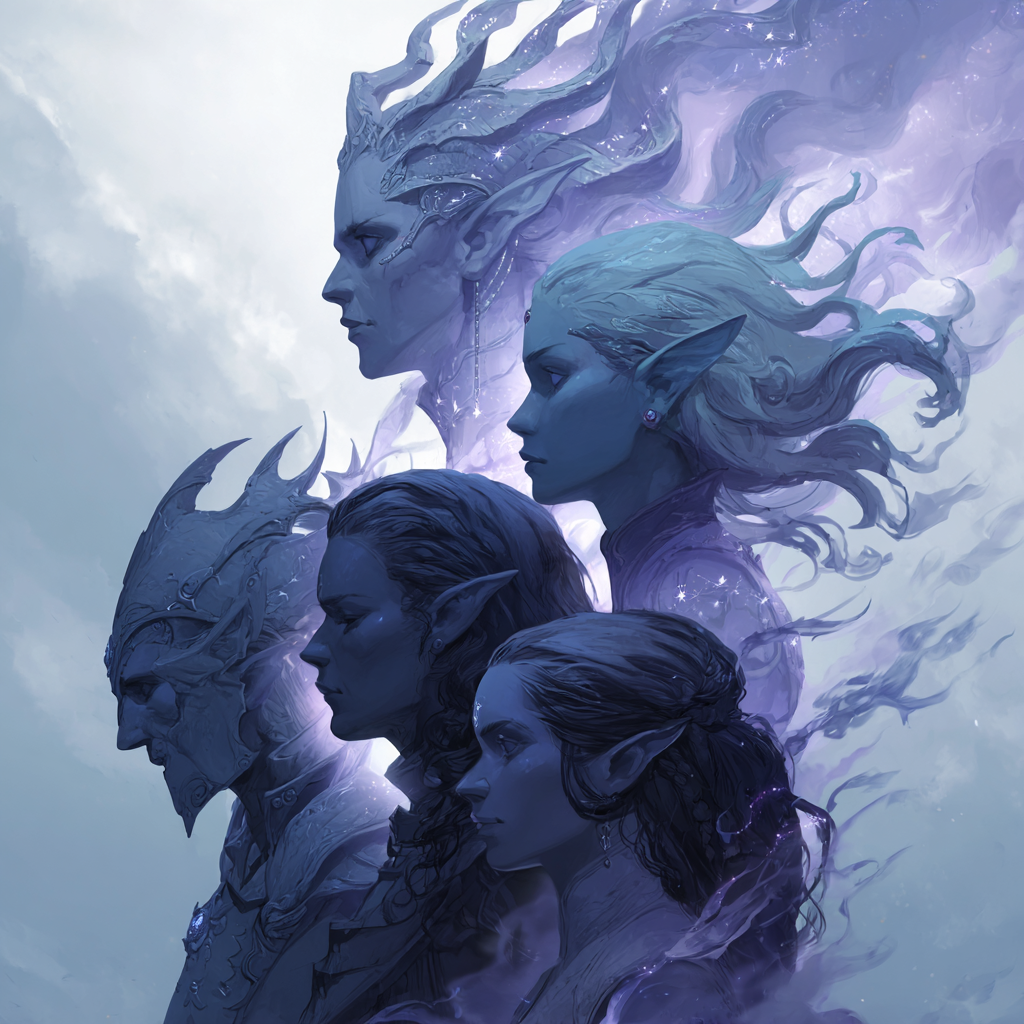
Dul Duana faded by Midjourney
Disbandment
This is believed to be a dead religion. What fate might befall a god in such a case is unknown, but worship of these deities has ceased.
DISBANDED/DISSOLVED
Type
Religious, Pantheon
Alternative Names
The Dul Duana, Heavenly Parents, Star Family
Successor Organization
Related Species
Related Ethnicities

Comments