Muldrak
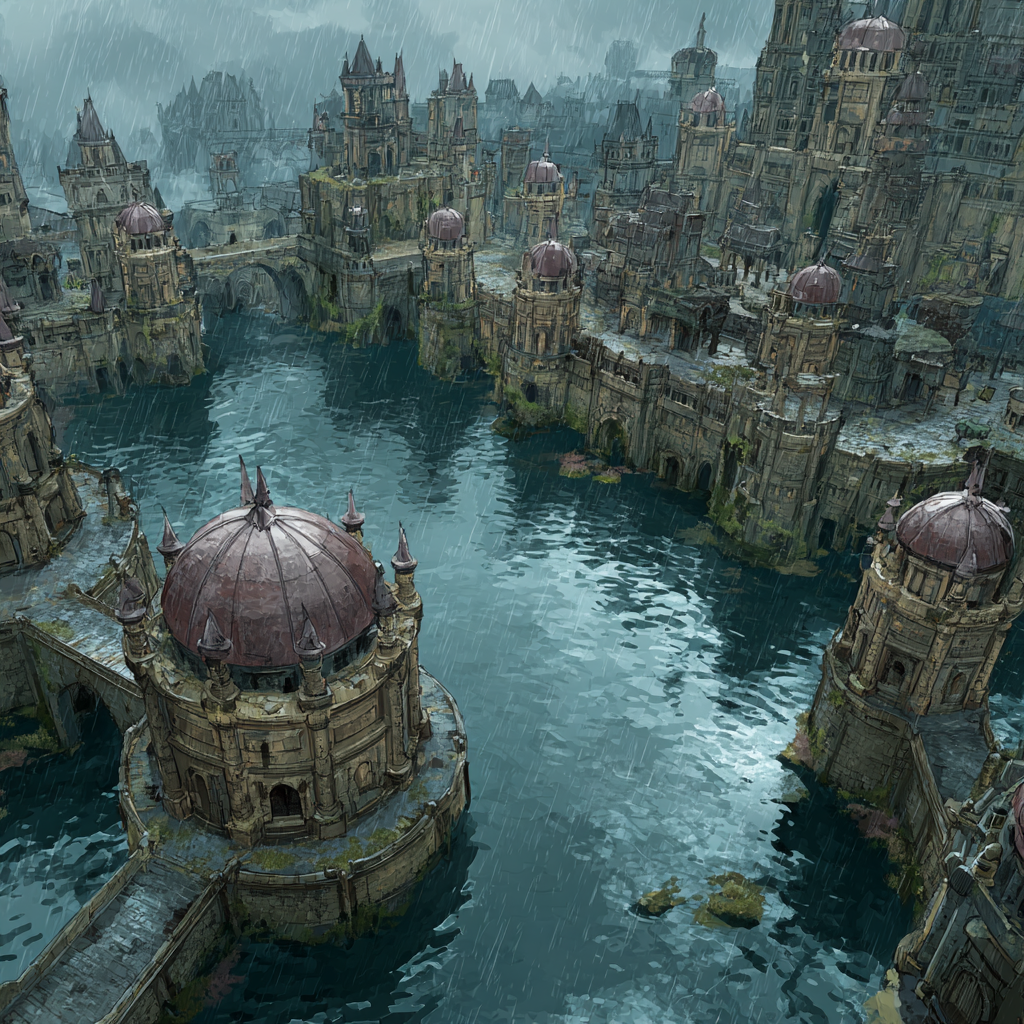
Everyone's just... gone. One night they were there and the next... gone. Replaced by flood waters and empty places where whole lives used to beFor some, Muldrak was the most incredible city ever built by the Ghal Ankharans. It was a jewel that held all the sprawling grandeur of the mountain kingdom, but rather than be buried within the stone of the eastern mountains, this city was laid bare for Tairos to see. The sun shone down upon their sturdy, blockish buildings and glinted off the golden bronze embedded within the architecture. Fresh waters from Lake Tairos lapped against their shore while Ankharan trade galleys sailed to and from every nearby community. Verdant farmlands surrounded the city, and enduring brick roads connected the many small satellite townships to Muldrak and ran all the way to Ackley City and into Ghal Pelor's Anvil West district. Muldrak operated as intended for over a thousand years of its existence. It was built in tandem with Ghal Pelor and meant to be its twin. While Ghal Pelor would be a more spread-out city and intended to attract foreign visitors, Muldrak embraced traditional dwarven architecture and city planning. While it takes up only about 3/4th's the space of Ghal Pelor on the surface, it contains an entire functional city beneath. The city's diamond-shaped Urin Hall lies nestled in the midst of the sprawl, resembling a pyramid rising toward the sky on its surface side and a hanging pyramid below. This is the governmental center of Muldrak and home to the primary passageway into the undercity. While smaller entries do dot the city, access was kept limited for defense purposes. Once one manages to find their way into the undercity, they are treated to stunning sights such as the Heroes' Passage, the Temple of The Forge-Father, the fungal gardens, and the famous Bhurnwoll Ale House. This city acted as Ghal Ankhar's hand within the surface world, a true reflection of dwarven power. Where Ghal Pelor was meant as a gathering place (and a place for dwarven influence to leech into continental business), Muldrak held thousands of soldiers, unapologetic dwarven cultural hallmarks, and cherished forges. It was also situated right in the middle of the continent, giving it the perfect vantage point to exert control where needed. It remained a jeweled fist of dwarven might all through Tairos' history - through the Fang Crusades, the Plague of Undeath, and even during the war with The Autumn Queen. Many nations crumbled in the face of The Queen's Rebuke Muldrak endured. Then, seven years ago, everyone vanished. The night of the Black Wind, as it's known in Ghal Pelor, savaged much of the region around Lake Tairos. Many River Halfling communities were washed away entirely. Ships were sunk. The entirety of the Lakewatch Vale district of Ghal Pelor was leveled by a tornado and flooded. Eyewitnesses near Muldrak claimed the sky turned dark as pitch and cleaving winds sliced into the city while waters from the lake drowned the streets. Days after the disaster, dwarves from Ghal Pelor ventured to their sister city to see how their kin held up, only to find Muldrak empty of life. Stagnant water had overtaken the surface, waist-high in the best of cases. The undercity fared worse, flooded to the entrance and impossible to explore. Ghal Pelor's government dispatched trained soldiers and emergency rescue teams to search for survivors and save the city. They teamed with Rylander engineers to deploy Steamtech pumps to try and dredge the dwarven undercity, but no matter how much was pumped out, more water seemed to seep in from beneath. Meanwhile, rescuers searched far and wide for survivors. For weeks on end, they explored every inch of the city. During the day, they met with stiff resistance from the stale waters, sickness, and the summer heat. By night, these teams were plagued by strange happenings - nightmares, shadows slithering in the murk, soldiers wandering off to vanish into the dark, and haunting whale-song like noises that would claw at the psyche of the searchers. After a month of no results and mounting tragedies, the search was called off. After departing, Ghal Pelor's authorities established a quarantine zone around Muldrak. Publicly, they cited the disease-ridden waters as reason enough to condemn the region. In truth, the reports from surviving rescue teams were impossible to ignore. Leadership feared the unnatural influence of lurking beneath Muldrak and the possibility that some looter might foolishly bring disaster home with them. The nearby satellite communities around Muldrak were annexed, their citizens inducted into Ghal Pelor, and the villages scoured by special task forces similar to what happened in Klementia. Today, Muldrak is a ruin that's mostly been forgotten. Life in the region has marched forward, newcomers have acclimated, and Muldrak is left to rot behind a blockade of Ghal Peloran patrol ships. There are always rumors of looters who managed to make it inside and steal riches left behind, but these rumors always turn out to be hearsay or lies. No one has reliablely entered that city and returned to tell of it. Should Ghal Pelor have its way, no one ever will.
Demographics
None now. Was previously over 85% dwarven, with the remainder being human and halfling.
Government
For most of its existence, Muldrak was run by Reeves and clan elders who represented the home interests back in Ghal Ankhar.
Defences
Muldrak did have large functional stone walls when it was operational. Because of the rainy nature of the area and proximity to Lake Tairos the walls required a sophisticated plumbing system to keep them stable. Visitors who pass near the ruins today state that very little of the walls are fully intact. Most have sunk into the swampy land or toppled over. Rotting in the city's harbor are the large cargo vessels it used for business. These vessels were also well armed with mangonels and heavy dwarven cannons
Infrastructure
Muldrak was known for having ore refineries and workshops of outstanding quality. It also sat upon a considerable deposit of precious metals used for armor crafting.
Districts
The undercity was the most prominent section of the city. The below region was believed to be equal in size to the surface city
Guilds and Factions
None currently. Prior to vanishing of the last survivors dwarven clans, factions and politics dominated much of life in Muldrak.
Points of interest
The Heroes' Passage is a statue garden in the undercity that contains sculptures of some of the city's greatest heroes, along with any signature items they may have carried. It was a sacred place, one of great beauty and serenity. The pathway through this area led directly to the city's Temple of the Forgefather. This indomitable structure contained a sacred forge and a giant brass statue of their patron god. Dwarves from all across the surface of Tairos would make a pilgrimage here to pay their respects. Bhurnwoll Ale House was one of the most famous restaurants and breweries on the continent. It was renowned not only for its drinks but also for its fried mushroom delicacies and goat meat entrees.
Tourism
Today, none, but before the Night of the Black Wind, it was a location that many in Ghal Pelor and the lake region would travel to for extended stays. They would come for the gambling houses, the splendor of the undercity, the bioluminescent fungal garden, and the posh luxury of the surface city.
Architecture
Traditional Dwarven architecture that made use of some Rylander pumping systems to keep waters away.
Natural Resources
Natural ore deposits, access to the lake, quality farming lands


RUINED SETTLEMENT
Seven years ago
Type
City
Population
0
Owning Organization
Related Reports (Primary)
Related Reports (Secondary)

Comments