

Simian
Basic Information
Anatomy
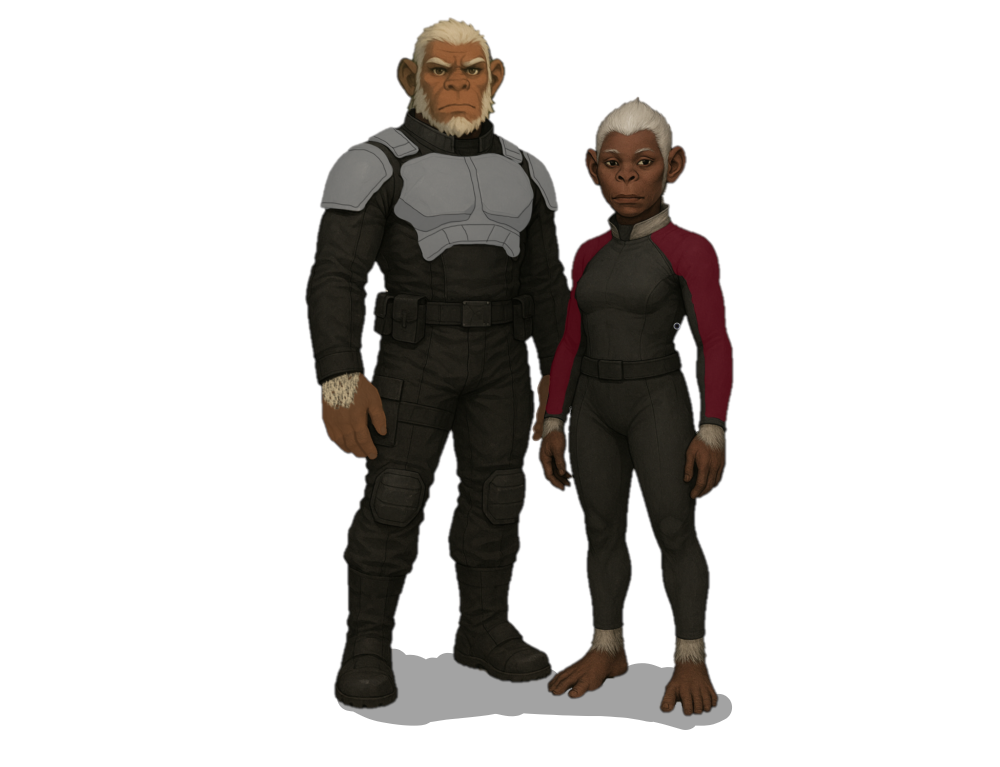
Simians are bipedal, averaging 1.5 to 1.8 meters in height, with sturdy frames adapted for both endurance travel and bursts of explosive strength. Their bodies are covered in a short to medium-length coat of fur, except for the face, throat, chest, hands, and feet, leaving key areas of skin exposed for cooling and tactile sensitivity. The Simian face is mostly bare, with expressive brow ridges, flattened noses, and strong jawlines. Their mouths contain broad, flat molars suited for grinding plant matter, complemented by shorter canines than most non-sapient primates. Eyes are forward-facing, granting excellent binocular vision, and tend to be brown, hazel, or amber. Beneath the fur, Simians possess dense musculature and a robust skeletal structure that allows for powerful bursts of motion. They have four limbs with human-like joint articulation but enjoy a broader range of motion in the shoulders and hips. Hands have five digits with slightly thicker, padded fingertips for grip and manipulation, and their feet are more dexterous than human feet, capable of limited grasping.
Biological Traits
Characteristics:
Simians have the following modifiers applied to their characteristics: SOC-1Traits:
Agile Climbers: Simians receive +1 DM on all Athletics (DEX) checks, reflecting their natural agility, balance, and dexterous feet.Genetics and Reproduction
Simians are sexually dimorphic, though the differences are subtle compared to many other species. Males tend to have slightly broader shoulders and more pronounced brow ridges, while females have narrower faces and proportionally wider hips. Both sexes possess comparable endurance and agility, making division of labor more cultural than biological. Reproduction is sexual, with live birth after an average gestation period of eight months. Births typically result in a single offspring, though twins occur naturally in about 4% of pregnancies. Infants are born with a thin coat of fur and remain dependent on parental care for several years, clinging to the parent’s torso in early months. Genetically, Simians are highly adaptable; their physiology adjusts to a wide range of climates and diets over just a few generations. Diaspora populations often develop distinct fur densities, color variations, and even minor stature changes.
Dietary Needs and Habits
Simians are omnivores with a diet leaning toward fruits, nuts, grains, and occasional animal protein. They are naturally lactose intolerant after weaning, with lactose tolerance persisting only in infants and young children; as adults, consuming dairy without fermentation or processing can cause digestive discomfort. Diaspora Simians adapt their diets to local cuisine but generally favor fresh produce and high-energy foods. Food customs vary widely between worlds, reflecting the cultural diversity of their populations, though the act of sharing a meal often retains a universal role as a gesture of trust and camaraderie.
Additional Information
Geographic Origin and Distribution
Simians originate from the Sinon System, but centuries of Imperial expeditions and relocations have spread them widely across the known universe. Diaspora populations are most concentrated in regions relatively close to their home system, though significant communities exist on worlds far from Sinon, where they have adapted to diverse climates and cultures.
Civilization and Culture
History
First encountered in the Sinon System, Simians were initially dismissed by Imperial surveyors as little more than upright human-like apes, not a sentient species. In those early years, Imperial ships rarely visited the system except for occasional expeditions that removed small numbers of locals for study or labor. When these captives showed they could learn languages, follow orders, and adapt to complex tasks, the Empire reclassified them as sentient. The change meant little in practice, serving only to justify their exploitation as a subordinate people rather than as curiosities. Captives were taken in small but steady numbers and shipped to distant worlds. Some served as laborers in mines or factories, others as household servants, and a few were displayed in courts as oddities. Over generations, these displaced populations adapted to their surroundings, often intermingling with other cultures and species. The descendants of these captives became the Simian diaspora, spread across the galaxy. Diaspora Simians often retain fragments of their ancestral heritage, but their cultures vary widely, shaped more by the worlds they grew up on than by the homeworld their ancestors left behind. Many have no direct knowledge of Sinon beyond what might be preserved in family stories.
Though Sinon was largely ignored by the Galactic Empire, historical evidence suggests that several expeditions or slave raids did occur during the Imperial zenith. Small numbers of Sinonians were removed from their homeworld, likely as laborers, exotic curiosities, or xenoanthropological specimens. These early captives or their descendants can now be found scattered throughout the galaxy particularly in the Federation, border worlds, or among Republic citizenry.
Most know little of their ancestral world, and many have developed distinct cultures, dialects, or spiritual beliefs, disconnected from the moon-reverence and symbology of native Sinon society. Some offworld Sinonians are highly integrated, while others live in diaspora enclaves or serve as mercenaries, shiphands, or traders in the shadow of more dominant species.
In their own tongue, the people of Sinon call themselves Sinonians, a name tied to their world’s ancient history and myths. However, offworld they are almost universally referred to as Simians — a misnomer dating back to the Galactic Empire’s first crude xenological surveys, which categorized them by their broadly primate-like physiology rather than their own name for themselves.
For most of the diaspora, “Simian” has simply become the norm, a convenient label used across galactic trade, politics, and military records. On Sinon itself, however, the name is often seen as an outsider’s term, a reminder of the Empire’s meddling in their past. Tensions sometimes arise when offworld Simians and homeworld Sinonians meet, as each group navigates the cultural gap left by centuries of separation.
Scientific Name
Simianthropus erectus
Lifespan
70 standard years
Average Height
1.5 to 1.8 meters
Body Tint, Colouring and Marking
Coat Color: White, black, dark brown, light brown, tan, reddish, golden.
Fur Patterning: Uniform, brindled, grizzled.
Skin Tones: Pale beige, medium brown, dark brown.
Eye Colors: Brown, amber, hazel, green, gold.
Fur Patterning: Uniform, brindled, grizzled.
Skin Tones: Pale beige, medium brown, dark brown.
Eye Colors: Brown, amber, hazel, green, gold.
