

Planetary Vehicle Catalogue
This catalogue presents a selection of vehicles commonly encountered across settled worlds, ranging from everyday civilian transports to specialised military platforms. While interstellar travel defines the scope of civilisation, it is planetary vehicles that shape daily life on the ground. They carry people to work, haul goods across continents, till the fields of frontier colonies, and enforce the will of governments and corporations alike. Vehicle design varies from world to world, shaped by local technology, environment, and culture, yet common patterns emerge across the known galaxy and beyond. Personal transports prioritise convenience or prestige, utility machines form the backbone of industry and settlement, and combat vehicles embody the projection of organised force. Vehicles are presented roughly in order of technological sophistication, then by relative cost, so buyers can gauge both advancement and affordability at a glance. Prices exclude ammunition and optional equipment. Together, these designs define how societies move, work, and fight on their home soil.
Personal Vehicles
Covers the full range of transports designed for individual or small-group use. Their unifying purpose is personal mobility and private ownership, whether for everyday convenience, status, or leisure. Travellers, colonists, nobles, and business magnates alike depend on them for moving about in comfort and style.
Show spoiler
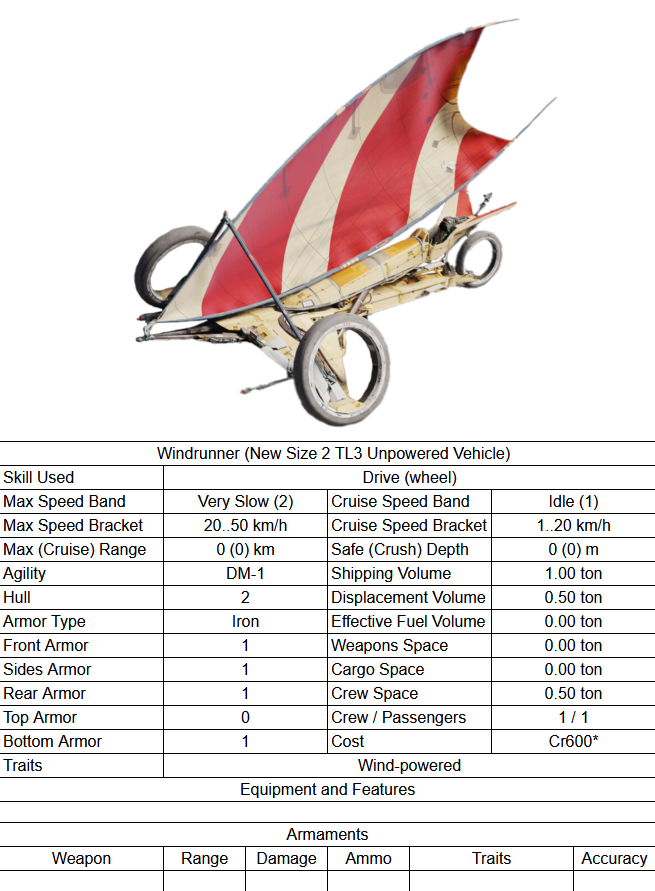
Windrunner
Show spoiler
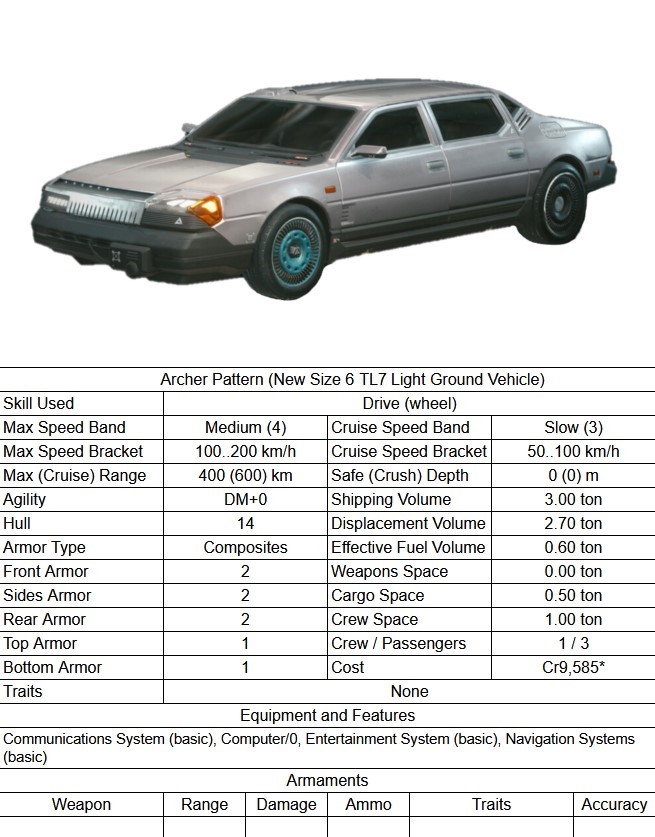
Archer Pattern Sedan
Windrunner is a wind-powered vehicle built for worlds with broad, flat expanses and steady prevailing winds. Its light wheeled chassis and tall sail allow it to cover great distances at remarkable speeds when conditions are favourable. The design thrives on arid plains, salt flats, and coastal steppes, and is especially valued in regions where a light touch on the ground is essential, whether to avoid disturbing fragile terrain or to pass unnoticed by predators. Windrunners typically carry either a passenger or a small load of cargo, with little room for both. Their real strength lies in their simplicity: they require no fuel beyond the wind and can be built and repaired with basic tools. For this reason, they remain a staple of low-tech colonies, offering cheap and reliable transport across open country. On more developed worlds, the Windrunner often becomes a racing craft or leisure vehicle, its frames and sails enhanced by advanced materials to improve both speed and durability. Both practical and evocative, the Windrunner remains one of the simplest yet most captivating vehicles found across the known galaxy.
NOTE:
From TL6, Windrunners are available in composite materials (Armor 2 F/S/R).
From TL9, Crystaliron frames become common (Armor 3 F/S/R) and speed increases by one band.
From TL6, Windrunners are available in composite materials (Armor 2 F/S/R).
From TL9, Crystaliron frames become common (Armor 3 F/S/R) and speed increases by one band.
Show spoiler
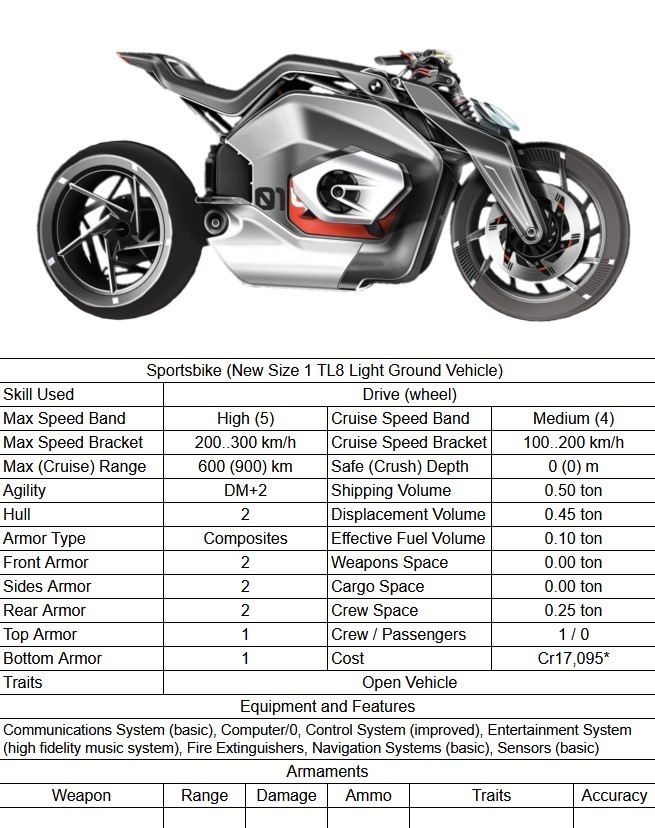
Sportsbike
The Archer Pattern is a practical wheeled Sedan designed for comfort, reliability, and everyday use. Favoured by working families, local professionals, and civic employees, it offers dependable performance without unnecessary luxury. The Archer Pattern is not tied to a single manufacturer, but rather represents a widely recognised design standard: manufacturers across the galaxy produce their own variants, all sharing the same hallmarks of the Archer; reliability, practicality, and ease of maintenance. Built on a durable chassis with standard suspension, it provides a smooth ride on paved streets and suburban roads, making it a practical and low-cost alternative where grav traffic is limited or restricted, and blending seamlessly into areas where grav technology is absent. Its interiors include resilient materials, seating for up to four people, a basic entertainment system, and satnav for navigation. The Archer Pattern Sedan also forms the basis for many fleet vehicles, most notably as taxis and police variants, with the latter retaining its reliability while being outfitted with law enforcement equipment and reinforced security features. Known for its dependability and versatility, the Archer remains a staple across both urban centers and frontier settlements, offering a balance of affordability, comfort, and practicality for everyday transportation.
Show spoiler
Chevillon Pattern SUV
A high-performance road machine built for speed, agility, and style, the Sportsbike blends a high-powered electric drive with a deliberate nod to its combustion-era heritage. Its batteries are stacked vertically and longitudinally, leaving space for a cylindrical motor mounted low in the frame, connected by a shaft to the rear wheel. This design delivers blistering torque from a standstill, producing breathtaking acceleration that rivals its forebears. Side-mounted cooling ribs and fan-fitted elements extend when the bike is powered on, a visual cue that it is ready to ride. Built from lightweight aluminium and carbon-fibre, the frame and minimal fairing keep the machine agile and sharp in handling. Bespoke tyres with embedded micro-lights illuminate the wheels in the dark, adding a touch of spectacle. Favoured by riders who crave performance on winding roads and open stretches alike, the Sportsbike’s sleek silhouette and aggressive stance make it a performance machine and a cultural statement: a declaration of speed, freedom, and style.
Show spoiler

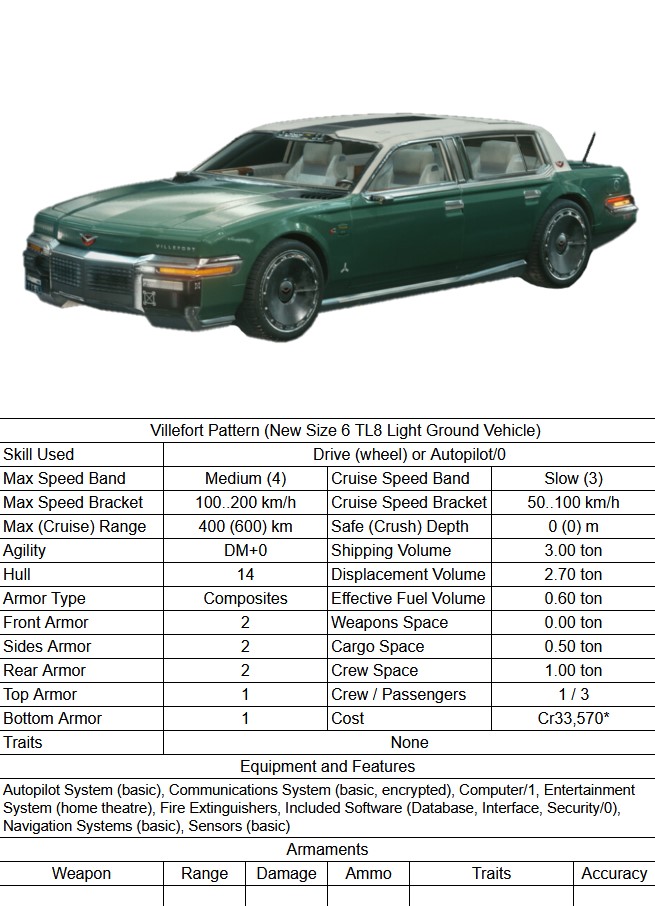
Villefort Pattern Town Car
The Chevillon Pattern is a versatile wheeled SUV designed for families and professionals who require both comfort and capability. The Chevillon is a widely recognised Pattern not the product of a single manufacturer, with various manufacturers across the known galaxy building their own variants while maintaining the same basic design. Built on a durable chassis with a suspension and drivetrain tuned for rough terrain, it handles off-road conditions with confidence while maintaining a smooth, composed ride on paved streets. Its elegant interior accommodate four people comfortably and include a high-fidelity audio entertainment, onboard computers, and a communications system, with satnav and sensor-assisted driving helping both driver and passengers navigate with ease. A spacious boot allows for hauling all your adventuring gear for the weekend. The Chevillon remains a popular choice in both frontier settlements and urban centers, and many jurisdictions also field police variants equipped with reinforced security features and law enforcement systems. Whether ferrying a family across rugged terrain or making a discreet impression in city traffic, the Chevillon Pattern SUV balances capability, comfort, and style with confidence.
Show spoiler
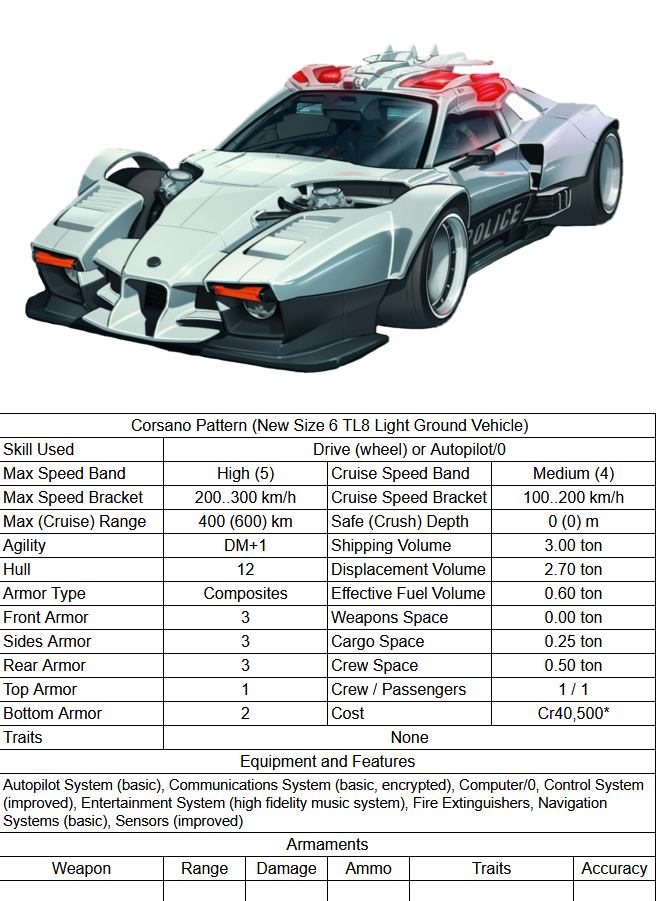
Corsano Pattern Sports Car
The Villefort Pattern is a refined wheeled Town Car designed for those who value discretion, comfort, and prestige. Favoured by executives, officials, and affluent families, it embodies a quiet dignity that makes it as much a statement of taste as of wealth. The Villefort Pattern is less a single manufacturer’s product than a widely recognised design standard: local builders across the known galaxy produce their own variants, but all share the same hallmarks of the Villefort; refinement, discretion, and an air of quiet authority. Built on a reinforced chassis with active noise-cancellation, it insulates passengers from the chaos of city streets, while its interiors feature hand-finished materials, adaptive climate seating, and a suite of privacy and security features. Built-in computers, encrypted communication devices, a home-theater entertainment system, and satnav with a driving-assisting sensor suite provide both connectivity and convenience. Many manufacturers also offer an optional wet bar in the rear passenger cabin for 2,000 credits. A professional driver often takes the wheel, though the forward cabin is fully equipped for owner use. The Villefort is also a common sight as a fleet vehicle, serving in both official taxi services and police motor pools, its adaptability reinforcing its reputation for reliability and discretion. The Villefort offers a practical yet luxurious alternative where grav traffic is limited or restricted, and is a clear symbol of upper-class status where grav technology is absent.
Show spoiler
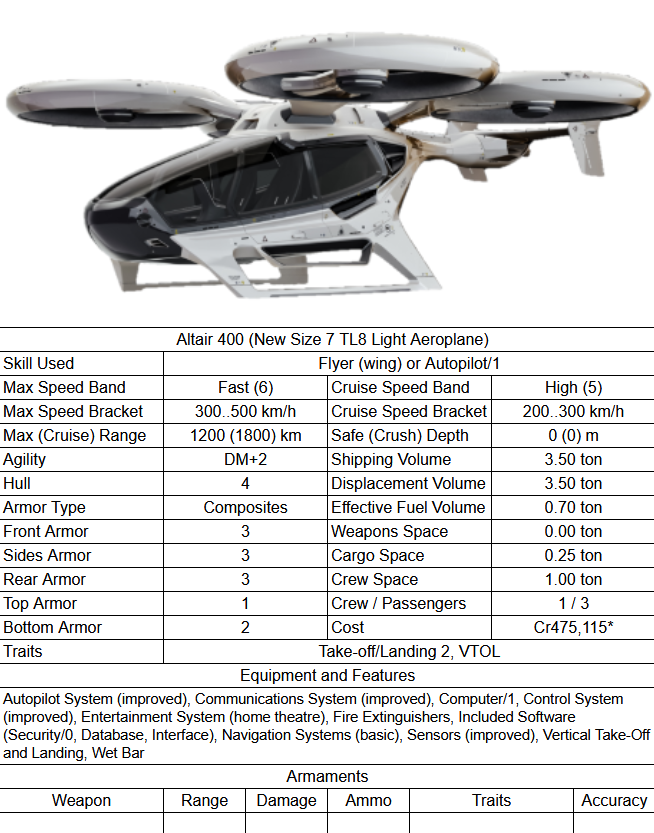
Altair 400 Tiltrotor
The Corsano Pattern is a high-performance two-seat sports car, celebrated across the galaxy as much for its style as for its speed. The Corsano is built with a singular focus: to deliver the thrill of driving. Its sleek aerodynamic lines, finely tuned suspension, and high-output powerplant give it blistering acceleration and razor-sharp handling, making it a favourite of enthusiasts and status-seekers alike. Cargo space is minimal, just enough for a weekend bag, but the real luxury lies in its precision craftsmanship and responsive controls. The Corsano is a widely recognised Pattern, not the product of a single manufacturer, with manufacturers across the known galaxy producing their own variants while maintaining the same underlying layout. Although it is usually the domain of private owners, it has occasionally been adopted by highway patrols in certain jurisdictions, where its speed and handling make it well-suited to high-speed pursuits. Whether in the hands of a wealthy professional taking it out on the weekends, a young upstart making a statement, or a racing circuit-tuned variant, the Corsano embodies aspiration and performance. More than just a car, it is a statement.
Show spoiler
TL: 8│ Range: 800m │Damage: 7d6 │ Mass: 45kg │ Mag: 20 │ Avail: 8+ │ Cost: Cr5000 │ Ammo: Cr400 │ Traits: AP 5, Auto 2, Very Bulky
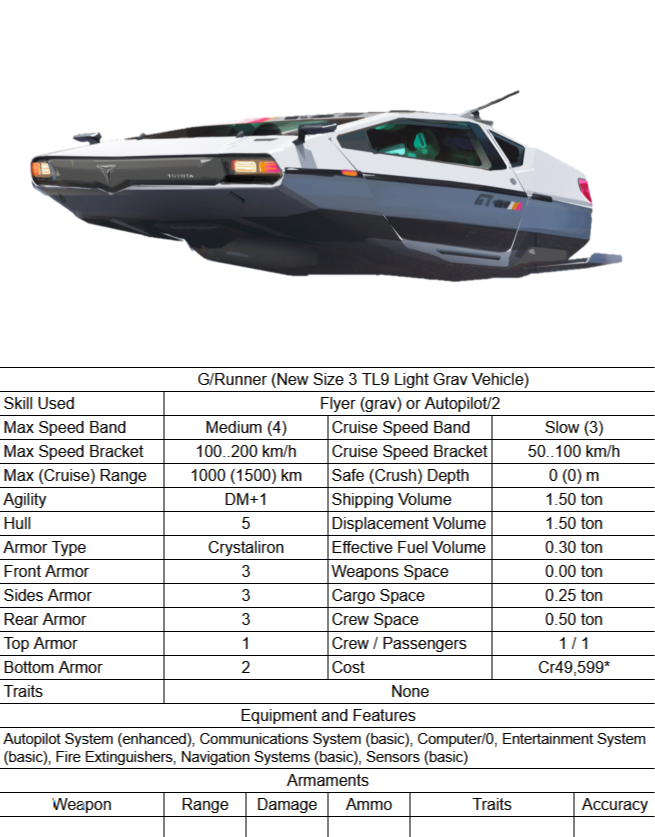
City Car G/Runner
The Altair 400 is a luxury civilian tiltrotor aircraft designed to combine the versatility of a helicopter with the refinement of an executive transport. Its sleek frame and panoramic glass cabin give passengers an uninterrupted view of the skies, while the spacious interior provides seating for a pilot and up to three passengers. The cabin is furnished with comforts that mark it as a prestige vehicle rather than a practical one: an integrated home theatre system, advanced onboard computers, and even a wet bar, ensuring that every journey feels indulgent. while it could conceivably be reconfigured to suit other roles, the high unit cost and its artisanal favoured design makes this prohibitive. As a result, the Altair remains a symbol of luxury travel, used by corporate magnates, wealthy patrons, and those seeking to make an impression as they descend upon cityscapes or retreat to private estates.
TL: 8│ Range: 800m │Damage: 7d6 │ Mass: 45kg │ Mag: 20 │ Avail: 8+ │ Cost: Cr5000 │ Ammo: Cr400 │ Traits: AP 5, Auto 2, Very Bulky
Show spoiler
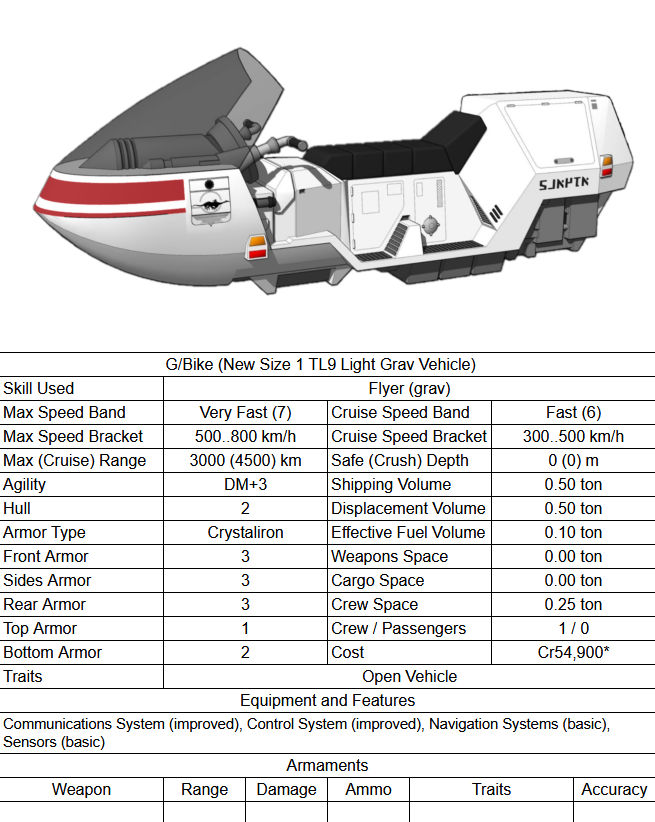
G/Bike
G/Runner is the most common entry-level grav car found across the settled worlds. Small but well-formed, it is perfectly adapted for the tight confines of urban environments, where space is scarce and traffic congestion is constant. Despite having a small cargo capacity and only two seats, the small sizes allows it to slip through traffic with agility and park just about anywhere. Its low-maintenance and widespread availability of parts keep ownership costs down, ensuring its popularity among young professionals, and anyone seeking an affordable way to move about a bustling metropolis. Easy to pilot, reliable, and almost universally available, the G/Runner remains the trusted workhorse of short-haul personal transport.
Show spoiler
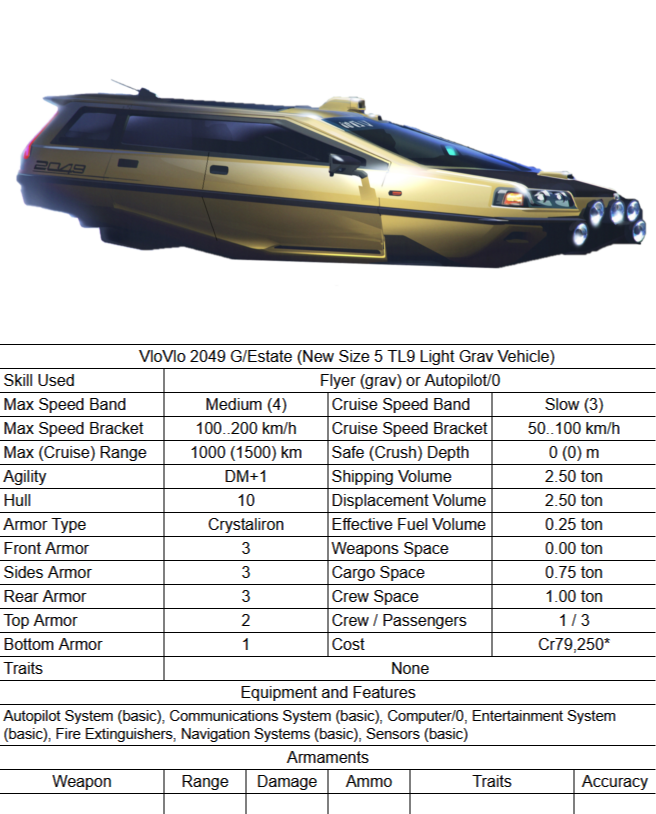
VloVlo 2049 G/Estate
Much like its ground-based predecessors, the G/Bike’s agility and compact size make it a favourite among Travellers needing a reliable way to move through unfamiliar worlds. Countless manufacturers and custom shops produce their own takes on the design: sleek Sporter models, Chopper-style machines and Touring versions. Beyond utility, the G/Bike is also a cultural icon. It serves as a symbol of freedom and independence for some, while for others it is the heart of vibrant subcultures and notorious gangs scattered across the known galaxy. Whether a personal runabout, a weekend thrill ride, or a gang’s signature machine, the G/Bike embodies the timeless appeal of fast, personal, and unmistakably stylish.
Show spoiler
Cien G/Sporter
The 2049 Estate has earned a reputation as the dependable family workhorse, equally at home navigating tight urban lanes, threading through colony settlements, or skimming across the open countryside. Built around a robust grav-chassis, the Estate prioritises stability and safety over flash or speed. Its boxy frame maximises cabin volume, offering generous seating for five adults and ample cargo capacity, making it a favourite among families, tradespeople, and those who value reliability over flair. The controls are intuitive, maintenance is straightforward, and parts are widely available. While the 2049 Estate lacks the luxury trim or high-performance grav-drives of more expensive competitors, its enduring design philosophy has ensured its place as a cultural icon.
Show spoiler

The G/Sporter is a sleek two-seat grav car designed for drivers who value speed, style, and precision handling. With a low, streamlined frame and finely tuned grav modules, it offers sharp acceleration and responsive control, making it as much a statement of personality as a practical mode of transport. While it includes a small cargo compartment for essentials, the focus is firmly on performance rather than utility. Favoured by young professionals, thrill-seekers, and anyone wishing to stand out in the air lanes, the G/Sporter combines the freedom of grav travel with the excitement of a sports car. It is fast enough to compete with some racing craft, but refined enough for everyday use in the city or on the open gravways. Local manufacturers often customise their variants with aesthetic flairs such as extended fins, bold paintwork, or luxury interiors, further cementing its reputation as the grav car of choice for those who want to be seen.
Utility Vehicles
The working backbone of most worlds. Utility vehicles are built for durability and function, often trading speed and comfort for load capacity, specialised equipment, or rugged terrain performance. Colonists, contractors, and industries alike depend on them to keep settlements and economies running.
Show spoiler
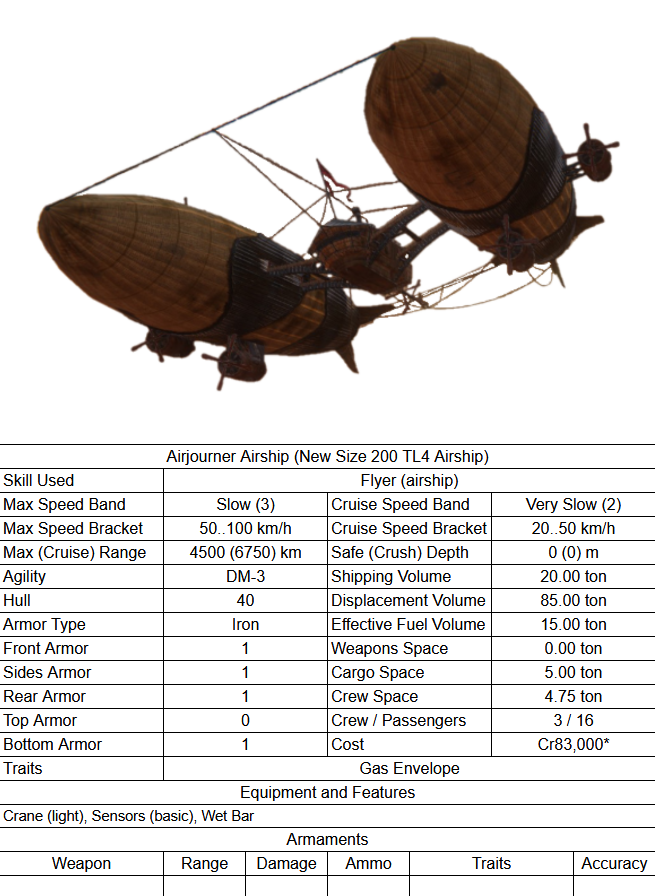
Airjourner Airship
Show spoiler
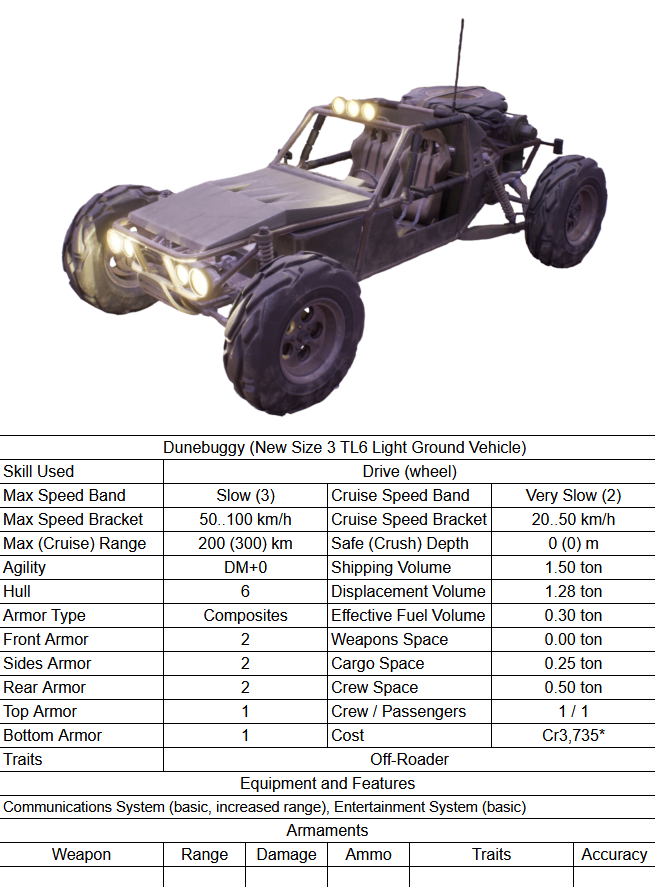
Dunebuggy
The Airjourner is a hybrid passenger and cargo airship built for endurance and dependability rather than speed. Its broad, gas-filled hull and reinforced frame allow it to carry both people and freight efficiently across settled and frontier worlds. Equipped with a light cargo crane, it can load and unload freight even in the absence of ground facilities, a feature that has made it invaluable on worlds with limited infrastructure. Typically configured to transport a modest number of passengers alongside cargo, the Airjourner’s interior can be adapted for light industrial transport, regional logistics, or survey and communications duties. Thanks to its low operating costs, generous payload capacity, and ability to operate from improvised landing zones, it remains a practical choice, though as technology advances, the Airjourner is increasingly found in service as a leisure craft or within atmospheres that prohibit the easy use of other vehicles.
NOTE:
from TL6 with material and engine advances, speed increases by 1 band, electronics improve and range increases to 6750 (10125) and armor 2/2/2 (F/S/R)
from TL7 Liftbody shape become common, increasing speed by 1 band and increasing lift resulting in cargo increase to 8.50 Tons and 20 passengers. Costs 366.900cr
from TL9 Crystalion materials become available and electronics improves, range increase to 9000 (13500) and armor 4/4/4 (F/S/R), Costs 370.150cr
For an additional 2.022.000 cr, short-term life support, an airlock, and corrosive environment protection can be added, reducing passenger capacity to 18.
from TL6 with material and engine advances, speed increases by 1 band, electronics improve and range increases to 6750 (10125) and armor 2/2/2 (F/S/R)
from TL7 Liftbody shape become common, increasing speed by 1 band and increasing lift resulting in cargo increase to 8.50 Tons and 20 passengers. Costs 366.900cr
from TL9 Crystalion materials become available and electronics improves, range increase to 9000 (13500) and armor 4/4/4 (F/S/R), Costs 370.150cr
For an additional 2.022.000 cr, short-term life support, an airlock, and corrosive environment protection can be added, reducing passenger capacity to 18.
Show spoiler
TL: 8│ Range: 800m │Damage: 7d6 │ Mass: 45kg │ Mag: 20 │ Avail: 8+ │ Cost: Cr5000 │ Ammo: Cr400 │ Traits: AP 5, Auto 2, Very Bulky
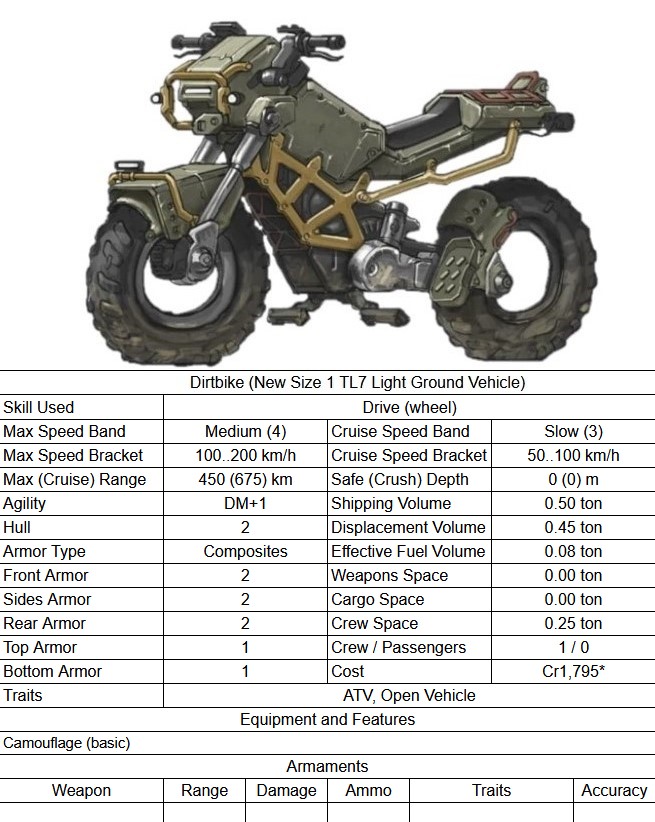
Dirtbike
The Dunebuggy is a small, agile four-wheeled vehicle built for speed and control across difficult terrain. With space for a driver and a passenger, its open frame, rugged suspension, and oversized tires make it well suited to dunes, dry riverbeds, or rocky uplands. Originally designed for recreation, the Dunebuggy has proven equally valuable to explorers and colonists working on worlds with few reliable roads. Its light weight and quick handling let it traverse ground that would bog down heavier transports, though this comes at the cost of protection. While its main role remains recreational or exploratory, armed variants are sometimes fielded by military forces or mercenaries in need of a fast, light scout. The Dunebuggy endures as both a tool of practical frontier travel and a vehicle of pure thrill and enjoyment.
TL: 8│ Range: 800m │Damage: 7d6 │ Mass: 45kg │ Mag: 20 │ Avail: 8+ │ Cost: Cr5000 │ Ammo: Cr400 │ Traits: AP 5, Auto 2, Very Bulky
Show spoiler
Thorton Pattern Pickup
The Dirt-Bike Off-Roader is a lightweight, rugged machine built for navigating extreme terrain with speed and agility where larger vehicles cannot follow. Designed for one rider, it can carry minimal gear, making it ideal for scouts, messengers, or anyone needing to cover rough landscapes quickly. Its low profile and off-road capabilities allow it to slip through dense forests, rocky trails, and desert canyons while remaining discreet, and it is available in both silent fuel-cell and traditional combustion variants. Favored on frontier worlds and in remote colonies, the dirt bike is prized for its maneuverability and reliability under harsh conditions. Though simple in design, it has become a staple among adventurers and reconnaissance units, offering a fast, versatile, and affordable way to traverse landscapes that would stall heavier or less nimble vehicles. This dirt bike is ideal for lone scouts or rapid messengers. It offers unmatched maneuverability at a low cost, making it a popular choice if needing to cover large areas quickly.
Show spoiler
Longhorn Pattern Utility Truck
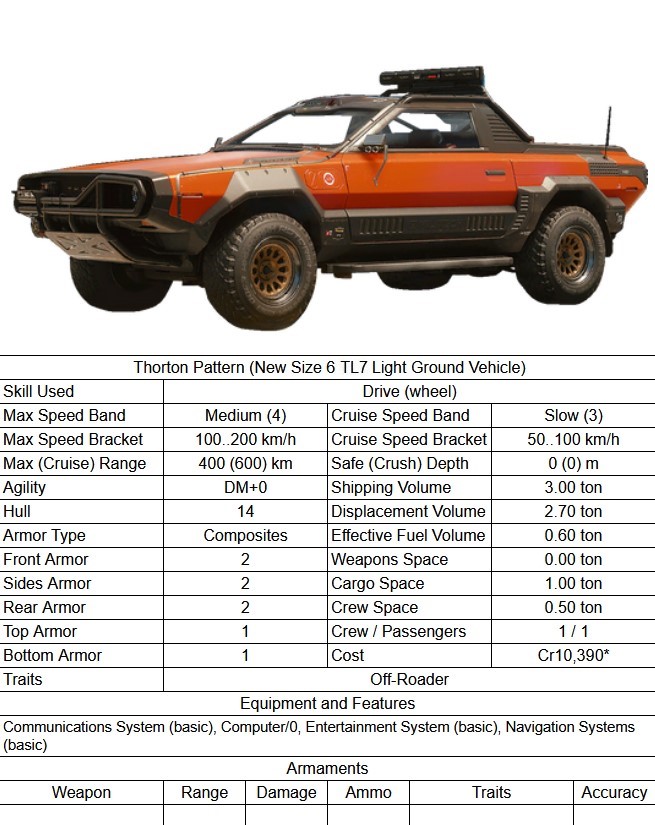
The Thorton Pattern is a rugged wheeled Pickup designed for work, reliability, and adaptability. Built on a reinforced ladder-frame chassis with heavy-duty suspension, it is equally at home hauling supplies across city streets or grinding through the dirt roads of frontier settlements. As a Pattern, the Thorton is not the product of a single manufacturer but a widely adopted standard: countless builders produce their own versions, all sharing the same basic layout and ideals of toughness and utility. Seating the driver and one passenger in its cab, with an extended cargo bed for tools, goods, or equipment, the Thorton prioritises function above all. Interiors are simple but practical, with a short range radio, a basic entertainment system, and satnav for navigation. More popular in frontier colonies and rural districts than crowded urban centres, the Thorton is the vehicle of choice for farmers, tradesmen, and small business owners, while explorers and surveyors value its dependability off-road. Governments and larger companies also employ the design as a versatile fleet vehicle, from the local sheriff’s patrol truck to the service vehicles of major mining operations. Known for its rugged dependability and straightforward design, the Thorton Pattern Pickup has become an indispensable part of everyday life across the known galaxy, a workhorse that thrives wherever hard roads and hard work are found.
Show spoiler
Behemoth Cargo Helicopter
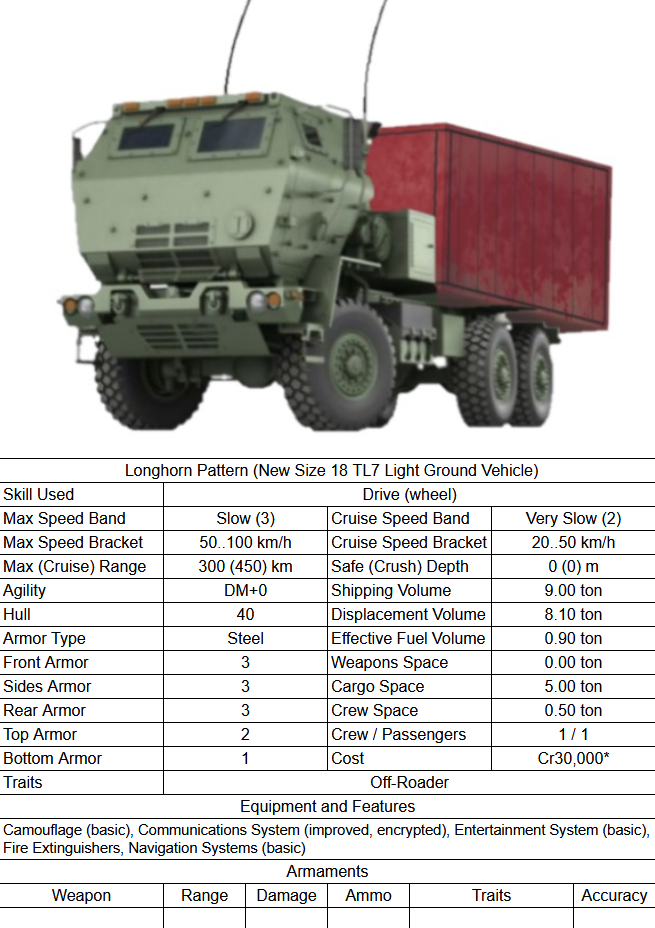
The Longhorn is a 6x6 Utility Truck built for versatility across frontier worlds. Capable of traversing rugged backroads, off-road paths, or paved highways, it can haul up to 5 dT of cargo, whether small goods, containers, bulk materials, or liquids, depending on its configuration, making it indispensable for industry, trade, and settlement supply chains. The cab seats a driver and a passenger, and the vehicle’s modular design allows it to be adapted for a wide range of roles. Expedition modules turn the Longhorn into a self-sufficient mobile base with living quarters, storage, and extended-range systems for deep exploration. RV-style variants provide long-range comfort for private travel, while militarized models trade some cargo space for armor, weapons, or personnel transport. Its rugged 6x6 chassis, reliable drivetrain, and off-road capability make the Longhorn a familiar sight from colony construction sites to remote outposts.
NOTE:
TL9 Upgrade: +1 speed band; range 375 (563).
TL9 Upgrade: +1 speed band; range 375 (563).
Show spoiler
Pacer Pattern Van
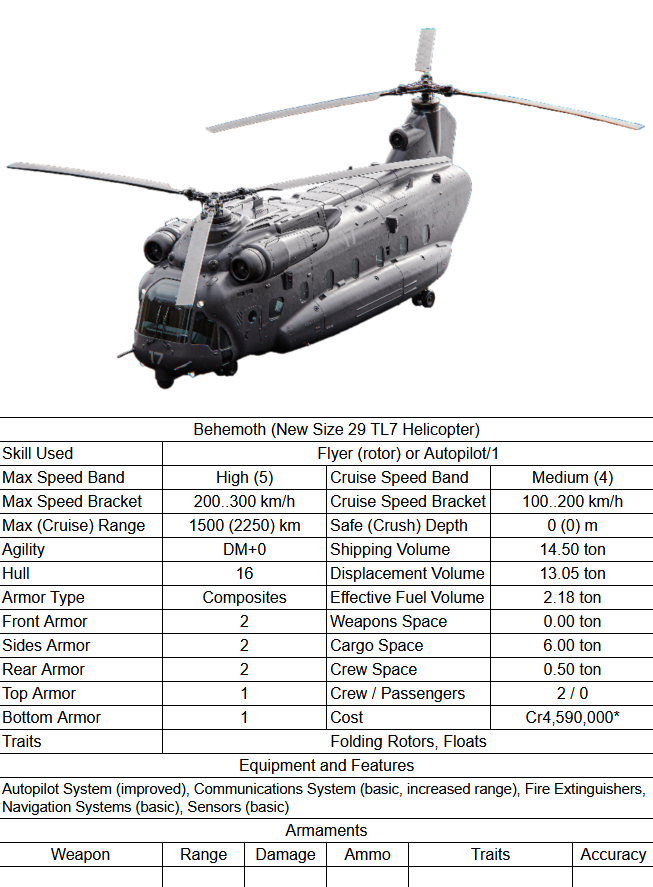
The Behemoth Cargo Helicopter uses twin rotors which together provide enough lift to carry large cargoes quickly and safely. Being able to land and take-off vertically, the Behemoth can access hard-to-reach areas long before grav technology becomes practical, and its large fuel tanks means it has good range for a helicopter, despite its size. It carries up to 6 dT of cargo or 24 passengers in relative comfort, with military models stripping out comfort to squeeze in more troops. The twin rotors provide enough lift for sling-loading up to 12 dT externally, though not alongside a full internal load. The hull is built and shaped in such a way as to allow the helicopter to land on water, while folding rotors make stowage aboard transports or carriers easier. Military variants often sacrifice 1 dT of capacity for a loadmaster’s station, defensive gunners, and decoy dispensers. Whether inserting personnel, resupplying forward bases, or hauling freight through remote regions, the Behemoth is a cornerstone of heavy lift logistics.
Show spoiler
Haulmaster Semi-Truck
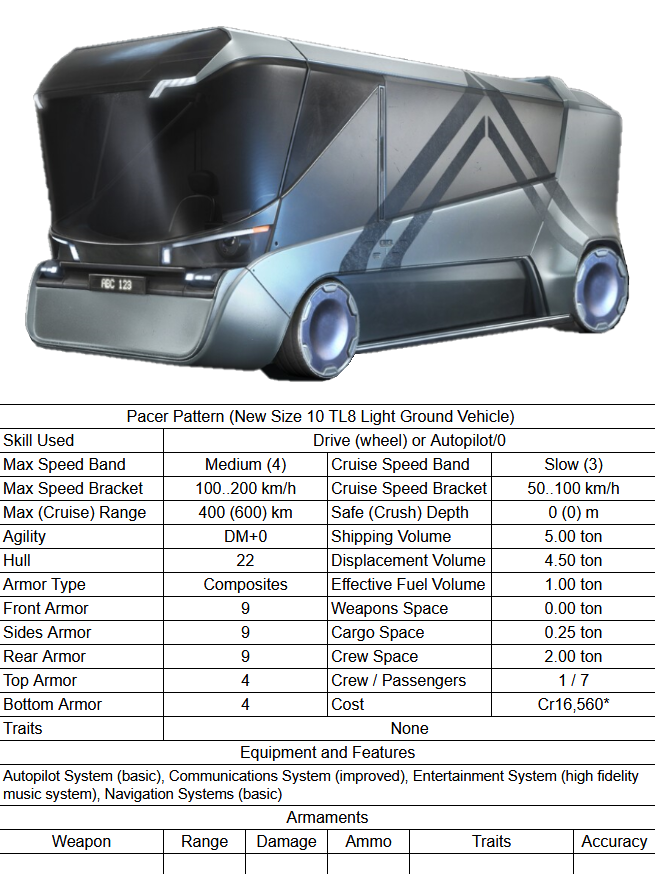
The Pacer is a dependable, multi-purpose van designed as a universal platform for commercial, civilian, and paramilitary roles. Built on a sturdy chassis with ample cargo space, it has become the foundation for a wide range of specialized variants. Common models include builder’s vans, cargo haulers, minibuses, and delivery vehicles, all valued for their simple maintenance and low operating costs. Law enforcement agencies employ the Pacer as armored response vehicles or prisoner transports, while emergency services adapt it into ambulances and rescue units. Security forces and private contractors frequently use reinforced versions for personnel transport or to carry valuables, often equipped with additional armor and communication systems. Whether moving goods through crowded city streets or ferrying personnel across rough backroads, the Pacer’s reliability and versatility have made it a trusted workhorse in almost any environment.
NOTE:
Standard Van: 1 crew, 2 passengers, 1.75 tons of cargo. Armor 2/2/2 (F/S/R). No built-in communications. Cost 15,075 cr.
Minibus Variant: 1 crew, 8 passengers, 0.25 tons of cargo. Armor 2/2/2 (F/S/R). No built-in communications. Cost 15,075 cr.
Armored Variant: As displayed, configurable as either a personnel transport with up to 8 seats or a valuables transport with 3 seats and 1.25 tons of cargo.
Standard Van: 1 crew, 2 passengers, 1.75 tons of cargo. Armor 2/2/2 (F/S/R). No built-in communications. Cost 15,075 cr.
Minibus Variant: 1 crew, 8 passengers, 0.25 tons of cargo. Armor 2/2/2 (F/S/R). No built-in communications. Cost 15,075 cr.
Armored Variant: As displayed, configurable as either a personnel transport with up to 8 seats or a valuables transport with 3 seats and 1.25 tons of cargo.
Show spoiler
CAT P-5000 Cargo Lifter
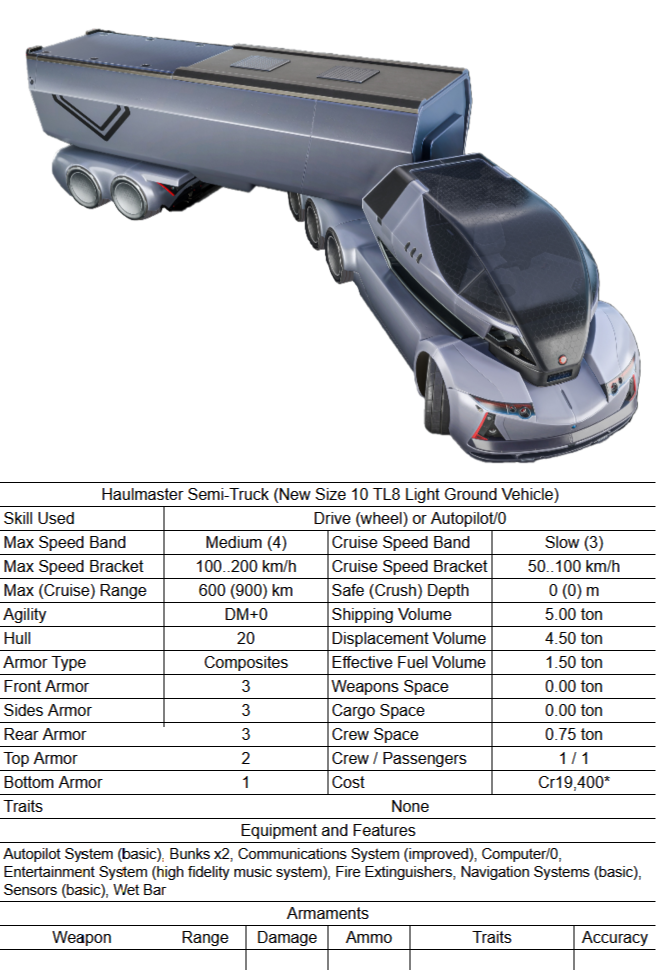
The Haulmaster is the workhorse of ground-based freight, a 6x4 semi-truck built to endure long hauls and heavy loads with dependable reliability. Its cab is designed for practicality, seating a driver and one passenger as standard, though many long-haul operators prefer a single central seat for greater comfort and space. The cab is fitted with a ‘Wet Bar’, although in practice this takes the form of a small refrigerator and microwave unit, providing drivers with basic food storage and reheating facilities for long-haul journeys, while a bunk bed allows the operator to rest inside the vehicle. The Haulmaster’s true strength lies in its versatility as a tractor unit, able to connect with a wide range of trailers depending on cargo needs. The most common trailers are a flatbed trailer, an enclosed box trailer and a tanker trailer. Able to serve the many freight needs of planetary settlements, the semi-truck remains the backbone of planetary surface logistics on many worlds.
Semi-Trailers:
Flatbed Trailer: Carries up to 10 tons of cargo or two standard containers, Costs 9,150 cr.
Box Trailer: Enclosed cargo space, carries up to 9.5 tons, Costs 10,300 cr.
Tanker Trailer: Specialized for liquids, carries up to 8.5 tons, Costs 12,650 cr.
Flatbed Trailer: Carries up to 10 tons of cargo or two standard containers, Costs 9,150 cr.
Box Trailer: Enclosed cargo space, carries up to 9.5 tons, Costs 10,300 cr.
Tanker Trailer: Specialized for liquids, carries up to 8.5 tons, Costs 12,650 cr.
Show spoiler
W.A.I.C.
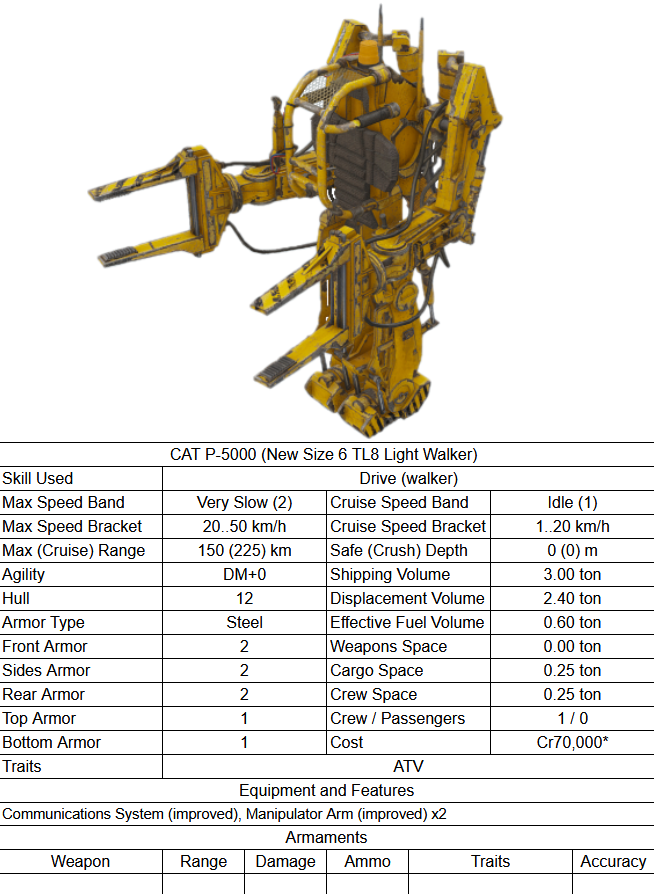
The Cargo Lifter is a familiar presence in starports, warehouses, and industrial yards, built to handle the endless movement of freight that sustains interstellar trade. Standing roughly three metres tall, it is fitted with two heavy-duty manipulator arms capable of lifting and manoeuvring containers or machinery far beyond the strength of any human, allowing a single operator to move cargo quickly and efficiently. A sealed version can be purchased for an extra Cr70000, which includes short term life support and vacuum protection for use in hazardous environments or on zero-atmosphere worlds. This version sacrifices the small internal cargo compartment found on the standard model. Whether shifting freight in a bustling starport or unloading supplies on a remote colony, the Cargo Lifter remains one of the most practical and enduring machines of heavy industry.
Show spoiler
Pioneer Rover
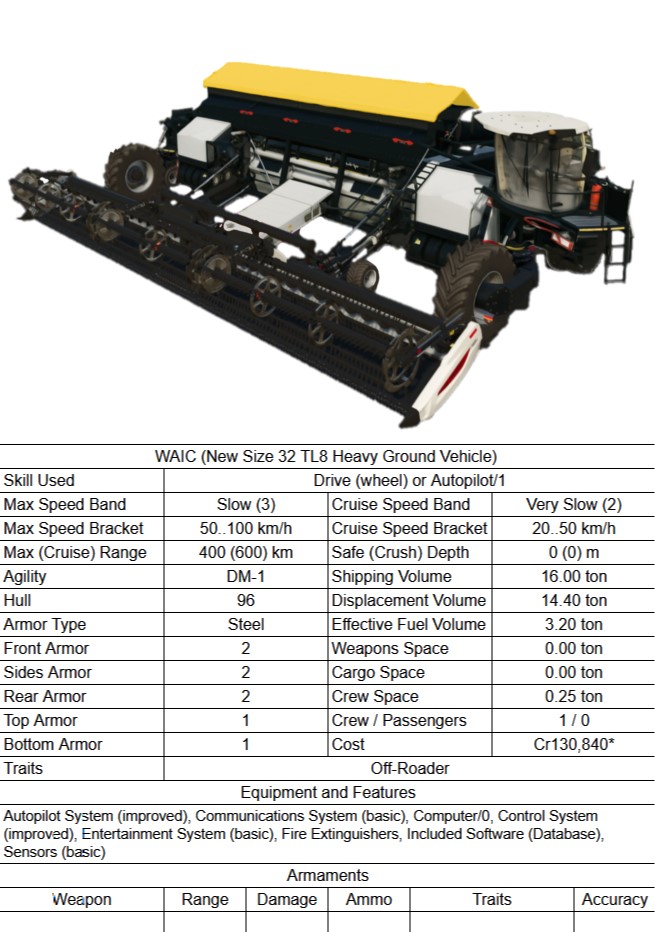
The Wide-span Agricultural Implement Carrier is a modular agricultural platform designed to meet virtually all fieldwork needs through the use of interchangeable modules. Modules must be purchased separately to equip the WAIC for specific agricultural tasks. From cultivation to planting, fertilising, and harvesting, the WAIC allows a single vehicle to perform multiple tasks with minimal downtime, with its implement modules designed to be swapped by a single operator. The vehicle has two driving modes: in transport mode it moves lengthwise, adopting a long and narrow profile suitable for roads, while in work mode it reorients to crosswise movement, presenting a broad, stable platform ideal for fieldwork. A tracked version is also available for softer soils, increasing cost by 60,000 cr. Highly efficient, it is widely used across large-scale farms and agriworld colonies.
WAIC Modules:
Harvesting Module: 34 spaces, 85,000 cr; carries up to 4 dT of grain (16 spaces).
Drill Module: 34 spaces, 68,000 cr; carries up to 4 dT of seed (16 spaces).
Fertiliser Module: 34 spaces, 61,200 cr; carries up to 4 dT of liquid (16 spaces).
Harvesting Module: 34 spaces, 85,000 cr; carries up to 4 dT of grain (16 spaces).
Drill Module: 34 spaces, 68,000 cr; carries up to 4 dT of seed (16 spaces).
Fertiliser Module: 34 spaces, 61,200 cr; carries up to 4 dT of liquid (16 spaces).
Show spoiler
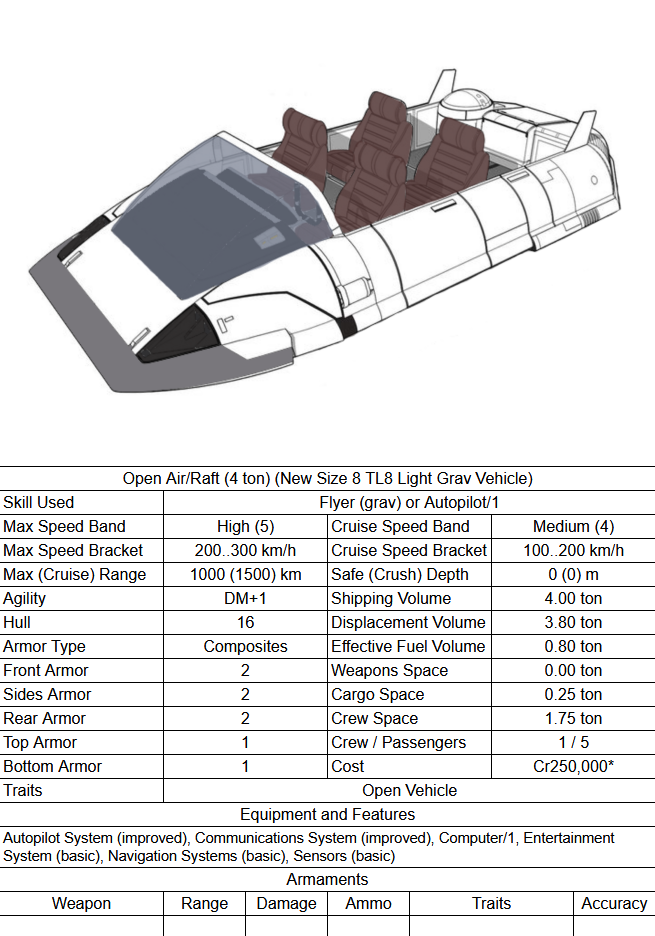
Air/Raft
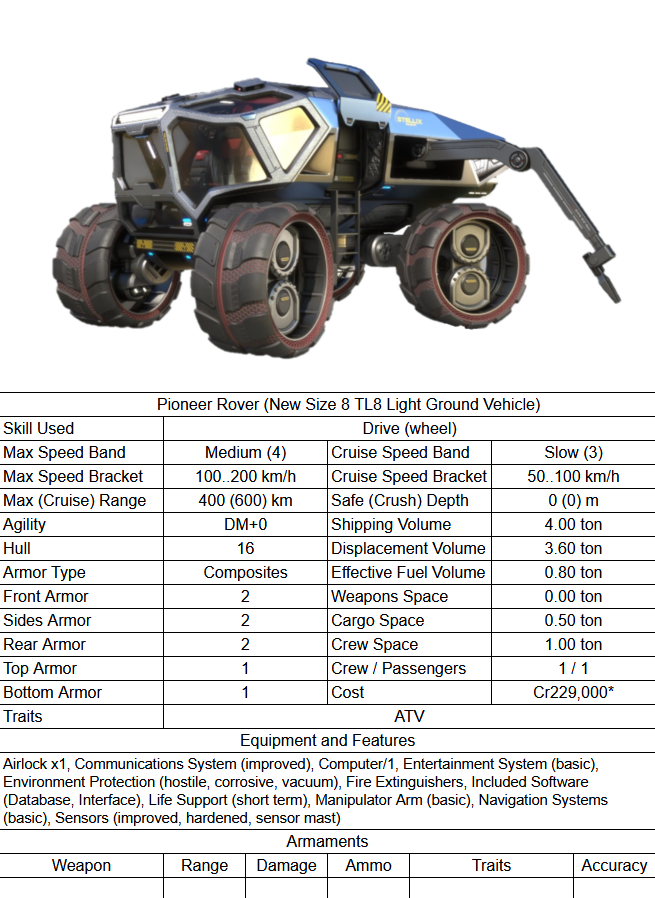
The Pioneer Rover is a rugged, enclosed four-wheeled vehicle designed for exploration and research on hostile worlds. Protected against vacuum and corrosive atmospheres, it features an airlock that allows its occupants to suit up and exit the vehicle for short-term EVAs when necessary. Short-term life support ensures crews can operate safely in environments that would otherwise be lethal. Its compact interior includes limited cargo space for essential equipment or samples, while a built-in manipulator arm, integrated computer, and onboard database assist crews in handling materials, conducting analyses, and performing minor maintenance. Advanced sensors and hardened communication systems make the Pioneer Rover ideal for long-range surveys, mapping and planetary research. Whether traversing uncharted terrain, monitoring hazardous sites, or supporting scientific expeditions, the Pioneer Rover offers a versatile, self-contained platform for small teams exploring the frontier.
Show spoiler
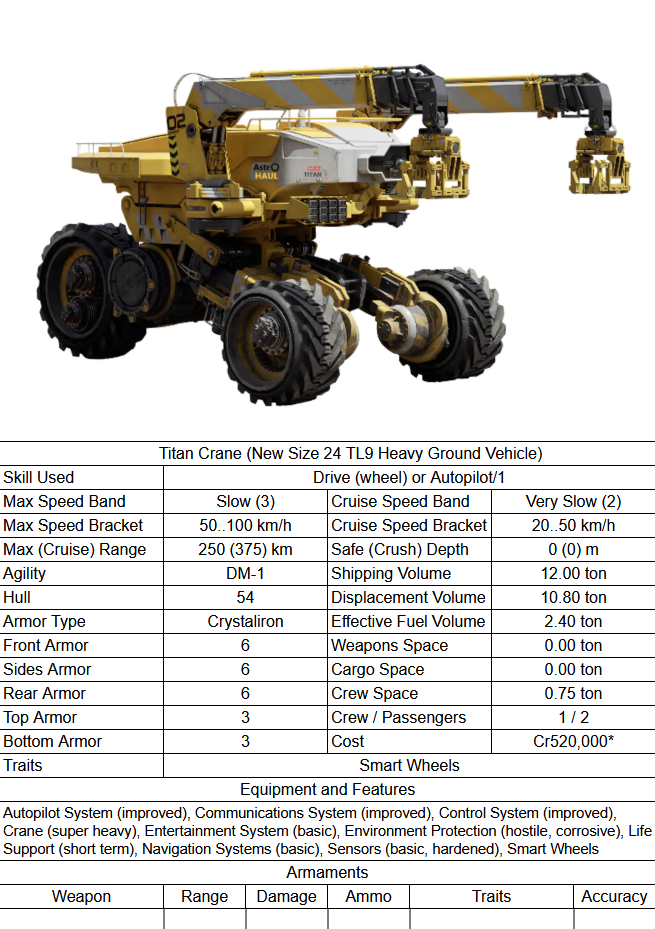
Titan Crane
The Air/Raft is one of the most ubiquitous grav vehicles in the galaxy, valued for its simplicity, versatility, and reliability. Its open-topped hull is supported by rugged anti-gravity modules, allowing it to skim effortlessly above ground or water and even ascend into orbit if required, though passengers must wear vacc suits to survive the exposure. Standard models balance seating and cargo space, but countless local variants adapt the same proven design for different needs, from utility haulers to personal runabouts. Easy to fly, straightforward to maintain, and supported by a near-universal supply of spare parts, the Air/Raft has become a common sight everywhere from dense megacities to the remotest frontier colonies.
NOTE:
People Carrier: 1 Crew, 5 Passengers, 0.25 ton cargo
Cargo Air/Raft: 1 Crew, 1.5 ton cargo
Runabout Air/Raft: 1 Crew, 3 Passengers, 0.75 ton cargo
Space Operation: Thrust 0.3 G Duration 5 hours
People Carrier: 1 Crew, 5 Passengers, 0.25 ton cargo
Cargo Air/Raft: 1 Crew, 1.5 ton cargo
Runabout Air/Raft: 1 Crew, 3 Passengers, 0.75 ton cargo
Space Operation: Thrust 0.3 G Duration 5 hours
Show spoiler
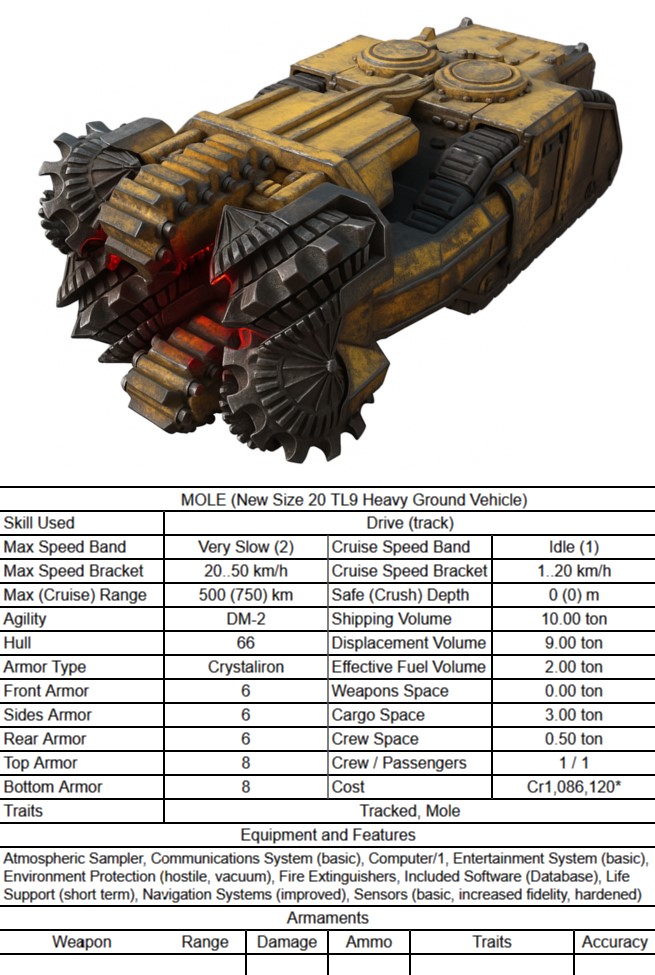
M.O.L.E.
The Titan Crane is a massive wheeled lifting vehicle designed for the heaviest industrial and construction tasks. Twin crane arms mounted on either side can be operated independently for routine work or together to function as a single super-heavy rig capable of hoisting loads that smaller machines cannot approach. Arms are rated for lifting 10 tons each, while combined they can lift up to 100 tons, making the Titan indispensable in shipyards, starports, and heavy industry. Its sealed cabin comes equipped with life support, allowing crews to operate in hazardous environments, and all models are built with protection against corrosive atmospheres as standard. Some operators replace the crew space and support systems with an AI control module, further reducing risk in dangerous work zones. Whether erecting orbital launch structures, loading superfreighters, or salvaging wreckage, the Titan Crane remains one of the most powerful lifting platforms available.
Show spoiler
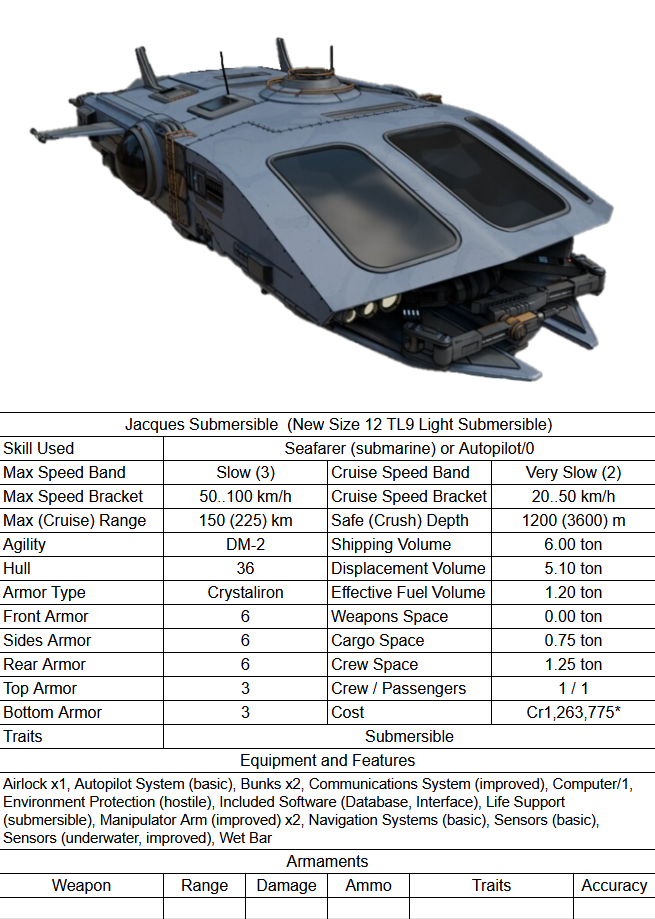
Jacques Submarine
The Mobile Oblique Lateral Excavator is a tunnelling vehicle built to handle a wide range of underground and surface excavation tasks. Optimised for subterranean work, its front-mounted drill and rock grinders can bore through soil and solid rock with ease, making it ideal for tunnel construction and underground mining. Excavated material can be collected in an internal 3 dT hopper for transport or disposal. The pickup for which divides the vehicle’s two sealed crew compartments. Each compartment contains a full set of controls, allowing the Mole to be operated from either side, and both are equipped with their own side entry door and top hatch for safety and redundancy. With no direct view of the outside, operators rely entirely on a network of cameras and sensors to navigate and control the Mole. While usually crewed by a single operator, the second station is often used for training, oversight, or backup in hazardous environments. The hull is fully sealed for vacuum operations and includes short-term life support, enabling the Mole to function in airless or toxic atmospheres. Compact and self-contained, its tracked chassis allows it to manoeuvre in confined tunnels, making it invaluable for mining colonies, frontier expeditions, and construction projects where heavy digging and reliable performance are essential.
Tunnelling Operations: Borrowing Speed 90 m/h
Show spoiler
Brutus Pattern Heavy Cargo Truck
The Jacques Submersible is a compact, deep-operations vessel designed for exploration, research, and industrial work beneath alien seas. Built to sustain a two-person crew for extended missions, its reinforced pressure hull and efficient life-support systems allow it to operate safely at extreme depths where surface communication is unreliable. Two articulated manipulator arms mounted on the bow provide the ability to collect samples, conduct maintenance, or handle equipment in environments too hostile for direct human activity. The Jacques is a favourite among oceanographic teams, surveyors, and salvage operators, prized for its reliability, endurance, and excellent underwater handling. In frontier service, it often performs dual roles, shifting from scientific survey to resource extraction or wreck recovery with minimal modification. Whether charting the unlit abyss, studying alien marine life, or supporting subsea construction, the Jacques Submersible remains a trusted platform for work in the deep.
Show spoiler
Timberjack Foresty Walker
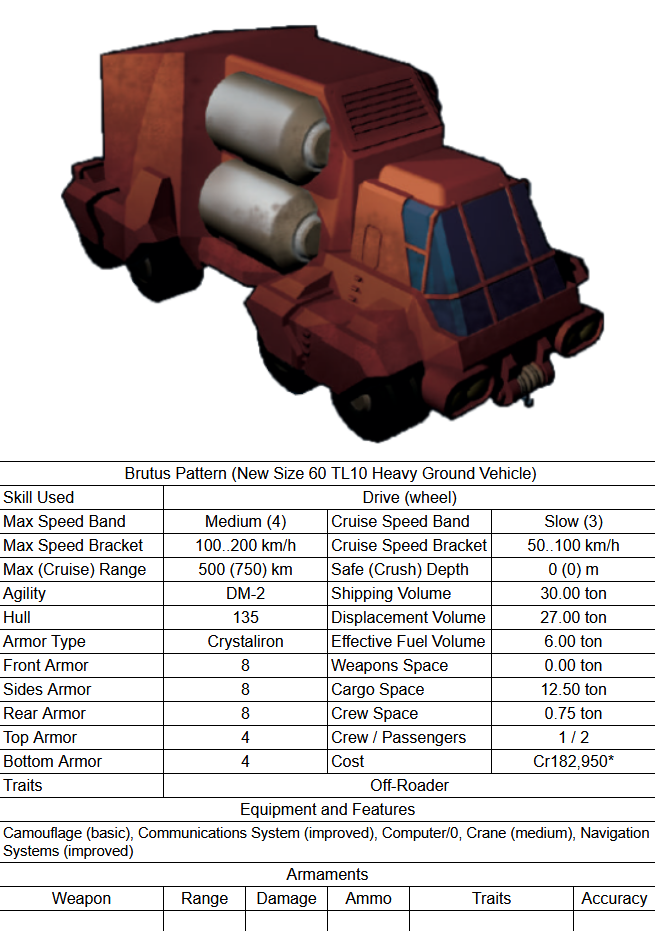
The Brutus Pattern Heavy Cargo Truck is a massive, no-nonsense hauler built to move large loads where smaller vehicles would falter. It sees extensive use across frontier worlds as a heavy freight mover, capable of carrying large quantities of construction materials, machinery, or agricultural produce between settlements and industrial sites. Its reinforced frame, high ground clearance, and durable drivetrain allow it to operate across rough terrain and primitive roads with minimal maintenance. Its immense carrying capacity has also made it a favourite among military and mercenary operators. While lacking the glamour of armoured vehicles and aircraft, the Brutus Pattern provides the vital ability to deliver supplies, ammunition, and wounded personnel to and from forward bases, offering the greatest possible load capacity within the fewest vehicles. Its sheer reliability and endurance have earned it a reputation as the backbone of heavy logistics on many worlds.
Show spoiler
Explorer All Terrain Vehicle
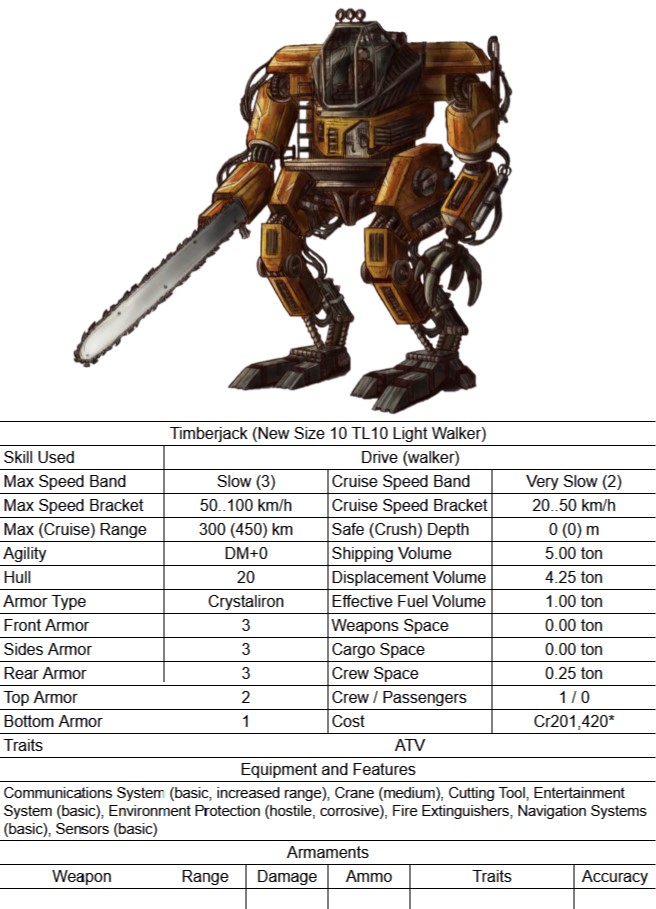
The Timberjack is a bipedal forestry walker built for large-scale logging and land management in rugged or heavily forested environments. Standing on two powerful articulated legs, it can traverse terrain impassable to traditional wheeled or tracked machines, from steep inclines to dense undergrowth. Its main toolset consists of a hydraulically articulated crane-arm ending in a reinforced claw, capable of lifting up to two tons, allowing it to grip, steer, and stack cut logs with precision, while a second arm carries a massive chainsaw blade for felling and sectioning trees on-site. The sealed cockpit protects the operator from corrosive and hostile environments that may be found on frontier worlds, though it does not include integrated life-support, so additional equipment may be required for extended operations. Widespread in colonies where forestry is a cornerstone of the economy, the Timberjack has become synonymous with efficient frontier industry and is often among the first machines deployed on new worlds, carving out clearings for towns, farms, and industry to follow.
Show spoiler
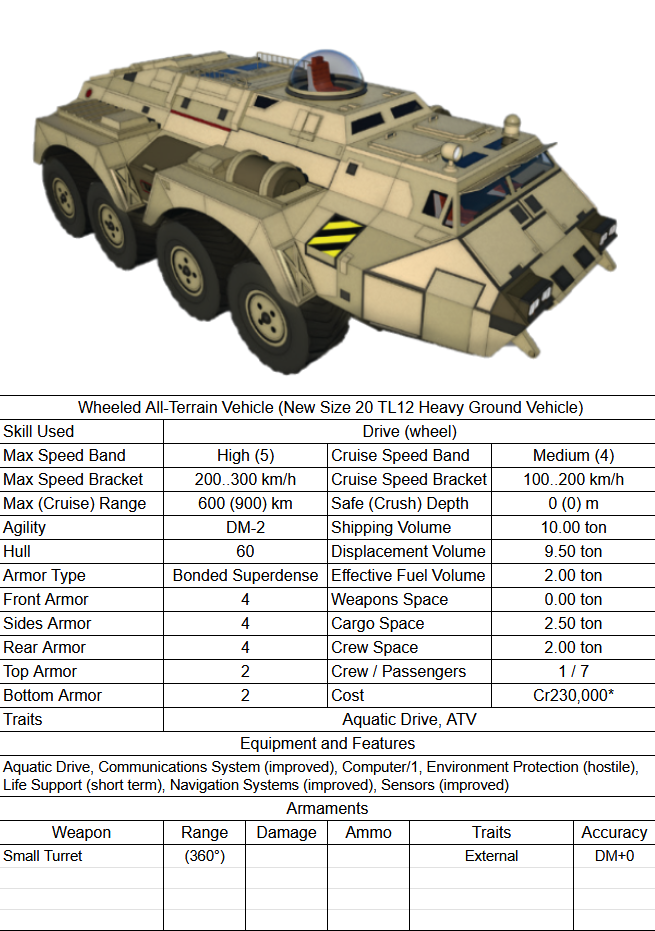
The Explorer ATV is an eight-wheeled, enclosed all-terrain vehicle built for long-range travel across challenging worlds. Its rugged chassis and large tyres provide excellent traction over broken terrain, while its sealed compartments and buoyant design allow it to float across calm water. Fully pressurised and equipped with short-term life support, it allows crews to operate safely on worlds with hostile environments. A suite of integrated sensors and communications equipment makes it particularly well suited for surveying, mapping, and exploration. The standard ATV carries a hardpoint for a turret, though it is rarely armed in civilian service. Frontier settlements and expeditions, however, often adapt the design for harsher conditions. Internal cargo space can be traded for heavier armour or additional seating, and mounting a weapon in the turret transforms the ATV into a capable paramilitary vehicle. This flexibility has kept the Explorer ATV in service across countless colonies, where it remains a trusted platform for both discovery and defence.
NOTE: A tracked version of the ATV is available. This uses the Drive (track) skill, has Speed: Medium (slow) and cost +30.000cr
Aquatic Operation: Speed: Medium (slow) , Agility DM-6
Aquatic Operation: Speed: Medium (slow) , Agility DM-6
Combat Vehicles
Purpose-built for security, law enforcement, and military roles, they emphasise armour, weapon mounts, and survivability. These machines are the tools of organised force. Militaries, mercenaries, and corporate or planetary security forces all rely on them to project power and maintain control. (ammo cost not included)
Show spoiler
"Jeep" GPV
Show spoiler
Razorback MICV
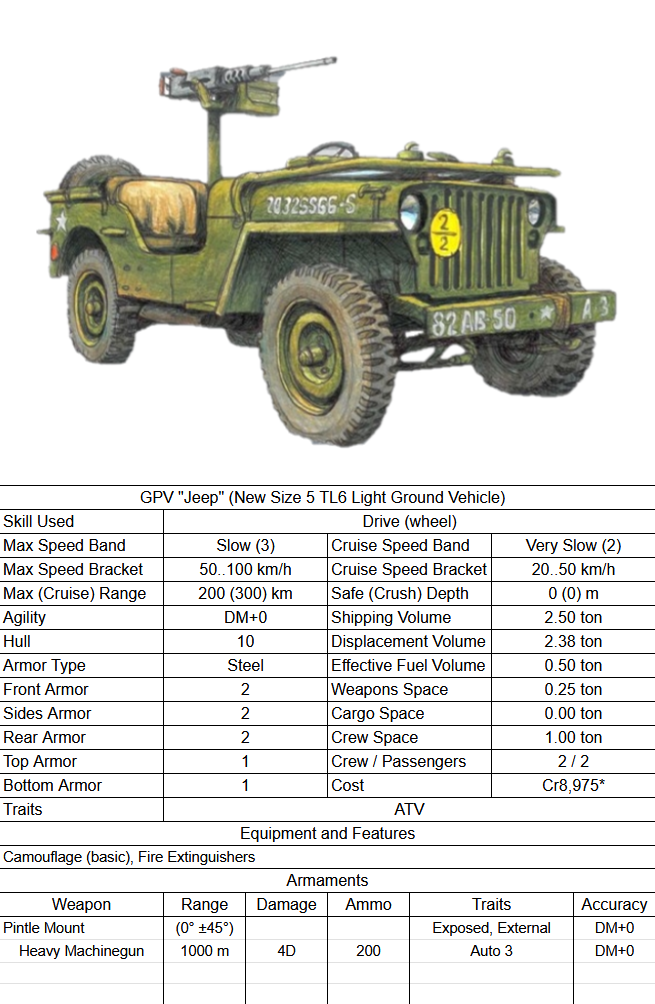
The General Purpose Vehicle, or due to a common misconception of its abbreviation, colloquially known as the "Jeep". It is a simple, utilitarian light transport designed for military logistics, reconnaissance, and general field duties. Built for reliability over refinement, the GPV is a lightweight, open-frame vehicle capable of traversing rough terrain and carrying a modest payload. It can be fitted with a pintle-mounted weapon or left unarmed for transport and utility roles. Though largely replaced in professional militaries by more modern multi-role vehicles, its simplicity, low cost, and ease of maintenance ensure it remains in widespread service across the frontier. Decommissioned and surplus units are frequently sold into civilian hands, where they are valued for their durability and off-road performance. Whether hauling supplies across backwater colonies or serving as improvised transports in remote settlements, the venerable “Jeep” continues to embody practical mobility at its most accessible.
NOTE:
The shown price, includes a heavy machine gun, for an unarmed version subtract the price of the weapon.
Its Pintle mount, Accepts a wide range of weapons, often limited by the operators budget.
Its Pintle mount, Accepts a wide range of weapons, often limited by the operators budget.
Show spoiler
Keiler M70E1 Battle Tank
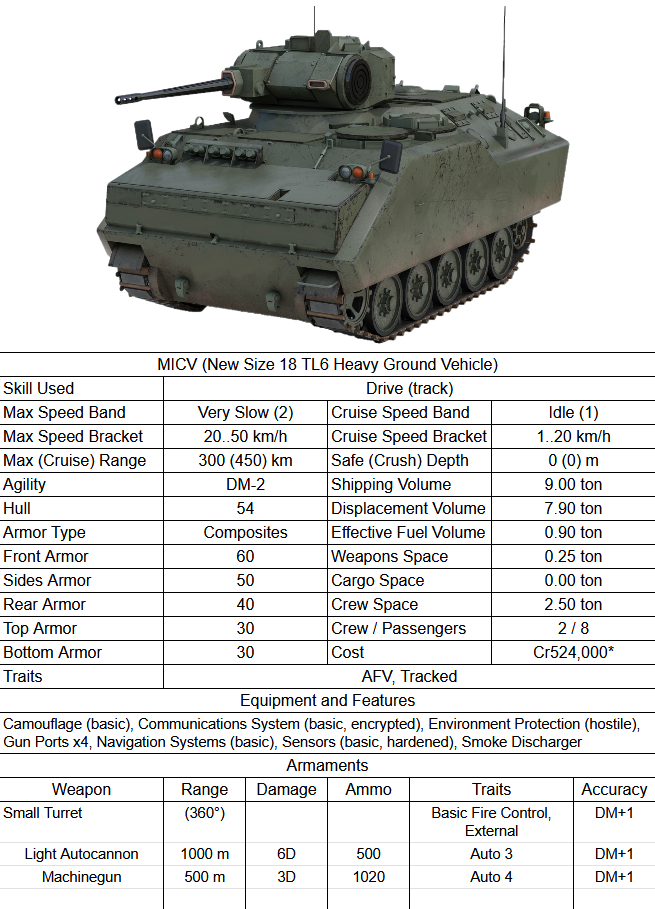
The Mechanised Infantry Carrier Vehicle is a tracked infantry fighting vehicle designed to accompany main battle tanks into combat and provide mechanised infantry with protection and mobility on the battlefield. Built to the same technological standard as the M70E1 Battle Tank, it shares many automotive components and often serves alongside it within armored formations. The MICV mounts a turreted autocannon and coaxial machine gun, giving it the ability to engage light vehicles and infantry while transporting a full squad under armor. A rear access ramp allows for rapid deployment of troops, and four hull gun ports permit embarked troops to fire from under protection. Its rugged suspension and powerful diesel engine enable it to traverse the same terrain as the tanks it supports. Though increasingly outclassed by grav-propelled and fusion-powered designs, the MICV remains a dependable and economical vehicle, widely used by planetary defence forces and mercenary units that value its straightforward maintenance and proven battlefield utility.
NOTE:
From TL7, the vehicle’s speed increases by one band and its range rises to 400 (600). Basic Reactive Armor (+15) becomes available as an optional upgrade for 20,000 Cr.
From TL7, the vehicle’s speed increases by one band and its range rises to 400 (600). Basic Reactive Armor (+15) becomes available as an optional upgrade for 20,000 Cr.
Show spoiler

LMV
The M70E1 Battle Tank is a robust and dependable vehicle that stands as one of the most advanced examples of tracked armored warfare at its technological level. Though firmly rooted in the combustion era, it remains a capable main battle tank, combining firepower, protection, and mobility in a balanced and efficient design. Its autoloading main gun and remote-operated light autocannon give it a strong offensive capability for its size, while its composite armor provides respectable protection against most weapons of comparable sophistication. While more advanced vehicles exist, the M70E1’s heavy cannon still represents a serious threat to anything short of the most heavily armored opponents. Crewed by three, it can operate for extended periods in the field, though its reliance on chemical fuel limits operational range. Long overshadowed by grav and fusion-powered vehicles, the M70E1 continues to see extensive service among planetary defence forces and mercenary companies that value its rugged reliability, simple logistics, and proven battlefield record.
NOTE:
From TL7, the vehicle’s speed increases by one band and its range rises to 400 (600). Basic Reactive Armor (+15) becomes available as an optional upgrade for 20,000 Cr.
From TL7, the vehicle’s speed increases by one band and its range rises to 400 (600). Basic Reactive Armor (+15) becomes available as an optional upgrade for 20,000 Cr.
Show spoiler
SA-2 Samson
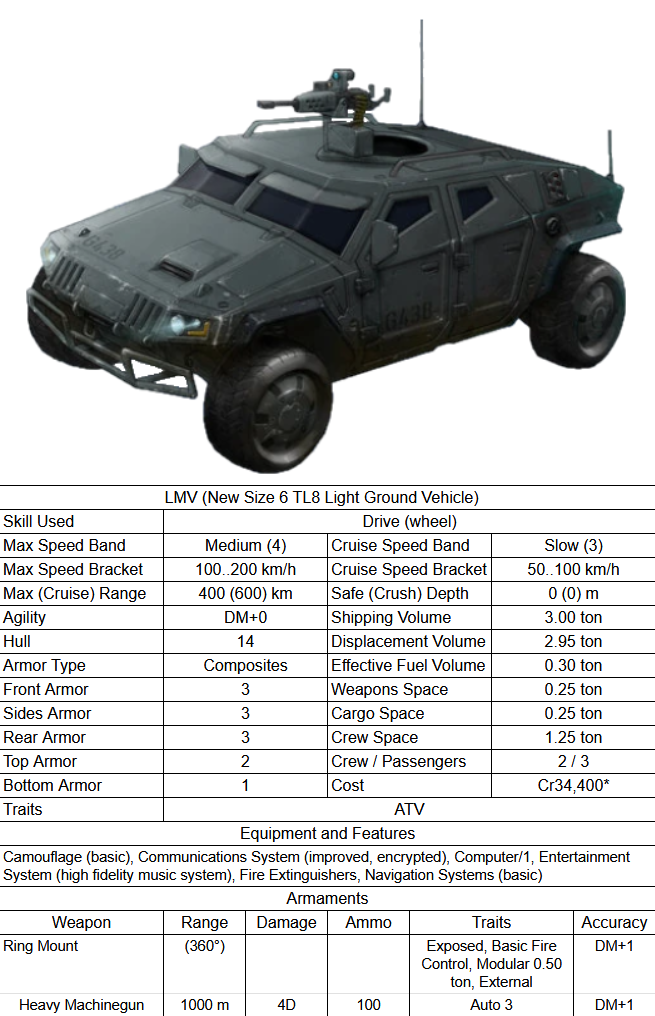
The Light Mobility Vehicle is a military light transport designed for speed, reliability, and all-terrain performance. Built to carry five troops and a small cargo load, it provides the mobility and endurance required for reconnaissance, escort, and patrol duties. Its rugged suspension and reinforced frame allow it to operate effectively off-road in combat conditions. Integrated long-range radios, navigation systems, and an onboard computer provide command-and-control capabilities, distinguishing it from earlier light transports and enabling coordinated operations across dispersed formations. A roof ring mount supports a heavy machine gun by default but can accept a wide range of other weapons, including grenade launchers, anti-tank missiles, or rotary guns. the LMV has remained a staple among mercenary units and planetary defence forces alike.
NOTE:
The Ring mount may be replaced with a remote-controlled small turret, reducing troop capacity to 4. Cost Cr10000 on top of cost of weapon.
The Ring mount may be replaced with a remote-controlled small turret, reducing troop capacity to 4. Cost Cr10000 on top of cost of weapon.
Show spoiler
Kodiak WCV-60
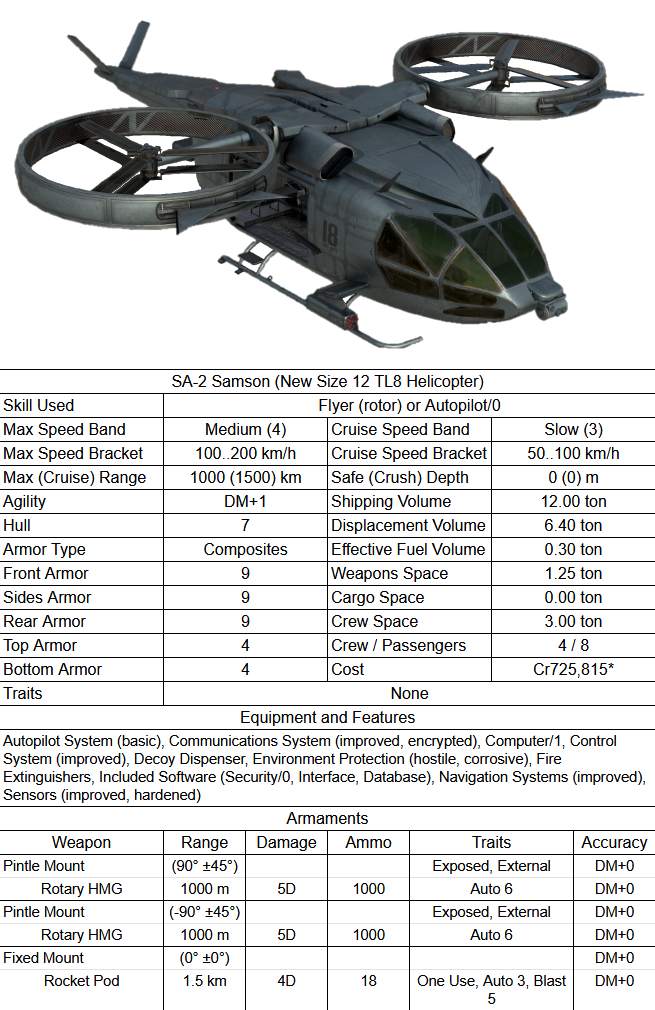
The SA-2 Samson is a versatile, multi-role tiltrotor-wing utility aircraft with a robust design tailored for demanding aerial service. It typically operates with a small crew and can carry up to ten passengers in its default configuration. The aircraft can be quickly converted for MEDIVAC or Search and Rescue roles. In military applications, the Samson is armed with door-mounted rotary heavy machine guns, offering defensive firepower. Trading passenger lift capacity, it can be further outfitted with additional weapon pylons aft of the cockpit. Alternatively, it can be configured to sling-load cargo for logistical support. Equipped with advanced communication, navigation, and environmental protection systems, the Samson is built to perform in hostile and corrosive environments.
Show spoiler
Pathfinder CM-RW
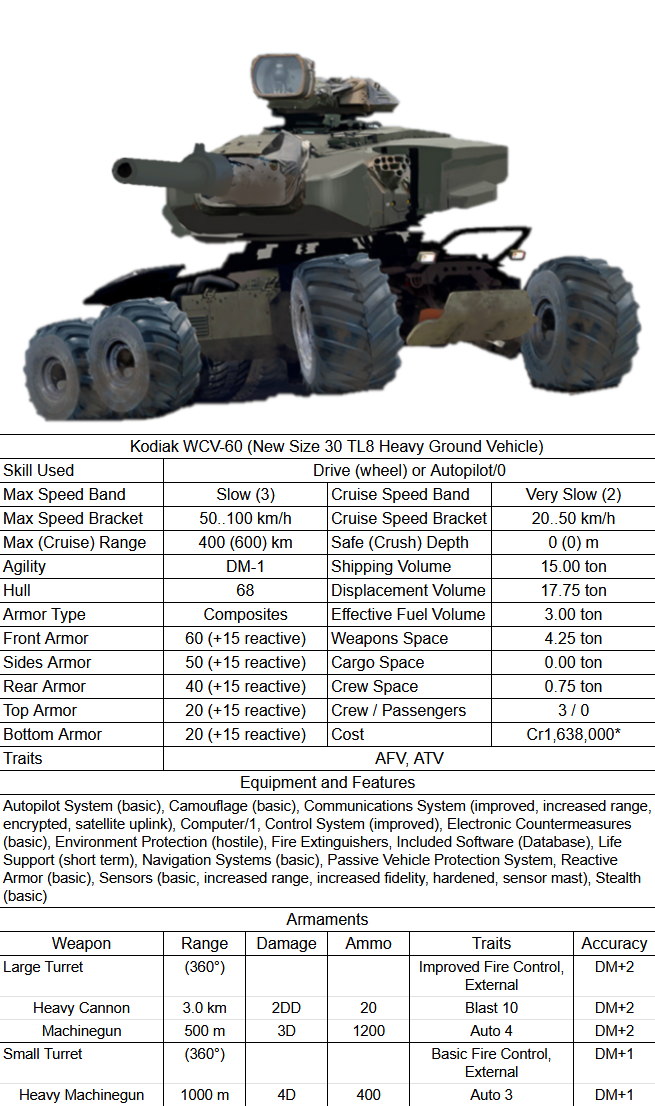
The Wheeled Combat Vehicle 60, or Kodiak, is a fast-moving, hard-hitting armored vehicle designed to deliver firepower and maneuverability in rugged terrain. Despite its tall profile, the Kodiak boasts a compact hull with all three crew members seated within its large, high-mounted turret. The turret design keeps the Commander and Gunner in conventional positions, while the driver’s seat is uniquely turret-mounted, rotating automatically to maintain a forward-facing orientation with the hull, regardless of the turret’s rotation. This advanced alignment system allows the driver to maintain full situational awareness even when the turret is engaged in off-angle targeting. Equipped with powerful off-road wheels, the Kodiak combines speed, stability, and a formidable gun, making it ideal for rapid deployment and heavy-hitting strikes in unpredictable environments.
Show spoiler
Atlas Walker
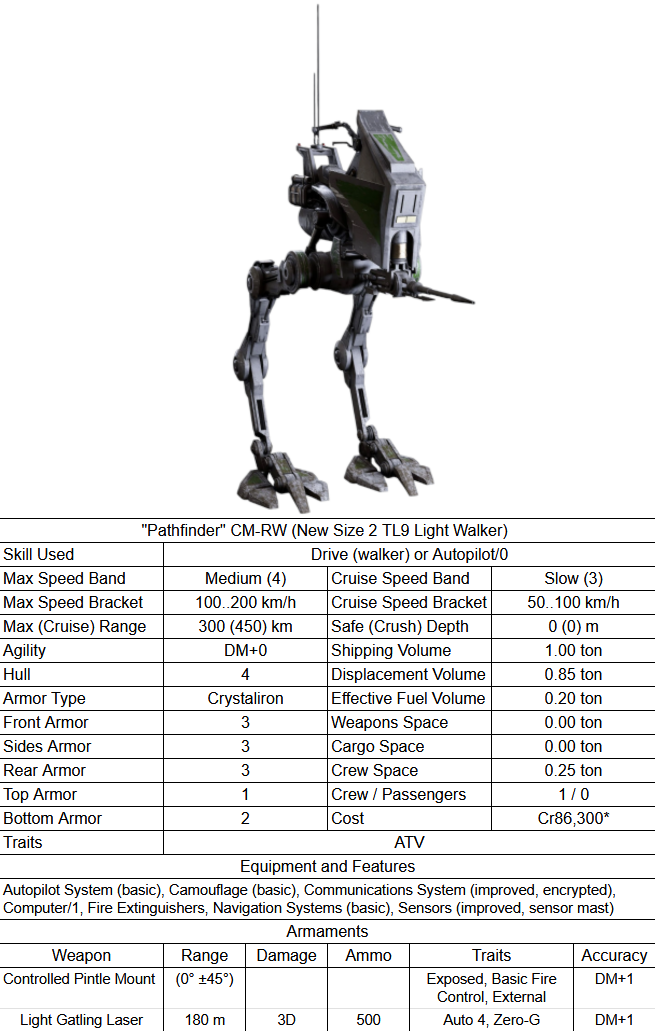
The Combat Machine Recon Walker or Pathfinder is a combat recon walker designed like a motorcycle translated to a bipedal chassis: lean, fast, and optimized for single-operator scouting missions. Its narrow profile and articulated legs trade heavy protection for exceptional mobility, allowing rapid traversal of uneven terrain, alleyways, and drop-off approaches that wheeled vehicles cannot negotiate. The Pathfinder uses gyroscopic stabilizers and responsive hydraulics to deliver motorcycle-like handling with the tactical advantages of a walking platform. A chin-mounted weapon provides a compact, low-slung firing position ideal for suppression and precision bursts without compromising the rider’s field of view; common armaments include machine guns or Gatling lasers in the remote-controlled chin pintle mount. Integrated retractable sensor mast and comms system support long-range observation and relay duties. Favoured by reconnaissance detachments, raiding teams, and planetary scouts, the Pathfinder excels when speed and concealment are key.
Show spoiler
"Spearhorn" MOMLP
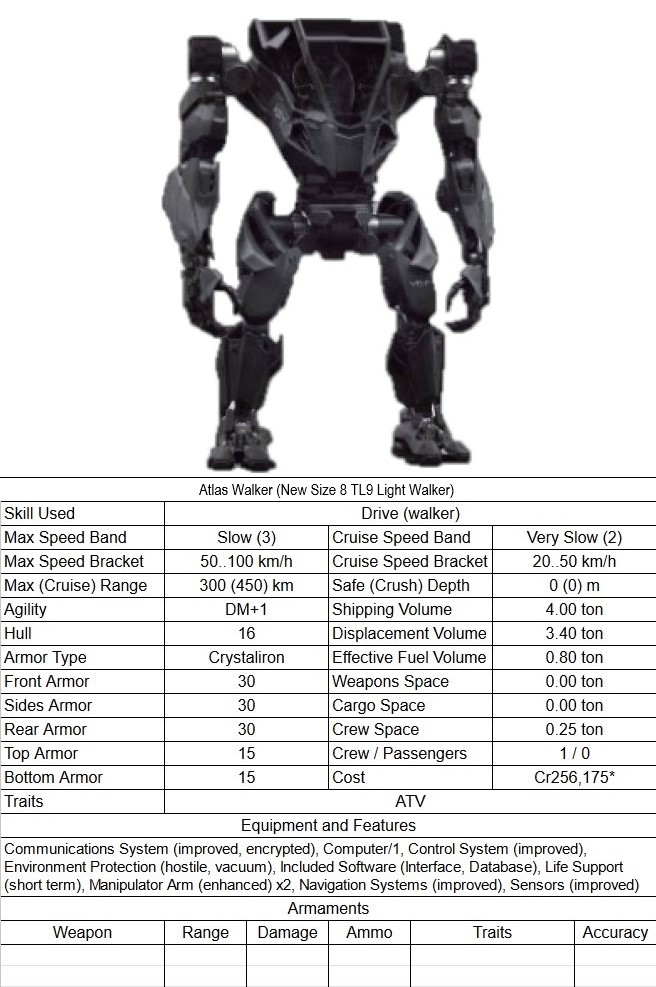
The Atlas is a well-armored, cost-effective alternative to advanced battlesuits, with a design rooted in industrial exoskeleton technology. Originally a modified cargo-handling frame, the Atlas was adapted for combat to provide a durable and affordable platform for frontline and support units. Retaining its reinforced chassis and hydraulic limbs, it offers exceptional load-bearing strength and protection at a fraction of the cost of powered armor or light mechs. Two enhanced manipulator arms allow it to mount or carry heavy weapons that would otherwise be impractical for infantry, such as rotary cannons and autocannons. its approachable cost, rugged construction and ease of maintenance make it a popular choice among militias and planetary defence forces, that cant acquire advanced battlesuits. The Atlas remains ideally suited for combat support roles where mobility, resilience, and sheer firepower are valued over sophistication.
Show spoiler
Bison APC
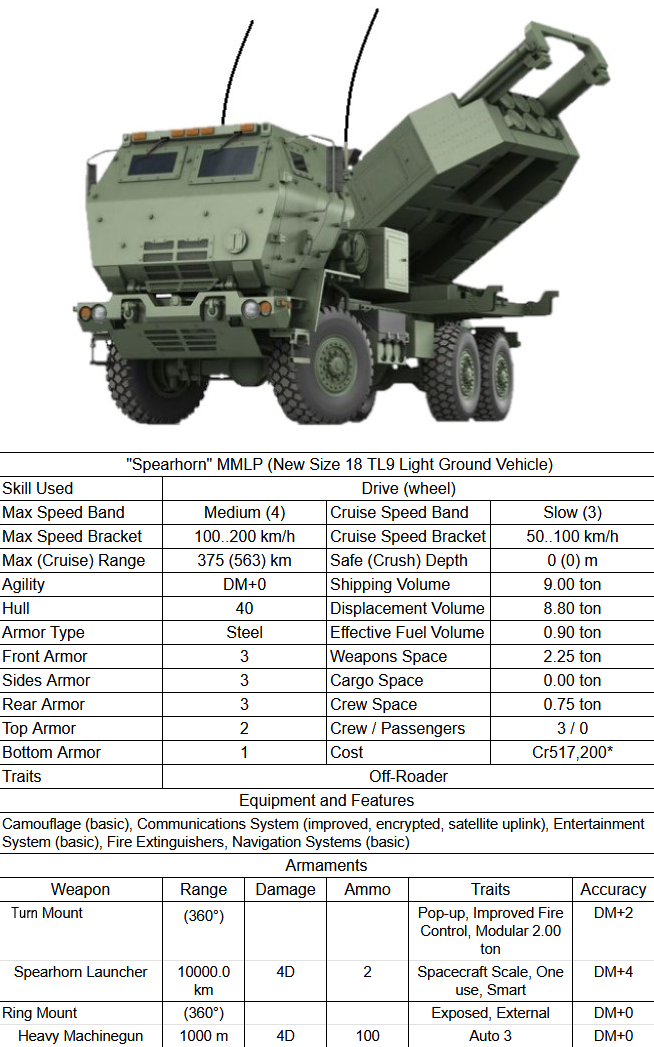
The Mobile Orbital Missile Launcher Platform or "Spearhorn" is a militarized variant of the Longhorn Utility Truck converted into a mobile missile platform capable of delivering both orbital and surface strikes. Retaining the Longhorn’s rugged 6x6 chassis and off-road mobility, the Spearhorn operates from remote forward positions and austere colony roads alike. Its signature Spearhorn launcher carries up to two missiles and is built as a modular system, normally loaded with Longspear missiles for orbital defence but readily reconfigured to accept a wide range of payloads, including nuclear, fuel-air, and bomblet warheads. Crews can reload and service ordnance in the field using integrated handling rigs, while reinforced suspension and launch dampers absorb the stresses of missile firing. Employed for orbital interception, mobile artillery, and tactical strikes, the Spearhorn gives commanders a long range rapid-response option that combines the Longhorn’s durability with the reach and flexibility of modern missile systems, making it equally effective for deterrence as for strikes.
Show spoiler
Velites IFV
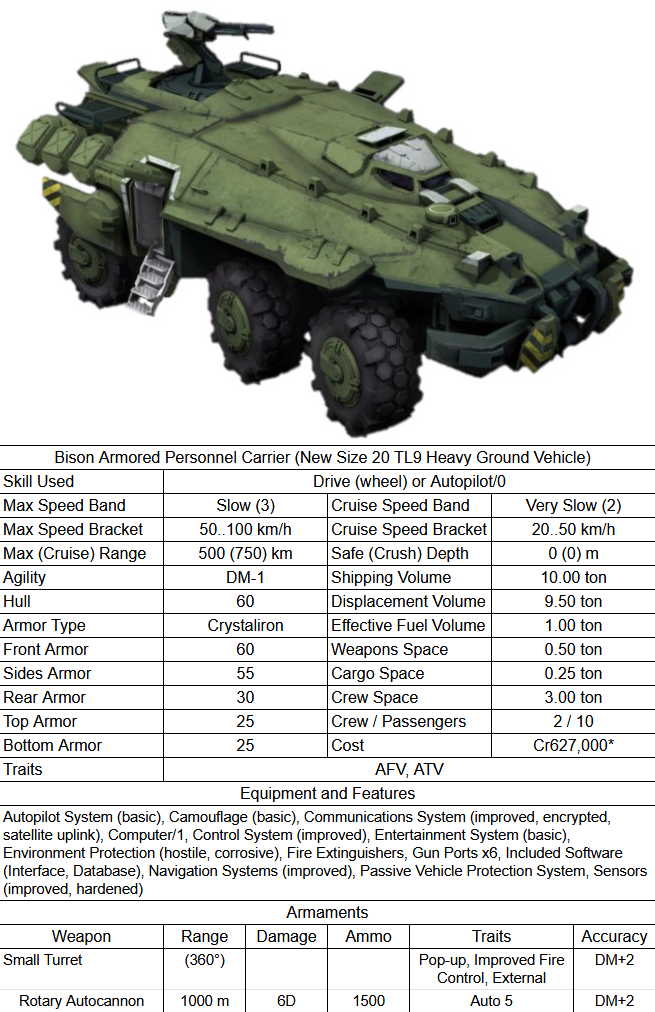
The Bison Armored Personnel Carrier is a rugged all-terrain vehicle designed to transport infantry safely through hostile environments and directly into combat zones. Crewed by two and carrying up to ten troops, the Bison combines dependable protection with reliable cross-country mobility. Its reinforced armor and sealed hull provide excellent survivability against small arms, shrapnel, and environmental hazards, while integrated communication and navigation systems ensure coordination. The troop compartment features three access points, with one rear hatch and one on either flank, allowing rapid embarkation and disembarkation under fire. A remote operated rotary autocannon provides responsive fire support and local defense, giving embarked troops covering fire during assaults or extra protection while on the move. Some operators modify the Bison with external mounting racks, allowing it to carry up to two exosuits or battledress-equipped troops on its hull in addition to its internal complement. Durable, versatile, and easy to maintain, the Bison remains a trusted workhorse among planetary defense forces, mercenary units, and colonial militaries alike.
Show spoiler
“Martinique” ACVI-3
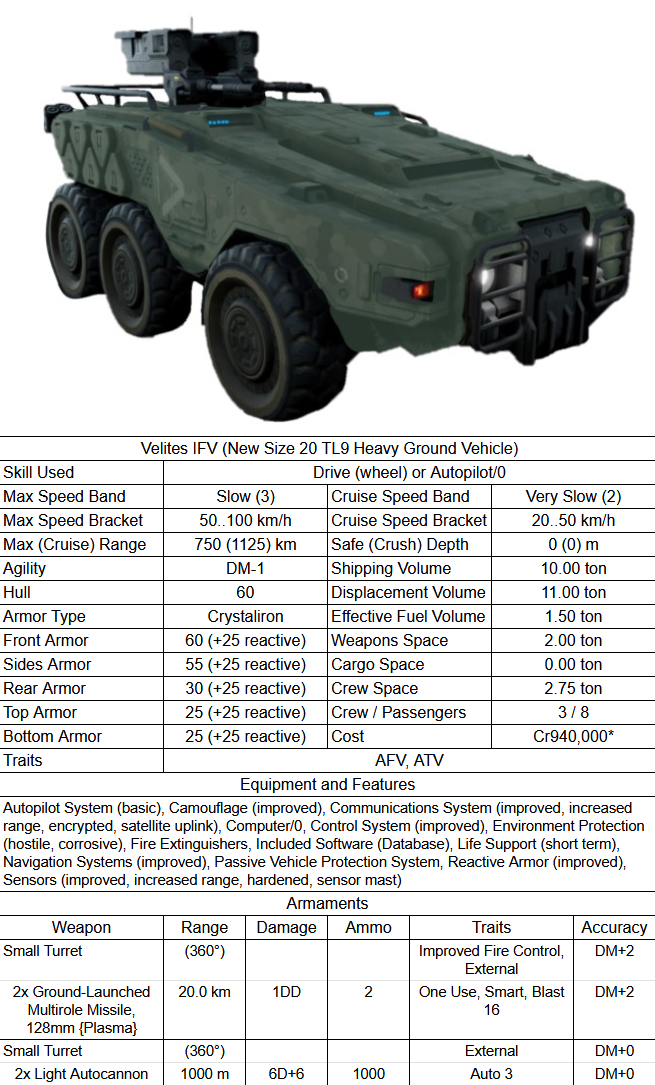
The Velites Infantry Fighting Vehicle is a 6x6 wheeled combat vehicle designed to deliver infantry quickly and safely across the battlefield. Its dual remote-operated weapon stations, one mounting a pair of multipurpose missiles for armored or aerial targets and the other twin light autocannons or a single medium autocannon for fire support, give it the striking power of a much heavier vehicle. The Velites is typically crewed by three and carries eight infantry, though some operators reduce the crew to two to increase dismount capacity, relying on the gunner to double as commander. Its all-wheel-drive system and reinforced suspension provide excellent cross-country mobility, allowing it to operate confidently in both rugged terrain and city streets. Designed for rapid deployment and ease of maintenance, the Velites is a viable choice for expeditionary and planetary defense forces seeking a fast and versatile vehicle capable of holding its own in frontline combat.
Show spoiler
Dragoon UCV-90
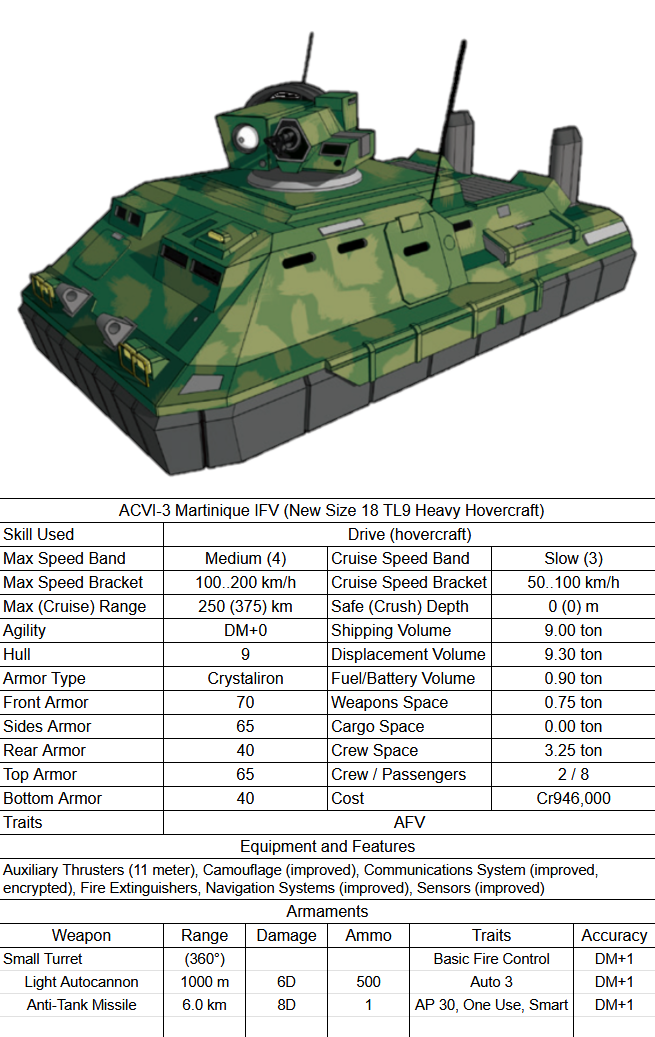
The Air Cushion Vehicle Infantry-3 (ACVI-3), commonly known as the Martinique, is a widely used air-cushioned infantry fighting vehicle, encountered on many frontier worlds, either in the hands of colony militaries or mercenary forces. Its proven design has been widely copied, and numerous derivatives and near-identical models serve across a variety of forces. The Martinique allows a squad of infantry to be amphibiously deployed under armor, nearly anywhere, while supporting the squad with additional firepower. Like many military air-cushion vehicles, it can perform short hops using vectored thrusters, providing limited jump-jet capability that allows it to negotiate cliffs, ravines, and other obstacles otherwise impassable to hovercraft.
Show spoiler
Cataphract Grav Assault Gun
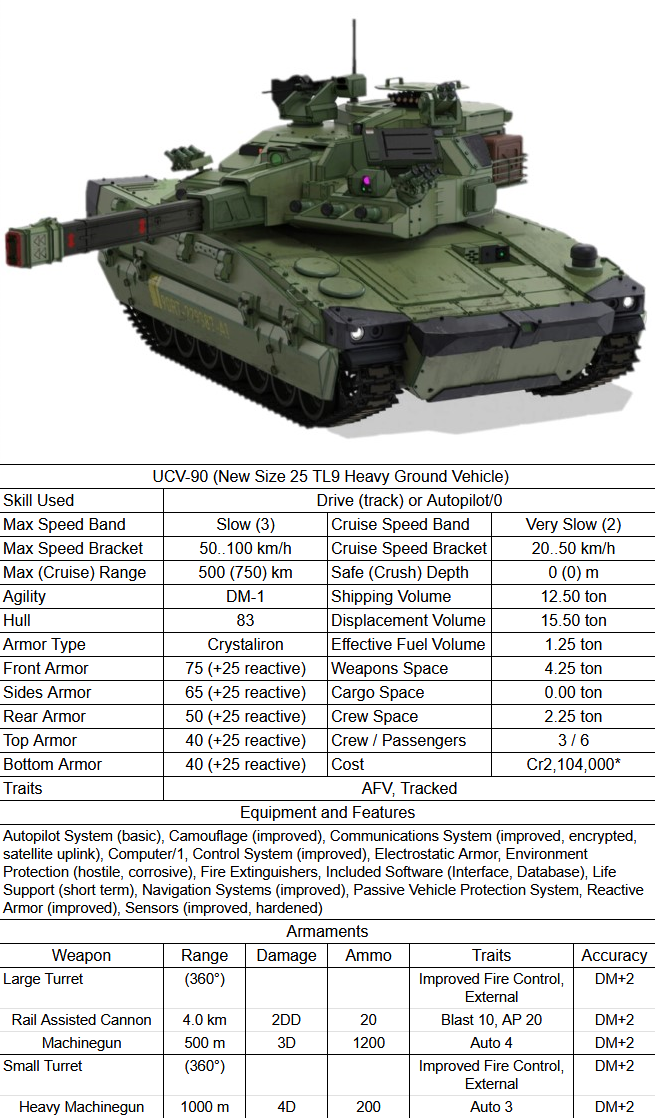
The Universal Combat Vehicle 90 represents the culmination of efforts to merge the roles of main battle tank and infantry fighting vehicle into a single, adaptable platform. Designed to provide both heavy firepower and troop transport capability, it carries a crew of three and a six-person infantry squad in its rear compartment. Its primary weapon, a high-velocity cannon supported by coaxial and remote-mounted secondary armaments, allows the UCV-90 to engage a wide range of targets, from fortified positions to hostile armor. Thick composite armor and advanced countermeasure systems offer substantial protection for both crew and passengers, while its powerful engine ensures impressive mobility despite its weight. The result is a versatile combat vehicle capable of leading assaults, supporting infantry, or serving as a breakthrough platform in combined-arms operations. A grav-propelled variant is produced, but its significantly higher unit cost limits its use, leaving the tracked version a far more common sight. While the rail-assisted gun remains the standard armament, the UCV-90 is also available with a heavy autocannon if the client prefers. Even so, many militaries consider the UCV-90 a worthy investment, able to replace multiple vehicle types with a single, highly capable design.
NOTE:
Electrostatic armour momentarily increase armour (+27 x1/rnd)
Autocannon variant costs 1.267.000 cr
Grav variant has Speed increased by 1 band, Range 1500 (2250). additional cost of 11.5 Mcr, regardless of armament configuration.
Autocannon variant costs 1.267.000 cr
Grav variant has Speed increased by 1 band, Range 1500 (2250). additional cost of 11.5 Mcr, regardless of armament configuration.
Show spoiler
Gunskiff
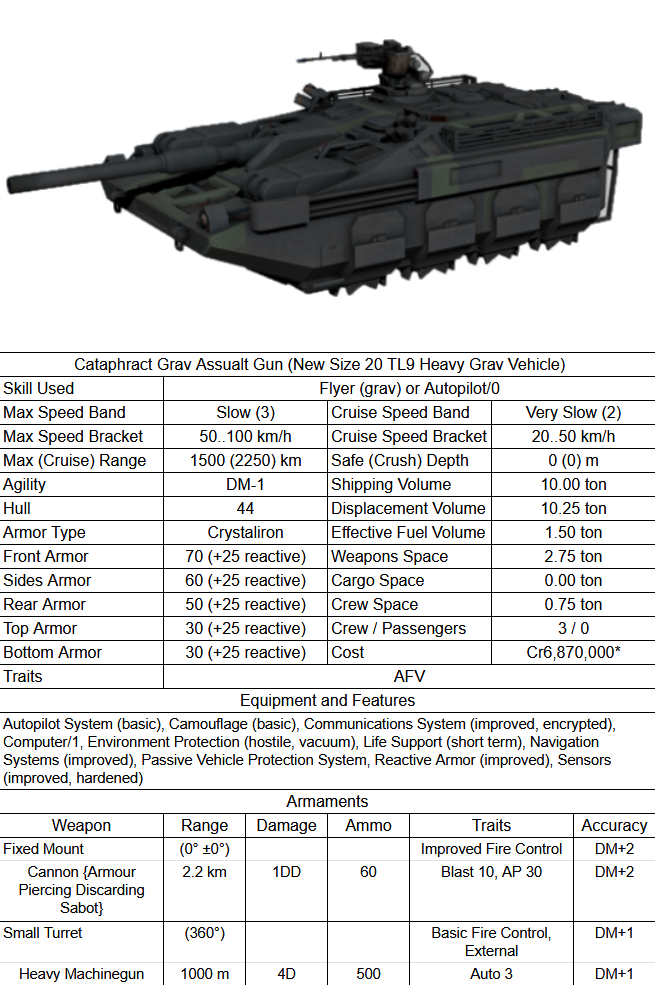
The Cataphract Grav Assault Gun, colloquially known as the Imperial Siege Tank, is a grav tank once fielded by the legions of the galactic imperium for both direct assault and indirect fire missions. the Cataphract mounts a fixed cannon as its main armament, while a remotely operated heavy machine gun on the roof provides local defence. Crewed by three, it relies on an autoloader to maintain a sustained rate of fire during extended engagements. Its grav chassis offers excellent cross-country mobility and stable firing performance, though the fixed gun mount requires the entire hull to pivot and hold position when engaging in indirect fire. Originally a symbol of Imperial might, the Cataphract’s widespread production during the Imperium’s reign ensured its survival long after its fall, and it remains in service today with numerous successor states and mercenary forces across the galaxy.
Show spoiler
Armiger Walker
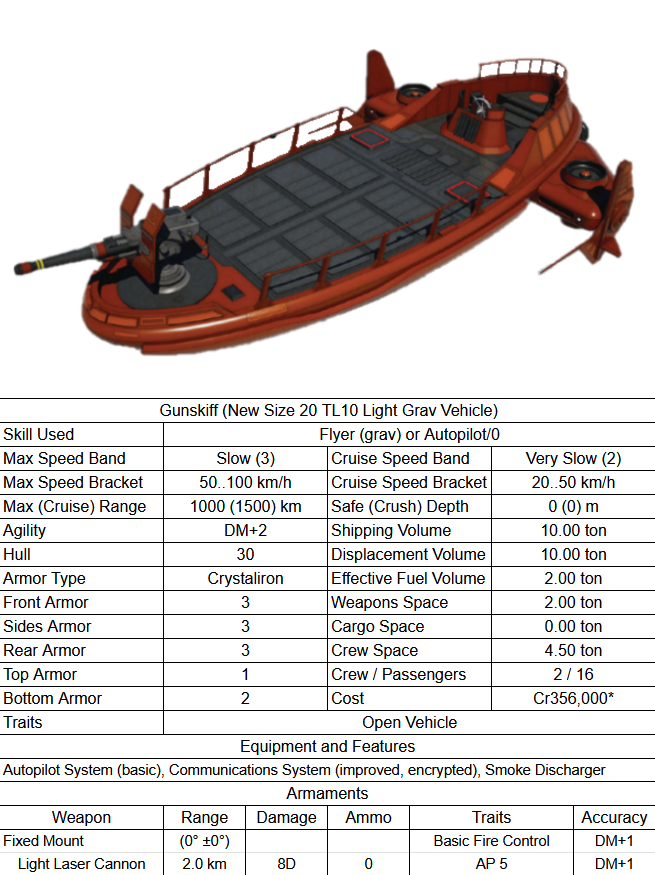
The Gunskiff is a lightweight open-topped grav platform designed to deliver mobile heavy firepower across rough or obstructed terrain. Built on a flatbed chassis with minimal armor, it trades protection for mobility and payload flexibility allowing easy redeployment of support weapons and squads. A single heavy weapon mount provides its primary firepower. When not carrying passengers, it can easily accommodate up to 4 tons of cargo. making it adaptable to a wide range of field tasks. Though vulnerable to concentrated fire, its relative low cost and flexibility make it a common sight among both raiders, and planetary militias alike. The design has seen particular favor among Zygerrian hunting bands and military forces, who employ Gunskiffs for slave raids and troop insertions.
Show spoiler
Bogatyr CM-BW
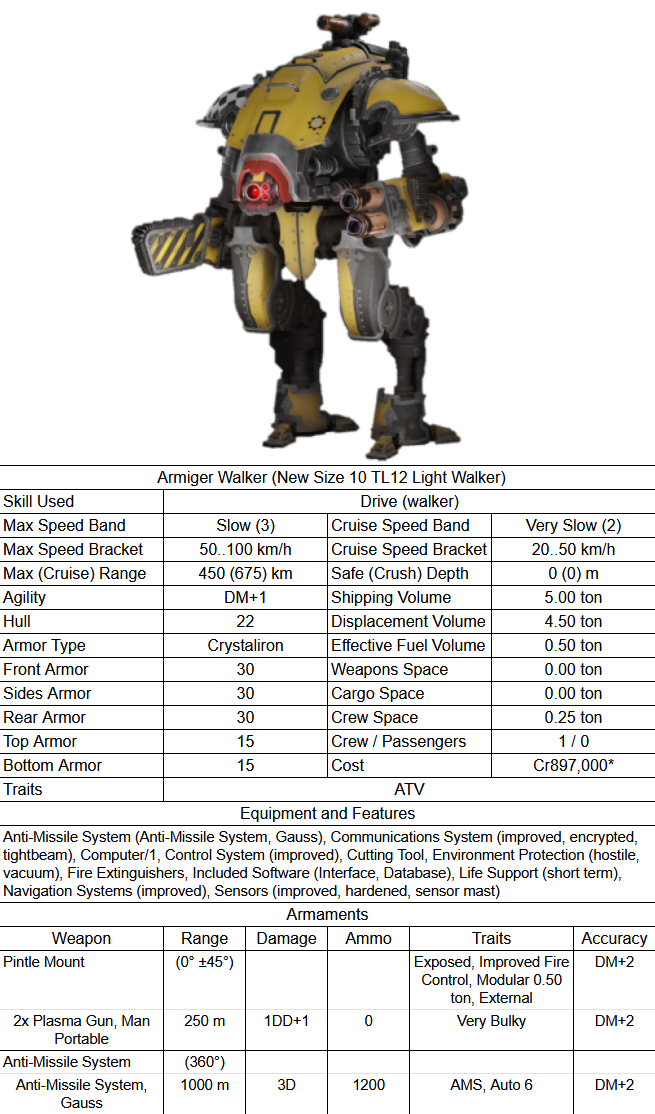
The Armiger Pattern Walker was a light combat walker employed by the Galactic Imperium, serving as both a cavalry platform and close infantry support vehicle. Designed for agility and precision rather than massed firepower, the Armiger mounted a pair of articulated weapon arms, most famously configured with twin PGMPs on one and a powered cutting implement on the other. While intended for clearing foliage and debris, there are many accounts of it being used as a formidable melee weapon in close combat, earning the walker a reputation for brutal efficiency. A top-mounted defensive system, commonly a gauss machine gun, provided protection against missiles and other close-in threats. The pilot sat within a sealed armored cocoon, operating through external cameras and neural interfaces that linked directly to the machine’s systems. Within the Legions, piloting an Armiger was both a martial duty and a mark of status, its operators revered as knights of the Imperium. Limited production and the requirement for cybernetically augmented pilots restricted its availability, and following the collapse of the Imperium, few remain in service, their roles now filled by simpler and more conventional machines.
NOTE:
When using Cutting tool as a weapon, Range: Melee, Damage: 4D, AP 5
When using Cutting tool as a weapon, Range: Melee, Damage: 4D, AP 5
Show spoiler
Hoplite M135A6 ICV
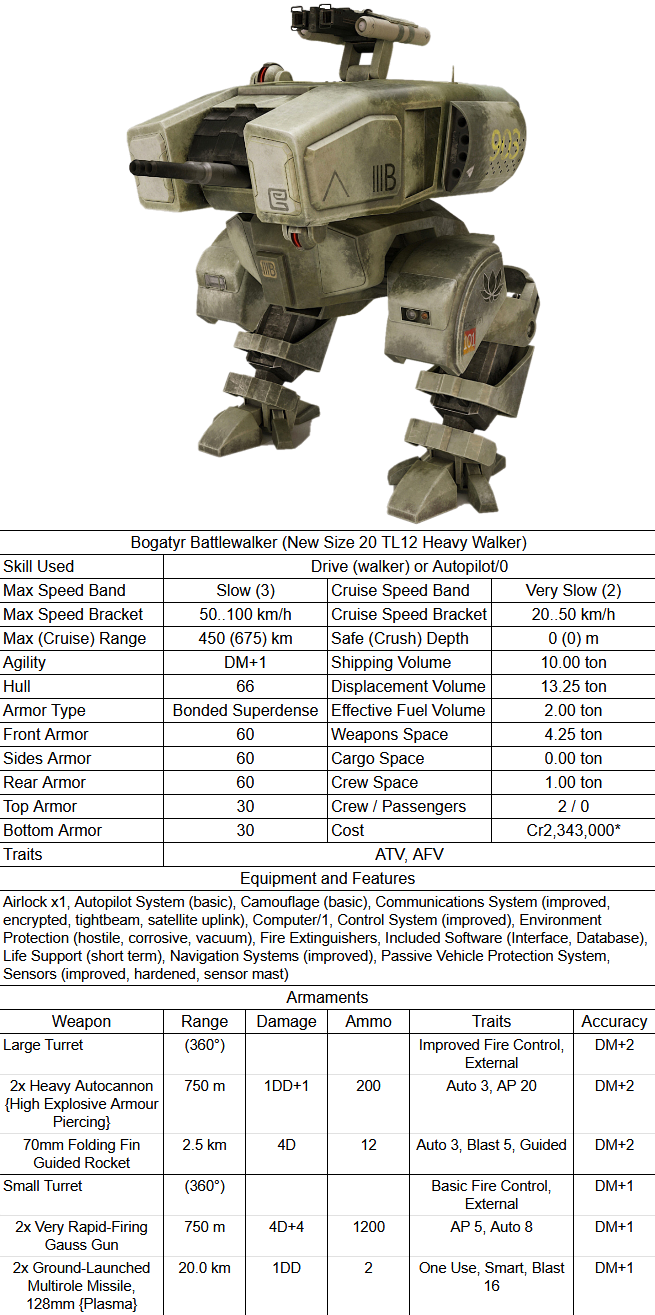
The Combat Machine Battle Walker, commonly known as the Bogatyr Pattern, is a heavy bipedal combat platform designed for sustained frontline engagements and harsh planetary conditions. Twice the size of older walkers, the Bogatyr brings increased armor, firepower, and endurance to the battlefield. Operated by a two-person crew within a sealed, sensor-linked turret, it provides complete environmental isolation and protection from hazards including corrosive atmospheres, radiation, and extreme temperatures. Its primary armament consists of centrally mounted twin autocannons supported by a guided rocket launcher system, while a secondary turret above carries twin VRF gauss guns and multi-role missile pods for close defense and anti-air support. With no direct view of the outside, the crew rely entirely on a network of cameras and sensors to navigate and engage targets. Known for its resilience and heavy firepower, the Bogatyr excels in breaking fortified positions, supporting infantry advances, and dominating contested battlefields where lighter machines would falter.
Show spoiler
TL: 8│ Range: 800m │Damage: 7d6 │ Mass: 45kg │ Mag: 20 │ Avail: 8+ │ Cost: Cr5000 │ Ammo: Cr400 │ Traits: AP 5, Auto 2, Very Bulky
WLO-5 speeder tankTL: 8│ Range: 800m │Damage: 7d6 │ Mass: 45kg │ Mag: 20 │ Avail: 8+ │ Cost: Cr5000 │ Ammo: Cr400 │ Traits: AP 5, Auto 2, Very Bulky
Show spoiler
TL: 8│ Range: 800m │Damage: 7d6 │ Mass: 45kg │ Mag: 20 │ Avail: 8+ │ Cost: Cr5000 │ Ammo: Cr400 │ Traits: AP 5, Auto 2, Very Bulky
“Outlaw” RRAWTL: 8│ Range: 800m │Damage: 7d6 │ Mass: 45kg │ Mag: 20 │ Avail: 8+ │ Cost: Cr5000 │ Ammo: Cr400 │ Traits: AP 5, Auto 2, Very Bulky
Show spoiler
TL: 8│ Range: 800m │Damage: 7d6 │ Mass: 45kg │ Mag: 20 │ Avail: 8+ │ Cost: Cr5000 │ Ammo: Cr400 │ Traits: AP 5, Auto 2, Very Bulky
ACVP-2 “Cayman”
The Rapid Recon Assault Wheeled, popularly known as the Outlaw, is a versatile, high-speed combat vehicle engineered for rapid deployment and reconnaissance. Outfitted with a remote-controlled turret armed with a rotary autocannon, it delivers sustained and effective firepower for light engagements. The Outlaw also features a four-tube missile launcher, capable of loading both anti-tank and anti-air missiles, allowing it to engage a wide range of targets. Equipped with advanced stealth systems and electronic countermeasures, it maneuvers swiftly and covertly in hostile environments, making it ideal for reconnaissance, patrol, and hit-and-run tactics, and a key asset for those who require fast scouting and assault capabilities.
TL: 8│ Range: 800m │Damage: 7d6 │ Mass: 45kg │ Mag: 20 │ Avail: 8+ │ Cost: Cr5000 │ Ammo: Cr400 │ Traits: AP 5, Auto 2, Very Bulky
Show spoiler
TL: 8│ Range: 800m │Damage: 7d6 │ Mass: 45kg │ Mag: 20 │ Avail: 8+ │ Cost: Cr5000 │ Ammo: Cr400 │ Traits: AP 5, Auto 2, Very Bulky
UC91-IFV42 / EXUC91-IFV42
The ACVP-2, commonly known as the Cayman, is an air-cushioned patrol vehicle originally designed for civilian use as a bus or van. In its military configuration, the Cayman serves as a versatile asset, occupying a niche between a traditional patrol boat and an air-cushioned armored personnel carrier (APC). The main cabin offers seating for four passengers, while the broad side decks over the air-cushion system provide space to transport additional soldiers. However, care must be taken when transporting personnel on the side decks, as they are exposed to the rear-mounted pusher fan. The Cayman is equipped with basic armor and weapon mounts, making it suitable for a variety of patrol and support roles in warborne operations.
TL: 8│ Range: 800m │Damage: 7d6 │ Mass: 45kg │ Mag: 20 │ Avail: 8+ │ Cost: Cr5000 │ Ammo: Cr400 │ Traits: AP 5, Auto 2, Very Bulky
Show spoiler
TL: 8│ Range: 800m │Damage: 7d6 │ Mass: 45kg │ Mag: 20 │ Avail: 8+ │ Cost: Cr5000 │ Ammo: Cr400 │ Traits: AP 5, Auto 2, Very Bulky
Barracuda JetTL: 8│ Range: 800m │Damage: 7d6 │ Mass: 45kg │ Mag: 20 │ Avail: 8+ │ Cost: Cr5000 │ Ammo: Cr400 │ Traits: AP 5, Auto 2, Very Bulky
Show spoiler
TL: 8│ Range: 800m │Damage: 7d6 │ Mass: 45kg │ Mag: 20 │ Avail: 8+ │ Cost: Cr5000 │ Ammo: Cr400 │ Traits: AP 5, Auto 2, Very Bulky
AT-59 Cheyenne Gunship
The Barracuda is an amphibious, subsonic jet designed for versatile roles such as sea patrol, search-and-rescue, and light transport. Built with waterborne operations in mind, its wingtips fold down to act as stabilising floats during aquatic landings. The tandem cockpit seats two crew, typically a pilot and a co-pilot or systems officer, though the configuration allows for flexible mission assignments. While not conceived as a combat aircraft, its rugged airframe have shown quite capable of being modified with hard points. A popular adaptation is outfitting the barracuda with Y-pylons on each side of the fuselage, enabling it to carry up to four missiles of various types. A rear launch tube beneath the fuselage, intended to deploy a single airdropped search buoy in civilian maritime monitoring, has been adapted for use with torpedoes, making it equally useful in military applications. For non-combat roles, a hatch behind the wing on the left side of the fuselage provides access to a compact compartment capable of holding two passengers or up to 500 kg of cargo. This proven adaptability has ensured the Barracuda’s continued service across frontier settlements, rescue fleets, and defence forces alike.
TL: 8│ Range: 800m │Damage: 7d6 │ Mass: 45kg │ Mag: 20 │ Avail: 8+ │ Cost: Cr5000 │ Ammo: Cr400 │ Traits: AP 5, Auto 2, Very Bulky
Show spoiler
TL: 8│ Range: 800m │Damage: 7d6 │ Mass: 45kg │ Mag: 20 │ Avail: 8+ │ Cost: Cr5000 │ Ammo: Cr400 │ Traits: AP 5, Auto 2, Very Bulky
Federal Gunship
The AT-59 Cheyenne is a heavily armed tilt-rotor gunship, designed for close air support and precision strike roles in hostile environments. With a two-person crew, it features advanced stealth and camouflage systems, allowing it to operate effectively in high-threat areas. Equipped with a rotary autocannon in a small turret for flexible engagement, it also carries fixed-mounted rocket pods and anti-tank missiles for powerful ground attacks. The Cheyenne's crystaliron armor provides robust protection, while its enhanced sensors and navigation systems enable it to detect and engage targets at extended ranges. Engineered for resilience, it includes environmental protection for hostile and corrosive conditions, ensuring dependable performance in diverse operational theaters.
TL: 8│ Range: 800m │Damage: 7d6 │ Mass: 45kg │ Mag: 20 │ Avail: 8+ │ Cost: Cr5000 │ Ammo: Cr400 │ Traits: AP 5, Auto 2, Very Bulky
Show spoiler
TL: 8│ Range: 800m │Damage: 7d6 │ Mass: 45kg │ Mag: 20 │ Avail: 8+ │ Cost: Cr5000 │ Ammo: Cr400 │ Traits: AP 5, Auto 2, Very Bulky
TL: 8│ Range: 800m │Damage: 7d6 │ Mass: 45kg │ Mag: 20 │ Avail: 8+ │ Cost: Cr5000 │ Ammo: Cr400 │ Traits: AP 5, Auto 2, Very Bulky
