
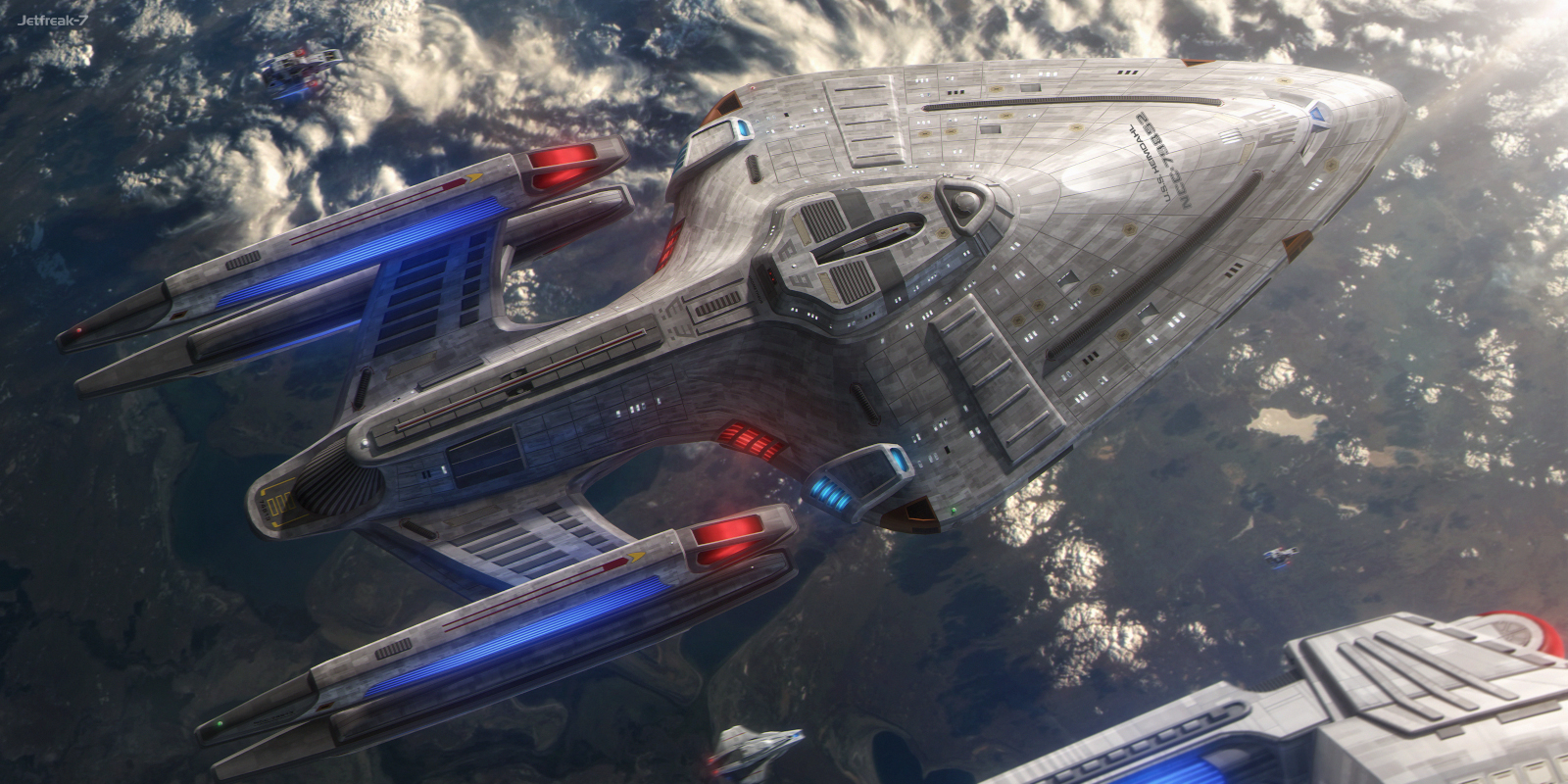
Environmental / Life Support / Maintenance Group
ENVIRONMENTAL / LIFE SUPPORT / MAINTENANCE GROUP
Distributed Subsystems for Ship Sustainability — USS Heimdahl
Title: Environmental / Life Support / Maintenance
Configuration: Present in each module (Dorsal, Middle, Ventral) — location density varies by deck design. Some paired behind shared bulkheads, others split for redundancy.
ENVIRONMENTAL SYSTEMS
Function: Atmosphere regulation, thermal control, gravitic balance, radiation shielding modulation.
Environmental nodes are responsible for maintaining breathable atmosphere and survivable conditions across all compartments, regardless of species-specific tolerances. Heimdahl’s mission profile includes crew of diverse biology (Cardassian, Orion, Trill, Anabej, etc.), so environmental control is highly segmented and reprogrammable.
- Key Features:
- Modular environment cores per module with isolated damage containment
- Deck-specific CO₂ scrubbers and O₂ regulators
- Humidity gradient control (adjustable per habitat corridor)
- Radiological dampers (automated during nebulae or core venting proximity)
- Grav-plating tuned for tri-core acceleration harmonics
- Special Subsystems:
- Anabej Cloak Feedback Dampeners — prevent illusion distortion due to ambient EM fluctuation
- Fenrir Respiratory Stabilizer Grid — tailored filtration in corridors he frequents
Redundancy Model: Each module has 1 primary and 2 secondary environmental hubs. If one fails, the other two isolate and compensate.
LIFE SUPPORT SYSTEMS
Function: Core biological support: air pressure, water recycling, food replication feedstocks, internal temperature stabilization, bio-contaminant detection.
Life Support Systems are distinct from general environmental control. While Environmental Systems regulate the space, Life Support maintains the crew within it.
- Key Features:
- Interlinked hydration loops and waste reclamation tanks
- Replicator matter stream injection banks, tied to each module’s energy budget
- Pathogen sweeps conducted hourly by Heimdahl (not Nyx)
- Emergency hard-seal routines across decks during hull breach or decompression
- Nanite-based internal duct cleaners — passive monitoring for contamination
Shared Access: In some areas (notably Decks 5 and 6), Life Support and Environmental access share bulkhead space, with sensor control racks visible behind maintenance plating.
MAINTENANCE INFRASTRUCTURE
Function: Structural repair support, internal systems routing, and engineer access zones for all mechanical and power conduits.
Maintenance access is the most physically distributed of the three systems—running under decks, between conduits, and across Jefferies tube networks. This includes direct access to power relays, gel pack junctions, and transit elevators for hauling machinery through tight spaces.
- Key Features:
- Color-coded diagnostic cables tied to Nyx's predictive maintenance routines
- Emergency tool lockers every 20 meters
- Micro-replicators for component fabrication (middle module only)
- Multi-layer routing to bypass sabotaged sections
- SWAI has embedded silent diagnostic nodes that feed into non-networked sectors, allowing for covert damage assessments
Crew Access: Technicians and engineers (including NCOs) are trained to traverse these paths under zero-G or suit-required conditions. These crawlways are also used by Fenrir during internal emergencies.
SYSTEM INTERDEPENDENCY
While each of these three functions—Environmental, Life Support, Maintenance—is compartmentalized, their combined impact is structural survival. One sustains conditions. One sustains life. One sustains function. Heimdahl’s stealth mobility, crew resilience, and adaptability depend on the quiet perfection of this triad.
If even one fails, SWAI watches. If two fail, he acts. If all three fail?
That isn’t a ship anymore. That’s wreckage waiting to be tagged.
Comments