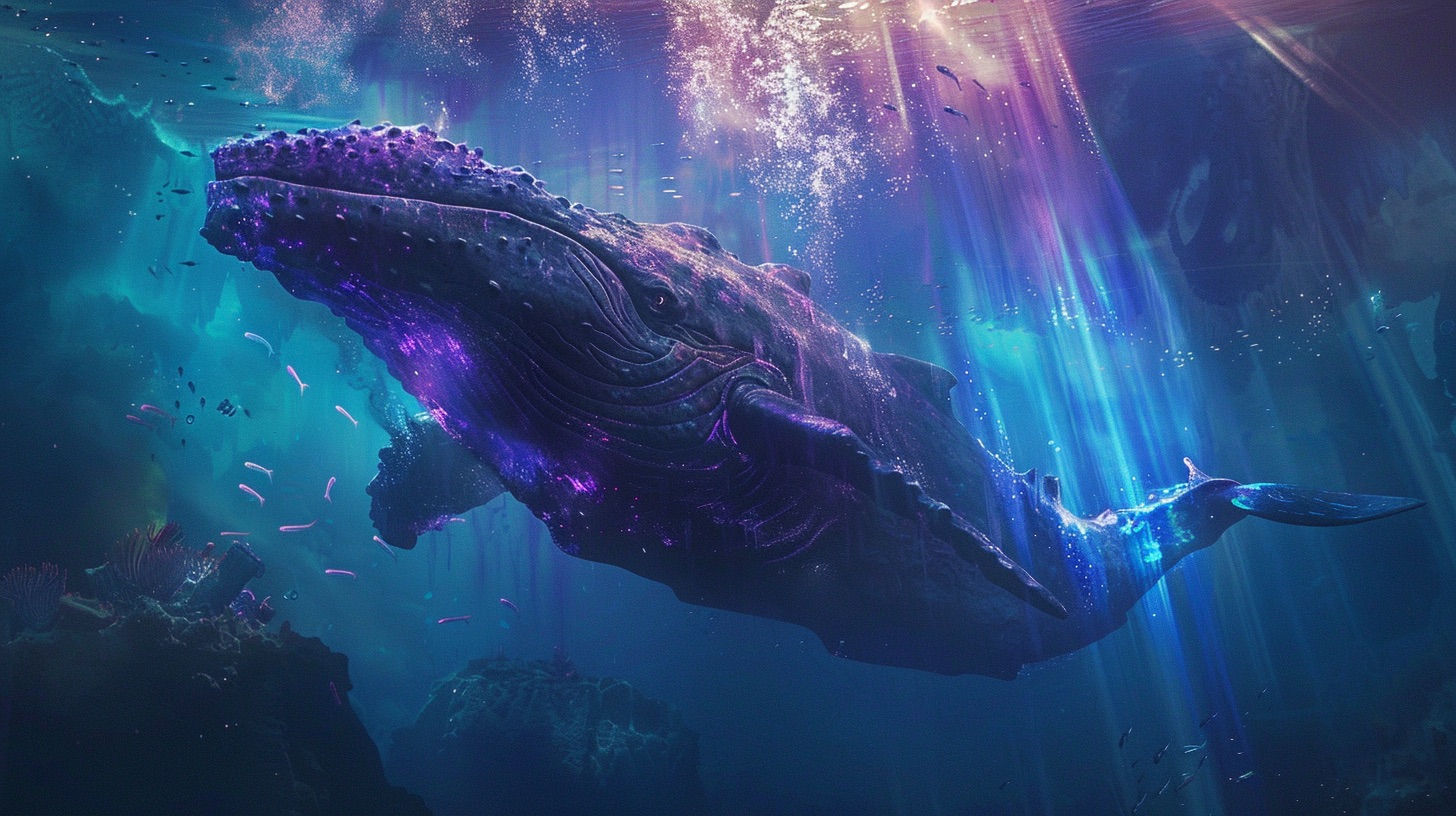
Adriates
The Indigo Whales of the Altian Reaches
In the rolling expanse of the Altian and Ichor oceans, few creatures are as instantly recognisable—or as quietly enchanting—as the Adriates. Their bodies, vast and elegant, move through the water with a serene confidence that belies their impossible size. From a distance they seem sculpted from stormlight itself: deep purple along the spine, sinking into ocean-blue flanks, and finally softening into a pale, amethyst underside that glimmers when they breach the surface. Yet nothing defines them quite like the translucent indigo sacs running the length of their bellies, each one glowing with gentle bioluminescent warmth. These sacs shimmer in long pulses or ripple in delicate waves, painting the darkness beneath a ship in drifting violet constellations.
This glow is not merely a quirk of nature but central to the Adriates’ identity. At rest their bodies cradle a soft luminescence, as though illuminated from within by steady embers. In moments of excitement or curiosity, the light sharpens and brightens, drifting along the sacs like quicksilver fire. When threatened, the glow shifts abruptly into an intense flare—brief, startling, and impossible to ignore. Scholars believe the light forms a language alongside the resonant low calls that the Adriates send echoing through the deep. These calls travel astonishing distances, slipping beneath the waves for hundreds of kilometres.
Among all their traits, however, their curiosity is what sailors speak of most. Adriates have a notorious habit of approaching vessels at sea simply to observe them. They pace beside the hull, drifting in a parallel rhythm, sometimes shadowing a ship from sunrise to moonrise. Old mariners claim the creatures follow out of mere amusement, drawn in the same way a child might be fascinated by a dancing lantern. Others insist they ride the wake for comfort, or that they enjoy the vibrations formed by the ship’s movement. Many crews swear that particular individuals recognise specific vessels and will return years later, greeting them with the same quiet enthusiasm, even when the ship bears a fresh coat of paint.

These immense beings spend much of their lives migrating, travelling in sweeping arcs across ocean basins. They favour the fertile regions where deep currents meet volcanic upwellings, places where plankton blooms turn the water rich and shimmering. Their filter-feeding plates—tinted with a faint violet hue from their diet—sweep through the water in rhythmic movements as they draw in clouds of plankton and tiny bioluminescent organisms. Despite their size, they are gentle feeders, disturbing nothing larger than a drifting school of fish.
Adriates form loose, shifting groups, gathering and parting without ceremony. They are social in a relaxed, fluid manner, drifting together when the mood suits and parting when instinct calls them onward. Mothers, however, show fierce dedication to their young. A newborn Adriate is a bright little lantern, its bioluminescent sacs far more luminous than those of adults. This brightness is thought to confuse predators, and adults in the pod will surround a calf in a protective halo of synchronized light, their combined glow producing a swirling barrier that flashes unpredictably to disorient any approaching threat. Calves learn the ways of the ocean from their mothers over the course of several years, memorizing the warm calving grounds, the seasonal routes of food-rich waters, and the faint long-range calls of distant kin.
One of the more extraordinary features of the Adriates lies beneath their skin, within their skeletons. Their bones are resonant, porous structures capable of capturing the faintest vibrations from faraway storms or undersea volcanic unrest. Naturalists have long noted that Adriates may alter their behaviour long before a tempest arrives, sometimes intensifying their glow in nervous flickers. This sensitivity made them symbols of foresight among coastal cultures, believed to be harbingers of oncoming weather or shifting fortunes of the sea.
To those who live by the rhythms of the ocean, Adriates are more than animals; they are companions and omens. In ports across the Thierry Free States, sailors whisper that a journey accompanied by a glowing Adriate cannot end in misfortune. Some insist that the creatures brighten their sacs at dawn to greet a ship they favour, while others believe a circling pair at night binds the vessel to a year of safety. Artists in Serendale, inspired by sightings during ship passages, decorate mosaics and murals with their likeness: long, elegant bodies curling through tides of electrum-dusted light.
Yet even in their near-mythic splendour, Adriates face threats. Shifting currents and the relentless hum of naval traffic have begun to alter their traditional routes. Their sensitive nature makes them vulnerable to mechanical disturbances that confuse their long-range communication. In the last decade, researchers and engineers have collaborated to design quieter modes of oceanic propulsion, hoping to preserve the age-old partnership between ships and these radiant travellers of the deep.
Through all these changes, the Adriates remain as they have always been: luminous wanderers, guardians of the open waters, and curious companions to those who ride the waves. Their presence transforms even the darkest night crossing into something almost sacred. For when an Adriate glides beneath a ship, glowing like a drifting constellation, the ocean seems to breathe with a gentler rhythm, and the world—just for a moment—feels immeasurably wider and profoundly alive.
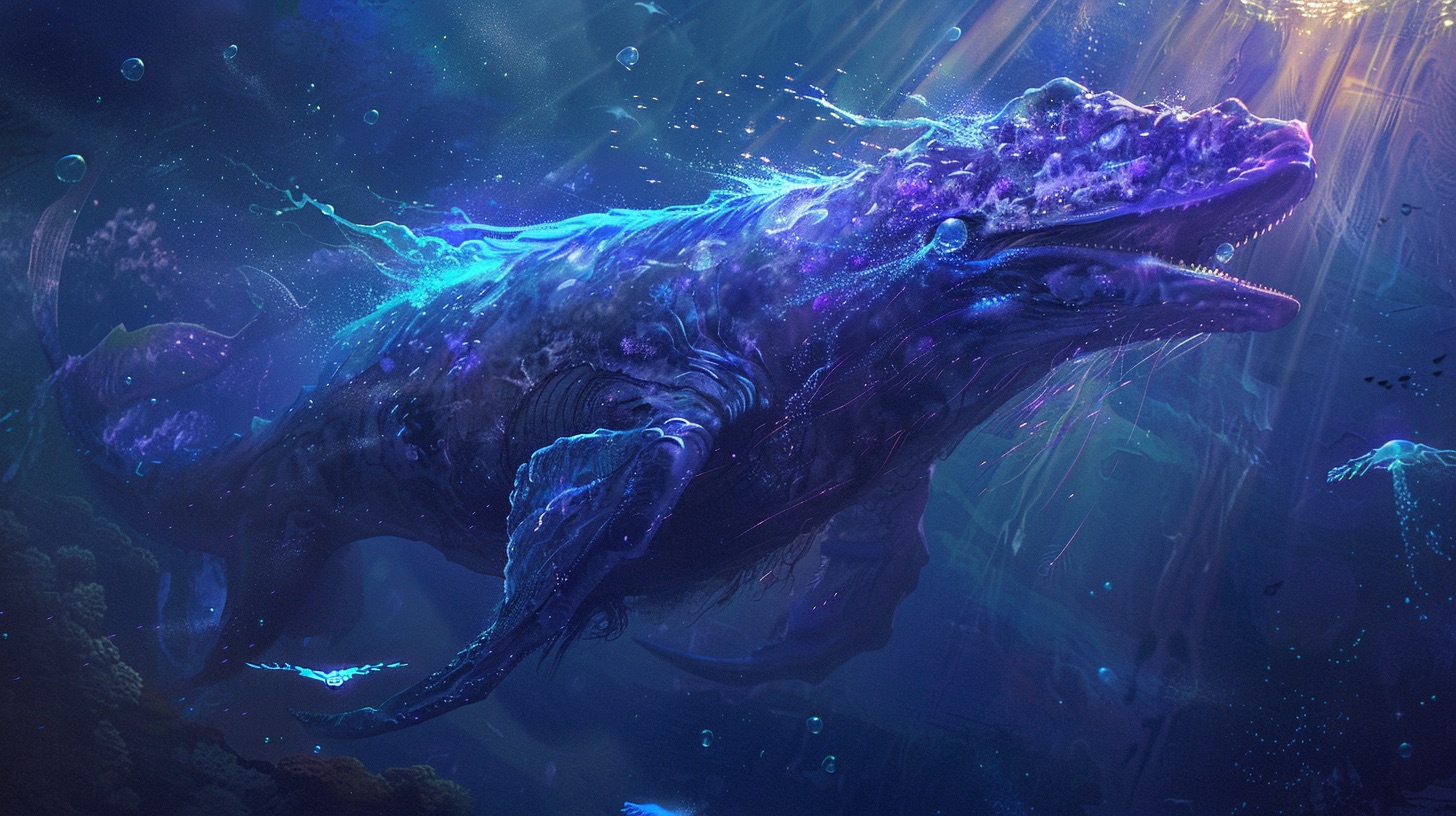
Reverance & Exploitation
For centuries, Adriates have existed in a strange tension between reverence and exploitation. To many coastal cultures, they are sacred presences—gentle giants whose glowing forms glide beside ships like guardian spirits. These communities see the Adriates not merely as part of the natural world but as living omens of fortune and stability. The soft illumination of their bioluminescent sacs is believed to calm storms, guide lost sailors, or warn of approaching danger. In these regions, harming an Adriate is a crime akin to desecrating a shrine. Priests bless departing crews with charms shaped in their likeness, and entire festivals are held in honour of the “Indigo Wanderers” when migration season paints the coastline with drifting violet light beneath the waves.
But admiration has never been universal. In other lands—particularly those struggling with scarcity or driven by industrial demands—the Adriates are seen in a far more utilitarian light. Their immense bodies contain resources that some societies consider invaluable. The bioluminescent gel within their indigo sacs can be refined into long-burning lamps prized by deep-sea divers and night-sentinels. The resonant bones, once dried and treated, are capable of producing instruments of exceptional clarity or components for delicate vibration-sensitive machinery used in navigation and early-warning devices. Even their filtered diets infuse their tissues with trace minerals believed to possess medicinal or alchemical potential. To such cultures, the Adriates are not symbols but untapped wealth gliding serenely through open waters.
As industrial fleets expanded and the hunger for rare materials deepened, hunting Adriates became a lucrative trade. Poachers learned to track the subtle glow of their sacs at night, using fast boats to pursue them into quieter waters. Black markets formed around the sale of their luminescent gel, which some claimed could extend life, sharpen memory, or reveal hidden truths when burned in ritual lamps. Most of these claims were superstition, but the rumours were profitable, and so the killing continued.
This divergence—between those who see Adriates as living wonders and those who see them as valuable harvest—has sparked conflicts both political and physical. Nations with strong maritime traditions and deep-rooted cultural ties to the Adriates have enacted fierce protections, even deploying patrol ships to disrupt poachers. In contrast, industrial states dismiss such concerns as sentimental indulgence, arguing that the resources drawn from the creatures can fuel economic prosperity or scientific advancement. Attempts to negotiate international laws have faltered repeatedly, each side regarding the other with a mix of suspicion and moral certainty.
For the Adriates themselves, the divide is invisible. They continue to wander the oceans as they always have, approaching ships out of innocent fascination, unaware that some greet them with offerings of fruit or songs—while others approach quietly, with hooks, harpoons, and nets. Their glowing forms remain symbols of both hope and danger, depending entirely on who watches them slip beneath the waves.
24–36 m
Purple, Luminescent

Noooo, don't hunt the bioluminescent whales! D: I love them.
Explore Etrea | WorldEmber 2025