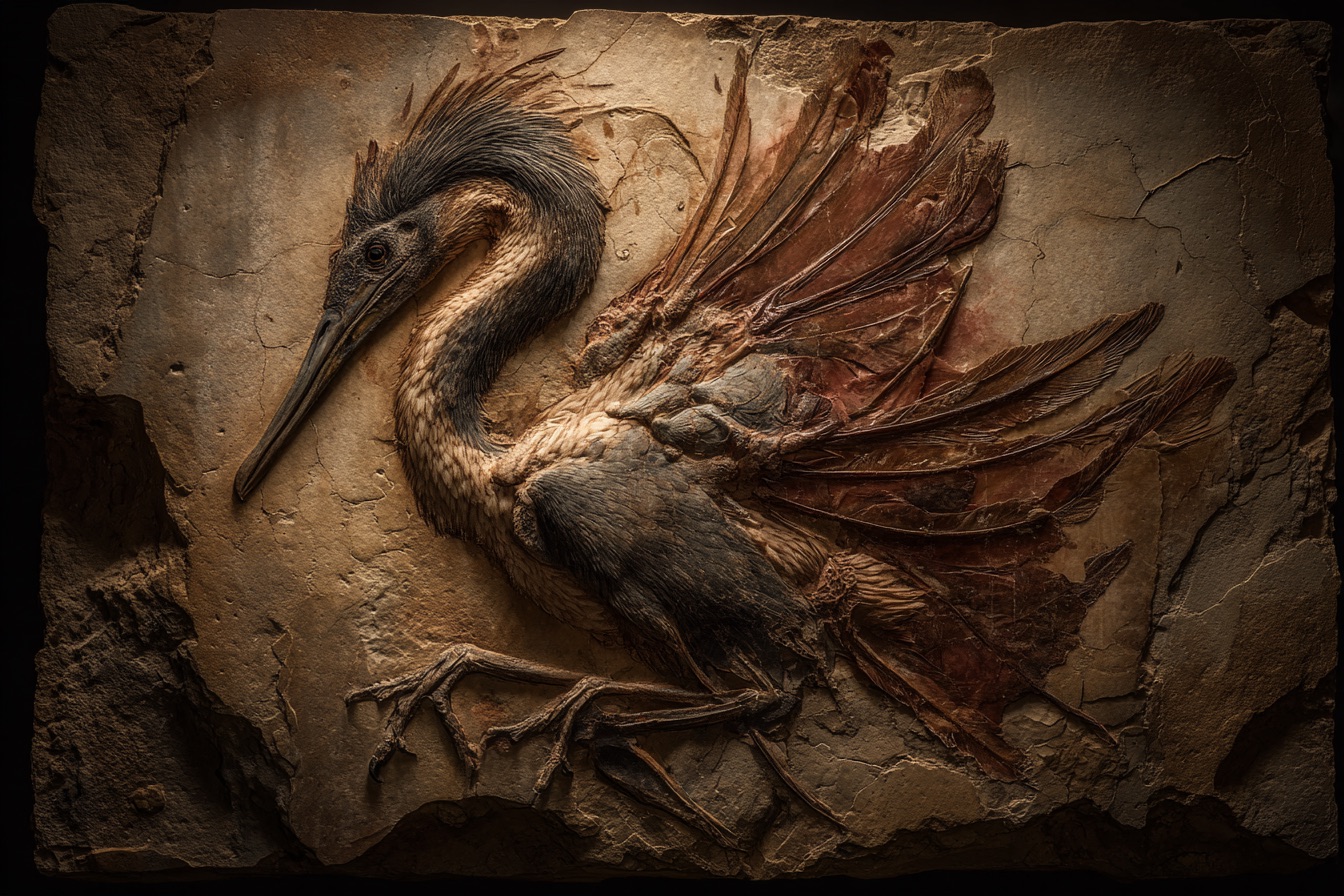
Aselhern
The Aselhern was the largest known sky-borne creature of the Elder Skies—an impossibly vast, long-necked, long-beaked avian whose wingspan was said to rival the breadth of a village. Though extinct for millennia, its silhouette haunts murals, rock carvings, and the myth-cycles of half a dozen ancient cultures. In life, the Aselhern dominated the winds as effortlessly as a drifting cloud, yet struck with the swiftness of a falling spear.
Scholars of natural history compare it to the legendary Atarani birds of the sunward deserts—creatures of immense wingspan supported by hollow yet unbelievably strong bone structures. Yet the Aselhern was no mere scavenger of the skies. Legends, fossil records, and magical residue all suggest a creature of surprising intelligence and a near-mythic presence that shaped early civilizations.

Appearance
The Aselhern stood nearly seven meters tall at rest, supported by elongated forelimbs that doubled as wings. Its beak was narrow and spear-like, used to pluck prey from the waves or skewer creatures of the plains. Unlike lesser sky-colossi, it bore a crest of iridescent feathers, shimmering teal and violet, which caught the sun in dazzling displays during flight. Ancient scribes described the Aselhern gliding “like a living river of light across the firmament.”
Its wings, when unfurled, stretched far beyond the length of any known bird, with slender bones and membranes reinforced by strands of preternatural cartilage. Many ancient tribes believed these strands were spun from starlight—an idea now thought metaphorical, though some specimens recovered from deep fossil beds do contain trace arcane signatures.
Behavior and Ecology
Despite its terrifying size, the Aselhern was not a predator of settlements. It fed primarily on giant fish, sky-shoals of migratory insects, and the young of rock-dwelling megafauna. The creature was known for its slow, spiraling ascents on thermal winds, followed by hunting dives so swift and precise that observers often mistook the strike for a falling star.
Aselhern mated only rarely—perhaps once every few decades—and nested in the highest basalt spires or floating isles of the world. Their low reproductive rate, combined with sweeping environmental shifts at the end of the First Age, likely contributed to their extinction.
Some cultures claim the birds migrated to a higher plane of existence, taking their eggs with them. Others believe they died defending the world from a primordial cosmic storm.
Remnants and Relics
Aselhern remains are incredibly rare. Their bones were light and fragile, often destroyed by time, but in certain deep shale beds, paleontologists have uncovered:
- Crest fragments with fossilized pigment that still shimmer faintly
- Beak pieces sharp enough to cut stone
- Wing membrane impressions, showing a tracery of veins that should not, by natural law, have supported such size



Awesome birdies!! I choose to believe they migrated to some other plane, I don't want to think them extinct!!