Galvanic Engineering
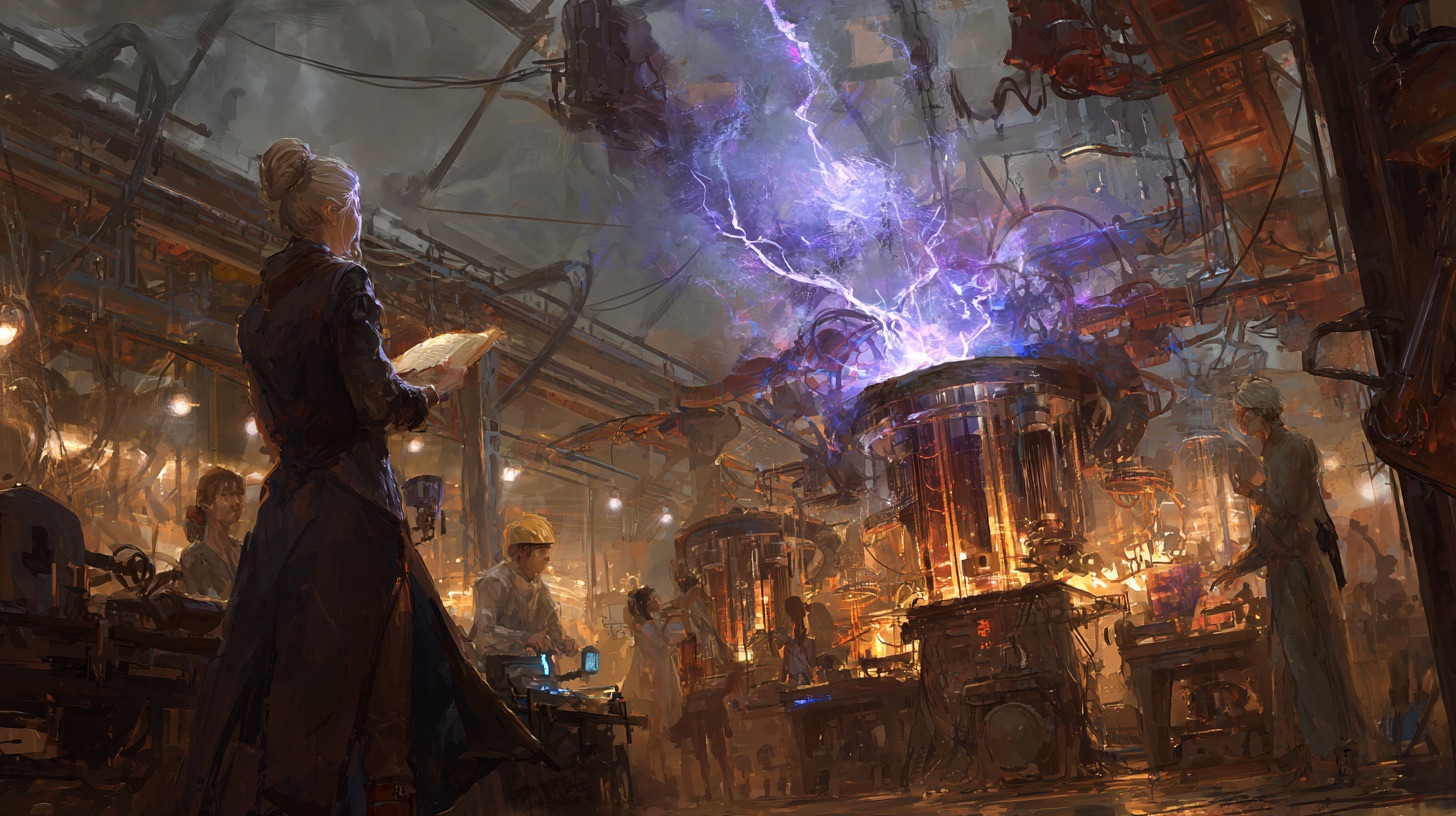
Galvanic Engineering and Physics is the scientific and technical discipline devoted to the study, measurement, and application of galvanic power: an invisible, transferable force that arises from differences in material state and can be guided through prepared pathways to perform work. It forms the backbone of modern industry, infrastructure, and mechanized systems.
Definition
Galvanic Engineering and Physics encompasses both the theoretical understanding of galvanic phenomena and the practical construction of systems that generate, transmit, regulate, and apply galvanic power. The field treats galvanic power as a natural force governed by consistent laws, capable of being quantified, stored, and transformed into motion, illumination, heat, or signal.
Theoretical Foundations
Galvanic Physics concerns itself with the behavior of galvanic flow: how it arises from potential imbalance, how it propagates through conductive media, and how it is impeded, accumulated, or redirected by different materials and structures. Fundamental concepts include galvanic potential, flow intensity, resistance, accumulation capacity, and induction effects between adjacent conduits.
These principles allow predictions about system behavior under load, failure conditions, and environmental stress, forming the basis for safe and reliable design.
Engineering Practice
Galvanic Engineering applies theoretical principles to real-world systems. Engineers design galvanic networks, conversion devices, control assemblies, and protective mechanisms to ensure consistent output and prevent destructive surges. Emphasis is placed on standardization, modularity, and redundancy, allowing systems to scale from handheld instruments to city-spanning grids.
Engineering solutions often combine galvanic components with mechanical structures, using galvanic flow for control, actuation, or sustained power delivery.
Generation and Transmission
Galvanic power is produced through controlled interactions of materials prepared to maintain a difference in state. These generators are designed to sustain output over time and to isolate reactive processes from users and surrounding structures. Transmission relies on conductive pathways shaped and insulated to minimize loss and interference, enabling power to be moved efficiently across distance.
Materials and Infrastructure
The discipline relies on conductive metals, treated alloys, insulators, and containment materials selected for durability and predictability. Advances in refinement and fabrication have allowed increasingly compact systems with higher output and greater stability. Urban infrastructure—lighting, transport controls, communication arrays, and industrial machinery—depends on extensive galvanic installations maintained by trained specialists.
Relationship to Other Disciplines
Galvanic studies intersect with mechanical engineering, materials science, architecture, and applied mathematics as well as a variety of Alchemical processers. While distinct in focus, galvanic systems frequently serve as the organizing framework for complex machines, providing precise control where purely mechanical solutions are insufficient.
Contemporary Significance
In modern Nyrian societies, Galvanic Engineering and Physics is regarded as a foundational discipline. Its principles enable reliable power distribution, automation, and communication, shaping daily life at every scale. Though its terminology reflects long-established tradition, the field continues to evolve, refining its understanding of galvanic behavior and expanding its applications across industry, science, and civic development.

Comments