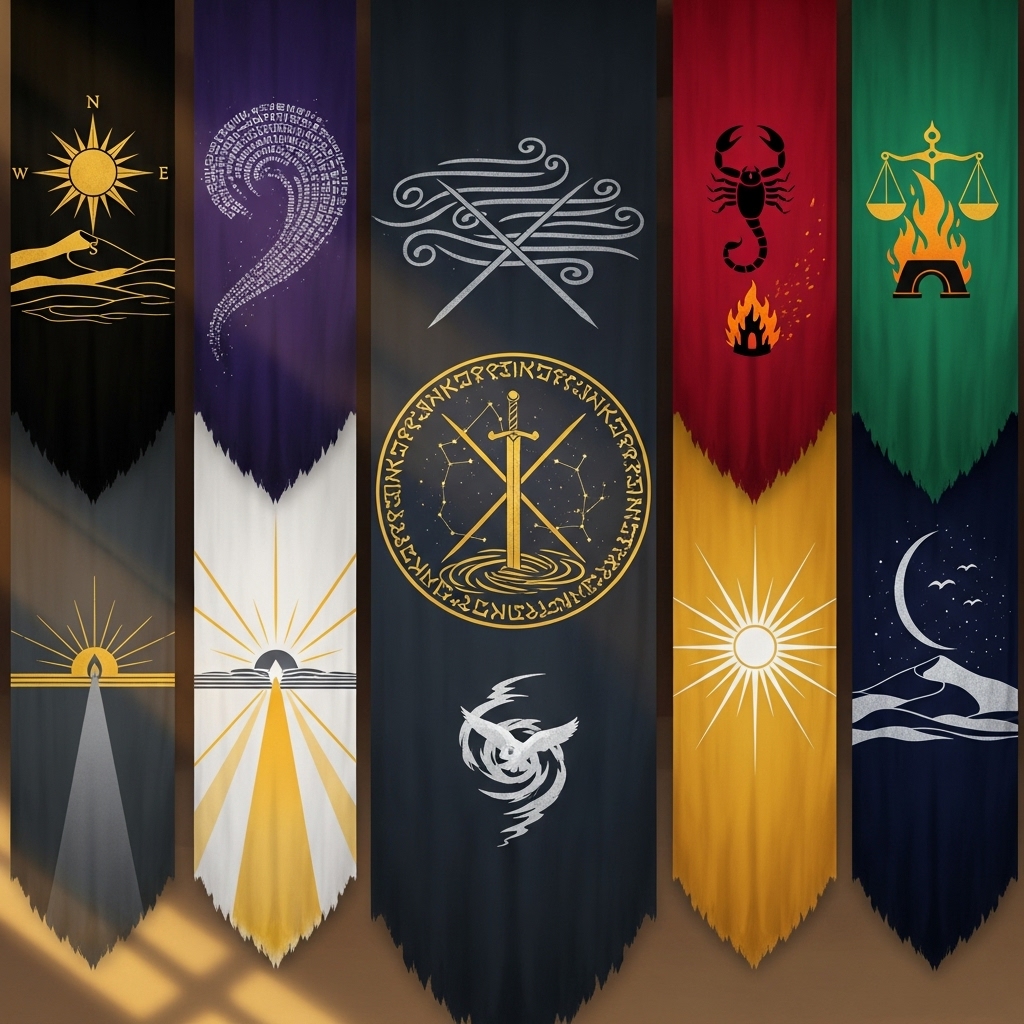
Driftborn
An exiled, ship-borne society that crosses the Shifting Sands on large, magically propelled sandships. Their mobile capital, Drift’s End, is a roving city of five great ships where policy, markets, and memory are centralized. Civic life, governance, worship, schooling, industry, happens aboard hulls or directly upon open sand. By edict at the end of the Great Rebellion, any Driftborn who sets foot on solid land dies; the sentence was meant as extermination, and the taboo remains absolute.
Government
Structure
Drift’s End is governed by a Quorum of Five, one captain for each of its great ships. The quorum meets aboard Qalb al-Raml (“Heart of the Sand,” called the Great Sandship by outsiders), while independent fleets beyond the capital operate under their own captains and courts but reconvene at scheduled moots to set routes, market posture, and defense. The Memory-ship’s lorekeepers maintain records and precedent; religious counsel is advisory, not directive.Current Quorum (Drift’s End):
- Qalb al-Raml (“Heart of the Sand”) - Great capital hull; Captain Malik al-Seyyah
- Zikrā (“Remembrance”) - Memory-keeper; Captain Qadir ibn Maazin
- Samūm (“Poison Wind”) - War hull; Captain Khalid ibn Ḥamal
- Sūq al-Rīḥ (“Market of the Wind”) - Trade/Festival hull; Captain Samira bint Farid
- Safar (“Journey”) - Diplomatic hull; Captain Rashad al-Nimr
Decision-Making
Policy on water shares, route secrecy, salvage protocols, and market openings is debated in open councils aboard Qalb al-Raml and then ratified by captains. Emergency authority (piracy, storm displacement) is temporary and reviewed at the next moot. Markets and any parley with foreign caravans occur only at approved anchor points and under posted conduct rulesLeadership
Captains rise by lineage, merit, or trial (varies by fleet). The Great Sandship’s captain moderates the quorum but wears no crown. Lorekeepers from the Memory Ship safeguard records and precedent; wayfinders advise on celestial and dune currents; shapers interpret omens in sand and wind. Priests of the Old Gods counsel but do not command.Demography and Population
Interlinked clans berth under banner-marked canopies across nine major fleets (five at Drift’s End, four abroad) with numerous escorts and skiffs. Crews mix sailors, shapers, hunters, smiths, healers, and quartermasters. Outsiders may be admitted under oath; education is shipboard (letters, craft, wayfinding), with lorekeepers rotating to preserve the long memory.Territory
Geography & Environment
Operating area: the Shifting Sands, storm belts, glass flats, salt pans, and ruin-fields. Drift’s End is mobile (“where the banners are”), tracking wind seasons and ley cycles under the twin suns Ayin and Yesh, whose unstable influence drives route timing and provisioning. Routes braid between hidden oases and desert beacons; fixed coordinates are avoided.Routes & Waystations
Standard circuits include hardened glassway segments for heavy cargo and seasonal corridors that minimize storm exposure. Rendezvous points (oasis moots, cistern ridges) are temporary, security-screened, and rotated to avoid predictable ambush lines. The as-Sūq al-Mutahawwilu (“Shifting Bazaar”) is deployed only when weather and security conditions are favorable.Military
Doctrine emphasizes layered mobility and terrain control. War-fitted hulls mount ballistae and scorpions; boarding cadres and bladebearers drill for ambush, screening, and fast extraction. Typical sequence: raise a dust-veil, shape dunes to stall enemy runners, strike, and disengage along pre-charted lines. All ships keep arms; festival days run with posted watches. Sandshaper crews harden, part, or liquefy sand beneath hulls to maintain speed and maneuver, practical “engines” used for propulsion and field-works (temporary berms, blinds, windbreaks).Trade
Major Trade Goods
- Desert glass & glasssteel: vessels, lenses, and tempered blades
- Spice resins & herbal draughts: heat-stable tonics, dyes, incense
- Ceramics & woven silks: kiln-fired wares, wind-loomed textiles
- Ruin-salvage: brasswork, star-metal scrap, arcane oddments (ethically sourced)
- News & routes: maps, storm forecasts, convoy escorts
Trade Network and Logistics
Commerce is modular and risk-managed. The as-Sūq al-Mutahawwilu, collapsible awnings and cold larders, opens on a cleared deck ring under guard; caravans meet on the sand by appointment. Coin circulates, but water, timber, metal stock, cloth, and medicines price at a premium. Escort contracts, salvage shares, and route notices are standard instruments.Hubs
- Market Ring of Qalb al-Raml: neutral ground for caravans and emissaries
- Oasis moots (e.g., Three-Cisterns): timed to storm lulls for safe exchange
- Ruin-fair landings: controlled salvage meets with vetted buyers
Regulation & Practice
Quartermasters coordinate floor prices to prevent undercutting; water-share ratios activate in scarcity. Provenance audits on artifacts aim to limit cursed stock. Doctrine favors fair dealing without tribute ties; markets close when security or weather degrade. Public Old Gods rites are muted when trading where suppression is common.Law & Justice
- Exile Edict: touching land is a mortal taboo with immediate consequence; violations trigger isolation and last rites.
- ‘Ahd ar-Raml (Sand Oath): hospitality under an awning guarantees water and ward; penalties for breach scale from restitution to exile.
- Salvage Code: ruin-dives require manifests, witness marks, and post-market audits; sales to slavers or Magisterium clients void parley.
- Market Rules: weapons peace-bonded on bazaar decks ; disputes go to quartermaster arbitration; barred offenders are reviewed at the next moot.
Public Agenda
Guard the People Keep ships seaworthy-on-sand, protect routes and wells, break slavers and raiders, and ensure Drift’s End never stalls. Keep the Memory Preserve oral lineages, memory stones, and prophecy tablets; teach letters and craft aboard every ship; sing the long history nightly. Trade Without Chains Barter fair, refuse tyrant tribute, and prefer alliances to entanglements. Escort the weak; do not nourish the cruel. Walk With the Old Gods Honor Vaelum (wind), Auralia (balance), Pyrathos (fire), Lunara (dreams), Teranos (earth), Aquila (healing), Sylvaris (growth), Umbrae (shadows), Solara (light), and Chronis (time) with quiet rites and open-handed deeds.