

Guldopelgu
Guldopelgu
Type: Cultural Anchor City / Storm-Basin Settlement
Region: Brollstryde (Southern Semi-Arid Peninsula, Korinbrol)
Primary Culture: Drellen (Algulup – Dryland Drellen)
Population: ~8,000–12,000 (highly cyclical, seasonally shifting)
Development Tier: IV (Ancient Living City)
Known Exonym: Guldopelgu (“South Haven,” Glunnish / Tradetongue)
Overview
Guldopelgu is the largest and oldest Algulup Drellen settlement in southern Korinbrol—not because it was designed to endure, but because it has learned how to remain.
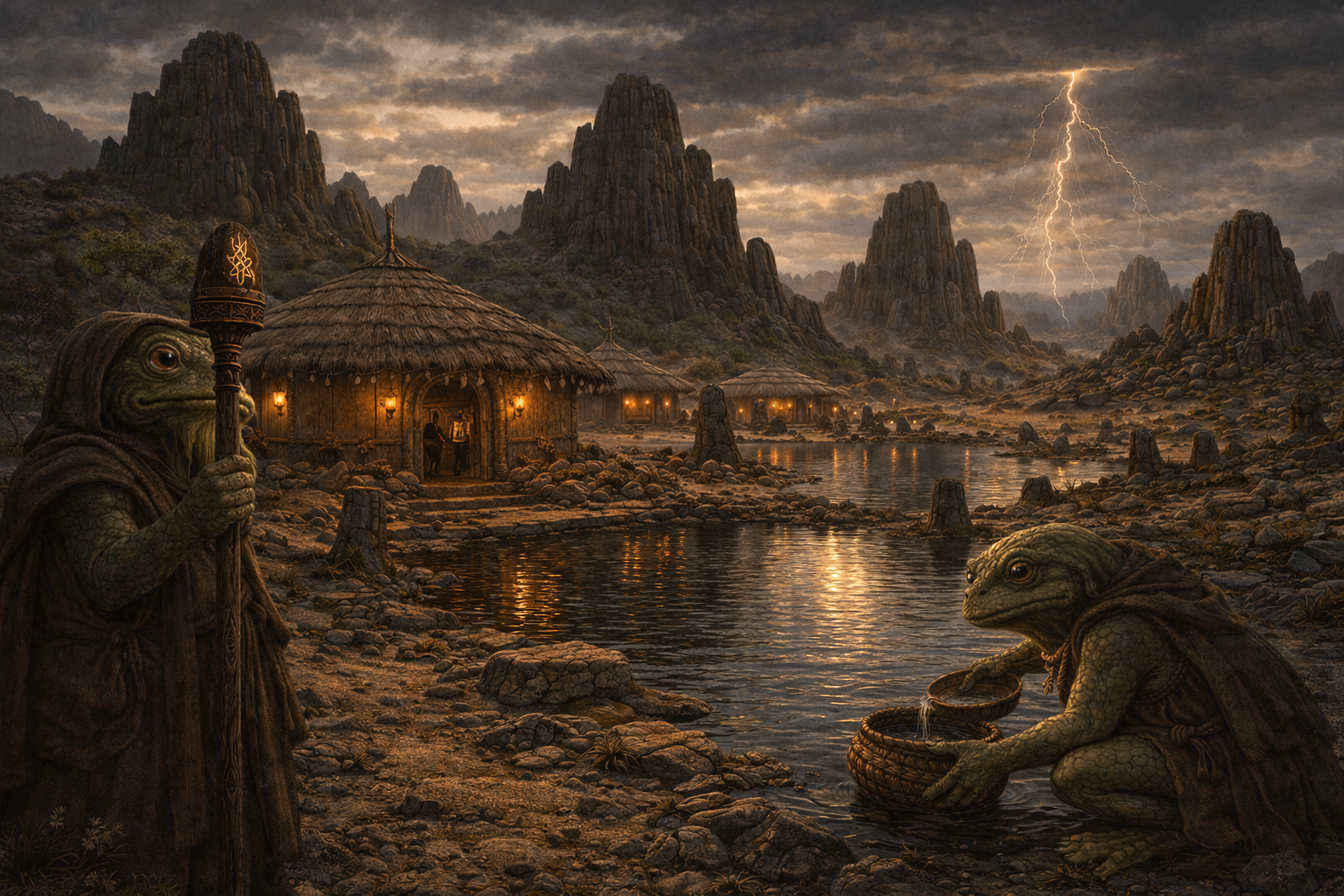
To outsiders, Guldopelgu appears fragile: low, round dwellings of thatch and woven reed clustered among basalt spines and salt-swept basins. There are no walls, no towers, no monumental streets. And yet, the city has persisted for nearly seven thousand years, renewing itself through ritual, storm, and memory rather than stone.
Guldopelgu is not a capital in the political sense.
It is a place of return.
Name & Meaning
The name Guldopelgu is a Glunnish rendering, meaning “South Haven.” It is the name most often used by Vrobosh traders, cartographers, and scholars.
Among the Algulup Drellen themselves, the city is rarely named so directly.
In ritual and memory-song, it is known by a water-name translating loosely as “Where the Storm Is Received.” In daily speech, it is more commonly referred to as “the basin,” “the low place,” or simply “here.”
To the Algulup, naming a place too rigidly is seen as an attempt to bind it. Guldopelgu is listened to, not possessed.
Founding & Age
Guldopelgu was established shortly after the Algulup Drellen were lifted into sapience by Potoka and Vaelren, elevated from desert toads who survived by waiting, burrowing, and emerging only when the land allowed.
Early settlements formed around a shallow storm basin at the southern taper of Brollstryde, where lightning repeatedly struck a cluster of basalt spines and rainwater briefly gathered before sinking back into the earth.
Rather than forcing permanence, the Algulup learned the land’s rhythms:
- When to gather
- When to disperse
- When to rebuild
- When to let structures return to soil
Since its founding, Guldopelgu has been rebuilt countless times, not from destruction alone, but by choice.
Geography & Environment
Guldopelgu lies among the basalt spines of southern Brollstryde, where salt-laden winds from the Downwither Sea meet the heat-baked interior.
Key environmental features include:
- Seasonal storm basins, dry most of the year
- Subsurface cistern pools fed by brief rainfall and condensation
- Basalt outcroppings that act as lightning anchors and windbreaks
- Salt-cracked soil marked by old seabeds and spirit crossings
Rain is rare. Lightning is not.
Storms often arrive silently, crawling across the sky before breaking against the basalt spines. When rain falls, it does so violently and briefly—enough to wake the land, never enough to tame it.
Architecture & Layout
Guldopelgu has no fixed center.
The city forms a loose spiral around its primary storm basin, expanding and contracting with the seasons. Structures are:
- Round or oval
- Low to the ground
- Built from woven reed, salt-grass thatch, treated wood, and hide
- Anchored lightly with stone or weighted frames
Basalt is used sparingly:
- As grounding pillars
- Ritual markers
- Storm-binding anchors
Homes are designed to be dismantled, repaired, or replaced without grief. Roofs are expected to be torn away by storms. Walls are woven to breathe.
Open-air spaces dominate the settlement. Life is lived between structures, not inside them.
Population & Culture
Demographics
- Entirely Algulup Drellen
- Population fluctuates dramatically with season and ritual cycles
- Influx during major storms and rites
- Outflow during drought periods
Families are fluid. Lineages are remembered through stories and water-glyphs rather than permanent dwellings.
Cultural Character
The Algulup of Guldopelgu are mystics, shamans, and land-tenders.
They practice water magic not to summon abundance, but to:
- Guide runoff
- Ease salt-scorched earth
- Calm flood surges
- Coax condensation
- Remember where water will return
Lightning is treated as a form of communication, not destruction. Storms are listened to. The land is tended, not conquered.
Change is expected. Metamorphosis is sacred.
Governance
Guldopelgu has no rulers.
Authority rests with:
- Water-speakers
- Storm-shamans
- Land-tenders
- Elders who remember previous cycles
Decisions are made communally, often near the storm basin or grounding spines. Those who remember how the land behaved before carry the most weight.
Economy & Sustenance
Guldopelgu produces little surplus.
Sustenance comes from:
- Drought-hardy crops
- Seasonal foraging
- Managed water basins
- Trade with nearby Drellen settlements
Trade is welcomed but not pursued aggressively. The city does not seek growth—it seeks balance.
Relations
- Ujualbo & Dursayadbi: Satellite villages tied by seasonal movement and ritual duty
- Agadoru & Bilupado: Distant Algulup peers with divergent customs
- Vrobosh Settlements: Trade partners, often perplexed by Algulup impermanence
Guldopelgu is respected, but rarely understood.
Narrative Role
Guldopelgu exists to show:
- A civilization that endures without fortifying
- A city older than empires that never sought to rule
- What it means to live with a hostile land rather than against it
It is not a relic.
It is a listening place, where the land still speaks—and someone is always there to hear it.

Comments