

Dursayadbi
Dursayadbi
Type: Coastal Satellite Village / Stormward Settlement
Region: Western Brollstryde (Downwither Coast)
Affiliation: Guldopelgu (ritual and seasonal)
Primary Culture: Algulup Drellen (Dryland Drellen)
Population: ~500–900 (highly variable, storm-dependent)
Development Tier: III (Established village, weather-tested)
Overview
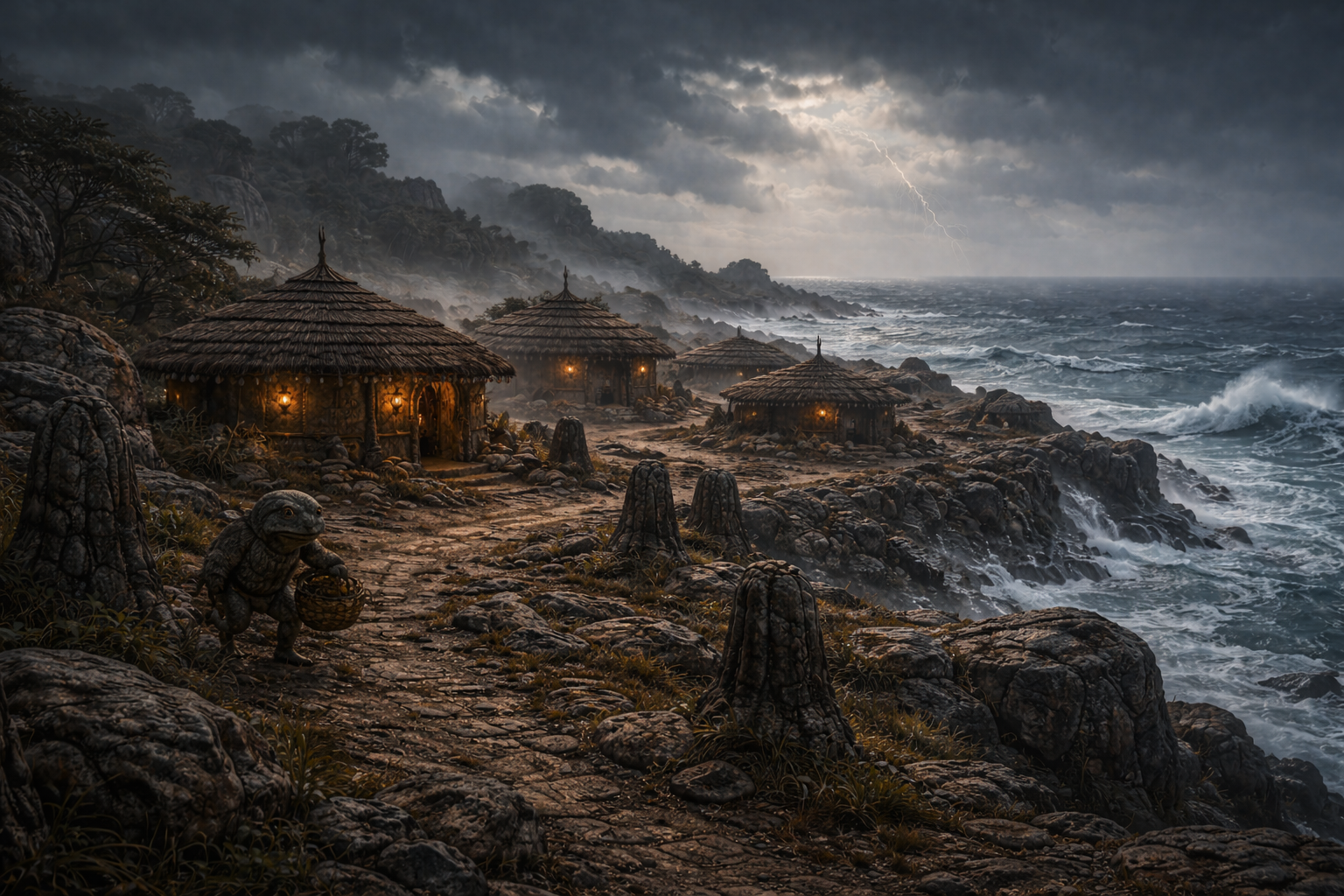
Dursayadbi stands along the western edge of Brollstryde, where salt wind and sea-brine erode both land and certainty. It is a village shaped less by patience than by endurance, less by waiting than by knowing when to yield.
If Guldopelgu listens to the sky and Ujualbo watches the horizon, Dursayadbi leans into the wind.
It is not welcoming.
It is not hostile.
It simply survives.
Founding & Purpose
Dursayadbi predates Ujualbo by several centuries, founded roughly 900–1,200 years ago as a response to increasingly violent coastal storms along the Downwither Sea.
Rather than retreat inland, the Algulup chose to establish a permanent coastal presence—one tasked with:
- Reading sea-weather and storm fronts
- Anchoring ritual protections against salt-flood and surge
- Serving as a seasonal buffer between sea and basin settlements
Unlike Guldopelgu, Dursayadbi was never meant to grow.
It was meant to hold.
Geography & Environment
Dursayadbi occupies a narrow stretch of elevated ground overlooking unseen sea cliffs. The shoreline itself lies below, inaccessible except by known paths cut into stone and sand.
Environmental conditions include:
- Constant salt winds
- Sudden temperature drops
- Salt-fog that dulls sound and sight
- Occasional surge-floods following distant storms
Basalt outcroppings are more densely clustered here than inland, forming natural windbreaks and ritual anchors. Many are etched with weathered glyphs no longer fully legible.
The sea is always present—but rarely addressed directly.
Architecture & Layout
Dursayadbi is more compressed than other Algulup settlements.
Structures are:
- Low, rounded, and tightly grouped
- Reinforced with weighted stone frames
- Roofed with layered thatch bound by salt-cured fiber
- Oriented away from prevailing winds
Open-air spaces exist, but they are sheltered, carved into the lee of stone or earth.
Walkways are worn smooth by generations of wind and grit. Very little is decorative. Everything here serves a purpose.
Culture & Daily Life
Social Character
The people of Dursayadbi are quieter, more reserved, and less ritual-forward than those of Guldopelgu. Speech is sparse. Observation is constant.
Life here emphasizes:
- Early warning over ceremony
- Practical storm magic over symbolic rites
- Communal response to weather events
Children learn to read wind shifts before they learn formal ritual names.
Spiritual Practice
Storm rites in Dursayadbi are blunt and functional.
Practices include:
- Grounding circles reinforced with basalt and lead
- Sea-facing storm tokens cast and reclaimed after surges
- Collective silence during peak winds
Water magic here focuses on deflection and absorption, not blessing or renewal.
Failures are not debated. They are remembered.
Governance
Dursayadbi is guided by a small council of Stormwardens—experienced practitioners chosen not by lineage, but by survival history.
Authority rests with those who have:
- Witnessed multiple surge-cycles
- Lost structures and rebuilt them
- Correctly predicted dangerous weather shifts
Decisions are fast, sometimes abrupt, and rarely ceremonial.
Relations
- Guldopelgu: Ritual anchor and cultural center
- Ujualbo: Viewed as young, watchful, and fragile
- Downwither Sea: Respected, never trusted
- Outsiders: Rare, tolerated only if useful
Dursayadbi is often the first to warn and the last to recover.
Narrative Significance
Dursayadbi represents:
- The Algulup refusal to abandon difficult ground
- The reality of living where water does not ask permission
- A form of spirituality rooted in accepting damage without surrender
It is not a place of beauty.
It is a place of weathered resolve.
Where Guldopelgu listens and Ujualbo learns,
Dursayadbi endures.

Comments