

Bilupado
Bilupado
Type: Water-Break City / Threshold Settlement
Region: Northwestern Brollstryde, at the Gulpo Bagu
Culture: Drellen (Algulup – Dryland Strain)
Affiliation: Brollstryde Network; gateway to Wanefelm
Population: ~2,500–4,000 (seasonally variable)
Development Tier: IV (Established City, Transitional)
Overview
Bilupado stands where Brollstryde ends—and something else begins.
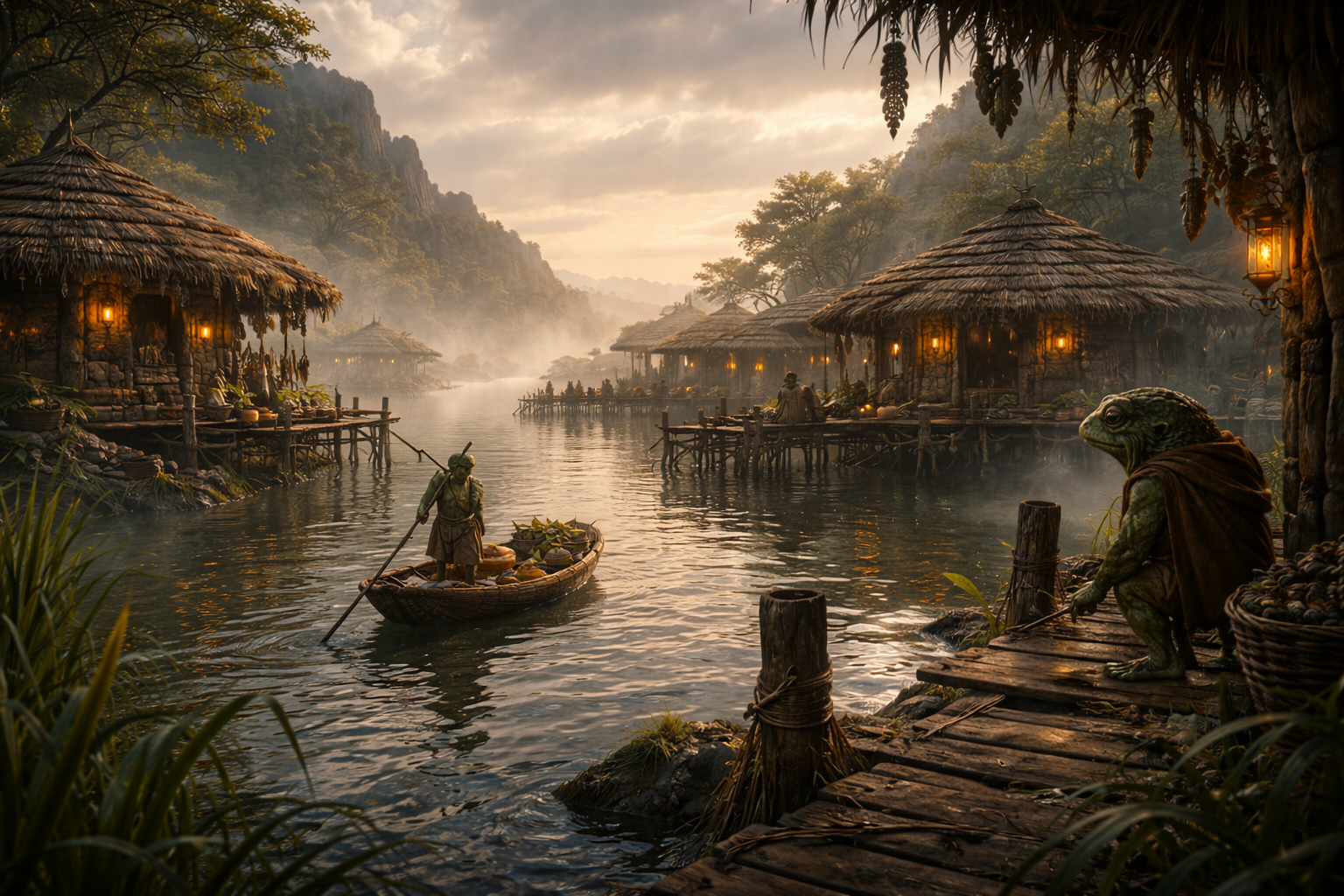
Built at the Gulpo Bagu, a vast water break and lake-system separating the dry southern peninsula from the marshlands of Wanefelm, Bilupado is not merely a city but a threshold. It is the last Algulup Drellen settlement before the land gives way to saturated earth, shifting waters, and the cultures shaped by them.
To pass Bilupado is to leave certainty behind.
To the Drellen, this makes it sacred.
Founding & History
Bilupado was founded approximately 1,000–1,200 years ago, later than Agadoru but earlier than many of the coastal satellites. Its establishment followed a period of dangerous migration attempts into Wanefelm, when Algulup Drellen repeatedly underestimated the instability of the marshlands beyond the Gulpo Bagu.
Rather than press forward blindly, the Drellen chose to stop.
Bilupado was built as a holding place—a city meant to observe the water, read its moods, and teach restraint. Over time, it became the recognized point where Algulup Drellen tradition gives way to dialogue with the marsh-dwelling Drellen further north and west.
Bilupado has never attempted to dominate Wanefelm. It exists so that no one forgets where not to build.
Geography & Environment
The Gulpo Bagu is not a single lake, but a broad, shallow water break—a braided system of slow-moving channels, reed seas, and mirror-flat expanses that shift subtly with storm cycles and lunar pull.
Bilupado is built on:
- Elevated natural ridges
- Hardened sediment shelves
- Carefully reinforced stone islands
Environmental conditions include:
- Frequent mist and low fog
- Sudden water-level changes
- Long, reflective horizons that distort distance
- Increased insect life and amphibian diversity
The city faces the lake, not away from it. To turn one’s back on the Gulpo Bagu is considered deeply disrespectful.
Population & Culture
Demographics
- Algulup Drellen form the core population
- Regular visitors from Wanefelm’s marsh Drellen
- Temporary ritual guests and water-readers from Agadoru
Population fluctuates with seasonal rites and water cycles.
Cultural Character
Bilupado’s culture is defined by listening and pause.
Where Agadoru anchors, and Guldopelgu shelters, Bilupado waits.
Residents speak softly and move deliberately. Sudden action is discouraged; decisions are expected to “sit with the water” before being acted upon.
A common saying in Bilupado:
“If the water does not answer, it is because you asked too soon.”
Governance
Bilupado is governed by a Council of Currents, composed of:
- Elder water-tenders
- Storm-readers
- One appointed voice from Guldopelgu
- One rotating envoy from Wanefelm (when relations permit)
Governance emphasizes mediation, observation, and delay. The city is known for refusing to make binding decisions during unstable lunar phases.
Economy & Role
Bilupado is not a trade city in the traditional sense.
Its primary functions are:
- Monitoring water behavior at the Gulpo Bagu
- Hosting cross-cultural ritual exchanges
- Serving as a staging point for safe passage into Wanefelm
Exports include:
- Reedcraft and woven water-barriers
- Water-marked stone charms
- Navigational knowledge specific to the lake system
Bilupado deliberately limits material growth to avoid anchoring too heavily in a mutable environment.
Architecture & Layout
Bilupado’s architecture reflects its threshold nature.
Structures are:
- Round and elevated
- Built on stilts, stone shelves, or braided platforms
- Constructed from reed, saltwood, treated stone, and woven fiber
Buildings are arranged in loose arcs facing the water rather than strict streets. Walkways rise and fall with the land, and no permanent walls block access to the lake.
Open-air ritual spaces dominate the city’s center, while dwellings cluster inward during high-water seasons.
Spiritual Significance
Bilupado is sacred as a place of transition.
Key rites performed here include:
- Water-consent rituals before travel
- Marsh-calling ceremonies
- Mourning rites for those lost beyond the Gulpo Bagu
It is widely believed that the spirits of the lake listen most closely here—and that lies spoken at Bilupado carry consequences.
Relations
- Guldopelgu: Primary support and coordination
- Agadoru: Provides storm and water counsel
- Wanefelm Drellen: Complex, respectful, cautious
- Outsiders: Rare and closely supervised
Bilupado is the last place where Algulup customs fully apply. Beyond it, the world speaks a different dialect.

Comments