
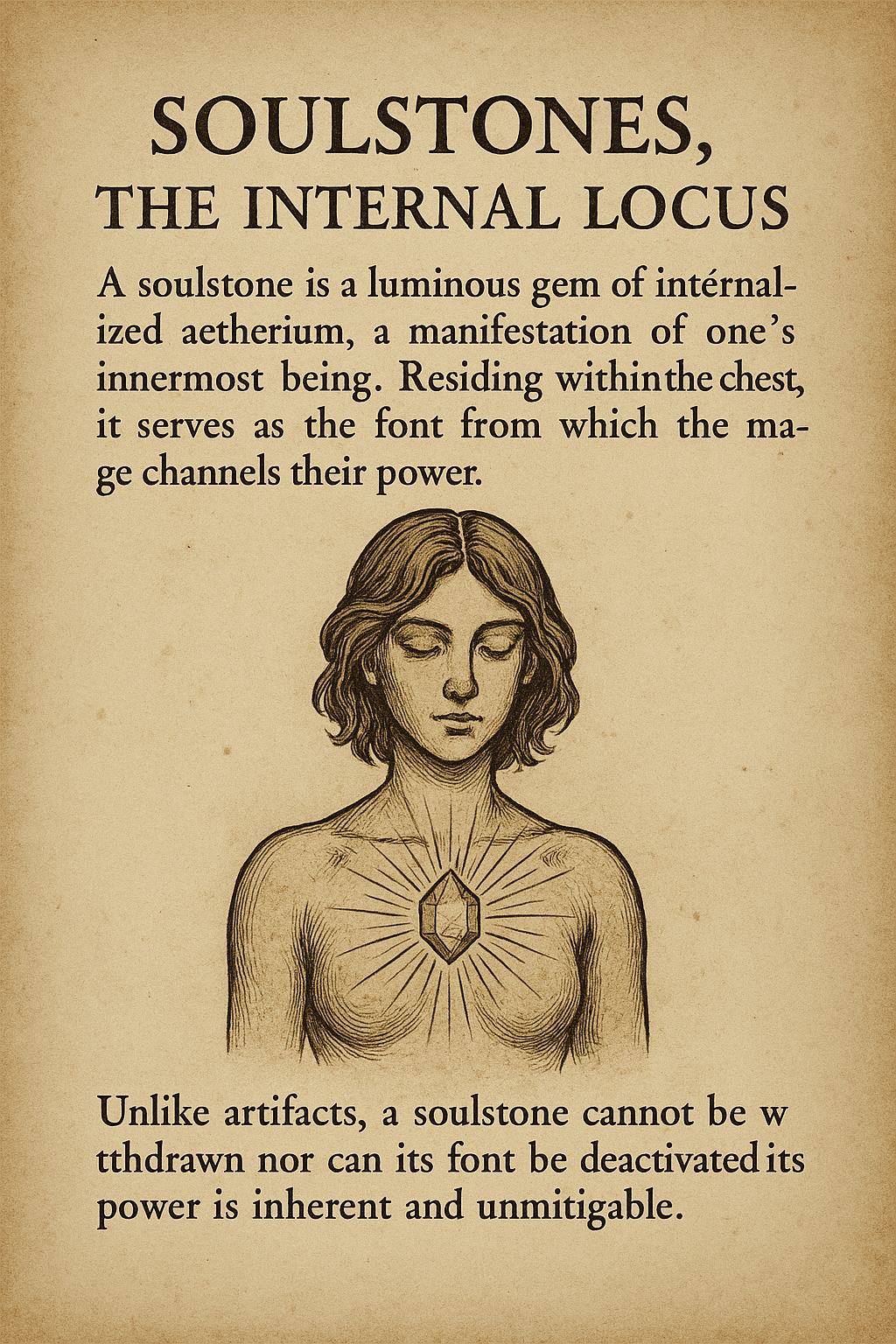
Soulstones, the Internal Locus
There is a myth, oft-whispered beneath cathedral eaves and alchemist tables alike, that the gods once plucked stars from the Aetherium and buried them in the marrow of mortals. These stars, now called soulstones, are not artifacts one can hold, but crystalline mirrors embedded deep within the self—an internal locus, refracting the potential of being.
A soulstone, in its truest form, is not seen but felt. It is an echo of your own anima—shaped by intention, fractured by trauma, and honed through ritual. All sapient life is born with one, though few ever awaken it. The locus lies dormant unless pulled into harmonic resonance with the Aetherium, the outer realm from which all magic flows. The act of channeling is not summoning, but alignment. A focused will—disciplined, wrathful, grieving—becomes a key, turning the soulstone’s lock and inviting potential through.
Some practitioners must rely on external foci—gems, relics, or demon-forged stones—to bridge this gap. But those with awakened loci, those with soulstones finely-tuned and scarred into resonance, require no such prosthetics. They are the spell itself, the wand and the will, inseparable.
Yet beware the corrupted locus. When the soul fractures, when one's purpose becomes hollow or twisted, the soulstone clouds. A corrupted soulstone does not cease to function—it becomes something far worse. It begins to hunger. These are the origins of Infernal conduits and demonic channelers: once-mortal casters whose loci now serve something older than sin.
The difference between an internal and external locus is not merely semantic. It is theological. The internal locus is a whisper of divinity; the external is a tool. One belongs to you. The other, to time.
Manifestation
To the uninitiated, the soulstone is myth—spoken of in poetry, feared in whispers, and referenced only in the sacred tongues of scholars. But to those who have glimpsed it—truly glimpsed it—it is a revelation.
When seen through aetheric perception, or while under the influence of deep attunement rituals, the soulstone does not appear as a stone in the traditional sense. It is not anchored in the body, nor is it tethered to the heart or mind—but rather it floats, weightless, somewhere between the self and the unseen.
Visual Description:
- It appears as a crystalline constellation, suspended in the void behind the eyes when viewed through magical sight—shaped like a many-faceted prism orbited by glyphs that shift with thought.
- Its core glows with a color unique to the individual: a hue shaped not by birth but by their essence—rage may burn crimson, mourning may flicker indigo, devotion might shimmer gold-white. The color is alive, ever-changing.
- Thin lines of aether thread from the core to the limbs, the voice, the breath—an invisible nervous system of will.
When channeling begins, the soulstone blooms like a sacred geometry, unfolding in rotating spirals. It emits an audible hum—not sound, but resonance. Those nearby may feel pressure in their teeth or bones. Candles bend toward the caster. Ink in vials may tremble. The world leans.
If corrupted, the manifestation shifts:
- The soulstone fractures inward, leaking fumes of black-violet mist that twist in reverse patterns.
- The light becomes irregular, like a heartbeat skipping or pulsing to an ancient rhythm.
- Voices may echo faintly when one is near—not speech, but memory, distorted as if underwater.
To witness one's own soulstone is rare and dangerous. To tamper with it, even more so.
Localization
The soulstone is not a physical organ, yet it is more than metaphor.
It exists in a liminal position—a point of resonance between the body, the mind, and the Aetherium. Scholars of House Nocturne call it the internal locus, but this is a simplification. It is not contained—it is centered.
❖ Physical Localization (In-World Understanding)
- To the untrained eye: there is no visible soulstone. It cannot be dissected, drawn, or pinned beneath glass.
- To aetheric sight or magical probing: it appears just behind the sternum, suspended between heart and breath—where exhale becomes speech and inhale becomes thought.
This is why many casting forms focus on breathwork, mantras, or centerline gestures. The soulstone must be “resonated into alignment.” - When magic is cast: the soulstone flares outward along the spine and arms, temporarily blooming like an internal sunburst or radial glyph pattern across the torso and neck.
- Wounds to this region are especially dangerous for attuned casters. Damage near the locus can cause magic to misfire, invert, or collapse into internal recursion (called “soul-knotting”).
❖ Metaphysical Localization (Between Planes)
The soulstone is a dimensional anchor to the Aetherium, the realm of potential. It is not located within the caster’s body, but rather the body is shaped around it, like bone forming around a seed.
- It is both within the self and echoed across the Veil—a transpositional constant.
- When a soulstone is active, it behaves like a mirror facing the Aetherium, allowing the caster’s will to pass through and shape what comes back.
- For powerful casters, the locus may begin to affect nearby geography, probability, or emotional resonance in others—even when no spell is being cast.
You do not "reach" into Aetherium. You align with it. The soulstone is the hinge.
Corrupted Localization
If a soulstone becomes corrupted (e.g., into a Sentient Stone), it begins to drift, whisper, and move inside the metaphysical body.
- It may appear higher—near the throat, twisting voice.
- Or lower—near the stomach, devouring intent.
- This dislocation is not just symbolic—it causes genuine instability in the self.
Some report dreams of being hollowed from the inside. Others forget names, faces, or even their own voice.

Comments