
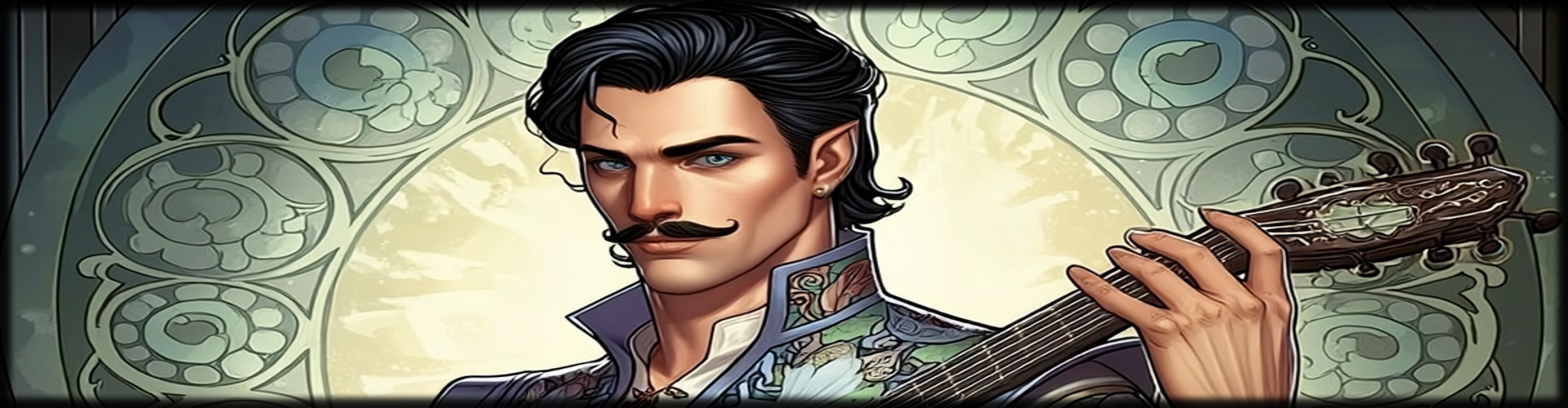
Frederick's Story
Frederick Austerlitz took the final five steps to the Ta’alaq’s archway in a series of little hops, arms flung in fourth position, as if he might draw the dusk along with him into the famous establishment. It was said that the Ta’alaq was always brimming with patrons, that the singular atmosphere of the quaint little tea house was so enchanting, that even the leaders among the Erudite Triad often frequented it. As it turned out, it was just another tall tale among the multitude of rumors and gossip flowing through Shal’Azura.
Sure, the Ta'alaq's location was nothing short of extraordinary. Tucked beneath the famous Bennabi Bridge—a structure whose enchanted webs stretched across the chasm like a spider's masterpiece, hosting countless tea houses and cafés. Ta’alaq, which meant “The Sparkle” in the Old Tongue, was a tea house carved directly into the city's bedrock. To reach it, one traversed a narrow walkway that descended behind the waterfall where the river plunged from the flying city's edge. The thundering waters transformed into a perpetual mist that nourished the verdant Wadi Adkhar far below.
At this hour, the Ta'alaq was nearly deserted, the hush almost ecclesiastical. Only three other souls braved the cavernous warmth—a paunchy merchant whose bronze bangles clinked with nervous energy, a clouder poetess in tidy rose-silks quietly committing lines to a battered notebook, and a black dragonborn waiter, who moved with perfect poise and precision among the low tables. The waiter's immaculate suit—sharp-shouldered and starched, not a wrinkle in sight—betrayed no evidence of the damp that lingered along the chiseled cilice of the walls.
Frederick paused just within the antechamber, inhaled the mingled scents of cinnamon, crushed mint, and various more exotic tastes that undoubtedly stemmed from the multitude of teas-and a surprisingly strong scent of garlic that surprised his well-honed sense of smell. He let the hush settle onto his shoulders, savoring the solace. He had spent all day in the Warda district, feigning an interest in metaphysics and stifling his own, ungovernable laughter at the endemic pomposity. He suspected even the lowliest street sweeper in Shal’Azura secretly wielded a half-finished thesis.
The dragonborn approached, his scales the smoky gray of a long-extinguished campfire, teeth glinting with a butler's pride. “Honored guest, the precipitory table awaits. Or would you prefer something chamberside, nearer the tea stoves?”
Frederick made a shallow bow, lost in the arsenal of unconscious gestures accumulated by a stage life, and flashed the waiter a smile with just enough subservience to disarm suspicion. “Precipitory, if you please. I long for the sight of a waterfall tumbling from above, and the chance to see if mortal fear improves the palate.”
The dragonborn’s smile broadened, all fangs, no threat. “By your wish, sir.” He turned on his heel with such military exactitude that Frederick found himself compelled to copy the snap of it, following two steps behind in a parody so subtle it hovered perfectly on the border between flattery and mischief.
They lock-stepped up the spiraling stairs and up to the precipice, where only two tables stood surrounded by an assortment of cushions of many shapes and colors, inviting him to rest and partake of the incredible sight of the waterfall thundering past him only a few spans from where he seated himself. His senses tingled slightly as he felt the arcane barrier, installed to keep the mist and foam of the roaring waters out.
Far below, evening’s wind beckoned uprising clouds in cauldron swirls. Shal’Azura hung over him, visible only by the roselight-glow of a dozen lamplit windows, each refracted through the perpetual water curtain outside. The tables—set with porcelain so fine it was surely anointed by tiny, invisible gods—stood alone on the gallery. A carafe awaited, glass dew-beaded, enveloped by two cups shaped like miniature amphitheaters. Frederick took his seat, thriving in the sensation that he was moments from tumbling headlong into legend.
He turned to the waiter, politely asking, “Might the proprietor of this fine establishment be around at this hour? I am a musician of some skill, you see, and would offer my services to this most esteemed of tea houses.”
The dragonborn politely answered, “Alas, the masters are not in today. Ta’alaq is more of a morning establishment, and at this hour, only I hold the fort.” There was no bitterness in the declaration, merely a gentle pride, as if he felt himself quite sufficient to uphold the glittering promise of the house alone. “But if you wish to make your mark, a performance for myself and these luminous guests would be an honor without comparison.”
The poetess looked up at this, seated at her table across the room, her gaze as pale and clear as the waterfall’s spray, and Frederick realized that despite the thundering waterfall, the gallery doubled as a stage of incredible acoustics. She gave a subtle, deferent nod, pencil poised over her next stanza, as if she’d already committed herself to sketching the stranger in words. The merchant’s clinking bracelets ceased for a heartbeat.
“Then consider your invitation accepted,” Frederick replied, voice as honeyed as any ballroom’s prelude. He produced a battered, lacquered case from beneath his cloak—a reliquary of secondhand artistry, more chip than veneer. From within, he drew his flute, midnight-black, though the wood shimmered with a secret iridescence where the light hit it, as if the instrument still half-remembered the living sky it once grew beneath. “A few moments of solitude to find my tune and practice my craft before I begin would be most appreciated. Is there a chamber, I can use nearby?”
The dragonborn inclined his head with ceremonial gravity, scales catching lamplight in solemn flickers, then guided Frederick down the spiraling staircase. They passed through the main chamber into the tea house's inner sanctum—a compact kitchen where copper stoves simmered with aromatic brews, and glass-fronted cabinets displayed porcelain treasures so delicate they might shatter at a whisper. The scent of garlic was more pronounced here, and lingered somewhat on. Through another door lay a small but quaint room, the waiter standing aside, holding the door for Frederick, said, “It is yours until you are ready, master bard. I will be in the main chamber. Call, if you have need of anything for your preparations.”
Frederick made no effort to hide his glee. Once alone, he tucked the door shut, let the little room’s hush envelop him, and gave a low, theatrical bow to the empty air. The energy of performance wriggled under his skin, a living contagion.
He uncased the flute, turning it over with the careful wonder of a priest at mass, then held it to the blue light that flickered in the strange gemstone lanterns that lighted the tea house. One long, silent breath. His lips quirked; the old spirit was already moving through him. He wet the embouchure, poised his fingers over the first notes, and exhaled a single, tentative measure-when he realized with a start that he was not alone in the room any more.
Soundlessly, a figure stepped into his peripheral vision, tall and slender, clad in monochrome garments of unknown design that seemed to flow with a strange rhythm, as if rippled by a soft, halting breeze that rose and fell and changed with the passing of every second ticking by, despite the obvious lack of wind in this enclosed space. Their face blurred by a soft opaque veil of a mysterious liquid fabric, their frame androgynous, their voice resounded through Frederick’s mind like the duet of a rich basso dancing with the purest of sopranos in the echoing dome of creation’s most perfect opera house.
“I bring to this house the words that have traveled far,” they spoke immediately, without hesitation or introduction or pause.
He lowered his instrument and, after a pause blanketed in contrary impulses—run, question, collapse to the floor in operatic fear—he gave the apparition a respectful incline of his head. “You must be a regular, then. May I offer you a tune in tribute to your long journey?” He attempted a smile with the edges turned sharp, knowing instinctively that wit might fare better than bravado.
The shrouded shape drifted closer, the air around it chilling even the steam rising from the immense copper samovar in the corner. “Tribute,” it repeated, syllables tremulous with possibility. “Names become tribute, music a cipher. But you are here for a different reason.”
“Once, Shal’Azura anchored its secrets to certainty,” the apparition intoned. There was no inflection in the words; each syllable fell with grave, assiduous precision, echoing unbroken even after its utterance, only a faint underlying accent hinting at some shade of personality. “Now? Memory clouds, and the bedrock of what-is erodes from below. You have noticed it, collector of songs. You have felt the little cracks.”
With gloved fingers, the stranger took a small box - lacquered ebony inlaid with a sliver of mother-of-pearl in the shape of a crescent moon - seemingly conjured from thin air and set it atop the clinking and rapidly cooling samovar.
Frederick did not reply, though his body registered the sense of old dread in the hollow beneath his breastbone. Maybe he had seen the cracks—maybe it was why, for years, the city’s music had grown so melancholy, why the works commissioned for the Clouders’ council rang always in some minor, unresolved key, even in celebration. An afterimage of this melancholy seemed to radiate from the box and he felt his gaze drawn toward it, towards the crescent moon emblazoned on it, a sense of foreboding settling deep in his stomach.
“The words that have traveled far will have to be found again. I cannot do this. They should have been lost, but instead they linger, waiting.”
From inside his monochrome coat, the stranger pulled out a card, ecru and textured with the feel of handmade vellum. He placed it next to the crescent-shaped box with the practiced flourish of a veteran artist. The ink on the card was so fresh that the looping, ornate calligraphy—reminiscent of his own—glistened in the lamplight. In the lower left corner, a crescent moon, matching the one on the box, was embossed in deep midnight foil, adorned with a delicate, swirling filigree that, when caught in the right angle of crystal light, suggested the image of a blindfold suspended in mid-air.
Frederick stared at the card. No address, nor any name, just a single line:
*To You, the Named and the Nameless: The Blind Storyteller bids you join him at the Market of Melodies, Last Bell.*
Frederick's spine froze as if someone had replaced his marrow with winter. His palms went slick and clammy, and his stomach knotted with the particular dread known only to performers who've forgotten their lines before a waiting audience.
A note rang, clear and steady from every direction at once, as if he were sitting inside the bowel of a wine glass of the Gods while Corellon himself ran his finger around the rim.
When the note subsided, he stood alone again in the chamber.
Gone. Not a trace of the stranger lingered: no footprints, no vapor, no imprint in the fabric of the air, only a violet crescent fading above the shrine almost as if the box, too, had never been there at all.
His knees buckled and he took a quick step, his body falling into the routine of many hours of arduous practice. However, as the violet crescent faded from his sight, so did the memory of the strange encounter. Forgotten was the stranger and the box, the talk of words and the stranger’s eerie allegations.
Only one line remained in his mind; as the thick vellum card remained in his hand:
*To You, the Named and the Nameless: The Blind Storyteller bids you join him at the Market of Melodies, Last Bell.*
Sure, the Ta'alaq's location was nothing short of extraordinary. Tucked beneath the famous Bennabi Bridge—a structure whose enchanted webs stretched across the chasm like a spider's masterpiece, hosting countless tea houses and cafés. Ta’alaq, which meant “The Sparkle” in the Old Tongue, was a tea house carved directly into the city's bedrock. To reach it, one traversed a narrow walkway that descended behind the waterfall where the river plunged from the flying city's edge. The thundering waters transformed into a perpetual mist that nourished the verdant Wadi Adkhar far below.
At this hour, the Ta'alaq was nearly deserted, the hush almost ecclesiastical. Only three other souls braved the cavernous warmth—a paunchy merchant whose bronze bangles clinked with nervous energy, a clouder poetess in tidy rose-silks quietly committing lines to a battered notebook, and a black dragonborn waiter, who moved with perfect poise and precision among the low tables. The waiter's immaculate suit—sharp-shouldered and starched, not a wrinkle in sight—betrayed no evidence of the damp that lingered along the chiseled cilice of the walls.
Frederick paused just within the antechamber, inhaled the mingled scents of cinnamon, crushed mint, and various more exotic tastes that undoubtedly stemmed from the multitude of teas-and a surprisingly strong scent of garlic that surprised his well-honed sense of smell. He let the hush settle onto his shoulders, savoring the solace. He had spent all day in the Warda district, feigning an interest in metaphysics and stifling his own, ungovernable laughter at the endemic pomposity. He suspected even the lowliest street sweeper in Shal’Azura secretly wielded a half-finished thesis.
The dragonborn approached, his scales the smoky gray of a long-extinguished campfire, teeth glinting with a butler's pride. “Honored guest, the precipitory table awaits. Or would you prefer something chamberside, nearer the tea stoves?”
Frederick made a shallow bow, lost in the arsenal of unconscious gestures accumulated by a stage life, and flashed the waiter a smile with just enough subservience to disarm suspicion. “Precipitory, if you please. I long for the sight of a waterfall tumbling from above, and the chance to see if mortal fear improves the palate.”
The dragonborn’s smile broadened, all fangs, no threat. “By your wish, sir.” He turned on his heel with such military exactitude that Frederick found himself compelled to copy the snap of it, following two steps behind in a parody so subtle it hovered perfectly on the border between flattery and mischief.
They lock-stepped up the spiraling stairs and up to the precipice, where only two tables stood surrounded by an assortment of cushions of many shapes and colors, inviting him to rest and partake of the incredible sight of the waterfall thundering past him only a few spans from where he seated himself. His senses tingled slightly as he felt the arcane barrier, installed to keep the mist and foam of the roaring waters out.
Far below, evening’s wind beckoned uprising clouds in cauldron swirls. Shal’Azura hung over him, visible only by the roselight-glow of a dozen lamplit windows, each refracted through the perpetual water curtain outside. The tables—set with porcelain so fine it was surely anointed by tiny, invisible gods—stood alone on the gallery. A carafe awaited, glass dew-beaded, enveloped by two cups shaped like miniature amphitheaters. Frederick took his seat, thriving in the sensation that he was moments from tumbling headlong into legend.
He turned to the waiter, politely asking, “Might the proprietor of this fine establishment be around at this hour? I am a musician of some skill, you see, and would offer my services to this most esteemed of tea houses.”
The dragonborn politely answered, “Alas, the masters are not in today. Ta’alaq is more of a morning establishment, and at this hour, only I hold the fort.” There was no bitterness in the declaration, merely a gentle pride, as if he felt himself quite sufficient to uphold the glittering promise of the house alone. “But if you wish to make your mark, a performance for myself and these luminous guests would be an honor without comparison.”
The poetess looked up at this, seated at her table across the room, her gaze as pale and clear as the waterfall’s spray, and Frederick realized that despite the thundering waterfall, the gallery doubled as a stage of incredible acoustics. She gave a subtle, deferent nod, pencil poised over her next stanza, as if she’d already committed herself to sketching the stranger in words. The merchant’s clinking bracelets ceased for a heartbeat.
“Then consider your invitation accepted,” Frederick replied, voice as honeyed as any ballroom’s prelude. He produced a battered, lacquered case from beneath his cloak—a reliquary of secondhand artistry, more chip than veneer. From within, he drew his flute, midnight-black, though the wood shimmered with a secret iridescence where the light hit it, as if the instrument still half-remembered the living sky it once grew beneath. “A few moments of solitude to find my tune and practice my craft before I begin would be most appreciated. Is there a chamber, I can use nearby?”
The dragonborn inclined his head with ceremonial gravity, scales catching lamplight in solemn flickers, then guided Frederick down the spiraling staircase. They passed through the main chamber into the tea house's inner sanctum—a compact kitchen where copper stoves simmered with aromatic brews, and glass-fronted cabinets displayed porcelain treasures so delicate they might shatter at a whisper. The scent of garlic was more pronounced here, and lingered somewhat on. Through another door lay a small but quaint room, the waiter standing aside, holding the door for Frederick, said, “It is yours until you are ready, master bard. I will be in the main chamber. Call, if you have need of anything for your preparations.”
Frederick made no effort to hide his glee. Once alone, he tucked the door shut, let the little room’s hush envelop him, and gave a low, theatrical bow to the empty air. The energy of performance wriggled under his skin, a living contagion.
He uncased the flute, turning it over with the careful wonder of a priest at mass, then held it to the blue light that flickered in the strange gemstone lanterns that lighted the tea house. One long, silent breath. His lips quirked; the old spirit was already moving through him. He wet the embouchure, poised his fingers over the first notes, and exhaled a single, tentative measure-when he realized with a start that he was not alone in the room any more.
Soundlessly, a figure stepped into his peripheral vision, tall and slender, clad in monochrome garments of unknown design that seemed to flow with a strange rhythm, as if rippled by a soft, halting breeze that rose and fell and changed with the passing of every second ticking by, despite the obvious lack of wind in this enclosed space. Their face blurred by a soft opaque veil of a mysterious liquid fabric, their frame androgynous, their voice resounded through Frederick’s mind like the duet of a rich basso dancing with the purest of sopranos in the echoing dome of creation’s most perfect opera house.
“I bring to this house the words that have traveled far,” they spoke immediately, without hesitation or introduction or pause.
He lowered his instrument and, after a pause blanketed in contrary impulses—run, question, collapse to the floor in operatic fear—he gave the apparition a respectful incline of his head. “You must be a regular, then. May I offer you a tune in tribute to your long journey?” He attempted a smile with the edges turned sharp, knowing instinctively that wit might fare better than bravado.
The shrouded shape drifted closer, the air around it chilling even the steam rising from the immense copper samovar in the corner. “Tribute,” it repeated, syllables tremulous with possibility. “Names become tribute, music a cipher. But you are here for a different reason.”
“Once, Shal’Azura anchored its secrets to certainty,” the apparition intoned. There was no inflection in the words; each syllable fell with grave, assiduous precision, echoing unbroken even after its utterance, only a faint underlying accent hinting at some shade of personality. “Now? Memory clouds, and the bedrock of what-is erodes from below. You have noticed it, collector of songs. You have felt the little cracks.”
With gloved fingers, the stranger took a small box - lacquered ebony inlaid with a sliver of mother-of-pearl in the shape of a crescent moon - seemingly conjured from thin air and set it atop the clinking and rapidly cooling samovar.
Frederick did not reply, though his body registered the sense of old dread in the hollow beneath his breastbone. Maybe he had seen the cracks—maybe it was why, for years, the city’s music had grown so melancholy, why the works commissioned for the Clouders’ council rang always in some minor, unresolved key, even in celebration. An afterimage of this melancholy seemed to radiate from the box and he felt his gaze drawn toward it, towards the crescent moon emblazoned on it, a sense of foreboding settling deep in his stomach.
“The words that have traveled far will have to be found again. I cannot do this. They should have been lost, but instead they linger, waiting.”
From inside his monochrome coat, the stranger pulled out a card, ecru and textured with the feel of handmade vellum. He placed it next to the crescent-shaped box with the practiced flourish of a veteran artist. The ink on the card was so fresh that the looping, ornate calligraphy—reminiscent of his own—glistened in the lamplight. In the lower left corner, a crescent moon, matching the one on the box, was embossed in deep midnight foil, adorned with a delicate, swirling filigree that, when caught in the right angle of crystal light, suggested the image of a blindfold suspended in mid-air.
Frederick stared at the card. No address, nor any name, just a single line:
*To You, the Named and the Nameless: The Blind Storyteller bids you join him at the Market of Melodies, Last Bell.*
Frederick's spine froze as if someone had replaced his marrow with winter. His palms went slick and clammy, and his stomach knotted with the particular dread known only to performers who've forgotten their lines before a waiting audience.
A note rang, clear and steady from every direction at once, as if he were sitting inside the bowel of a wine glass of the Gods while Corellon himself ran his finger around the rim.
When the note subsided, he stood alone again in the chamber.
Gone. Not a trace of the stranger lingered: no footprints, no vapor, no imprint in the fabric of the air, only a violet crescent fading above the shrine almost as if the box, too, had never been there at all.
His knees buckled and he took a quick step, his body falling into the routine of many hours of arduous practice. However, as the violet crescent faded from his sight, so did the memory of the strange encounter. Forgotten was the stranger and the box, the talk of words and the stranger’s eerie allegations.
Only one line remained in his mind; as the thick vellum card remained in his hand:
*To You, the Named and the Nameless: The Blind Storyteller bids you join him at the Market of Melodies, Last Bell.*

Comments