

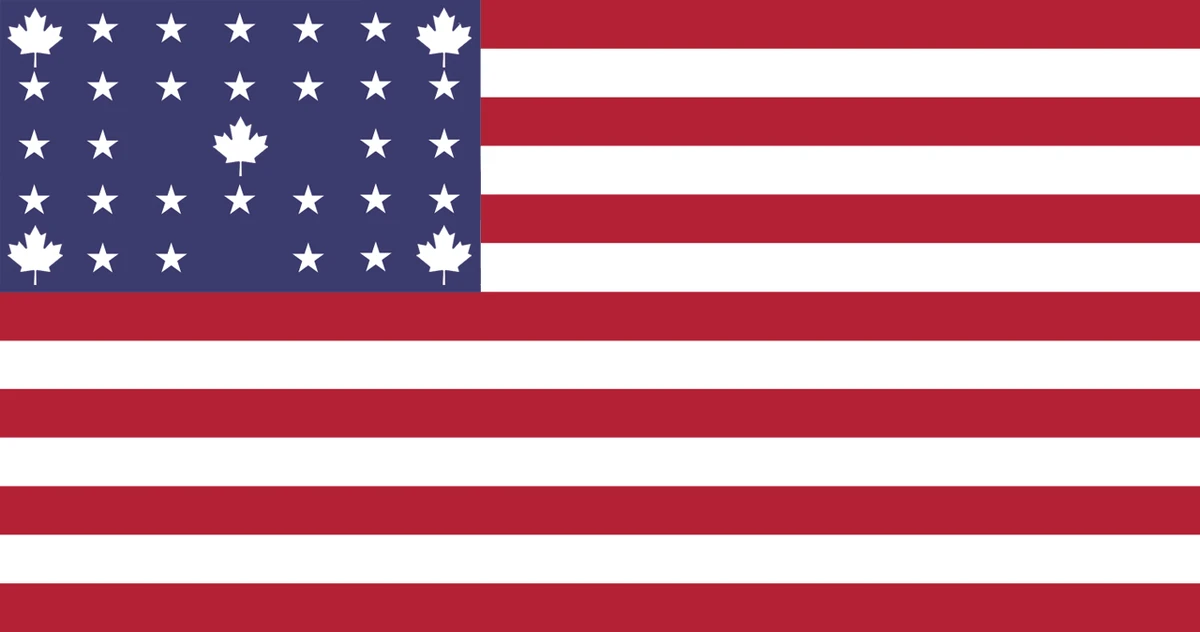
United Canadian-American States
There are still a few pockets of wilderness, or close to it— mostly old U.S. national parks and the like that weren’t plundered for the riches beneath them. They have managed to grow wild, and we are richer for it. The vast majority of the land in the UCAS is dangerous territory. To be fair, though, most of what makes up the UCAS is either city center or wilderness. Ever since the Awakening, ever since Goblinization, you name it: if it’s caused rioting, if it’s caused you to look over the horizon every now and again and ask yourself, “How is everyone not dead already?”—the wilderness reawakened. A long time ago, everyone lived in cities and everything they knew nothing about was found out in the wilderness. It’s like that again—what with all the monstrosities out there. Have you been out in the wilderness lately? Once you get to a one-hundred-kilometer radius from people, you start to see it. The metahuman population per square kilometer drops, the things-that-want-to-eat-you density climbs. Speaking of wanting to eat the locals, I have to say that the UCAS lucked out in gaining control of all of the Great Lakes—I can be counted on to make my regular home near one of them for half the year, every year, because I love to fish. I’m also fond of the Appalachian trail and much of the Mississippi River. Not to make my home, of course, but merely to get away and into the wild. I prefer to stick around anywhere I can flash my (best) SIN. Less trouble that way. But I suppose for the capitalist-minded among us, control of all the Great Lakes means more than just more fishing for me. The Great Lakes continue to attract all manner of sports-minded folk like myself, but whatever they’re keeping under the Great Lakes continues to maintain a no-visitor policy. For the casual traveler in the UCAS, the official currency is the UCAS dollar ($), but we just about as often use the international nuyen (¥), and we don’t have an official language, but we usually use English or a version thereof (“city speak,” I’m looking at you), but that varies, too, depending on which coast you find yourself nearer. A big country has a lot of neighbors. To the north is the Algonkian-Manitou Council, to the south-southwest is Aztlan, otherwise, the Confederation of American States lies all along the southern border. To the west-southwest is the Pueblo Corporate Council, and to the west-northwest is the Sioux Nation. And with a lot of territory, not much of it filled with much population, there’s a lot of room to disappear. Smugglers run anything you can imagine across land and sky, but also river, and we have the mighty Mississippi river running down nearly the entire country, down into the CAS, and that river gets a lot of traffic.
Assets
From the northeast coast (including Maine to the north, but also New Brunswick, Nova Scotia, and Prince Edward Island), running south to the southern border of the Federal District of Columbia, across the southern borders of West Virginia and Kentucky, then straight across Missouri, to encompass most of Kansas. The western border runs from the northwest about a hundred kilometers north of Weyburn, south to catch the Missouri and follow it down through the middle of the Dakotas, then straight down Nebraska and Kansas and just barely into Oklahoma. The northern border extends from just north of Weyburn and cuts a jagged line east to include the southern edge of what was Manitoba and a good portion of what used to be Ontario: Ottawa, Sudbury, and Sault Saint Marie, but excluding Thunder Bay, which remains on a peninsula of Algonkian-Manitou Council land. That said, the western border of the UCAS proper (yeah, I said it; bite me, Seattle) lies along the course of the Missouri and runs past Bismarck—a town that never really lost its loose skin after the mining industry bloated its borders seventy-some years ago. Bismarck has been a hotspot for frequent flare-ups between the UCAS and Sioux Nation. The grain belt, or what’s left of it after the war and the Awakening and the drifting fallout from Chicago-way, has a significant presence in the nation.
History
The United Canadian and American States, founded in 2030, comprises much of what was once the United States of America and a sliver of what was once Canada. It was a rocky start, with a group of the southern states of the former United States, California, and Hawaii all seceding from the country. But eventually, the borders stabilized—at least, for the time being.
Remove these ads. Join the Worldbuilders Guild





Comments