
Mephistopheles (me-fiz-TAF-e-leez)
Archdevil Mephistopheles (a.k.a. Archduke of Cania, Lord of the Eighth, Duke of Brimstone)
(https://forgottenrealms.fandom.com/wiki/Mephistopheles)
Mephistopheles, sometimes shortened to Mephisto and once under the name of Molikroth, was the lord of Cania and the most powerful archdevil next to Asmodeus himself. Hell's greatest wizard was a walking contradiction: on the surface, the cool and calculating Cold Lord, and beneath that, the grandiose and hot-headed Lord of Hellfire.
Personality:
Mephistopheles was a being of razor-sharp instinct, careful suspicion and prodigious brilliance, a cunning genius with an unparalleled understanding of Hell's political dangers and a great capacity for patient deception. Foremost wizard of Baator, his ordinary speech was like a whispering wind and his cool, pleasant demeanour gave him the outward appearance of a princely gentleman. He came off as sophisticated and charming when he spoke, an intellectual force of understated wit, reason and self-restraint, and embodied the casually crafty aspect of Hell's evil.
However, this was by no means his ordinary behaviour, but a façade like Dispater's which disguised his true personality, a veneer of elegance as carefully crafted as his traditionally infernal appearance. Despite his courteous persona, Mephistopheles was an unstable individual on the inside, the contrast between his cold surface and fiery core a perfect example of his existence as a walking contradiction.
Mephistopheles was a vicious being with an outrageous temper, who, when alone in his palace, frequently flew into violent rages, his quick wit burning away when met with his underlying hate and frustration. In his shrieking fits of terrible wrath, he would start tearing at his own skin and destroying his surroundings in explosive outbursts of fiery, magical destruction, his unpredictable eruptions of rage having been his undoing multiple times in the past. Although his conniving intelligence was certainly real, Mephistopheles was an emotional entity that was ultimately driven by his passions.
Obsession:
Mephistopheles suffered no distractions from his focus, his studious pursuits being of utmost importance to him. Though he would entertain visitors purely for his own amusement, a rarity among the archdevils, he hated any unwanted distractions and rarely gave time to anything not worth his personal attention. He was known for disintegrating underlings for the slightest annoyance, only allowing a few devils to speak without being spoken to, and sometimes executing his servitors based on the suspicion that they would bother him. Further cementing him as a contradictory entity was the strong but flickering nature of his focus.
Mephistopheles's great intelligence often ended up mixing with his obsessiveness, as in his pursuit of knowledge, he became fascinated with the most minor details. However, this allowed him to delve deeper into topics than typical wizards; his unrelenting focus had to be tempered by his responsibilities and was ultimately undermined by his mercurial behaviour. When forced by some political circumstance to stop what he was doing, there was a chance upon returning that some new project would catch his eye, at which point that research would become his new top priority. Because of this cycle of undivided attention followed by casual neglect, Mephistopheles had many useful discoveries ready to be accessed that he simply didn't know about.
Pride:
While his anger and neurotic tendencies were weaknesses, which he could either hide or use to his advantage, Mephistopheles' most damaging issues were his rampantly unchecked megalomania and recklessness in the pursuit of power. Though he'd hate to be compared to Baalzebul, both archdevils seemed incapable of being content and compulsively overextended themselves, Baalzebul's plans collapsing under the weight of his unrealistic expectations and Mephistopheles becoming so absorbed in his plans that he ignored his overall well-being. Mephistopheles's manifestation of greed, however, was somewhat opposite to that of the Lord of the Lies, who hid his goals through skilfully woven deception, since Mephistopheles's execution of wicked plots was always extreme and dramatic, his brazen ambition almost glorious in its nakedness.
Mephistopheles was perhaps the most entitled of the archdevils, an avatar of envy who resented the fact that he was "merely" the second most powerful archdevil. Always jealous of others, he couldn't get enough of prestige, wondering where his awards were when another was rewarded for service despite having continually, confidently, and directly told Asmodeus he planned to take his throne. Though willing to fawn if needed, he normally didn't bother to cloak his intent with fake vows of obedience, truly believing that he was the rightful ruler of Hell, that his destiny was to rule it, and that he deserved to be worshipped as a god. He constantly demonstrated this attitude anew each day, and likely wouldn't be satisfied even if he achieved this primary reason for existence.
Molikroth:
When donning the mask of Molikroth, Mephistopheles was a being without mercy that reportedly harboured great hatred for Asmodeus. While an archdevil being cruel wasn't exactly unusual, Molikroth stood out by the sheer extent to which he took his sadism, crushing most visitors between glaciers for years as a form of entertainment and utilising the powers of cold in such agonising ways that even godly agents would want to beg for mercy. He rarely left his citadel, both out of a preference for victims to come to him and out of a complete interest in active and direct governance, as well as vigilant protection of his territory.
Activities:
From the wizard's tower that was Mephistar, Mephistopheles performed many tests to discover more about arcane magic and the nature of the planes, his most recent pet project being his hellfire obsession. He had spent a great amount of time mastering and experimenting with the new, magical fire, which distracted him from the needs of his formerly favoured minions, the gelugons, his realm's stability and his soul-harvesting efforts.
With Cania's old power structure virtually upended, the ice devils fled to the mountain Gelineth and formed a retreat known as Nebulat, which stuck out of the mountain's side like a crystal fungus. Though none would directly condemn him, the discontent devils made many plans to resolve their situation, some scheming to undermine his lead researchers by finding or planting evidence of treachery, creating a new type of ice magic to win back his interest, trying to correct his behaviour, and others just plotting to replace him.
Meanwhile, Mephistopheles's attempt to grow his cult using hellfire had put him in large amounts of divine energy debt to some of the other archdevils, particularly Dispater and Levistus. He was taking a serious gamble, for though his success could ideally grant him the largest and most popular cult, failure would leave him devastated, and his investors would likely sabotage him if his risks seemed likely to pay off.
Divine Symbols & Sigils
Physical Description
Body Features
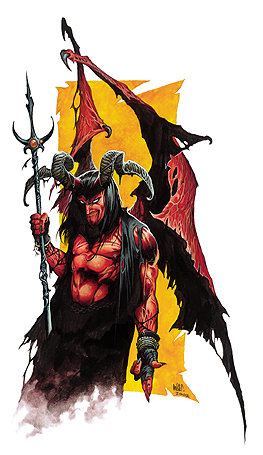
Mephistopheles played up his infernal image as much as possible, intentionally appearing as the classic archetype of a diabolical devil. He was 9 ft (2.7 m) tall and striking, his handsome visage and charming yet unnerving smile of self-superiority contrasted by his more monstrous features. His fiendish claws, bright, crimson red skin, large, bat-like wings and impressive, curling ram horns all left his hellish heritage on proud display. Another source of contrast was his dead-white eyes against his long, straight, black hair, as well as his dramatic, flowing cape as dark as the deepest void.
Earlier reports of Mephistopheles claimed that he once had an image more befitting of Cania. He had blue-black skin across his heavily muscled body; wings, horns, and claws a deep shade of blue, scales of sooty black, and eyes that were pale blue except for the red irises and pupils.
When Mephistopheles was donning his Molikroth persona, he appeared as an obese man whose gross levels of fatness were frankly absurd. Despite being only 7 ft (2.1 m) tall, he was still massive because he was wider than he was long, competing with creatures like hill giants in terms of sheer mass. Even when the waddling baron was swathed in clothes made from only the most ridiculously expensive materials that were the height of Sigilian fashion styles, all his foppish finery couldn't hide his ultimately foolish appearance.
Special abilities
Mephistopheles was a being impervious to the cold, not just due to having ruthlessly exposed himself to Cania's coldest temperatures, but because of his unrivalled mastery of hellfire. A corrupt and extremely potent energy with the properties of flame, hellfire was unimaginably hot and created by tapping into and mastering the profane essence of Hell and channelling it into a usable form of power. Unless he chose to repress it, his body would emanate dark flames, causing anyone who touched him, or anyone nearby if he evoked a burst around him, to be scorched by the unholy energy.
To further his mastery of fire, Mephistopheles took up the study of wizardry, specialising in evocation magic modified to taint his foes with foulest evil, with a noticeable disinterest in enchantments and illusions. Given the nature of baatezu politics, Mephistopheles rarely travelled alone, often bringing two bodyguards with him anywhere he went and able to summon a few gelugons or pit fiends, often choosing the latter, while his accompanying servitors kept the enemy busy. Given his sense of self-importance, he believed anyone who dared attack him deserved no less than utter obliteration, and so let loose a barrage of offensive magical destruction from the rear of the fight, teleporting away and leaving his allies to their fate if met with a real threat.
Though lacking the most powerful spells as a wizard, Mephistopheles' innate spell-like abilities more than made up for it. He could cast all sorts of ice and fire-related spells, showcasing his mastery of both elements, such as cone of cold, fireball, and wall of ice or fire, meteor swarm being his most powerful and the one he could use only once per day. He was also capable of inducing fear, either through an aura or via his gaze.
As Molikroth, he specialised in ice-related magic so powerful that no known spell could fully protect one from his frigid powers. The longer one fought the Baron, the more frostbite would set in, and after several minutes, the body would begin slowing down as cold-induced torpor numbed the reflexes.
Specialized Equipment
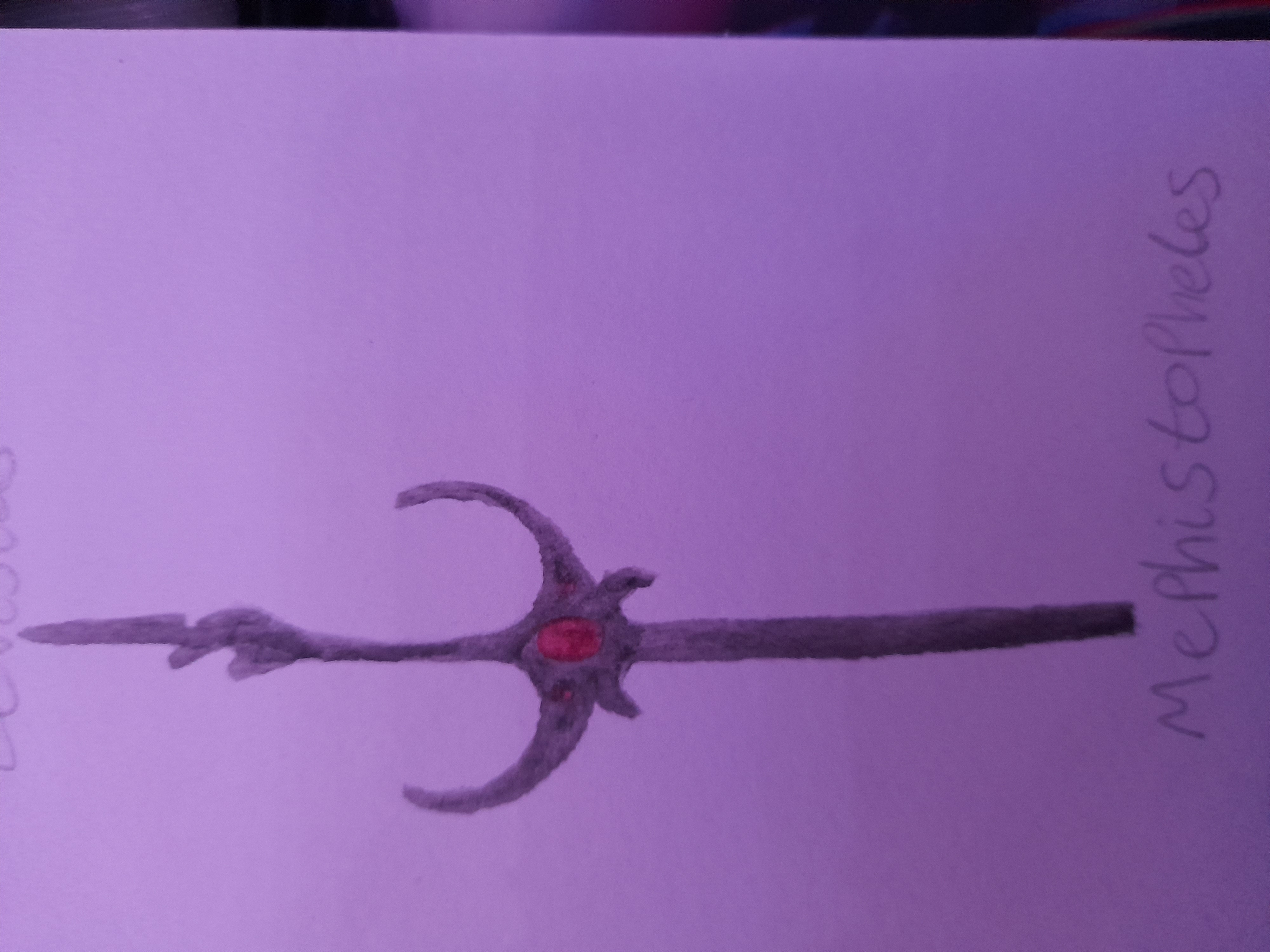
Mephistopheles' favoured weapon was a three-tined military fork or ranseur. He was known to have different types, such as one that could switch between inflicting fire, cold, and electricity, each three times per day. Another switched between burning eternally and being covered in frost, and allowed the wielder to focus hellfire spells to be more devastating. Aside from that and other magical items, the laboratories in his home citadel were filled with spellbooks containing nearly every known arcane spell, allowing him to prepare almost any he pleased.
Mental characteristics
Personal history
Mephistopheles was an ancient entity, a being rivalling even Asmodeus in terms of age, and during his time as an archdevil, he had been responsible for many infernal innovations aside from hellfire. Millenia ago, he had entrapped a race of mercenary fiends similar to the mezzoloths in Hell, keeping them in a state of perpetual servitude and giving rise to the gelugon baatezu. The fiendish surgeons within his palace augmented a breed of hell hounds, the fearsome Nessian war hounds, with even greater abilities, making Mephisto's pit hounds even stronger, bigger, crueller and fiery than Asmodeus's. He captured the blood and tears of Baalphegor in a vial to create a powerful artefact known as Baalphegor's Grace, allowing the user to summon a group of erinyes known as the Blessed Angels that were ultimately loyal to him, although he originally intended to loan it to favoured cultists before he lost track of it.
One of his infamous schemes was before the Reckoning, when he donned a secret identity as the archdevil Baron Molikroth. He "deposed" himself using this alter ego and ruled for a great amount of time before finally revealing his true identity. The traitors who co-conspired with Molikroth to overthrow Mephistopheles were ended along with the deception. When the Reckoning actually occurred and Mephistopheles's faction of Dispater, Mammon, and Geryon went up against Baalzebul's faction of Zariel, Belial and Moloch, his entire plan was undermined by a spy in his ranks; Geryon. Geryon was secretly siding with Asmodeus, and with a blow of his horn, the pit fiend generals of both armies turned against them. Despite the blatancy of his rebellion against Asmodeus, he was perhaps the archdevil that suffered the least, not cursed like Mammon or Baalzebul, cast down like Zariel, Belial, Geryon or Moloch, nor left to stew in his own paranoia like Dispater.
Attack on Toril:
Not too long after 1372 DR, a drow matron known to history only as the Valsharess managed to bind Mephistopheles into her service on the material plane in Toril. Aided by his powers, she proceeded to conquer much of the Underdark and even went on to try to expand her influence on the surface, attacking Waterdeep through Undermountain.
Previously, an adventurer fleeing the briefly reactivated, but once again falling, Netherese city of Undrentide into the Plane of Shadow had come across a strange relic that they had used occasionally to access the small plane of a strange creature known as the Reaper. This item was, in fact, meant for the leader of a cult of Mephistopheles and contained a piece of the devil's own flesh. Later, the adventurer, by then quite famous and powerful, came to Waterdeep to aid the city in its struggle against the Valsharess's forces. Mephistopheles manipulated the Valsharess to eventually bring the adventurer into her inner sanctum, where she ordered him to kill them. At this point, her control over Mephistopheles was loosened, since the relic carried by the adventurer bound them to the archdevil, and by ordering him to kill the adventurer, she broke the pact which she had used to bind him.
Instead of complying, Mephistopheles left the adventurer and his party free to duel and kill the Valsharess. He then sent them to Cania in his stead and set out to conquer Toril, intending to turn it into a new layer of Hell that would go down below the Ninth and make him the new supreme ruler of the plane. He raised the dead souls he had gained from the recent battles between the Valsharess and her enemies as a special form of spiritual army and began to follow a similar course of conquest to hers, advancing from the Underdark to Waterdeep. However, the adventurer, who had by this point grown in power far beyond that of most other mortals, was able to escape Cania by learning the Reaper's true name, Hecugoth the Abandoned. They returned to Toril and banished Mephistopheles back to his old domain before he could destroy the City of Splendours. It could be deduced that since Mephistopheles remained a threat to the planes as nobody's slave, the adventurer either did not learn his true name or simply chose not to use it to its full potential for whatever reason.
Ascension:
Mephistopheles's plans to become a god finally came to some form of fruition during the Spellplague. Mephistopheles had persuaded his half-breed son, Magadon, to release the devil inside of him and therefore bring himself and his fellow companions, Erevis Cale and Drasek Riven, to Cania through some manipulation of Cale's ability to travel through shadows. Mephistopheles then proceeded to kill his half-breed son after Erevis promised Mephistopheles a portion of the god Mask's divinity. He did this as part of the agreement, not that he discussed it with Cale, saying that he would keep half of Magadon's soul with him as collateral until the delivery. Erevis later returned to Cania and sacrificed his life for the return of Magadon's soul, giving Mephistopheles the divinity he so desired, although with an unexpected cost.
It was at this time that Riven, who used his new demigod powers obtained from absorbing some of Masks's divinity to travel to Cania, paid Mephistopheles a visit. Riven attacked and nearly decapitated the archdevil and told him that if he ever stepped out of his domain, Riven would utterly destroy him. Mephistopheles replied by telling Riven that he would come back and would be waiting for him, though he himself seemed to think that Riven would come back under the impression he would return for Cale at some later date. Even in the obtainment of divine power, his defeat notwithstanding, Mephistopheles was still undermined. Once Mephistopheles had fully recovered from Drasek's ambush attack, the insult to hours of injury revealed itself in the form of an icy cairn at the bottom of his domain, at the bottom of which lay Erevis. The rest of the divinity cheated from him was still down there, but no matter what he used, whether it was the power of hellfire, legions of furious devils, or teleportation, he couldn't enter or even scry what lurked beneath the shadow-leaking ice.
Making this worse was that during the Spellplague, Asmodeus had managed to absorb the half-murdered Azuth, who had simply fallen through the Astral Sea into Hell. Mephistopheles's divinity was only a fraction of Mask's power, which itself was only a fraction of the power taken from Kesson Rel, and while he was trying to finish obtaining the last of it, Asmodeus left him second-rate through sheer luck. Though he realised that the unbreakable ice was likely some ploy of the Lord of Thieves, Asmodeus's calls to his domain were filling him with dread and pushing him to act. He feared Asmodeus was prepared to punish him for trying to dethrone him and, befitting his ego, would rather try to obtain godly power and orchestrate a coup in his limited time than beg for mercy while hoping to evade his wrath. As Mephistopheles suspected, Mask was trying to manipulate him, although not exactly in the way he thought.
In 1484 DR, after a century of trying to break the ice, Mephistopheles chased the one clue he had, the existence of Erevis's son, Vasen Cale, believing he held the secret to getting to the bottom of the cairn. This was, in fact, all part of Mask's plan; Vasen was a powerful and dedicated servant of Amaunator, and the reunited father and son duo managed to strip the fragmented remains of Mask's divinity from all holders. Though Vasen intended to have his father receive the power, Riven decided to take on the divinity, effectively becoming the reincarnated Mask. Mephistopheles, meanwhile, found his plans thwarted, forced to flee the scene through teleportation without any divine spark while choking on his own blood and guts.

Comments