

History of Arkael
Arkael;
The land of One-Thousand Blades, this continent is a great melting pot of various cultures and races; being home to at least a dozen races, with dozens more having passed on or changed in ages gone by.
Arkael, also known as the Land of Blades, is one of the largest continents found on the planet Elysium. Large in size; it houses within it a wide variety of ecosystems, environments, and settlements.
Geography
All together, there are four main regions that make up the continent of Arkael. Because of its constant warring, these have fluctuated throughout Arkael's history, either shrinking or growing or being renamed with every battle fought, won, or lost, but these are the most usual form of reference.Shalepeaks
Mostly mountainous, dotted with sharp cliffs, wide canyons, and deep fjords; located to the north. Much less urbanized than many of the other regions, but the five largest cities do have a sizable population, with the other four cities being more like towns.Arborum
Densely forested and notoriously treacherous (because of both terrain and inhabitants located to the northeast.Arkonian Plains
Relatively tame; hill-dotted plains, thin forests, and grasslands; located to the west. Final resting place of the titan Arkon’s corpse. Home to the Titans only remaining offspring, ArkhaiotanSunscald
Also known as the Wastes. Harsh deserts, badlands, and savannas; located to the southeast. Final resting place of the titan Scael’s corpse.The First Era

The First Era King: Age of Luric
Arrogant, uncompromising and hopelessly conservative. On a bad day those are the only attributes that shine through him. On better days you could describe him as just, honorable and well, divine, I suppose
The Assault on Darham Fortress
The Wars between the Huldu and the Men of Arkael have been long and bloody ones. For years even before King Luric's right to power, Man and Elf have always been at odds with each other. The reason for the infighting and the violent Assault on Darham has been lost to time, but it is highly speculated that it was spurred by a discovery of something powerful. While others tend to speculate that it’s main cause was the elves, being themselves an extremely prideful race, fearing that the humans' culture would surpass their own and so sought to drive the humans from their lands. Darham was the first "true" city built in Arkael after the arrival of Men sometime during the beginning of the First Age. Following its destruction, small city-states and tribes were in constant conflict with one another – a time referred to historically as the "Age of Warlords'', and a time where a consequence of incessant warfare, famine and plague, would eventually lead to a third of the collective population dying. Order would eventually finally be instituted following the entrance of Supreme King Luric from the Northern Shalepeaks, whose prior historical accounts continue to elude history, leading to no direct information about his origin. It is thought the destruction of the once thriving city of Darham is what started Luric's campaign to become King, and between the years 1E 103-108, King Luric began the aggressive expansion campaign now known as the Shalepeak Conquests, which would culminate into the First Empire of Men in Arkael. Within a span of Five years, Lord Luric was able to raise an army, one strong enough that through sheer force alone, he subjugated the numerous nations under what would become the continent's first empire.The Dvergar of Arkael
During the time of the Shalepeak Conquests, The Dvergar of Arkael had managed to resist the advances of the Nér's as they battled with the Huldu, most of whom sought shelter within the Dwarven City-States. However, the Nér's of Arkael had managed to invade and conquer many of the Dvergar cities of Arkael, but not without sustaining great losses themselves. From 1E 107-112, some of the bloodiest wars during the conquests were said to be fought against the dwarves, due to the technological advances the Dvergar were known for. This war was fought over religion, philosophy, and issues over ethics, technology, and magic. However the central contentious point was the fact that the Dvergar were supposedly in possession of a powerful artifact. This supposed artifact was never found, but whatever remaining Dwarves retreated deeper into their underground cities. The Nér's would maintain control of Dvergar cities for almost a century before the Dwarves managed to recapture them following the "Death" of Luric.The Construction of Casian
Using various POW's, Lord Luric forced laborers gathered from throughout his new empire to construct a large capital city as a supposed "replacement" of Darham. It wasn't long after the construction, that the land itself was in a constant state of spiritual turmoil thanks to his despotic rule, which earned him an infamous name, the "Scourge of the North” and for good reason. For not long after his reign started, Luric defeated the lords ruling the surrounding lands, bringing them to their knees. He was rumored to have even grounded their crowns to dust and formed his own. Thus, the crowns became one as Luric became the tyrannical High Lord of Caisan. During his rule, Luric enacted a plethora of Rules and Laws, many of which targeted Huldu in the way of Bloody Reparations for the destruction of Darham and many of the non-Ner folk. With these laws in place, the Nér mounted a genocidal campaign and killed the Huldu by the thousand. However the law's were loose and disjointed and as a result, magic user's, even those not of Huldu heritage, were subjugated and magic became outlawed and punishable by death or long-term torture/imprisoment. When he was not out slaying or making life miserable for those not of "Ner heritage", rumors of Luric's times excessively drinking and having sexual encounters with various women in his Nér circle became so widespread, it led to the rumor that he may have also had illegitimate “Bastard” children; the rumors raising hopes that maybe one may have the motive to upstart his father and reign as a hopefully kind benevolent king. But that never happened. Luric’s cycle of ruthless tyrannical rule lasted a long time, during which he conquered many kingdoms throughout much of what would be upper Arkael. But the King could not conquer one thing, could not beat it into submission like he could any mere man. Aging.Fall of Luric
Despite all his powers of swordsmanship and war, Luric could not stop the natural process of aging. Following the humiliating loss of an attempted power grab for a neighboring kingdom, Luric was rumored to have started dabbling in the dark arts of magic, a hypocritical act no one had the courage to confront the tyrant on when he began searching for a way to reverse the aging process. While it is unclear by what means Luric used to slow his aging process, his skirmishes had begun taking POW’s captive, a far cry from his usual habit of slaughtering them all in the heat of battle. Whatever his methods, it is rumored Luric damned many innocent souls to an early grave just so he could outlive the ticking of time slowly consuming him. And it must have worked, for soon rumors began swirling about a rejuvenated Luric, going back to his old ways of drinking and pillaging. But when his drinking and lusting and his hunger for power became known to more and more people, demands to do something about this outrageous man became the talk of the land. There were talks about an attempt at assassination. However before it could be carried out the oddest thing had occurred Luric disappeared in the year 1E 190, 78 years after his crowning. After his supposed fall and the destruction of his imperial capital following a surprise sacking sometime later, his empire eventually became splintered into the various nations of which many now still exist under new leadership. Despite rumors of his whoring, it is unknown if he had indeed any blood, and as such, the kingdom was left with no direct successor, though it is believed that some may still carry the Mad King's Blood in their veins. With the first Empire beginning to crumble, as there was no heir to the throne, the Empire lost all lands beyond Shalepeak that it had captured, and was never able to regain these provinces successfully back. The Dvergar reclaimed their lands, however in the years that followed, calamity after calamity drove them to near extinction. The Huldu also suffered traumatic losses. It is unknown how many other Elves may be found, but it should be noted that several tome’s have stated that many fled Arkael, and may probably be living in other continents.The Moot, War of Succession and the True Fall of Casian
According to some scholars, the first Moot was held by King Luric during his Reign. Despite his atrocious standing toward many of his people, Luric himself was one for tradition, especially with the Nér's tradition of being a patchwork of rather autonomous Holds united under a common central authority. The Moot's were given the job of choosing the next "High King'' from among the remaining members of the royal family, should Luric ever have children However, as Luric became more of a tyrant in his later years, he took no wives who would inherit the throne incase of his passing, and any bastard children he may have sired did not step forward to claim the throne after his disappearance. The result of this became another bloody few years during a period of time known as the War of Succession for the Great Throne The Great Throne, was a throne that was forged at the order of Luric who conquered six of the seven independent kingdoms of Arakael and unified them under his rule - the seventh kingdom would later join through an uneasy alliance. The throne was allegedly forged from the 1,000 swords that had been surrendered to Luric in his conquest by the lords who had offered their fealty lest they temper his wrath. The Great Throne was the tipping point for the war of succession. Because the King had sired no children, the Throne became the center of a violent battle of "Capture The Flag", with many believing that he who succeeded in winning the battle against all the other nations, was permitted to sit upon the throne and become king of Arkael by right of war and not blood. During the middle half of the War of Succession, a champion soon seemed to have emerged. A lord from the east, Lord Guiraud who, much like his predecessor, cared nothing for the inhabitants of the land, and his rule was brutal and tyrannical. He took Casian by force in less than 3 months, during which he too used slave labor to construct great walls surrounding the castle that he had hoped to make grander in the coming years. However, fate seemed to be on the side of the people. . .mostly. . . for the king's reign was short. Lasting only 81/2 years until a tragic end befell the New King and the Kingdom of Casain fell for good.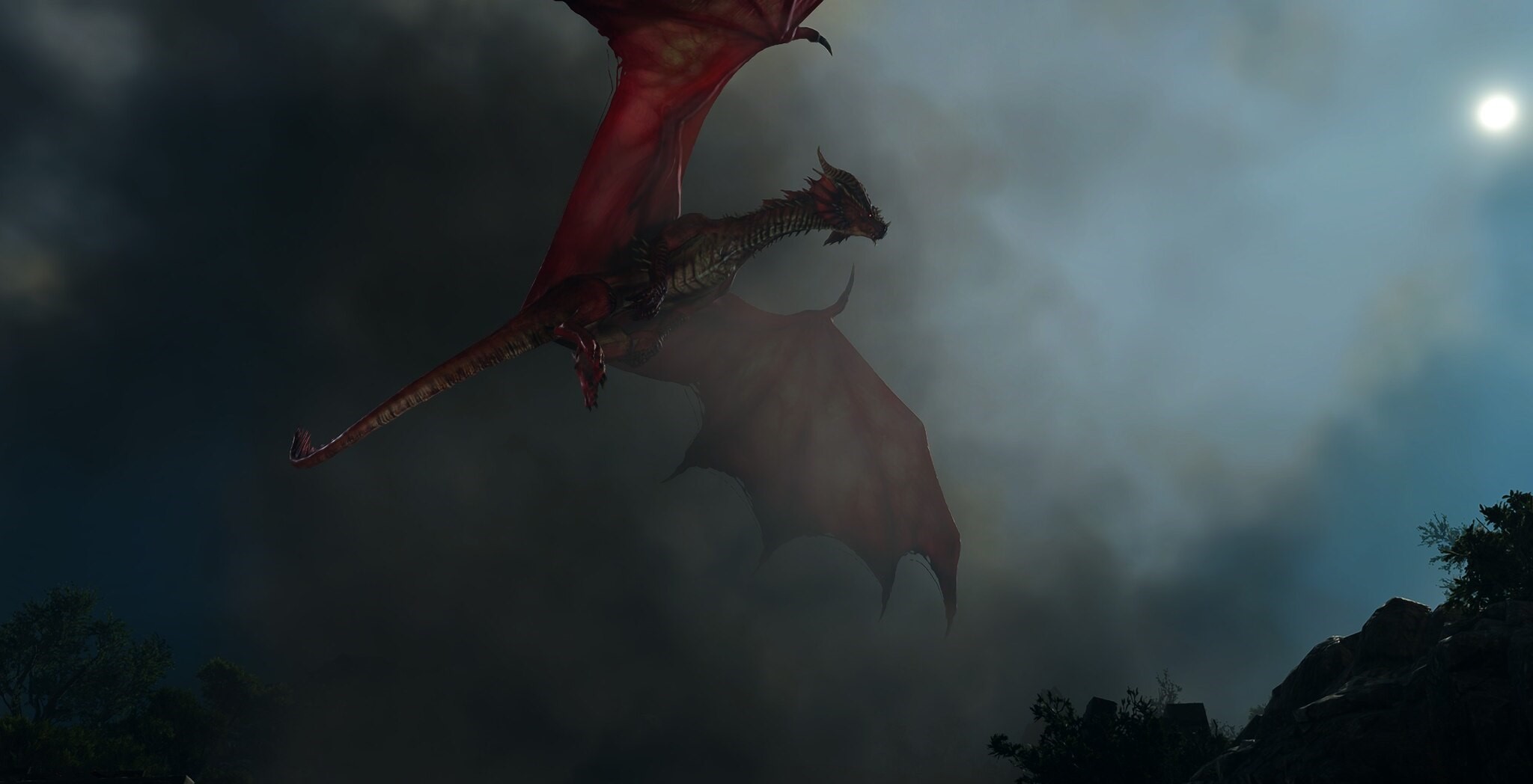
I built in stone. Stone does not burn
In the year 1E 218, almost 20 years after Luric's disappearance and 8 years into Lord Guiraud's reign, a Dragon had flown in from the west. While dragon sightings were not a rare occurrence in Arkael, especially during that time, this Dragon's visitation would live on in infamy in an event known as The Night of Fire. Sometime during the night, the dragon for some unknown reason had laid siege to the Kingdom of Casian. Because Guiraud had never experienced first-hand dragon-based warfare before, he remained boldly confident that the new massive walls he had reinforce the old original walls of his new castle would withstand any attack. Indeed, it is said that a million men could have marched against it and a million men would have been repulsed. And that indeed was true, the walls were too high and too thick, and well-stocked enough to withstand a siege. However, it did not occur to the King that his new castle was designed to withstand an attack by land, and that dragons could fly. When the King had refused to evacuate, Lord Guiraud had continued to boast about the strength of his castle until the very end, claiming that even if the dragon got over the wall, that the walls of the towers would keep them safe. When the sun had gone down, the Dragon had flown high above the walls before plunging down upon Castle Guiraud, burning the castle beneath him. All that was flammable, both suppliers and men, caught fire within the castle, while the great stone towers cracked and melted. Evacuating citizen's outside observed that the towers glowed and melted like candles. Then as the final act, the dragon then proceeded to roast Guiraud, his at the time pregnant wife and his men alive within their own tower, thus rendering the "House of Guiraud '' extinct. The entire castle was blasted with dragon-fire, its once-grand walls and towers left partially ruined and half-melted. Casian was finally no more. The Great Throne had been melted. There was nothing left to fight over.
Second Era
Following the Death of King Guiraud and the entire Guiraud family, life within Arkael actually became relatively peaceful for a while. While battles still raged on they were not as extensive or as long and tedious as the last ones had been. The Nér also retreated back to Shalepeak, having lost all the extensive territory it had obtained during Lord Luric's rule, leaving them back once again at the territory of Shalepeak. As it stood, only 9 royal families, descendants of the original first Nér chieftain's to set foot in Arkael, were what remained of the old days, the others having died out during the wars or other such disasters. Tired of fighting, and tired of bloodshed for the first time since being defeated, the families all agreed that the territory of Shalepeak would be divided amongst themselves. 5 created large cities, less urbanized than many of the other regions in Arkae but still sizeable. The rest simply dotted out across the region finding their own little niche and settled down. Outside of Shalepeak, the constant territorial disputes had resulted in new territories being formed. Because of its constant warring, these territories had fluctuated throughout Arkael's history, either shrinking or growing or being renamed with every battle fought, won, or lost. These territories became as followed: Shalepeaks to the North Sunscald to the South Arborum to the East and the Arkonian Plains to the West, with Shalepeak being the largest of all the regions in terms of landmass alone. For hundreds of years it had stayed like this, with new settlements and cities popping in and out of history. However the scars of the past rarely ever heal fully and Arkael has been proof of that.After Luric
Following the end of the Great Wars many things had changed within the region. The supposed death of Luric was meant to be a godsend to the people under his rule, however things had gotten harsher for many. Luric's death was likened by contemporaries to a "spell" being broken, a vaguely ironic choice of words. Public support for him had been collapsing for some time following his disappearance, and few in his kingdom really mourned his passing; One historian argues that most civilians and military personnel were too busy adjusting to the collapse of the country or fleeing from the fighting to take any interest. According to historian Gilrenen Adan, Lurics world "burst like a bubble" without its leader. However, despite this, his legacy never truly ended. Or at the very least, what came of it. Those who followed his policies, often Ner's, adopted a strong Anti-Mer mentality fueled by Lurics own Xenophobic rantings. Whether Luric's own actual hatred for Mer, especially Elves, came from his own experiences during the Darham Incident and the battles that came after it, or whether or not he was just using it as an excuse to push his own personal views is anyone's guess. But what came of it was a long line of supporters, adopting a policy known as sacraism Sacraism, also known as The Rulings of Sacred Law, was what many who shared Lurics views tended to call the almost "cult-like" movement that followed Lurics teachings way after his "death". The Ner's who supported Luric's Anti rulings, continued to fuel the fires of Lurics Xenophobic rantings, including of the existence of racial conflict between the Ner race and others—particularly Huldu. According to Luric during his ruling, he viewed Huldu as a race that had infiltrated multiple societies and was responsible for exploitation and repression of the Ner race. Many historians often argue:Once too much blood has been spilled on the same ground, the earth remembers and develops a thirst for it
. . . .the radical Ner's sense of morality could be described as a form of procedural virtue ethics, as it demanded unconditional obedience to absolute virtues with the attitude of social engineering and often replaced common sense intuitions with an ideological catalog of virtues and commands. The ideal new man was to be race-conscious and an ideologically dedicated warrior who would commit actions for the sake of the Ner race while at the same time convinced he was doing the right thing and acting morally . . .And it wasn't just Huldu who suffered from these ideologies. According to followers, Sacraism is a series of beliefs that ultimately lead to the idea that Ner were superior to all "non-human creatures/humanoids such as Elves Dwarfs and Beastfolk". This level of Xenophobia came at a price for many non-ner folk, who were either made into slaves, or nearly killed off in extermination attempts. Among these races also included the native Varúlfur. The Ner colonization of the Arkael continent fundamentally changed the lives and cultures of the resident Indigenous Beastfolk. Although the exact pre-colonization population-count of Arkael is unknown, scholars estimate that Indigenous Varúlfur populations diminished greatly by a staggering 80% and 90% drop within the first centuries of colonization, while the Huldu population diminished only 70%-80%, possibly due to tensions not rising between the people for some time until tensions rose between them. Even now in the middle of the 3rd Era, Varúlfur numbers still dwindle to scattered packs throughout Arkael, causing many go into hiding and thus become weary of new strangers. Many surviving Huldu scattered to the winds following the end of the First Era. It is only recently that some have decided to move back to Arkael while tensions are low. In addition, Multiple races of mer still exist within the world of Elysium and other Elven races outside of Arkael have since come from other corners of the world to Arkael. These Races include: Snjór'Huldu: Snow Elves Vatn'Huldu: Water Elves, Aska'Huldu: Fire Elves Each race is named after the elemental magic in which they succeed at, or region where they have hailed from. Aska'Huldu, for example or "Ash-Elves", hail from the "Rings of Cinder" a Hawaii-esq ring of island's south of the mainland known for their volcanic activity. In fact it is the eruption from one of these Volcanoes that caused the Migration of Aska to Arkael during the middle of the second Era. In addition, the Ruins of the city Casian, can still be seen today, baring still the scorch marks of the infamous dragon attack. It is often favored heavily for visitation by research groups and explorers looking to know more about the mad King 1
Trivia
- There was an old legend that occurred during his reign that said that whoever could slay Luric in battle would obtain his sword as a trophy to prove that the old king was dead. This was because The Greatsword of Great Lord Luric was the only weapon that he kept with him from beginning to end. Originally an executioner's sword made for decapitation, this blade was heavily chipped and stained with the blood of countless battles and it never left his side. After the castle of Luric was rennovated by Guiraud, the sword was discovered and put on display as a main attraction. However its disappearance following Guiraud's death and the burning of Castle Casian fueled the rumor that the old king may not truly be dead as the legend said that a person may only own the sword If the king was dead.
- On top of his genocidal tendencies, it is also hinted by many historians that Luric also suffered a great deal of paranoia. One such story, written by the accounts of one of the castle's servants described Luric as a “paranoid man who feared every outsider would do him or his rule harm should they be given the chance to do so”. Stories of the extent of his hatred towards outsiders also circulated amongst the people. Once such story that gained infamous popularity was the outcome of attempted peace talks with the crazed ruler
... Huldu messengers came to [Luric] to pay respects and negotiate peace talks, but refused to take off their Masks, according to their ancient customs. Whereupon the refusal, Luric strengthened their custom by having their masks nailed to their faces with three spikes [forehead, cheek, cheek] so that they could not take them off…
- Too this day, no one knows what became of Luric. Many theories suggest that his attempt to harness the black magic used to keep him younger did not work as he had planned, and after sometime he too fell victim to its corruption like many others beforehand. Other theories suggest that maybe he was indeed killed in an assassination attempt and his death was covered up, or that maybe, ashamed that his attempts at a longer life did not succeed to its fullest, he wandered the wilderness and perished in the elements. Some say, he’s still alive, wandering the castle grounds.
- The1 Lands that make up the original Castle of Casian are thought to be cursed. In addition to all the infighting that occured before Luric came into power, Guiraud had supposedly mixed beastfolk blood from his slaves into the mortar for the stonework of the new walls that surrounded the Castle; some believe that as a result the castle is cursed and haunted due to Guiraud's hubris and the horrors that have occurred within the castle's walls since Lurics reign. Proof of this supposed curse included the early deaths of many rulers who tried to establish territory on Casian after the fact, but failed within a year, the curse thought to prevent any lord from holding Casian indefinitely.
- The Capital of Sol-Impala, one of the newest and largest Capital in Arkael located within the Arkonian Plains and one of the contenders to the newest rounds of civil war set to start within the continent against the settlement Titanshade is noted to be one of the least friendly towards Mer/Beastfolk. Elves who live within the city are confined to a cramped slum below the rest of of the city and while Mer and Beastfolk are not violently persecuted, the locals are often suspicious and outwardly xenophobic while the Leader of Sol turns a blind eye to their plight and is even likely to do so if the confrontations even got violent in the first place. In fact the name Sol-impala is thought to translate into the phrase Fast-Sun, thought to reference/imply the bleak point in its history when magic users/non-human folk were supposedly executed via burning at the stake by a radical hate-group which supposedly formed in the city due to officials failure in cracking down on the hate-crimes that circulated against merfolk and beastfolk alike. It was even rumored that the leader of this group was a supposed General to the Sol garrison.
- In addition to Casian, another patch of land known as the The Culling Field is thought to be haunted: According to Legend it is
A land that has not yet once ever not felt the touch of war or battle. Eons of blood have been spilt on this land and some say eons more will follow before the world is done and the sun is dark. These lands are claimed to be cursed, for once stepped upon blood will flow regardless of the peace between any who dare attempt to cross it.


Comments