The
Firelance, also known as a
Gunlance is a new age take on an old age weapon.
Before the invention of the
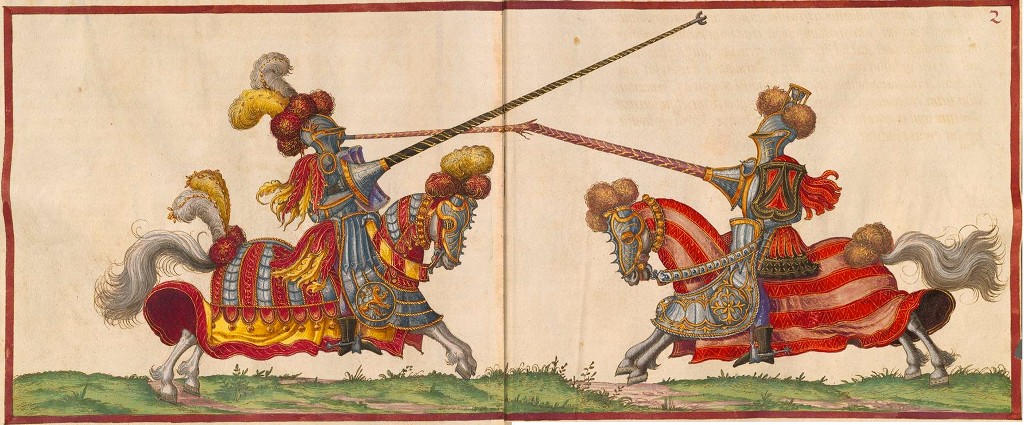
Firearm, Lance use during battle was considered a typical but ancient and medieval form of warfare. Like Pikes and Polearms, Lances evolved into the leading weapon in cavalry charges. However, it was unsuited for throwing or for repeated thrusting, unlike similar weapons of the javelin and pike family typically used by infantry. Lances were often equipped with a vamplate, a small circular plate to prevent the hand sliding up the shaft upon impact.
However, despite it’s constant use, the Lance was not entirely effective during times of war. Battlemen who often used them also carried secondary weapons such as swords, battle axes, war hammers, maces, and daggers for use in hand-to-hand combat, since the lance was often a one-use-per-engagement weapon; assuming the lance even survived the initial impact without breaking off, it was often (depending on the type of lance being used) too long, heavy, and slow to be effective against opponents in a melee.
However as time went on and the discovery and production of firearms became a persistent thing to the point they were starting to make a home for themselves on the battlefield, those who happened to enjoy the lance had a solution for the unreliable nature of the Lance.
By simply making the damn thing even more heavier and slower than before. . .
With the discovery of the firearm, came the creation of the
Firelance. Often called
Gunlances, Firelances are a new age take on the Ancient Lance. While still a long, piercing weapon, Firelances differed from their ancestors, due to a mechanism inside which could fire an explosive round into anything the spear embedded itself into. This motion became often known as
Shelling. However, unlike Guns which could fire a single round at a staggering length of distance before slowing and losing power, the Gunlance could not fire over long distances, lacking the speed necessary to carry the shell, making it that the Shelling ability could only be used from close range. However despite this short-distance limitation, the Firelance still had power behind it and did well when linked with the stabs of the Lance.
Instead of running full speed ahead hoping for spearing damage like one would do with a normal lance, the Firelance was designed to eject exploding shells that could deal massive damage to anything the lance was pointed at and had speared. When a shot wasn’t required, the Firelance could be and still was used like a Lance with its basic attacks being a mix range of stabs, sweeps and slams, the length of the spear also allowed for great distance between the enemy and the Lance-Holder though was ineffective for those who could not handle the slowness and weight of the weapon.
Beast Jousting
Spear hunting could quite possibly be one of the oldest methods of hunting in the world.
In fact the only thing that could be simpler than it would be the act of throwing a heavy rock or a stick at something. Spears and the act of spear hunting have been around since as far back as the
Dawn of Vacillation in Elysium according to archaeological digs. And the reason spears continued to rise in prominence was their simplicity; with the most basic spears being simply sharpened sticks, spear hunting became so prominent with early man that it is often theorized that hunters with spears helped cause the Quaternary extinction event by killing so many herbivores. The act of spear hunting has even been observed in different non-human and mer primates, including the chimpanzee and the orangutan.
In Arkael and more Eastern Continent's, spear hunting has a long history embedded into it. In many places, especially provinces run by lords such as the
Shalepeak Hinterland, Wild boar and Winset was strictly preserved in the royal forest for the benefit of the monarch and favored noblemen. Boars were hunted by packs of large mastiff-type hounds at this time, and when cornered and held at bay were slaughtered using swords and spears. As the spear slowly gave way to the gun however, spear hunting became less popular as time went on. However those who enjoyed the thrill it gave them kept the hobby alive. Despite this, hunting with a spear still remains more dangerous than hunting with a gun, or even a bow. If you miss a vital spot on your chosen game with a bow or gun you could simply reload-miss with a spear you would either spook the game or have to face a wild wounded animal, which was never safe.
Enter the production of the
Firelance.
The Firelance was supposed to be the answer to both
Power and
Convenience as well as be an upgrade for the typical nature of hunting with a lance/spear that many people still used and wanted to keep on doing so. And while it does have its downsides, the Firelance still remains one of the most popular weapons to use against large game as it presents a unique twist on a historical method of hunting which many big game hunters find thrilling, and people tend to often pay more for such a spectacle, despite the obvious dangers it presents.
Despite this, while hunting large game, Firelance's are not usually the first weapon of choice and are usually used as a backup to deliver a final
coup de grace to fallen creatures by stabbing it into a weak spot on the creature, such as the chest or the eyes and then repeatedly firing into it. In most cases the spear part of the weapon was often designed as such that once it penetrated something, it was quite securely anchored into the target. Those who desired more of a challenge however, often removed the hook-shape head in favor of something else like a club or a large blade like bayonet to do added damage to swing and slam attacks. Certain regional design choices also made changes to the weapon that allowed for the gun portion of the weapon to be fired more than once, making it capable of delivering up to several lethal blows once it has been anchored into the creature. Seven was normally the limit as anything higher ended up being a concern of a potential weight distribution issue thus making the Firelance too top heavy.
Changes like these were also often regional as material required to make the weapon more customizable were very hard to come by in more poorer parts of the continent, and as such using a Firelance to hunt was often saved for those of "rich" upper status or simply those who could afford the material or were willing to pay someone to have it made for someone such as
Royal Beast-Hunters or
Hunters for Hire
Mounts were also often used due to the potential of the lance's unwieldy size, but they were not necessary as an averagely built man can carry and run with the lance and accurately pierce it into their target just as easily as one with a mount. As a result, mounts were often instead only used when a Beast Jouster was participating in a
blood-sport, where timing and precision for quick kills are discarded for flashy foot-work and expert maneuvering skills and lengthening the hunt as long as possible.





Comments