

Grandi (Grand-ee)
Mother's Heat
To the unknowledgeable, the Grandi plant could be considered a relatively amusing, if annoying, plant to encounter. With an overtly bitter fruit and no other obvious beneficial elements, the plant was ignored for many years throughout Churrian history until a curious cook tried out the plant's seeds as a spice in an otherwise nonimportant dish as an experiment. The success of this recipe rocketed the plant into a place of cultivated importance that, even now, can be seen in many Churrian gardens throughout Refuge. Nonoffensive in its flavor, the Grandi spice is often referred to as Mother's Heat due to the pleasant warm glow it can give to the taster's tongue upon consumption.
Basic Information
Anatomy
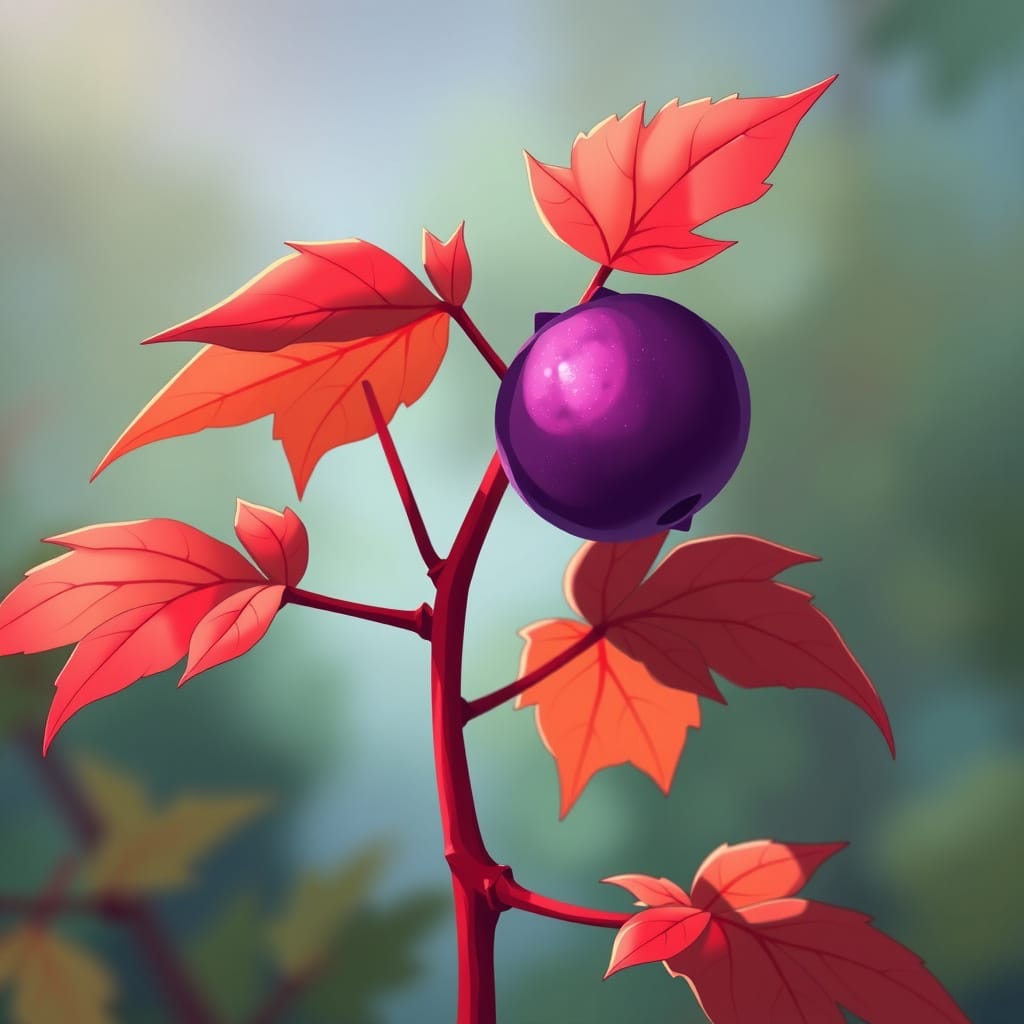
Consisting of a thick red stem and dull crimson leaves, the Grandi would often fail to stand out among the red foliage surrounding it were it not for the single large purple fruit that decorates it. Lucious in appearance, this fruit is filled with small round black seeds that are the source of Grandi seasoning. Slightly spicy and well-rounded in its flavor, this spice has seen cultivation of this plant occur in many Churrian gardens and greenhouses in order to maintain it as a staple food enhancer.
Biological Traits
Due to the Grandi's rapid growth and seeding cycle, the plant has seen consistent use as a selective breeding option for many Churrian gardeners. As such, there exists a wide variety of domestic options, including those with different types of seed shapes, smaller but edible fruits, and even different overall colorations to signify new internal characteristics such as subtle but powerful flavor changes.
Genetics and Reproduction
While wild versions of this plant rely on the dispersal of its seeds via animals attracted to eat the plant's juicy fruit, domestic gardeners have to be more purposeful in their sowing. During the spice harvesting process, a selection of the Grandi's seeds are set aside for future harvests as, unfortunately, the plant itself lives and dies in a single harvest cycle and, as such, cannot be maintained long-term without this forethought.
Growth Rate & Stages
To many Churrian gardeners, the Grandi plant is considered to be a bit of a dramatic species. While it performs reasonably well in a variety of different seasons and soils, the plant will always grow at a rapid rate to reach maturation and the development of its single large fruit before dying. As such, a single growing cycle similar to that which took place on their home planet of Churr may see two or three different harvests before a natural freeze prevents any further seeds from growing. Within greenhouses and other similar spaces, however, the plant may be grown and harvested indefinitely, provided the soil is frequently treated with nutrition.
Ecology and Habitats
Were it not for the plant's singular saving grace as a source of spice, it would be considered an annoying weed in many situations. Able to grow in many different climates and soil compositions, the Grandi plant can easily take over a patch of land before dying and regrowing rapidly once more in a consistent cycle that can frustrate the unprepared landowner.
Additional Information
Domestication
Utilized both as an in-home product and as a commercial food staple within Churrian society, the Grandi plant has seen an easy transition toward regular cultivation efforts and, as such, exists in many Sanguar Institute facilities as both a means of seasoning and as a strong initial trade good with friendly peoples.
Uses, Products & Exploitation
Primarily used as a source of Grandi seasoning, as the plant's central fruit has proven to be too bitter for all but the strongest stomachs, the plant's spice can be found all throughout Churrian society in many kitchens as a pleasant staple in various meat and stew dishes. This is acquired by removing the singular fruit, smashing it onto a flat surface, and allowing it to dry out either in the sun or with machine assistance. Once completely dry, the small black seeds are peeled off the plant's dehydrated fruit elements and ground into a fine powder or stored for use later.
Geographic Origin and Distribution
A relatively common sight within the fields of Churr, the Grandi can now only be found within the gardens and greenhouses of the displaced Churrian people. As such, it is rare to find it outside of these environments, although not impossible, thanks to the actions of careless gardeners or animal intervention.
Lifespan
1 Month.
Conservation Status
This species is relatively rare throughout Refuge as it is primarily found in Churrian gardens as opposed to being allowed to grow in the wild, though there are exceptions.
Average Height
2 to 3 feet.
Geographic Distribution

Comments