
Velkara Republic
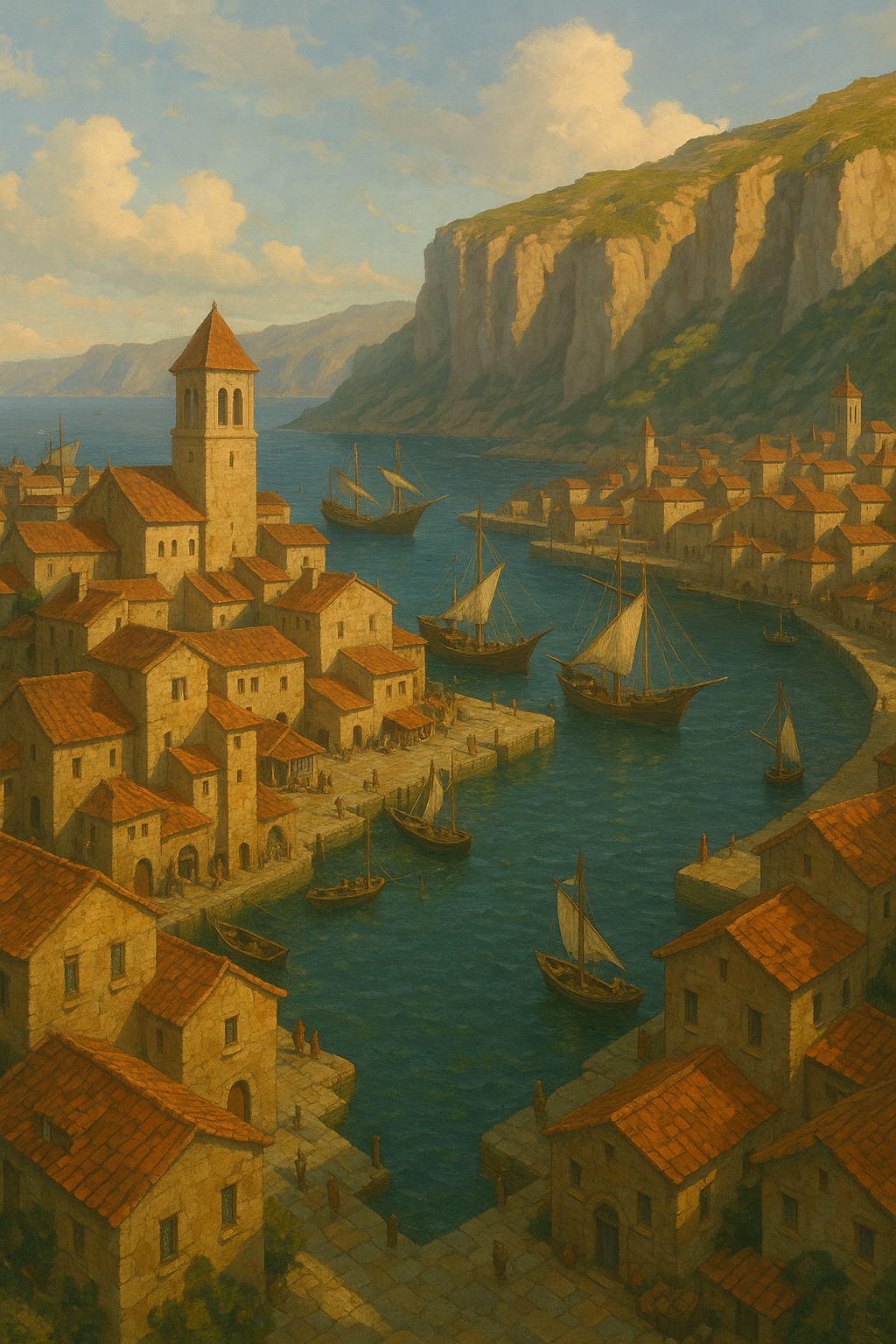
The Velkara Republic is a vibrant coastal nation defined by its fertile southern plains, bustling maritime routes, and the rugged mountains that anchor its northwestern border. Formed from an alliance of eight distinct racial factions—Humans, Elves, Dwarves, Gnomes, Halflings, Tieflings, Dragonborn, and Half-Elves—the republic thrives on a delicate balance of interdependent trades and shared governance. Each faction controls a vital part of the economy, from dwarven mining and halfling agriculture to human seafaring and gnomish innovation, creating a society where cooperation is not merely cultural but essential for national survival. The capital, Veshyr Port, stands as a cosmopolitan hub of commerce and diplomacy, its harbor bustling with ships that connect Velkara to distant regions and cement its reputation as one of the most trusted trading powers on the continent.
Politically, Velkara is governed by the Circle of Eight, a council of elected representatives—one from each faction—tasked with maintaining balance, mediating disputes, and safeguarding the republic’s prosperity. While factional rivalry and behind-the-scenes maneuvering are common, overt conflict is rare; the republic’s laws and shared founding myth promote unity and mutual respect. Velkara values innovation, fairness, and civic responsibility, resulting in advanced infrastructure, efficient trade networks, and a well-educated populace. Though surrounded by larger or more militaristic nations, Velkara’s strength lies in its diplomacy, strategic maritime presence, and the collective will of its diverse people. More than a political state, the Velkara Republic is a living testament to the belief that many voices can govern as one, and many cultures can prosper together.
Structure
The Velkara Republic operates under a Guild-Senate system, where political authority is distributed among the eight dominant trade factions that form the backbone of the nation’s economy. Each faction—representing one major race and its associated industry—elects or appoints a Guild Representative, known collectively as the Circle of Eight. These representatives travel to Veshyr Port, the capital, where they serve as lawmakers, trade arbiters, and foreign policy architects. No decision of national importance can pass without a majority vote from the Circle, ensuring that the republic remains balanced, cooperative, and economically aligned. Beneath them, regional councils manage local affairs, but all power ultimately flows through the factions’ influence in the capital.
The Circle of Eight works alongside the Maritime Chancellor, a human-elected executive who oversees day-to-day governance and mediates disagreements between factions. This Chancellor has limited direct power but wields immense influence through diplomacy, court management, and control over administrative appointments. Each faction representative brings the cultural perspective and economic priorities of their people: Gnomes argue for technological expansion, Dwarves secure mining rights, Halflings protect the food supply, Elves ensure legal consistency, Tieflings regulate finance and contracts, Dragonborn safeguard border defense, Humans negotiate trade treaties, and Half-Elves maintain internal harmony. The result is a republic held together not by monarchy or military rule, but by a web of shared economic dependency, political negotiation, and the constant balancing of factional interests.
Culture
The Velkara Republic operates under a Guild-Senate system, where political authority is distributed among the eight dominant trade factions that form the backbone of the nation’s economy. Each faction—representing one major race and its associated industry—elects or appoints a Guild Representative, known collectively as the Circle of Eight. These representatives travel to Veshyr Port, the capital, where they serve as lawmakers, trade arbiters, and foreign policy architects. No decision of national importance can pass without a majority vote from the Circle, ensuring that the republic remains balanced, cooperative, and economically aligned. Beneath them, regional councils manage local affairs, but all power ultimately flows through the factions’ influence in the capital.
The Circle of Eight works alongside the Maritime Chancellor, a human-elected executive who oversees day-to-day governance and mediates disagreements between factions. This Chancellor has limited direct power but wields immense influence through diplomacy, court management, and control over administrative appointments. Each faction representative brings the cultural perspective and economic priorities of their people: Gnomes argue for technological expansion, Dwarves secure mining rights, Halflings protect the food supply, Elves ensure legal consistency, Tieflings regulate finance and contracts, Dragonborn safeguard border defense, Humans negotiate trade treaties, and Half-Elves maintain internal harmony. The result is a republic held together not by monarchy or military rule, but by a web of shared economic dependency, political negotiation, and the constant balancing of factional interests.
Public Agenda
The public agenda of the Velkara Republic is driven by its foundational belief that prosperity comes from balanced trade, political cooperation, and safeguarding the nation’s diverse economic sectors. Velkara prioritizes maintaining open trade routes, expanding maritime commerce, and fostering innovation in agriculture, engineering, and magical research. The government works to ensure that each faction—whether tied to farming, mining, shipbuilding, or banking—remains stable and productive. Citizens from all walks of life support measures that strengthen the republic’s infrastructure, protect its ports, and ensure fair representation in the Circle of Eight. Public sentiment strongly favors policies that keep Velkara peaceful, wealthy, and diplomatically respected across the region.
At the same time, the republic’s agenda emphasizes internal cohesion and strategic defense. While Velkara is not an expansionist nation, it remains vigilant against external threats—especially from the militaristic Zilaran Empire to the north. The public supports investments in border defenses, mercenary contracts, and diplomatic alliances that preserve autonomy without provoking unnecessary conflict. Education, fairness in trade, sustainable use of natural resources, and respect for cultural diversity form additional pillars of Velkara’s agenda. Citizens expect transparency from their leaders and place high value on civil debate, believing that every faction’s voice must be heard for the republic to thrive. In Velkara, the public agenda is not merely a policy framework—it is the social contract that binds eight distinct peoples into a unified and prosperous nation.
Assets
The Velkara Republic possesses a wealth of assets derived from its diverse landscape and the specialized industries of its eight factions. The fertile plains and river valleys of the central region provide abundant agricultural output—grains, wines, fruits, and livestock—controlled by the Halfling Agricultural Syndicate. These food surpluses not only sustain Velkara’s population but also fuel trade with neighboring nations. Along the southern coastline, deep-water harbors and favorable currents create ideal shipping hubs, allowing the Human Maritime League to maintain one of the most active commercial fleets in the region. Meanwhile, the mountainous northwest grants the republic access to iron, silver, gems, and stone, harvested by the Dwarven Mining Guilds and refined in gnomish-equipped facilities. This balance of food, metals, and maritime supremacy forms the backbone of Velkara’s economic strength.
Beyond natural resources, Velkara’s greatest asset is its institutional and cultural infrastructure, built upon centuries of cooperation between distinct races and trades. The Gnomish Artificer Consortium contributes cutting-edge engineering, arcane machinery, and technological innovation that give Velkara a competitive edge in trade and defense. Elven-run universities and administrative institutions codify laws, advance magical research, and maintain stability within the republic’s borders. Tiefling contract houses provide financial services, forensic accounting, and diplomatic expertise, ensuring that Velkara remains a reliable trading partner and a formidable negotiator. Dragonborn frontier companies offer military resilience, guarding trade routes and reinforcing Velkara’s northern border. Together, these intertwined assets—economic, cultural, technological, and defensive—make Velkara one of the most stable and prosperous republics in the region.
Demography and Population
The Velkara Republic is home to an estimated 190,000 inhabitants, distributed across fertile coastal settlements, river-fed plains, mountain strongholds, and desert-edge frontier towns. Its population is remarkably diverse, with no single race forming an overwhelming majority—a rarity in Redredan and a defining strength of the republic’s identity. Humans make up roughly 30% of the population and are most common in port cities and market hubs, where they drive maritime commerce and diplomatic outreach. Halflings, composing 20%, dominate the agricultural heartlands and provide much of the nation’s food security. Gnomes (≈12%) inhabit workshop-dense mountain and riverside towns where they innovate, build, and engineer. Dwarves (≈10%) form the backbone of the mining regions, overseeing stonecraft and metallurgy. Elves (≈12%) are concentrated in administrative and academic centers, guiding Velkara’s legal system, magical research, and long-term policy planning.
Tieflings, about 8% of the population, cluster in mercantile districts where finance, contract law, and espionage networks thrive. Dragonborn, representing around 5%, hold key positions along the northern frontier, shaping the republic’s defensive strategies and maintaining order on desert trade routes. Half-Elves, approximately 3%, act as social binders, facilitators, and mediators across factional lines. This balanced demographic structure is central to Velkara’s political function: each major racial group anchors an economic faction, ensuring that power is distributed across cultural and professional boundaries. The result is a republic where diversity is not just tolerated—it is institutionalized, celebrated, and essential for national stability. Every Velkaran grows up understanding that the republic survives not because its people are the same, but because each group strengthens a different pillar of its society.
Military
The Velkara Republic maintains a highly coordinated but decentralized military, built around the strengths of its racial factions rather than a single unified army. At its core are the Velkaran Coastguard Fleets, commanded primarily by human admirals and staffed by mixed-race crews trained for naval defense, piracy suppression, and rapid response along the southern sea routes. On land, the Dragonborn Frontier Company provides disciplined, elite infantry stationed along the northern desert border, where they repel raiders, escort caravans, and monitor Zilaran troop movements. Supporting them are specialized units: Dwarven siege engineers who construct fortifications and design defensive artillery, Gnomish arcane-artificer squads capable of disabling enemy war machines or enhancing defenses, and Goblins hired as light scouts from nearby trade routes. Velkara’s military strength lies not in sheer numbers but in strategic coordination, faction synergy, and terrain mastery.
Because the republic values trade stability above conquest, its armed forces focus on defensive resilience, rapid mobilization, and tactical flexibility. The Halfling Agricultural Syndicate funds militia reserves to protect rural assets, while the Tiefling Contract Cartel manages intelligence networks, counter-espionage, and diplomatic crisis response. In wartime, the Elven Civil Assembly organizes logistics, command structure, and magical support through specialized battlemages trained in protective and divination arts. Velkara’s military doctrine emphasizes avoiding head-on conflict with larger empires; instead, it relies on fortified passes, naval control, mercenary auxiliaries, and clever engineering to outmaneuver stronger foes. The republic fights with precision, not force—ensuring that its soldiers, ships, and strategies safeguard commerce, independence, and the delicate balance that holds its faction-driven society together.
Technological Level
The Velkara Republic is widely regarded as one of the most technologically progressive nations in the region, thanks to the ingenuity of the Gnomish Artificer Consortium and the precision of the Dwarven Mining Guilds. Gnomerra-Lyss serves as the republic’s innovation capital, producing arcane instruments, mechanical devices, refined navigation tools, and early-stage magi-tech prototypes. Waterwheels, focused-light workshops, clockwork regulators, and mana-conducting alloys are common here. Meanwhile, dwarven metallurgy ensures that Velkara’s tools, weapons, and infrastructure are built to unmatched durability standards. Together, these two factions drive advancements in mining efficiency, transportation technology, architectural reinforcement, and agricultural machinery—allowing the republic to maintain high productivity with fewer workers.
Scientific progress is equally shaped by the Elven Civil & Arcane Assembly, which oversees magical research, astronomy, medicine, and the codification of natural laws. Elven academies maintain libraries of arcane theory and host colleges devoted to star-mapping, botany, hydrology, and civil planning. Tiefling contract scholars contribute rigorous economic analysis, forensic accounting, and legal logic frameworks that make Velkaran governance unusually rational and forward-focused. While the republic does not pursue high-level magical weaponry like the Zilaran Empire, its innovations prioritize efficiency, sustainability, and civic improvement—canal systems, standardized weights and measures, enhanced trade logistics, and reliable spell-regulation protocols. Velkara’s scientific identity is one of practical brilliance: a nation where progress is measured not by spectacle, but by how many people benefit from it.
Religion
Religion in the Velkara Republic is pluralistic, decentralized, and deeply tied to the professions and factions that define its society. Instead of a single dominant faith, each racial group maintains its own ancestral traditions, with temples and shrines integrated into their respective guild districts. Halflings honor agricultural spirits and hearth gods tied to the land’s fertility; Dwarves venerate forge-deities and ancestral spirits who guide their craft; Gnomes revere patrons of invention, curiosity, and discovery; Elves follow gods of order, knowledge, and arcane balance; Tieflings tend to worship gods of contracts, fate, and hidden truths; Dragonborn maintain reverence for martial and honor-bound draconic deities; and Humans uphold a wide range of sea gods, wind spirits, and deities of trade and travel. Despite this diversity, Velkara’s religious groups coexist peacefully due to shared civic values and a cultural expectation that faith must never obstruct trade or governance.
The republic’s most distinctive religious institution is the Harmonium Hall, a neutral sanctuary in Veshyr Port where representatives of every major faith meet to mediate disputes, coordinate festival calendars, and ensure rites do not conflict with public welfare. Rather than dogma, Velkaran religion emphasizes practical spirituality: blessings for safe voyages, good harvests, prosperous deals, and unified leadership. Citizens frequently participate in rituals outside their own tradition, viewing divine favor as a communal resource rather than a personal claim. This interwoven religious landscape reinforces the republic’s identity—faith is respected, shared, and adapted, but never weaponized. In Velkara, the gods are many, their followers diverse, and their purpose unified: to enrich life, guide honest work, and strengthen the bonds between the eight factions that hold the republic together.
Laws
Velkara’s legal system is built on the principles of fair trade, transparent governance, and balanced factional representation. The core legal code—maintained by the Elven Civil & Arcane Assembly—establishes equal rights across races, standardized commercial practices, and strict protections for contracts, property, and artisanal patents. All major disputes between individuals or factions are settled in Trade Speakers’ Courts, where arguments are judged based on evidence, logic, and precedent rather than social status or political influence. Corruption, fraud, and breach of contract are among the most heavily punished crimes, reflecting the republic’s belief that trust is the foundation upon which commerce and cooperation are built. Laws also prohibit monopolies and price manipulation to ensure that no faction’s economic dominance threatens the republic’s stability.
Local governance operates under regional statutes, but all must comply with the national code enforced by the Circle of Eight. Every major faction appoints legal advisors to monitor fairness within their sectors, and the Tiefling Contract Cartel serves as the republic’s de facto legal watchdog, identifying inconsistencies, abuses of power, or attempts at hidden exploitation. Punishments favor restitution over imprisonment—criminals often repay damages through labor, service to affected factions, or fines distributed back into the community. The republic also maintains strong anti-discrimination laws, ensuring that guild membership, employment, and political participation remain open across racial lines. Through these intertwined systems, Velkara’s laws cultivate an environment where cooperation flourishes, disputes are resolved without violence, and the integrity of trade remains sacred.
Agriculture & Industry
Agriculture in the Velkara Republic is dominated by the Halfling Agricultural Syndicate, whose farms, orchards, and vineyards cover the fertile coastal plains and central river valleys. These lands produce grains, fruits, vegetables, wine, livestock, and preserved goods that not only sustain Velkara but drive significant export trade. Halflings are masters of soil rotation, seed cultivation, and water-efficient farming—methods that the republic has adopted as national standards. Small human and elven settlements contribute supplementary crops and herbal stock, while gnome-built irrigation systems allow fields to thrive even during drier years. The agricultural sector is considered the republic’s “foundation,” ensuring stability and independence from foreign food supplies.
Industry, meanwhile, is a complex web of faction-driven specialization. Dwarven Mining Guilds supply iron, copper, silver, precious stones, and cut stone from the northwest mountains, forming the raw backbone of Velkara’s manufacturing strength. These materials feed into Gnomish artificer workshops, where metals are transformed into tools, enchantment-ready alloys, mechanical components, and high-efficiency machinery. Human coastal cities produce ships, sails, ropework, and trade goods tied to maritime industries. Tiefling contract houses support industrial expansion through financing, logistics management, and foreign partnerships. Together, these interconnected sectors allow Velkara to produce high-quality metalwork, engineered devices, agricultural technology, and commercial vessels, giving the republic a competitive edge in both local and international trade. Agriculture sustains the body of Velkara—industry fuels its ambition.
Trade & Transport
Trade is the lifeblood of the Velkara Republic, flowing through its southern coastline and central river systems like veins of prosperity. Veshyr Port, the capital, serves as the republic’s primary commercial hub—its deep-water harbor welcomes merchant fleets from across the continent. The Human Maritime League oversees shipping routes, naval escorts, lighthouse maintenance, and port tariffs, ensuring safe passage for goods and travelers alike. Coastal trade focuses on exporting agricultural produce, gnomish devices, dwarven metals, and crafted goods, while importing exotic spices, silks, rare magical components, and foreign manuscripts. Inland commerce moves along well-maintained roads linking Rivenpass Crossing to all major settlements, creating a seamless flow of caravans, diplomats, and trade envoys. Velkara’s reputation as a stable, fair-dealing republic makes it a preferred trading partner for many nations.
Transport within the republic reflects its commitment to efficiency and accessibility. Gnomish engineering has produced durable stone bridges, standardized road grades, calibrated mile-markers, and experimental self-pulling carts powered by controlled arcane pressure. Dwarven craftsmanship strengthens tunnels and mountain passes, allowing safe movement of ore to industrial centers. Dragonborn and Goblin mercenaries patrol desert-edge trade roads to discourage raiders and protect caravan routes. River barges connect inland agricultural districts to major coastal markets, and elven administrative oversight ensures infrastructure remains orderly, safe, and regulated. Meanwhile, tiefling financial houses insure caravans, ships, and high-value cargo, stabilizing the entire logistics network. Through this layered system of land, river, and maritime transport, Velkara maintains a robust, interconnected economy that supports its factions and secures its prosperity.
Education
Education in the Velkara Republic is shaped by its faction-based society, producing citizens who are both skilled in their trades and deeply aware of the republic’s cooperative structure. Children begin with Foundational Schooling, a universal program taught in every major settlement and overseen by the Elven Civil & Arcane Assembly. These early lessons emphasize literacy, arithmetic, history, civic responsibility, and an introduction to the eight faction trades so that every child understands the nation’s interdependent economy. Halflings teach practical agriculture and stewardship of the land, Humans instruct basic seamanship and trade etiquette, and Gnomes introduce mechanical principles and problem-solving through hands-on tinkering. By adolescence, most youths choose a Guild Path, apprenticing under their racial faction or joining a mentor from any trade they feel called to—regardless of their birth.
Higher education is centered in Vaelyrion and Gnomerra-Lyss, where elven academies and gnomish institutes operate side by side. Elven universities specialize in law, diplomacy, magical studies, medicine, and administrative sciences, forming the backbone of the republic’s civil service. Gnomish colleges focus on engineering, artificing, alchemy, and applied arcana, producing inventors and innovators who advance Velkara’s infrastructure and industry. Dwarven halls provide metallurgy mastery, Dragonborn schools teach martial discipline and frontier tactics, and Tiefling academies offer training in economics, contract law, and intelligence work. Half-Elven mediation houses round out the system with instruction in rhetoric, negotiation, and inter-faction diplomacy. Through this multifaceted educational network, Velkara cultivates a highly skilled, highly adaptable population—one capable of sustaining a republic built on both specialization and unity.
Infrastructure
The Velkara Republic boasts some of the most reliable and intelligently designed infrastructure in the region, thanks to the combined work of Gnomish engineers, Dwarven builders, and Elven civil planners. Major roads connecting the eight faction cities are paved with reinforced stone, fitted with standardized mile markers, and maintained by joint guild task forces. Bridges, aqueducts, and irrigation channels are engineered with precise gnomish mechanisms and constructed with dwarven stonework, ensuring durability against weather, flooding, and seismic shifts from the nearby mountain range. Coastal cities benefit from extensive dock networks, lighthouse systems powered by arcane lenses, and layered seawalls that protect harbors from storm surges. Inland, well-maintained canals and river ports support agricultural movement, allowing goods from Elarin Fields to reach Veshyr Port with speed and consistency.
Public services are equally advanced. Elven administrators oversee zoning laws, sanitation systems, and public lighting enchanted to illuminate streets at dusk. Gnomish water turbines provide clean energy to workshops and select districts, while tiefling-funded investment projects support the expansion of hospitals, libraries, and trade courts. Dragonborn frontier engineers fortify border roads and desert passes, ensuring safe travel and rapid mobilization in times of crisis. Even rural towns enjoy efficient storage granaries, reinforced wells, and planned caravan rest-stations that keep trade moving without interruption. Together, these innovations form a networked, resilient, and highly integrated national infrastructure—one that reflects Velkara’s core philosophy: a republic thrives when every faction builds something essential for all others.
Mythology & Lore
Velkaran mythology is a tapestry woven from the traditions of its eight racial factions, each contributing stories that reflect their trade, values, and ancient roots. Halfling myths speak of The Verdant Steward, a gentle guardian spirit who taught their ancestors how to coax life from barren soil. Dwarves tell of Stonefather Korun, whose hammer strikes shaped the first mountains and revealed the ores within. Gnomes revere Lyss the Tinkerer, a wandering demigod whose curiosity created both marvels and catastrophes. Humans share tales of Selthar the Navigator, a sailor blessed by wind spirits to chart the southern seas. Elven myths revolve around The Luminous Archivist, a deity of memory and magical order, while Tiefling legends recount The Blind Judge, a fate-bound entity who weighs truth without fear or favor.
These stories merge into a uniquely Velkaran tradition centered on The Eight Pillars, a mythic framework claiming that the world remains stable only when eight forces—craft, knowledge, labor, law, commerce, protection, nourishment, and invention—remain in balance. Ancient Half-Elven storytellers formalized this concept, and over time it became a symbolic representation of the republic itself. One widely shared myth warns of The Great Sundering, a time in primordial history when the Pillars fell into conflict, causing storms to tear the seas, deserts to swallow cities, and mountains to crack open. Peace was restored only when emissaries from each Pillar forged an oath to uphold balance above all else—a story Velkarans view as both allegory and prophecy. In this blended mythology, the republic sees its identity reflected: many peoples, many stories, united by the belief that strength comes from harmony, not domination.
Divine Origins
The Velkara Republic began as a loose network of independent trade settlements situated along the fertile southern coast and the mountain foothills to the northwest. In the early days, each racial group—Humans, Dwarves, Halflings, Gnomes, Elves, Tieflings, Dragonborn, and Half-Elves—lived in isolation within their respective territories, bound more by necessity than unity. As coastal trade expanded and mining operations deepened, tensions rose over resource rights, port access, and caravan protections. Conflicts became common, ranging from skirmishes between miners and farmers to naval disputes along the coast. Everything changed during the Era of Fractured Roads, when a series of devastating storms, bandit uprisings, and foreign manipulations threatened to collapse regional stability. It was during this crisis that leaders from each faction agreed to meet in neutral territory to discuss survival, not dominance.
From this emergency council emerged the Concord of Eight, a foundational pact in which each race pledged cooperation through shared governance, economic interdependence, and mutual defense. The Concord formalized the concept that each faction held mastery over a specific industry essential to the prosperity of all—agriculture, mining, artifice, law, commerce, sea trade, frontier defense, and diplomacy—binding them into an unprecedented alliance. Over generations, this alliance evolved into the modern Velkara Republic, with Veshyr Port rising naturally as the capital due to its central location and maritime accessibility. The Circle of Eight was established to maintain balance, ensuring no faction could dominate the others, and the republic transitioned from fragile coalition to flourishing nation-state. Velkarans today view their origins not as a tale of conquest, but as a triumph of cooperation—a reminder that the republic was born not out of shared blood, but out of shared need and shared vision.
Tenets of Faith
Although Velkara hosts many religions from its eight racial groups, a shared moral framework—known informally as the Principles of Concord—guides religious life across the republic. These principles are not enforced by law, nor attributed to a single deity. Instead, they evolved organically through centuries of interaction between Halfling farmers, Dwarven miners, Elven scholars, Gnomish inventors, and the other factions whose livelihoods depend on one another. The first and most sacred tenet is Balance Above All, echoing the myth of the Eight Pillars and emphasizing that no individual or faction may pursue prosperity at the cost of the whole. The second is Honesty in Craft, holding that deceit in trade, contracts, or workmanship is both a moral offense and an affront to the gods who bless labor. The third is Respect for Diversity, rooted in the belief that the gods speak through many domains—earth, sea, craft, law, invention, destiny—and that each race’s traditions reflect a facet of cosmic order.
The remaining tenets emphasize conduct rather than worship. Protection of the Vulnerable reminds frontier warriors, merchants, and scholars alike that the republic survives only when its weakest members are safeguarded. Stewardship of Land and Labor calls for responsible use of natural resources and celebration of honest work. Seek Knowledge, Share Knowledge encourages learning across faction lines and promotes the elven idea that enlightenment grows stronger when circulated rather than hoarded. Finally, Unity in Crisis serves as a moral commandment born from the republic’s founding: when external threats arise—whether famine, invasion, or political instability—all factions must stand together. These tenets do not replace traditional gods or rituals, but they form the spiritual glue of Velkaran society, shaping attitudes, guiding trade ethics, and reinforcing the belief that the republic’s greatest strength is the harmony of its many peoples.
Ethics
Ethical life in the Velkara Republic is grounded in the belief that integrity sustains prosperity, and that a republic built on intertwined trades can only function if its people uphold fairness in their dealings. Velkarans place immense value on honesty, transparency, and the fulfillment of promises—an ethos reinforced by both Halfling agricultural traditions and Tiefling contract culture. Breaking one’s word, falsifying records, or defrauding a partner is seen not only as dishonorable but as a direct threat to national stability. Because the factions rely on each other’s specialized labor, ethics naturally revolve around trust, cooperation, and professional pride. Citizens are expected to honor their craft, respect the contributions of other trades, and avoid actions that would disrupt the delicate balance between factions.
Social ethics further emphasize civic responsibility, believing every individual contributes to the republic’s greater good regardless of race or profession. Helping maintain public infrastructure, educating the young, protecting travelers, and showing courtesy during trade or negotiation are seen as moral obligations. Velkarans also value moderation and diplomacy, rejecting unnecessary conflict and viewing violent escalation as a failure of communication or leadership. Respect for diversity is a cornerstone of their ethics: no race’s customs, deities, or traditions are considered superior, and prejudice is socially condemned. In times of crisis, unity becomes the highest ethical standard—every faction is expected to set aside rivalries and support the needs of the whole. Ultimately, Velkaran ethics reflect the heart of the republic: a society where cooperation is virtue, balance is wisdom, and the wellbeing of many outweighs the ambitions of one.
Worship
Worship in Velkara is a deeply personal and highly varied practice, shaped by the republic’s multicultural identity and the absence of a single dominant religion. Each racial group maintains its own temples, shrines, and rituals, but all coexist peacefully within the same cities and markets. Halflings gather in open-air groves to honor spirits of land and harvest, while Dwarven forges double as sanctuaries for invoking ancestral smith-gods. Elves worship through meditation, scholarship, and quiet rituals within marble sanctums, whereas Gnomes favor lively workshops where invention is seen as an act of devotion to their patron deities. Tieflings conduct solemn rites in contract-houses that blend worship with oaths of truth and justice. Dragonborn venerate martial and honor-bound draconic gods through disciplined combat rituals, and Humans hold ceremonies for sea and wind deities that bless voyages and trade winds.
Despite this diversity, the Velkaran approach to worship is remarkably cohesive, founded on the cultural expectation that faith must support civic harmony rather than divide it. Interfaith ceremonies are common during festivals, trade agreements, and crisis moments, with priests of different traditions offering blessings side by side. The most respected sacred space is the Harmonium Hall in Veshyr Port—a neutral sanctuary where clergy of all races gather to mediate theological disputes, coordinate major holidays, and provide spiritual counsel to the Circle of Eight. Worship in Velkara emphasizes community welfare, honest craft, and the pursuit of balance. Citizens often adopt rituals from multiple traditions, believing that blessings from many gods better serve a republic built on many peoples. In Velkara, devotion is not a matter of whose god is greatest, but a shared commitment to harmony, prosperity, and mutual respect.
Priesthood
The priesthood of Velkara is not a unified hierarchy but a coalition of independent religious orders, each representing the spiritual traditions of one of the republic’s eight racial factions. Halfling priests serve as caretakers of harvest groves and community halls, offering blessings tied to seasons and well-being. Dwarven clerics operate temple-forges where spiritual guidance is intertwined with craftsmanship and clan heritage. Elven priests act as scholars, archivists, and diviners who maintain magical wards and interpret ancient doctrine. Gnomish priests double as inventors or alchemists, viewing innovation as a sacred duty. Tiefling clergy preside over oath-sanctuaries—places where contracts are blessed and truths are tested through ritual. Dragonborn priest-warriors uphold combat rites and teachings on honor and discipline, while Human clerics oversee maritime temples dedicated to navigation, storms, and safe passage. Half-Elven spiritual mediators help bridge theological divides, representing harmony as a sacred principle.
To maintain order among this diversity, Velkara established the Concordant Clergy, an interfaith council headquartered in the Harmonium Hall of Veshyr Port. This council is not a religious authority but a diplomatic body, ensuring that rituals do not conflict with public needs, mediating disputes between faiths, and advising the Circle of Eight during times of crisis. Members rotate based on faction elections or divine casting lots, ensuring no group dominates. The Concordant Clergy also manages shared public festivals, sacred spaces used by multiple traditions, and rites of national blessing. Through this cooperative priesthood system, Velkara avoids the religious power struggles that plague other nations. Priests serve their own gods and their own people—but they also uphold the greater spiritual harmony of the republic, honoring the belief that many faiths can guide one nation.
Granted Divine Powers
Divine powers in Velkara vary widely across the republic’s many faith traditions, but all share a common trait: they are practical, restrained, and tied to the craft or domain of the worshipper’s deity. Halfling clergy receive blessings that enhance growth, healing, and communal wellbeing—small miracles used to stabilize harvests or treat injuries in rural settlements. Dwarven clergy wield forge-magic that strengthens metal, mends stone, or imbues crafted items with temporary resilience. Elven priests draw upon subtle arcane-infused divinity, gaining insight into magical fluctuations, historical truths, and protective wards that keep libraries and cities safe. Gnomish priests manifest ingenuity-driven sparks of divine inspiration, enabling temporary enchantments on tools, mechanical constructs, or experimental devices. These powers are rarely destructive; instead, they reflect Velkara’s emphasis on creation, protection, and balance.
Tiefling oath-priests can invoke divine truth-sense, compel honesty in contractual matters, or unravel disguised intentions—abilities highly valued in diplomacy and law. Dragonborn priest-warriors channel draconic might into their strikes, enhancing martial discipline with elemental bursts or shields of spectral scales. Human sea-clerics wield blessings that calm winds, predict storms, guide ships, or purify water—gifts essential for maritime safety. Half-Elven mediators possess gentle but profound powers: emotional resonance, aura stabilization, or the ability to create zones of calm where hostile negotiations can proceed peacefully. While the republic does not elevate divine magic above secular governance, these abilities enrich civic life and symbolize the belief that every faith contributes a unique strength to Velkara’s prosperity. No single deity grants dominion over the republic; instead, the divine gifts of many traditions form a mosaic of blessings that sustain the nation.
Political Influence & Intrigue
Political intrigue in Velkara is driven not by monarchs or warlords, but by the subtle rivalries and shifting alliances among the eight major factions. Each faction maintains official representation in the Circle of Eight, but much of the real maneuvering happens behind the scenes in guild halls, trade courts, and contract chambers. The Tiefling Mercantile Cartel often acts as the shadow broker of the republic, using economic leverage, forensic accounting, and quiet intelligence networks to sway votes or expose corruption. Meanwhile, the Gnomish Artificer Consortium and the Dwarven Mining Guilds are locked in an ongoing negotiation war over resource access and technological priority—sometimes forming short-term alliances, sometimes threatening production strikes to twist the Circle’s hand. Elven administrators frequently intervene as mediators, but their impartiality is not always trusted; many suspect they maneuver to maintain bureaucratic dominance.
Beyond internal politics, Velkara’s influence extends across trade routes and diplomatic channels. Its coastal fleets allow Humans to control maritime negotiations, giving Velkara considerable sway over foreign economies dependent on sea trade. The Dragonborn frontier commanders hold quiet but tremendous power: their reports shape the republic’s military policy and, in times of external threat, can override factional disputes entirely. Halfling agricultural leaders command soft power through food supply management, and their support is often the deciding factor in contentious votes. Half-Elves serve as unofficial “kingmakers,” leveraging their neutrality to build or dissolve faction coalitions. While Velkara appears balanced and cooperative on the surface, the republic’s stability depends on a constant game of influence—where persuasion, trade leverage, and political finesse determine the nation’s future more than swords or spells ever could.
Sects
Although Velkara lacks a single dominant religion, numerous sects and sub-faiths flourish within its diverse cultural landscape, each reflecting the values and occupations of their parent factions. Among Halflings, the Circle of Verdant Hands promotes environmental stewardship and communal charity. Dwarves follow sects like the Hammerbound Kin, who believe craftsmanship itself is sacred, and the Deepcallers, who search mountain depths for ancient ancestral relics. Elves host esoteric orders such as the Luminarch Scholars, who blend magic with devotion, and the Silent Quill, whose scribes take vows never to speak falsehood. Gnomes are divided into small, eccentric cults like the Sparkweavers, who claim inspiration is a divine fire, and the Tinker’s Oath, who see invention as sacred ritual. Each sect influences politics subtly through guild alliances or ideological sway.
Tiefling sects are the most politically active. The Veiljudges operate oath-houses enforcing truth through divine rites, while the feared Ledger of Ash investigates corruption by exposing secrets through mystical means. Dragonborn sects split between the Order of the Molten Scale, devoted to martial honor, and the Dustguard, who watch the northern frontier for omens of danger. Human sects cluster around sea and storm gods, with the Navigant Clergy guiding sailors and the Tempest Choir blessing coastal towns before voyages. The most unique sect is the Concordant Path, a Half-Elven movement that teaches harmony between races as a spiritual journey, often acting as intermediaries in national crises. While none of these sects seek dominance, their beliefs subtly shape public opinion, faction alliances, and the political atmosphere of Velkara—making the republic a place where faith is diverse, influential, and woven quietly into the machinery of governance.

Comments