
Slonas
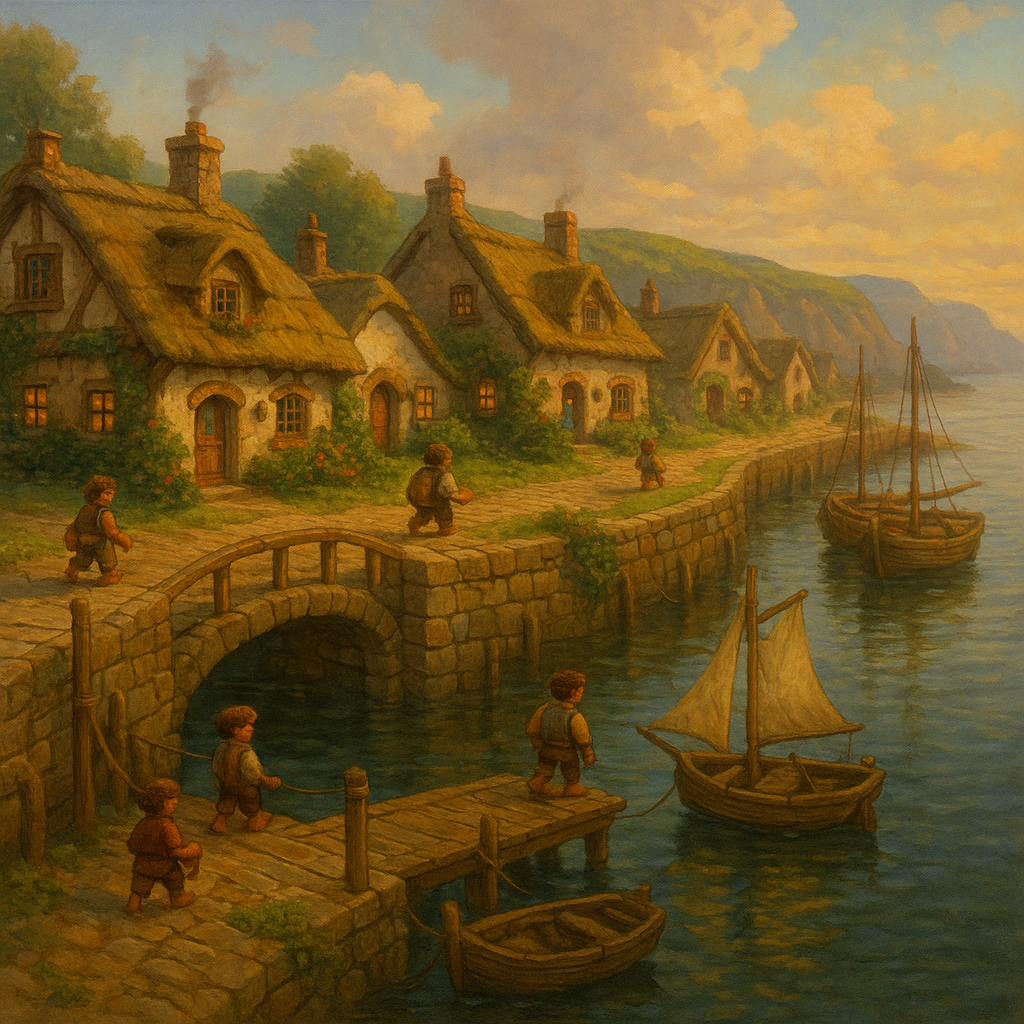
Slonas is a peaceful, agrarian republic nestled along fertile coasts and forested hills, shaped primarily by its Halfling majority and supported by a harmonious blend of Wood Elves, Humans, Gnomes, Half-Elves, and Tortles. Life in Slonas moves at a gentle, steady pace, guided by traditions of hospitality, community cooperation, and deep respect for the natural world. Its settlements thrive on rich soil, abundant orchards, sustainable forestry, and thriving river systems, producing some of the finest wheat, cider, honey, and herbal remedies in the region. Though lacking in grand armies or monumental architecture, the republic’s strength lies in its unity, its clever craftsmanship, and its ability to nurture relationships both within and beyond its borders. Hearthwharf, Mossbend, Silvergrove, and the other towns each contribute their own cultural flavor, creating a nation defined not by conquest or ambition, but by the quiet excellence of shared life.
Politically, Slonas is governed by the Council of Hearths—a representative body where reputation, wisdom, and communal trust matter more than wealth or power. Its diplomacy is built on reliability, soft influence, and fair trade, making Slonas a valued partner among neighboring states. Spiritual life here is gentle and interwoven with daily tasks: Halflings honor the Hearthmother through acts of kindness, Wood Elves maintain balance with nature through druidic rites, Gnomes bless their workshops with crafted charms, and Tortles read the stars to guide both sailors and seekers. Even its mild divine blessings reflect this humble worldview—subtle warmth, intuition, and harmony rather than dramatic miracles. Slonas endures not because it seeks strength, but because it embodies it in its own quiet way: a nation where community is sacred, nature is cherished, and peace is tended with the same care as the fields that feed its people.
Structure
Slonas is governed by a gentle but highly effective system known as the Council of Hearths, a deliberative assembly composed of representatives from each major town and each of the five major peoples of the republic: Halflings, Humans, Wood Elves, Gnomes, and Tortles. While Halflings hold the majority of seats due to population, every community—big or small—is guaranteed a voice. Councilors are not elected through campaigns or parties; instead, they are selected through clan consensus, community gatherings, or the blessing of local elders. The Council meets in the capital, Hearthwharf, beneath a domed hall carved into the cliffs overlooking the sea, where decisions are made slowly, thoughtfully, and always with an emphasis on the well-being of the community over ambition or authority. Laws, taxes, and infrastructure plans require broad support, ensuring no group or clan dominates the republic’s future.
Supporting the Council is the Circle of Clans, an advisory body made up of respected elders, druids, and guild leaders from each settlement. Wood Elves guide matters of nature and preservation, Gnomes advise on engineering and innovation, Humans on maritime trade, and Tortles on long-term planning and historical record-keeping. The Circle cannot pass laws but wields considerable influence—its role is to offer wisdom, mediate disputes, and prevent rash decisions. Day-to-day governance is handled locally: village reeves, orchard-masters, riverwardens, and communal stewards coordinate harvests, repairs, festivals, and defense. Slonas’ government lacks rigid hierarchy, but its cohesion is unmatched; the republic thrives because every voice is heard, every settlement contributes, and every decision is rooted in the cultural foundation that harmony is strength, and prosperity comes from shared responsibility.
Culture
The culture of Slonas is built around the Halfling ideals of community, hospitality, and harmonious living, shaped by a deep respect for nature and the rhythmic cycles of the land and sea. Festivals, shared meals, and agricultural rituals mark the passing of the seasons, with every town contributing its own traditions—Silvergrove’s moonlight orchard dances, Mossbend’s river-cider regattas, and Hearthwharf’s legendary Endless Table Festival. Homes are modest but beautifully crafted, decorated with carved woodwork, woven banners, and family heirlooms passed down through generations. Halflings take great pride in their agricultural mastery: tending orchards, vineyards, and fields is considered both a livelihood and a sacred responsibility. The influence of Wood Elves adds a gentle spiritual dimension, emphasizing balance, peace, and the careful stewardship of forest and field.
Slonas is also remarkably collaborative, welcoming the contributions of its minority communities. Humans enrich coastal culture with maritime lore and shipcraft; Gnomes bring innovation, curiosity, and tinkering artistry; Half-Elves serve as graceful mediators and poets; Tortles contribute ancient wisdom, star charts, and storytelling traditions that span centuries. Together, they have created a society defined by patience, creativity, and quiet resilience. Conflict is rare and typically resolved through calm discussion rather than confrontation. Music, food, and craftwork fill everyday life—bards wander from town to town, cider flows freely, and communal labor is celebrated rather than begrudged. While Slonas appears gentle, it is not naïve; its people possess a deep inner strength and an unshakeable belief that a peaceful life is worth defending. Above all, the culture of Slonas cherishes the simple truth that life is richer when shared, and community is the heart of every joy.
Public Agenda
The public agenda of Slonas centers on preserving harmony, protecting the land, and ensuring the wellbeing of every community. The Council of Hearths prioritizes sustainable agriculture, careful forest management, and the maintenance of shared resources that support both rural and coastal life. Investments in irrigation, orchard expansion, river upkeep, and communal granaries ensure food security across all seasons. The republic also places great emphasis on education in practical skills—farming, carpentry, winemaking, herbal craft, mapping, and seamanship—believing that every citizen should contribute meaningfully to their settlement. Cultural preservation is another key pillar: festivals, storytelling, and traditional crafts are supported by local councils, ensuring that Slonas’ rich heritage remains vibrant for future generations.
Externally, the public agenda focuses on peaceful diplomacy and mutually beneficial trade, especially with nearby nations like Velkara. Though Slonas avoids military entanglements, it takes border management, maritime safety, and forest protection seriously. The republic seeks friendly relations, fair trade agreements, and open travel routes, while maintaining firm neutrality during foreign conflicts. Slonas also prioritizes disaster preparedness—maintaining reserves, healing sanctuaries, and emergency cooperatives run jointly by Halfling and Tortle communities. Above all, the public agenda reflects the core belief shared across Slonas: that a nation thrives not through dominance, but through cooperation, stewardship, and the quiet strength of a united people.
Assets
Slonas’ greatest asset is its remarkably fertile land, blessed with rolling farmland, thriving orchards, vineyard terraces, and lush coastal meadows. Halfling agricultural mastery has turned the region into a breadbasket renowned for its wheat, cider apples, honey, root vegetables, herbs, and famous Mossbend ciders. These exports feed neighboring nations and provide stable income year-round. The forests surrounding Silvergrove offer rich herbal resources, medicinal plants, rare hardwoods, and spiritual groves protected in alliance with Wood Elf guardians. Slonas’ rivers and estuaries also support thriving freshwater fisheries, reedcraft industries, and the watermills that power many Gnomish workshops. Together, these natural advantages make Slonas one of the most agriculturally productive regions in the south.
Beyond its farmlands, Slonas possesses valuable cultural and intellectual assets. Tortle star charts and maritime lore make the republic a respected source of navigation knowledge, often sought by foreign sailors. Gnomish crafting ingenuity fuels small-scale industries such as pottery, clockwork tools, irrigation devices, and finely carved wooden instruments. The peaceful, trusted nature of Halfling trade customs has also made Slonas a preferred partner in diplomacy and commerce—its contracts are honored, its goods are reliable, and its caravans are welcomed across borders. Perhaps its most understated asset is its social cohesion: the unity of Halflings, Humans, Elves, Gnomes, Half-Elves, and Tortles creates a resilient, cooperative, and adaptable society. In a world shaped by ambition and conflict, Slonas’ greatest wealth lies not in what it produces, but in how its people choose to live.
Demography and Population
Slonas is home to a modest population of roughly 50,000 people, spread across fertile farmlands, forest hamlets, river settlements, and a warm southern coastline. Halflings make up about 65% of the total population, forming the cultural and political foundation of the republic. Their communities are dense, vibrant, and closely tied to the land, with family-based clans shaping much of daily life. The remaining population reflects a harmonious blend of Humans, Wood Elves, Gnomes, Half-Elves, and Tortles, each integrated into specific regions and trades. Humans cluster in coastal towns like Hearthwharf, working as sailors, fishers, and traders, while Wood Elves dwell primarily around Silvergrove’s forests, stewarding sacred groves and maintaining spiritual traditions. Gnomes thrive in Mossbend and other river towns, running forges, watermills, and inventive workshops that support the region’s economy.
Half-Elves live interwoven throughout Slonas, often serving as diplomats, scribes, and educators who connect the republic’s diverse communities. Tortles form the smallest minority, concentrated in Shellhollow, where their long lifespans and deep maritime knowledge make them revered sages and navigators. Despite these different cultural footprints, the people of Slonas share a strong collective identity grounded in cooperation, stewardship of the land, and communal celebration. There are no rigid social classes or racial hierarchies; every group contributes in a way that is valued and visible. This demographic balance creates a peaceful, interdependent society where diversity is not just tolerated—it is essential to the way Slonas functions. Its population is small but resilient, united not by force or tradition alone, but by the shared belief that life is best lived together, slowly, and meaningfully.
Military
The military of Slonas is small, largely decentralized, and fundamentally defensive, reflecting the Halfling belief that conflict is a last resort but community safety is sacred. Rather than standing armies, Slonas relies on local militias, forest wardens, river guardians, and coastal watch posts operated jointly by Halflings, Humans, and Wood Elves. Halfling militias specialize in terrain-based defense—ambush tactics, concealed traps, alarm networks, and expertly crafted sling and bow formations. Wood Elves maintain protected forest paths, act as scouts, and manage early-warning systems using animal messengers and druidic rituals. Human sailors and tortle navigators patrol the coast, watching for pirate activity or foreign incursions, while Gnomes support the militia with clever mechanical defenses, signal devices, and collapsible barricade systems. Slonas’ military strength lies not in force, but in preparation, communication, and intimate knowledge of the land.
In times of greater threat, the Council of Hearths can call upon the Greenward Compact, a traditional oath that binds all towns to unite their militias under shared command. This rare mobilization combines Halfling precision, Elven archery, Human seamanship, Tortle endurance, and Gnomish engineering to form a remarkably resilient defensive force. Instead of grand battlefields, Slonas excels at denial tactics: funneling enemies into traps, using terrain to slow advances, and harassing invaders until they retreat. Even foreign strategists acknowledge that Slonas is extraordinarily difficult to conquer—not because of overwhelming power, but because the land itself seems to defend the people who steward it. For Slonas, military strength is measured not in victories won, but in peace preserved, ensuring that its orchards, forests, and coastal villages remain places of gentle life.
Technological Level
Slonas is not a nation of grand inventions or arcane breakthroughs, but it excels in practical, community-centered technology shaped by Halfling ingenuity, Gnomish craftsmanship, and Wood Elven ecological knowledge. Its scientific advancements revolve around agriculture, irrigation, herbal medicine, and small-scale mechanical tools. Halflings have perfected soil rotation methods, frost-resistant crops, orchard grafting techniques, and efficient food preservation. Gnomes introduce clever waterwheel systems, grain mills, cider presses, collapsible surveying tools, and hand-crafted devices designed to make daily labor easier. Although magic in Slonas tends to be subtle rather than spectacular, Wood Elven druids contribute natural lore, weather-reading practices, and restorative herbal science that gives the republic some of the finest healers in the region. Together, these three traditions create a culture where technology is not disruptive, but woven seamlessly into daily life.
Scientific study in Slonas prioritizes observation, sustainability, and generational wisdom. Tortle astronomers and navigators provide star charts, tidal maps, and ancient mathematical records, making Slonas surprisingly advanced in maritime knowledge despite its modest naval presence. Gnomish workshops in Mossbend experiment with small-scale clockwork, lightweight gliders for orchard inspection, improved fishing gear, and early prototypes of magical–mechanical hybrids—simple enchantments tied to water flow, light, or temperature. Scholars in Silvergrove maintain archives of plant lore and druidic treatises, while Half-Elves contribute written histories, diplomatic treatises, and cross-cultural studies. Though Slonas lacks the industrial might of Zilara or the arcane institutes of Velkara, its technological level is steady, reliable, and deeply rooted in its natural environment. The people of Slonas measure progress not by how much they can build, but by how much they can protect, nourish, and pass forward to future generations.
Religion
Religion in Slonas is quiet, pastoral, and deeply tied to the rhythms of nature, community, and the simple joys of life. The Halflings practice a faith known as The Hearthway, centered on small household shrines, seasonal blessings, and spirits of field, forest, and river. Rather than worship powerful gods, they revere the Hearthmother, a benevolent guardian of warmth, safety, and shared meals—often believed to manifest in moments of hospitality or unexpected kindness. Festivals honor the turning of the seasons, the first harvest, the last cider press, and the renewal of communal bonds. Wood Elves add a layer of druidic spirituality, venerating ancient forest spirits, sacred groves, and the balance between growth and rest. Their rituals blend seamlessly with Halfling traditions, shaping a belief system that values harmony over hierarchy, and quiet devotion over grand temples.
Tortles and Gnomes bring additional spiritual texture. Tortles maintain the Way of the Tides, a contemplative tradition that studies the cycles of the sea, stars, and life itself—believing that every soul follows a long, winding current across centuries. Their presence has made stargazing and tidal readings common acts of reflection. Gnomes tend to blend practicality with spirituality, honoring minor craft spirits, ancestors, and household luck-keepers. Though varied, these practices coexist without conflict; Slonas has no state religion, no priestly elite, and no divine mandates. Instead, spirituality is woven into daily life—baked into bread, sung through orchards, carried along rivers, and shared around fires. Outsiders often remark that the faith of Slonas is not something its people speak about loudly, but something they live with every step, every meal, and every act of kindness.
Laws
The legal system of Slonas is rooted in common sense, community welfare, and restorative justice rather than strict punishment. Most laws arise from Halfling customs and are reinforced through the Council of Hearths, prioritizing cooperation and fairness over authority. Property disputes, trade disagreements, and personal conflicts are resolved through mediation circles, often led by Half-Elven scribes or respected elders from each town. Rather than prisons, Slonas uses community service, restitution, or apology rituals to repair harm and reintegrate offenders back into the community. The guiding principle is simple: “A mistake is a burden shared; a lesson is a gift returned.” Only the most extreme crimes—treason, repeated violent acts, or intentional destruction of sacred lands—result in exile, a rare but deeply symbolic punishment.
Slonas also enforces several important national protections. Wood Elven forests and sacred groves are shielded under the Greenward Accords, making illegal logging, poaching, or grove desecration among the most severe offenses. Agricultural sabotage—destroying crops, poisoning livestock, or disrupting water channels—is treated as a crime against the entire republic. Tortle coastal laws govern safe tides and harbor etiquette, requiring all foreign vessels to register and abide by local environmental protections. Trade laws emphasize transparent weights, honest pricing, and respectful negotiation, with Mossbend’s Gnome guilds acting as auditors for mechanical accuracy. Even so, Slonas prioritizes education over punishment: children learn local law early, elders teach ethical living, and the republic believes that a lawful society is not built through force, but through trust, clarity, and the shared commitment to protect one another’s peace.
Agriculture & Industry
Agriculture is the beating heart of Slonas, and the Halflings have refined it into both an art and a science. The republic’s rolling fields, mild southern climate, and rich soil support expansive orchards, vineyards, wheat terraces, herb gardens, and vegetable farms. Halfling farmers are renowned for their mastery of crop rotation, soil enrichment, irrigation canals, and innovative orchard grafting. Slonas exports cider apples, honey, root vegetables, premium wheat, and flavorful herbs to neighboring nations, making it a vital food supplier in the region. Livestock—particularly goats, sheep, and hardy coastal cattle—also form an essential backbone of rural life. Wood Elves contribute sustainable forest management and cultivate rare medicinal plants, while Tortles maintain tidal gardens and coastal kelp farms that bolster food security during lean seasons. Together, these efforts create a stable, abundant agricultural system capable of supporting both domestic life and trade.
Industry in Slonas is small-scale but highly specialized, centered around Gnomish craftsmanship, artisanal goods, and natural materials. Mossbend is famous for its water-powered mills, cider presses, carpentry shops, pottery kilns, and mechanical toolmakers. Gnome and Halfling collaboration produces reliable clockwork devices, irrigation pumps, lightweight farming tools, and finely crafted household wares. Hearthwharf’s coastline supports boatbuilding, fishing gear production, salt harvesting, and small-scale textile weaving. Silvergrove adds herbal distillation, salves, and druidic remedies to the republic’s exports. Though Slonas lacks heavy industry, its craftsmanship is prized for its quality, durability, and honesty. Every tool, barrel, and cask bears the mark of a community that values care over speed and sustainability over expansion. Slonas thrives not through industrial might, but through the quiet strength of work done well, shared fairly, and rooted in harmony with the land.
Trade & Transport
Trade in Slonas is steady, honest, and deeply rooted in agricultural surplus. The republic’s most valued exports include cider apples, fine wheat, honey, herbal goods, cheeses, dried fruits, Gnomish tools, and Tortle star charts. Halfling merchants have an excellent reputation across the region—known for fair prices, transparent measures, and contracts sealed over shared meals. Hearthwharf serves as the primary trade hub, connecting Slonas to Velkara and other nearby nations through coastal shipping routes. Greenbarrow Crossing maintains thriving rural markets that attract caravans from inland territories, while Mossbend ships barrels of cider and mechanical goods along river routes. Slonas rarely deals in luxury or arcane commodities, but its reliability has made it a preferred partner for nations seeking consistent, high-quality goods without political complication.
Transport within Slonas relies on a gentle, efficient network of rivers, forest roads, coastal paths, and small harbors. Halflings primarily travel by pony cart, footpath, or river barge, maintaining well-kept trails between towns. Gnomish engineering keeps the watermills and canal locks functioning smoothly, allowing goods from Mossbend and Silvergrove to reach Hearthwharf with remarkable ease. Tortles, masters of coastal navigation, operate lighthouse beacons and tide markers along the southern shore, ensuring safe maritime passage for local fishers and foreign traders alike. While Slonas lacks advanced airships or major highways, its transport system is deeply reliable—built on maintenance, community cooperation, and a detailed understanding of the land. Travel is safe, steady, and woven into the social fabric, reflecting a nation where the journey is often just as meaningful as the destination.
Education
Education in Slonas is a communal, practical, and lifelong process, rooted in Halfling traditions of shared knowledge and hands-on learning. Most children are taught within their villages by a combination of family members, local elders, and traveling tutors who move between towns. The curriculum emphasizes essential life skills: agriculture, cooking, carpentry, herbal lore, storytelling, and basic mathematics used for trade. Young Halflings often apprentice with orchard masters, brewers, or craftspeople, learning trades that support village life. Wood Elves contribute instruction in nature stewardship, animal husbandry, tracking, and forest ritual, making ecological understanding a core part of education. The tone of learning is gentle—encouraging curiosity, patience, and cooperation rather than competition.
More formal learning takes place in guild halls, druidic enclaves, Gnomish workshops, and Tortle chart-houses, each offering specialized knowledge shaped by their racial traditions. Gnomes teach engineering fundamentals, simple clockwork mechanics, and the clever use of waterpower. Wood Elves maintain herbal archives and healing circles that train new healers in natural medicine. Tortle astronomers instruct in navigation, tides, and stargazing, making Slonas surprisingly advanced in maritime mathematics despite its peaceful nature. Half-Elves often serve as scribes, historians, and diplomats, passing on reading, writing, cultural etiquette, and foreign languages. There are no grand academies or arcane universities in Slonas; instead, education is woven through daily life, emphasizing humility, community service, and the belief that knowledge is meant to enrich the whole village, not elevate the individual above it.
Infrastructure
Infrastructure in Slonas is modest but exceptionally well-maintained, built around the principles of sustainability, simplicity, and community cooperation. Roads between towns are small but reliable, consisting of packed dirt paths, stone-paved village centers, and wooden bridges crafted with Halfling precision. River systems are the nation’s true arteries—carefully managed with Gnomish-designed locks, waterwheels, and canals that allow goods to flow easily from Mossbend and Silvergrove to Hearthwharf. Public works emphasize communal comfort rather than grandeur: well-tended wells, shared ovens, orchard shelters, village greens, and open-air markets create welcoming, functional spaces. Halfling builders specialize in earth-embedded homes, insulated hill dwellings, and timber structures that blend seamlessly into the landscape, making Slonas feel warm, natural, and timeless.
Coastal infrastructure, guided by Tortle navigators and Human sailors, is surprisingly advanced. Hearthwharf maintains sturdy piers, tide markers, lighthouses, and breakwaters—many reinforced with stone whispered into shape by Elven druids. Shellhollow’s cliffside stairways and carved sea-caves serve as natural harbors, protected from storms by generations of Tortle engineering. Gnomes contribute mechanical flourishes to the nation’s infrastructure, such as mill networks, irrigation pumps, rotating grain dryers, and clever signal devices used for long-distance communication. Though Slonas lacks grand citadels, magical constructs, or industrial districts, its infrastructure reflects a nation that values function, beauty, and harmony with nature. Everything is built to endure, to serve the community, and to require as little disruption to the land as possible—an approach that makes Slonas quiet yet remarkably resilient.
Mythology & Lore
Slonas’ mythology is warm, humble, and rooted in the everyday beauty of the natural world. Halfling stories often center on the Hearthmother, a benevolent spirit of warmth, shelter, and shared meals who is said to have taught the first Halflings how to cultivate the land. Tales describe her as a wandering figure who visits homes where the fire burns low, offering comfort and guidance in times of need. Many myths revolve around small miracles—the fruit that ripened early to save a village, the fox that led a lost child home, the storm that paused just long enough for a harvest to be gathered. These stories reinforce the belief that kindness creates ripples of magic, and that the land rewards those who care for it. Wood Elf legends intertwine with Halfling tales, speaking of ancient forest spirits—whispering guardians who watch from the branches and guide travelers through silver-lit groves when the night turns strange.
Additional layers come from the Tortles and Gnomes. The Tortles teach the Cycle of the Tides, a mythic story describing life as a long, winding current that flows across ages, with each person carrying memories from lifetimes before. According to their myths, the stars themselves are shells of ancient celestial beings that drifted into the sky, leaving wisdom for those patient enough to study their patterns. Gnomish mythology is playful yet profound, filled with clever household spirits, luck gremlins, and ancestors who tinker within the walls to nudge fate in one direction or another. Together, these traditions create a mythology that is gentle rather than epic, emphasizing that magic is not found in grand battles or cosmic destinies, but in the quiet moments of life—warm fires, trusted friends, star-lit nights, and the timeless bond between people and the land.
Divine Origins
The origins of Slonas are humble and deeply tied to the land itself. Halfling oral histories claim that their ancestors arrived not as conquerors or refugees, but as wanderers seeking a place where “the earth felt soft beneath their feet and the air smelled of apples.” According to tradition, the first Halfling clans settled along the fertile southern coast, drawn by the region’s mild climate, plentiful rivers, and naturally terraced hills. With no desire for expansion or domination, they built small farms, dug hillside homes, and established communities centered around shared hearths. Over generations, these villages formed alliances through festivals and trade, eventually coalescing into a loose network of cooperatives long before Slonas became an official republic. The Hearthmother myth—describing a kindly spirit who taught the first clans how to live in harmony with the land—remains central to the identity of these early settlements.
The other peoples of Slonas arrived gradually and peacefully. Wood Elves from the northern forests established long-term pacts with Halfling elders, agreeing to share stewardship of the land in exchange for mutual respect and protection of sacred groves. Gnomes followed river routes from distant workshops, attracted by the calm stability and opportunities for invention. Humans came next, founding coastal villages and bringing maritime knowledge that reshaped trade and travel. Tortles, drawn by the warm coastline and quiet coves, established Shellhollow as a haven of learning and starlore. These groups blended naturally with the Halfling majority, valuing the stability, fairness, and gentleness of the emerging society. What began as scattered villages loosely connected by good will eventually solidified into the Council of Hearths, forming the peaceful republic known today as Slonas—a nation born not from conquest or mandate, but from friendship, shared labor, and the quiet pursuit of a good life.
Tenets of Faith
The faith traditions of Slonas—centered on the Hearthmother, the spirits of forest and field, and the long cycles of tide and starlight—are unified by a simple guiding principle: “Live in a way that leaves the world warmer than you found it.” Halflings teach that every act of kindness strengthens the Hearthfire, a symbolic flame representing community, safety, and shared life. Key tenets include hospitality, the idea that strangers should be treated as friends in need; stewardship, the belief that the land must be tended with gratitude and passed to future generations in good health; and contentment, the practice of valuing what one has rather than chasing power or wealth. Wood Elven influences add reverence for balance—between growth and rest, harvest and renewal—while Gnomish beliefs contribute the tenet of crafting with intention, reminding worshippers that work done with care has spiritual meaning.
Tortles contribute a contemplative perspective centered on patience, long-term harmony, and the flow of life’s many currents. Their teachings emphasize perspective—that one’s life is a small, precious part of a greater cycle—and truthful living, a commitment to honesty and clear intention. Together, these varied traditions form a cohesive spiritual philosophy grounded not in rigid doctrine, but in daily practices: sharing meals, tending gardens, telling stories, keeping hearths warm, and honoring the seasons. There is no expectation of perfection; instead, the tenets encourage steady, mindful improvement and kindness extended freely. Slonas’ faith is gentle, practical, and inclusive—reminding its people that devotion is not proven through grand rituals or sacrifice, but through how one treats neighbors, how one tends the land, and how one carries the quiet magic of goodness into each day.
Ethics
The ethical framework of Slonas is grounded in the belief that a good life is one lived in harmony—with one’s neighbors, with the land, and with oneself. Halfling ethics emphasize generosity, patience, humility, and the importance of shared responsibility. Causing unnecessary harm—whether through harsh words, greed, or neglect—is seen as a failure of character rather than a punishable offense, and community members are encouraged to gently guide each other back toward kindness. Honesty is deeply valued, not in a rigid legalistic sense, but because truth nurtures trust, and trust sustains the social fabric. Wood Elves reinforce this moral structure with principles of balance and environmental stewardship, teaching that every action has consequences that ripple outward through the living world. In Slonas, kindness is considered strength, and ethical living means being attentive to how one’s choices affect the community.
Gnomes and Tortles add further layers to Slonas’ ethical philosophy. Gnomes teach the virtue of purposeful creation—the idea that anything made, said, or done should add value rather than disruption. Their emphasis on careful craftsmanship extends to moral behavior: haste leads to mistakes, and mistakes should be met with accountability, not shame. Tortles introduce a long-view perspective, encouraging citizens to consider how their actions echo across seasons and generations. This leads to what Slonians call the “Quiet Compass”—an internal guide shaped by empathy, foresight, and a desire to leave the world better than one found it. Slonas’ ethics are not enforced through strict codes or religious mandates; instead, they are woven into daily life, reinforced by stories, rituals, and the gentle expectations of a culture that believes goodness is not a rule, but a practice.
Worship
Worship in Slonas is woven into everyday life rather than performed through grand temples or formal rites. Halflings honor the Hearthmother and the lesser household spirits through simple acts: lighting a morning candle, sharing food with a neighbor, tending gardens, or keeping the home’s hearth warm even in summer. These gestures are considered prayers in motion—quiet acknowledgments of gratitude and the hope that warmth and safety will spread through the community. Seasonal festivals take the place of formal ceremonies: the First Blossom Feast, the Long Harvest Night, and the Winter Hearth gathering each serve as communal celebrations of life’s cycles. Instead of priests leading these events, it is the elders, cooks, farmers, and storytellers who guide the traditions, reminding everyone that worship is most meaningful when it comes from the heart of the household, not the height of an altar.
Wood Elves, Tortles, and Gnomes all contribute their own forms of worship, blending seamlessly into the spiritual life of Slonas. Elven worship centers on sacred groves, moonlit rituals, and meditation beneath ancient trees—practices open to any who seek balance with nature. Tortle worship is contemplative, often taking the form of stargazing, tidal readings, or quiet walks along the shore, honoring the slow rhythm of existence. Gnomes pay homage to small craft spirits and luck-guardians, leaving offerings of tools, carved tokens, or fresh bread at workshop shrines. Half-Elves often combine traditions, serving as song-leaders or keepers of shared festival chants. Across all towns, worship in Slonas is gentle, communal, and unstructured—reflecting the belief that the divine lives not in distant heavens but in the warmth of a meal, the turning of the seasons, and the everyday acts of goodness that bind people together.
Priesthood
Slonas does not possess a formal priesthood in the traditional sense; instead, spiritual leadership is distributed across the community, embodied by elders, healers, storytellers, druids, and wise folk who naturally rise to positions of guidance. In Halfling villages, the closest equivalent to a priest is the Hearthwarden—an elder chosen by consensus to tend communal hearths, safeguard seasonal rituals, and oversee rites of passage such as births, coming-of-age feasts, and funerary gatherings. Hearthwardens do not command authority; they advise with warmth, mediate disputes, and ensure that traditions are passed gently from one generation to the next. Their role is as much emotional as spiritual—keeping the “inner fire” of the village alive. In times of hardship, a Hearthwarden’s calm presence is often said to be worth more than a dozen swords.
Meanwhile, the Wood Elves maintain Druidic Circles that handle sacred groves, natural rites, and deeper ecological wisdom. These druids guide ceremonies of balance, healing, and renewal, but hold no political power and see themselves as stewards rather than leaders. Tortles contribute Tide-Sages, contemplative figures who teach patience, starlore, and the long rhythms of life; they are sought for philosophical guidance rather than ritual authority. Gnomes have Craft-Chaplains, artisans who bless tools, workshops, and new creations, emphasizing intention and purpose in all things made. Together, these various forms of spiritual leadership create a priesthood that is fluid, humble, and entirely service-oriented. There are no grand vestments, no hierarchies, and no divine intermediaries—only individuals who have earned trust through wisdom, kindness, and the steady nurturing of their communities.
Granted Divine Powers
Divine power in Slonas is subtle, rare, and expressed through quiet blessings rather than dramatic miracles. Because the Hearthmother and the land-spirits are viewed as ever-present but humble forces, the gifts they bestow tend to mirror that philosophy: a grove that heals faster than expected, a crop that survives an early frost, a lost traveler guided home by an unlikely light. Hearthwardens sometimes experience what they call Ember Moments—brief sparks of intuition or warmth that lead them to comfort the grieving, sense a looming hardship, or resolve community disputes with uncanny clarity. These are not spells in the traditional sense but manifestations of the Hearthmother’s influence, emerging only when compassion, unity, and a genuine desire to help are present. Such blessings reinforce the belief that divine power grows strongest where love and community flourish.
More overt magic is seen among the Wood Elven druids and Tortle tide-sages, though even their abilities are grounded in natural harmony rather than strict divine intervention. Druids may coax plants to grow, calm animals, or purify water as part of their communion with the land—abilities considered gifts from ancient forest spirits rather than from a singular deity. Tide-sages can predict storms with uncanny accuracy, read the stars as if deciphering forgotten languages, or guide ships safely through fog and tide shifts. These powers bloom slowly over a lifetime of discipline and spiritual listening, not through prayer or hierarchy. Gnomish craft-chaplains sometimes create minor enchanted trinkets—charms of luck, tools that never rust, hearth-stones that hold warmth—believed to carry the goodwill of local workshop spirits. In Slonas, divine power is not something sought or wielded; it is something earned through kindness, patience, and a life lived in gentle balance with the world.
Political Influence & Intrigue
At first glance, Slonas appears free of political intrigue—its villages are peaceful, its councils harmonious, and its people content. But beneath this pastoral calm lies a web of soft power, quiet alliances, and subtle maneuvering centered around the Council of Hearths. Political influence in Slonas does not come from wealth or military strength, but from reputation, communal trust, and generational relationships. Halfling clan leaders often negotiate informally behind the scenes before any public vote, ensuring decisions align with long-term family interests. Wood Elven druids wield silent influence by controlling forest resources and offering spiritual legitimacy to certain policies. Gnome guildmasters exert pressure through their technological expertise—whoever controls the watermills and irrigation designs quietly guides agricultural stability. Even Half-Elven scribes, though outwardly neutral, shape policy by drafting laws and managing inter-settlement correspondence that can subtly influence interpretation.
Externally, Slonas practices a diplomatic style built on soft power and strategic goodwill. Its reliable food exports give it unusual leverage in nearby regions, allowing it to influence trade negotiations without ever appearing aggressive. Hearthwharf merchants cultivate relationships with Velkara traders and coastal navigators, slowly weaving Slonas into broader maritime networks. Tortle tide-sages serve as unintentional diplomats—their star charts and tidal predictions are so accurate that foreign captains and scholars regularly seek their guidance, increasing Slonas’ intellectual prestige. But not all political currents are calm: disputes occasionally arise between Mossbend’s Gnomes and Greenbarrow’s Halfling farmers over water rights or mill placements; Silvergrove’s druids sometimes halt development plans they deem harmful; and foreign traders occasionally attempt to manipulate markets, testing Slonas’ famed honesty. Yet through it all, Slonas maintains a delicate balance—the kind of influence that grows quietly, spreads gently, and shapes the region not through force, but through trust, wisdom, and quiet resilience.
Sects
Although Slonas has no formal clergy or unified religious institution, several informal sects have emerged over generations—each representing a different interpretation of the Hearthmother’s teachings and the spiritual traditions of Slonas’ diverse peoples. The most widespread is the Hearthward Circle, a Halfling sect that emphasizes hospitality, community warmth, and the sacredness of shared meals. They maintain village hearths, oversee feasts, and serve as mediators during disputes. Closely tied to them are the Keepers of the Quiet Flame, a contemplative group that believes the Hearthmother speaks through gentle intuition and emotional warmth; they focus on healing, counseling, and supporting families during times of hardship. Among the Wood Elves, the Circle of Silvergrove practices a druidic tradition centered on maintaining balance between growth and rest, guiding seasonal rituals, and safeguarding sacred groves.
The minority communities contribute their own subtle sects, each respected and integrated into Slonas’ cultural tapestry. Tortles practice the Tidebound Path, a meditative sect devoted to understanding life’s long cycles—it attracts not only Tortles, but also Humans and Half-Elves seeking wisdom in patience and perspective. Gnomes form the Order of the Crafted Spirit, a sect that blesses tools, workshops, and inventions, believing that every well-made object has a spark of intention that can bring good fortune. There is also the Starweave Fellowship, a small but growing sect combining Tortle astronomy and Half-Elven scholarship, dedicated to interpreting celestial patterns as subtle guidance for the future. None of these sects compete for power or dominance; instead, they represent different ways of understanding the same gentle truth that defines Slonas: the divine lives quietly in the world, and wisdom comes from living in harmony with land, family, and season.

Comments