
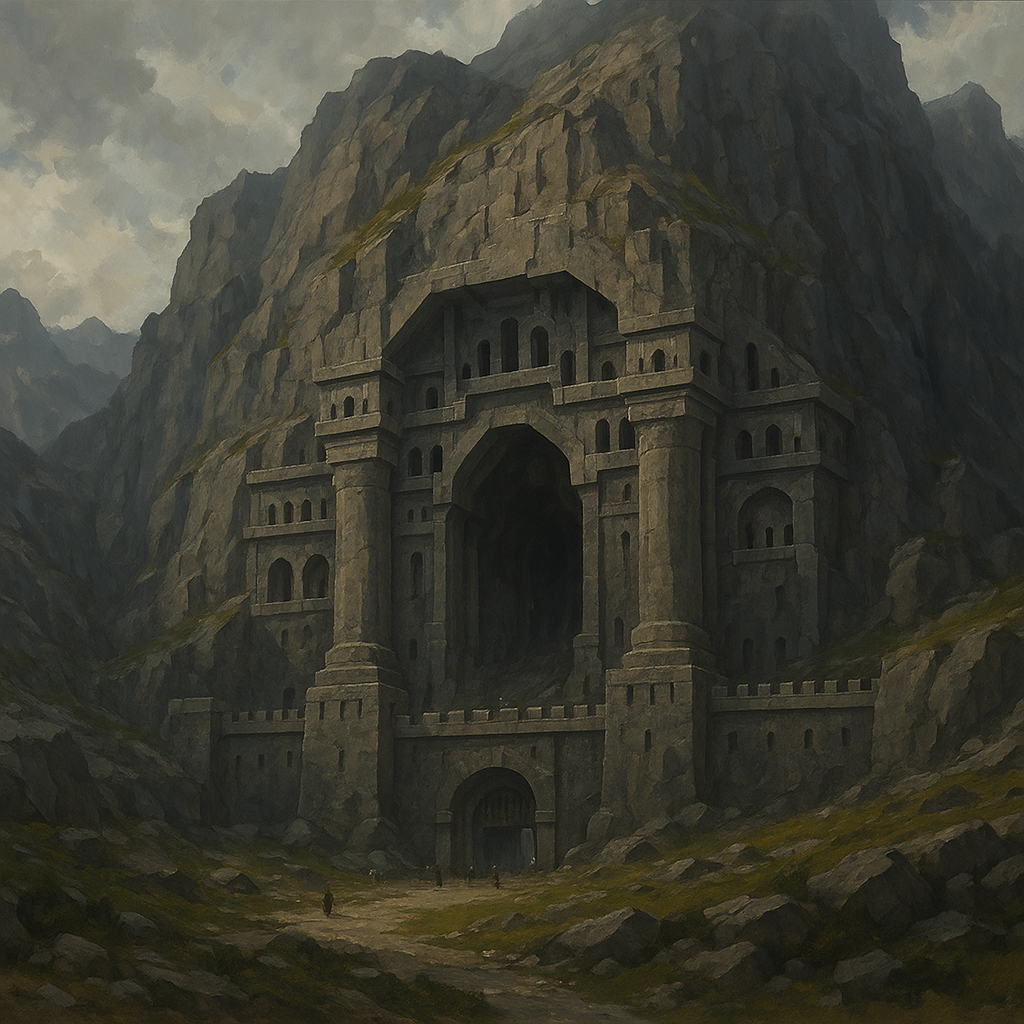
Skalzij ("Skall-z-i-j")
Skalzij is a disciplined, storm-forged Orcish clan-republic of roughly 212,000 people, stretching from the cold, granite Stoneback Mountains in the north to the roaring Storm Coast in the south. Its society is overwhelmingly Orcish—supported by Half-Orcs, Humans, Dragonborn, and small minorities—united beneath the authority of the Storm-Council, nine clan leaders who govern through earned strength and collective decision-making. The Great Midlands form the nation’s heartland, supplying grain, livestock, timber, and trade hubs such as Skarron’s Ford, while the north provides metals, stone, and hardy mountain defenders. Along the Storm Coast, shipyards, forges, and manufacturing districts—especially Korzath Harbor, Ath’jes Works, and Deepforge Docks—power Skalzij’s industrial rise and reinforce its growing naval supremacy. The Great Admiral and High Marshals jointly command a highly trained military, supported by efficient river routes, fortified roads, and integrated logistics that allow troops and supplies to move quickly across the kingdom.
Culturally, Skalzij is bound together by the Reverence of the Three Forces—Vraash-Tuun the Storm-Father, Grultara the Hearth-Mother, and Sorrowtide of the Deep—whose teachings shape ethics, governance, and daily life. Myths of ancestral heroes, storms, and sacred oaths reinforce values of endurance, unity, loyalty, and honorable service. Sects such as the Stormbound, Tidecallers, Hearthwardens, Windcallers, and Oathkeepers preserve different spiritual traditions, while Steadkeepers guide communities through ritual, wisdom, and moral leadership. Orcish ethics emphasize communal responsibility, craftsmanship, directness, and the belief that strength must always serve the clan and nation. Through its disciplined military, rapidly expanding industry, fortified trade routes, and steadfast cultural identity, Skalzij has become a rising power—resilient, cohesive, and shaped by the storms, rivers, and hard-won trials that forged it.
Structure
Skalzij is governed through a powerful clan-republic system centered on the Storm-Council, a ruling body composed of nine Orc clan leaders chosen from the oldest and strongest bloodlines in the nation. These leaders hold all legislative authority and collectively determine national policy, internal security, and resource allocation. Decisions require majority consensus, but military actions demand an even stronger supermajority, ensuring unity before Skalzij commits its forces. The council meets within the granite walls of Grak’Torun, where clan banners and ancestral records define political legitimacy. This structure prevents tyranny while preserving the Orcish values of strength, honor, and earned leadership.
Balancing the council’s power is the Great Admiral, Skalzij’s head of state and supreme commander of the navy, river fleets, and coastal defenses. Chosen for exceptional skill in navigation, strategy, and diplomacy, the Admiral represents Skalzij to foreign powers and leads the nation during times of war. Supporting the Admiral are the High Marshals, commanders of the mountain, Midlands, and coastal armies, each responsible for regional defense and large-scale mobilization. Together, the Storm-Council, Great Admiral, and High Marshals form a tightly coordinated leadership triad that blends traditional clan authority with disciplined military governance, allowing Skalzij to project strength across both land and sea.
Culture
Skalzij’s culture is defined by its Orcish storm-forged identity, a blend of endurance, discipline, and deep respect for the land that shaped them. Life in the northern mountains instills toughness and self-reliance, while the Midlands teach cooperation, agriculture, and the value of shared labor. Clan pride remains central, but Skalzij’s clans emphasize unity over rivalry—every Orc is taught that personal strength means nothing if it does not support the strength of the nation. Music centers on deep drums, wind-horns, and rhythmic chants, echoing through canyons and coastlines alike. Children are raised on tales of legendary sailors, steadfast warriors, and clan founders who endured impossible trials, reinforcing the belief that greatness is earned through hardship, not inherited.
The southern Storm Coast shapes the culture just as strongly, embedding a maritime spirit throughout society. Sailing, fishing, and shipcraft are seen as sacred trades, and nearly every Orc learns to read winds, tides, and storms by adulthood. Festivals revolve around the change of seasons, victory at sea, and offerings to the spirits of wind and water. Despite their reputation for martial prowess, Skalzij Orcs value craftsmanship, hospitality, and loyalty, treating guests with fierce respect as long as customs are honored. The blending of Half-Orc administrators, Human traders, Dragonborn smiths, and Sea Elf artisans enriches Skalzij’s cultural tapestry, but the nation’s identity remains unmistakably Orcish—proud, resilient, communal, and forever shaped by the storms they call home.
Public Agenda
Skalzij’s public agenda centers on national unity, coastal strength, and clan stability, with the Storm-Council continually emphasizing the importance of defending their borders and maintaining the prosperity of the Midlands. The government invests heavily in strengthening internal infrastructure—expanding river routes, improving the reliability of food production, and securing mountain passes to ensure trade and troop movement remain uninterrupted. Clan disputes are carefully mediated to preserve collective identity, and public programs encourage discipline, physical training, and maritime education. Every Orc is expected to contribute to the nation’s resilience, whether through farming, soldiering, smithing, or sailing, creating a culture where civic duty is deeply ingrained and widely respected.
Externally, Skalzij’s agenda aims to protect its coastal dominance, grow its manufacturing capabilities, and secure its foothold on Ath’jes Island. The Great Admiral’s office seeks favorable trade agreements, especially in raw materials and ship components, to support the nation’s expanding naval and industrial sectors. Skalzij is determined to deter foreign encroachment, building alliances where beneficial while maintaining a posture of strength toward rivals. Through this balance of industrious growth, strict preparedness, and strategic maritime influence, Skalzij works to ensure its place as a rising regional power capable of shaping both sea routes and political currents across the southern world.
Assets
Skalzij’s greatest assets derive from its strategic geography and highly disciplined Orcish population, granting the nation advantages across land, river, and sea. The northern mountains provide rich deposits of iron, copper, and granite, supplying the raw materials for weapons, fortifications, and large-scale construction. The fertile Midlands serve as the kingdom’s agricultural core, producing hardy grains, root crops, livestock, and timber essential to sustaining both civilian life and the military. Skalzij’s robust river systems double as natural highways, enabling efficient movement of troops, goods, and resources between regions. This internal connectivity, combined with the labor strength of Orcs and precision of Half-Orc administrators, forms the logistical backbone that powers the country’s growing manufacturing sector.
Along the Storm Coast, Skalzij commands exceptional maritime and industrial assets. Massive shipyards in Korzath Harbor and industrial hubs like Ath’jes Works and Deepforge Docks produce warships, naval hardware, and specialized components sought by neighboring states. Saltworks, brine fisheries, resin marshes, and woodworking towns further bolster coastal industry, ensuring stable exports and self-sufficiency. The nation’s foothold on Ath’jes Island grants additional strategic depth, acting as both a defensive buffer and expanded manufacturing zone. Strengthened by elite naval academies, river defenses, and a culture of relentless craftsmanship, Skalzij’s combined assets position it as one of the most formidable Orcish powers in the region, capable of projecting influence far beyond its borders.
Demography and Population
Skalzij’s population of roughly 212,000 people is overwhelmingly Orcish, with Orcs comprising about 70% of all inhabitants. These Orcs are distributed across every region of the country: hardened mountain clans in the north, agricultural and artisan families in the Midlands, and disciplined maritime laborers and sailors along the Storm Coast. Half-Orcs, making up around 12%, play a vital role in skilled labor, administration, navigation, and engineering, forming a bridge between the Orc majority and the minority populations. Humans account for about 8%, mostly concentrated in trade hubs and river-crossing towns, while Dragonborn (5%) are often found in metalwork, forging communities, and coastal industrial centers. Smaller groups—Aarakocra, Air Genasi, Goblins, Sea Elves, and others—compose the remaining 5%, contributing unique talents but rarely shaping leadership or policy.
Population density varies sharply across the kingdom. The Great Midlands hold the largest concentration of people, with its fertile lands supporting both large market towns and the country’s busiest trade corridors. The Storm Coast is the second-most populated region, home to major industrial and naval settlements like Korzath Harbor, Stormwake, and Ath’jes Works. In contrast, the Northern Mountains maintain smaller, more isolated communities centered on fortress-holds, monasteries, and mining towns. Despite regional differences, Skalzij’s demography is unified by clan identity, shared cultural expectations, and a strong national pride rooted in communal endurance, military readiness, and rigorous craftsmanship. Over time, this demographic cohesion has shaped Skalzij into a stable and fiercely self-reliant Orcish power.
Military
Skalzij’s military is built on the foundation of Orcish discipline, endurance, and martial tradition, forming one of the most cohesive fighting forces in the region. The land army is organized under the leadership of three High Marshals, each responsible for a different theater: the Mountain Holds, the Great Midlands, and the Storm Coast. Mountain forces specialize in defensive warfare, ambush tactics, and control of high passes, while Midlands legions form the backbone of Skalzij’s infantry—heavy shield lines, disciplined spear ranks, and elite shock troops trained at the Oathplain Barracks, where endurance trials, formation drills, and brutal close-combat training forge some of the toughest soldiers in the realm. Orcs make up the majority of the rank and file, supported by Half-Orc logisticians, Human scouts, and Dragonborn weapon specialists who maintain siege tools and advanced armaments.
The Skalzij Navy is the pride of the nation and the direct command of the Great Admiral, projecting power across the Storm Coast and beyond. Warships built in Korzath Harbor, Deepforge Docks, and Ath’jes Works combine raw Orcish engineering with Sea Elf maritime finesse, producing durable hulls, reinforced rams, and superior storm-handling capabilities. Patrol flotillas secure trade routes, while heavier vessels guard the coast and the Ath’jes foothold. Naval marines, trained for both shipboard combat and amphibious assaults, are widely feared for their resilience and aggressive precision. Complementing the navy are the river fleets of the Midlands, which move troops swiftly along major waterways, ensuring rapid mobilization between regions. Together, Skalzij’s land and naval forces form a synchronized military machine capable of defending its territory, enforcing maritime dominance, and responding swiftly to threats across any front.
Technological Level
Skalzij’s technological and scientific development is characterized by practical innovation, military efficiency, and large-scale industrial craftsmanship rather than abstract scholarship. Orcish culture values tools and inventions that directly strengthen the clan-republic—stronger weapons, sturdier ships, faster logistics, and improved agricultural systems. Their smithing techniques are advanced, with Dragonborn metalworkers and Half-Orc engineers contributing to the refinement of alloys, precision fittings, and armored ship designs. In the Midlands, irrigation systems, reinforced granaries, and standardized measurement tools have dramatically increased food stability, while mountain communities excel at stonework, surveying, and structural engineering. Although Skalzij does not pursue arcane or academic research in the scholarly sense, its practical sciences—mechanics, metallurgy, carpentry, hydrology, and animal handling—are highly developed and widely respected.
The coastal regions drive much of the realm’s innovation, fueled by the needs of shipbuilding, navigation, and industrial manufacturing. Ath’jes Works and Deepforge Docks function as research hubs where Orcs, Half-Orcs, Sea Elves, and Humans collaborate on maritime advancements such as improved hull curvature, reinforced rams, advanced ropecraft, waterproofing resins, and tidal-powered mechanisms. Navigation science is also prized: Half-Orc navigators study wind patterns, tidal cycles, and star-mapping, giving Skalzij’s navy an edge in speed and reliability. River-based logistics technology—barge-lock systems, water-cooled forges, and efficient troop-ferrying craft—link the Midlands and Coast into a unified, well-supplied engine of national strength. While not the most magically advanced nation, Skalzij stands at the forefront of industrial innovation, combining Orcish durability with engineering precision to build a society that values creation, craftsmanship, and the relentless improvement of tools that serve the collective.
Religion
Skalzij’s religious life centers on the Reverence of the Three Forces—a triad of elemental and ancestral powers that Orcs believe shaped the land and their people. The first of these is Vraash-Tuun, the Storm-Father, a roaring sky deity who represents endurance, courage, and the will to face hardship. Orcs pray to him before battles, sea voyages, and clan trials, asking for clarity of purpose and strength against adversity. The second is Grultara, the Hearth-Mother, guardian of the land, family, and the stability of the Midlands. Her worship takes place through feasting, agricultural festivals, and rites of clan unity. The third force is Sorrowtide, the Deep-Water Spirit who commands the sea’s merciless and generous moods; she is honored by sailors, fisherfolk, and naval officers who leave offerings at coastal shrines to earn her favor. Together, these three powers form a balanced spiritual worldview that guides everyday life and reinforces Skalzij’s values of discipline, unity, and perseverance.
Temples in Skalzij are not ornate structures but functional, communal sanctuaries integrated into the rhythms of the land. Mountain monasteries devoted to Vraash-Tuun serve as training grounds where acolytes endure cold winds and learn the discipline of focus under pressure. Rural shrines to Grultara are built near farms and gathering halls, emphasizing family honor and shared prosperity. Along the Storm Coast, tide-marked stone altars dedicated to Sorrowtide become centers for sea rites, launch ceremonies, and blessings for naval campaigns. Religious leaders—called Steadkeepers—are chosen for wisdom, service, and personal strength rather than bloodline, and they act as mediators, counselors, and guardians of tradition rather than political authorities. The faith of Skalzij is deeply ingrained in everyday life, shaping how its people work, fight, travel, and endure.
Laws
Skalzij’s legal system is founded on a strict Code of Clan Honor, a body of laws that emphasizes responsibility, loyalty, and the protection of the realm. At its core, the law demands that all citizens—regardless of clan or race—uphold duties to their community, respect the authority of the Storm-Council, and contribute to the strength of the nation. Crimes such as treason, cowardice in the face of enemy aggression, or sabotage of national resources carry the harshest penalties, reflecting the Orcish belief that betrayal of the collective is the gravest offense. Lesser crimes like theft, fraud, or breach of contract are usually resolved through restitution, labor service, or public oathbinding—ceremonies where offenders reaffirm loyalty under witness. Justice is delivered swiftly, with local Marshals and appointed Steadkeepers responsible for enforcing order and settling disputes in accordance with long-standing precedent.
Clan identity plays a major role in Skalzij law, though it never supersedes national unity. Each clan maintains its own internal traditions and dispute-resolution customs, but all are bound under the authority of the Storm-Council’s decrees. Duels of honor remain legal under controlled circumstances, particularly for settling personal grievances or defending reputation, but they must be overseen by recognized officials to prevent blood feuds. Foreign visitors are expected to follow the same laws as citizens, and violations—especially disrespect toward local customs, shrines, or soldiers—are taken seriously. Despite its martial reputation, Skalzij’s legal structure is not arbitrary; it is disciplined, predictable, and guided by a philosophy that prioritizes communal strength, accountability, and the maintenance of stability across the mountains, Midlands, and coast.
Agriculture & Industry
Agriculture in Skalzij is concentrated almost entirely within the Great Midlands, where fertile river valleys and rolling highlands support the country’s food production. The region grows hardy crops suited to Orcish diets and the variable climate—barley, rye, mountain wheat, root vegetables, and drought-tolerant legumes. Large herds of boar, cattle, and thick-coated mountain goats provide meat, hides, and labor, while the forest belts around Pinebarrow supply timber essential for construction and shipbuilding. The river systems linking the mountains to the coast act as natural irrigation and transport channels, allowing food to move rapidly to population centers. Farming is seen as a communal duty, and many clans take pride in the quality of their fields, using seasonal festivals and inter-clan competitions to celebrate agricultural success. Though the harsh northern terrain limits cultivation, its cold-weather herbs, fungi, and hunting grounds remain valuable supplements to the national food supply.
Industry is the true engine of Skalzij’s economic power, driven by the country’s exceptional shipyards, metallurgy, and manufacturing centers along the Storm Coast and in key Midlands towns. Korzath Harbor, Ath’jes Works, and Deepforge Docks dominate naval construction, producing warships, reinforced hull components, metal fittings, weaponry, and maritime hardware used across the region. The Midlands contribute their own industrial strength with carpentry, leatherworking, and the production of grain-based rations and supply goods for the military. Northern mining towns like Stonevein provide the raw materials—iron, copper, granite, and rare minerals—that feed coastal foundries and fortification projects. Marsh-based settlements such as Brinegul and Marshbarrow harvest salt, resins, and waterproofing materials essential for long voyages. Together, these interconnected industries form a self-sustaining machine that allows Skalzij not only to feed itself but to equip its armies, expand its naval influence, and maintain a thriving trade network grounded in Orcish craftsmanship and relentless productivity.
Trade & Transport
Trade in Skalzij flows along a north–south economic spine, with goods moving from the mineral-rich mountains and fertile Midlands to the bustling industrial ports of the Storm Coast. The Midlands serve as the country’s commercial heart, where agricultural surpluses, timber, leather, and crafted goods are gathered in market towns like Skarron’s Ford and Thornlash Market before being shipped along river routes. Coastal cities—especially Korzath Harbor, Skaleth’s Landing, and Ath’jes Works—export finished products such as naval components, metalwork, weapons, salt-fish, and ship-ready timber to neighboring nations. Imports tend to include luxury items, rare magical materials, fine textiles, and specialized tools not produced domestically. Trade negotiations are overseen by Half-Orc administrators and merchant guilds, while Orcish law ensures the protection of trade routes and the enforcement of fair dealing. Skalzij maintains steady exchanges with Pepji, the Velkara Republic, and certain Ath’jes factions, though always from a position of guarded strength.
Transport across the kingdom is efficient and heavily militarized, relying on integrated land, river, and sea networks designed to move both goods and troops rapidly. Three major rivers—Grakflow, Tuunwater, and Redhorn Run—form the backbone of internal travel, with barges delivering food, metals, and manufactured goods between inland hubs and southern ports. Well-maintained clan roads connect mountain passes to the Midlands, allowing caravans and regiments to traverse the country even in harsh weather. On the coast, Skalzij’s navy patrols shipping lanes, ensuring safe passage for merchants and deterring piracy. Fleetfoot Hold and similar settlements serve as logistic pivots where river and land transport merge. Thanks to disciplined engineering, coordinated clan effort, and strategic placement of waystations, Skalzij possesses one of the most reliable internal transport systems in the region—capable of sustaining rapid mobilization, consistent trade flow, and the continued rise of its industrial and naval power.
Education
Education in Skalzij is built on a foundation of discipline, apprenticeship, and clan stewardship, with learning focused on practical skills that strengthen the nation. Formal schooling begins within the clan, where children are taught reading, record-keeping, clan history, basic mathematics, and the Code of Honor through oral tradition and physical training. Practical instruction dominates early education—farming techniques in the Midlands, stonecraft in the mountains, and seamanship along the coast—ensuring every youth grows into a productive adult. Apprenticeships begin early, often around age ten, pairing young Orcs and Half-Orcs with skilled artisans, smiths, navigators, or soldiers. Elders and Steadkeepers act as moral instructors, emphasizing discipline, duty, perseverance, and unity above personal ambition. While magical or theoretical scholarship is rare, Skalzij places immense value on craftsmanship and measurable excellence, viewing mastery of a trade as the highest form of learning.
Beyond clan instruction, specialized training halls and academies serve as the centers of advanced education. The Oathplain Barracks provides elite military instruction, teaching formation tactics, endurance strategies, and battlefield leadership. Coastal settlements host navigational academies where Half-Orc and Human students study cartography, astronomy, tide cycles, and storm reading. In industrial cities such as Ath’jes Works and Deepforge Docks, engineering guilds train apprentices in metallurgy, machining, shipbuilding, and large-scale manufacturing. Even the Craghearth Monastery in the mountains acts as a school, teaching wind-discipline, focus, and physical mastery. While Skalzij does not pursue abstract academia, its educational system produces some of the region’s finest soldiers, sailors, artisans, and engineers—individuals shaped by rigorous instruction and the Orcish belief that learning exists to serve the clan, the land, and the nation.
Infrastructure
Skalzij’s infrastructure reflects its emphasis on strength, durability, and efficient movement, with the entire country connected by a network of clan-maintained stone roads, fortified passes, and well-engineered river routes. The northern mountains rely on carved switchback paths, reinforced tunnels, and lookout towers that secure high elevations and ensure year-round access despite harsh winters. As travelers descend into the Midlands, roads broaden into wide trade corridors constructed from compacted stone and timber, enabling caravans and military units to move seamlessly between farming towns, market centers, and gathering sites like Tuskmeet. The three major rivers—Grakflow, Tuunwater, and Redhorn Run—function as the nation’s internal arteries, with docks, barge stations, and controlled floodgates that maintain steady transport even during seasonal shifts. Bridges across these rivers are masterpieces of Orcish engineering, built to endure heavy loads and withstand storms that sweep inland from the coast.
Along the Storm Coast, infrastructure scales dramatically, reflecting the kingdom’s naval and industrial priorities. Korzath Harbor, Ath’jes Works, and Deepforge Docks feature massive ship ramps, reinforced quays, water-cooled forges, and sprawling warehouse districts integrated with river supply lines. Coastal breakwaters and tidal walls protect port towns from high waves, while lighthouse towers—maintained by Half-Orc navigators and Sea Elf advisors—guide ships safely during monsoons. Inland, garrisons, grain depots, and supply roads support rapid mobilization, allowing the military to shift between borders and coast with impressive speed. Clean water systems, clan-funded granary stores, and public workshops ensure stable living conditions, while communication towers built along high ridges relay signals across vast distances using horn blasts, fire beacons, and messenger birds. Together, these interconnected systems make Skalzij a nation built to endure hardship and excel in warfare, trade, and coordinated national effort.
Mythology & Lore
Skalzij’s mythology is deeply intertwined with the land itself, portraying the mountains, rivers, and stormy coast as living forces shaped by ancient spirits. Central to these myths is the tale of Vraash-Tuun, the Storm-Father, who is said to have carved the northern mountains with his thunderous footsteps and breathed the first winds that taught the Orcs endurance. Legends describe him wrestling the sky’s fury into submission so that his children would learn to stand unbroken before adversity. Grultara, the Hearth-Mother, emerges from stories as the sculptor of the Midlands, molding fertile plains with her hands and gifting clans with harvests, family, and unity. Her songs, carried by the breezes, are believed to teach compassion and cooperation, balancing the Storm-Father’s harsh lessons with stability and warmth. The third great figure, Sorrowtide, is the deep-water spirit whose realm lies beneath the waves; myths say she rises with storms to test sailors, rewarding reverence but punishing arrogance with shipwrecks and lost souls.
These divine beings are complemented by a vast tapestry of ancestral heroes and elemental creatures. Tales speak of the First Nine Clans, born from sparks shed during Vraash-Tuun’s battle with a sky serpent, each gifted with a different strength. Mountain myths tell of stone giants slumbering beneath Grak’Torun, their heartbeats felt as tremors during winter storms. Coastal stories describe Sorrowtide’s Heralds—mysterious silhouettes seen walking along the shoreline before great tempests. Even rivers possess their own guardian spirits, believed to guide or hinder travelers based on the honor they show the land. Mythic cycles are recited through drum-chants and seasonal festivals, reinforcing the idea that Skalzij’s people are not merely inhabitants of the realm but participants in a living saga. These stories shape the nation’s values, teaching Orcs to embrace hardship, revere nature’s power, and honor both ancestors and spirits as co-authors of their destiny.
Divine Origins
Skalzij’s origins trace back to the migration of several Orcish highland clans who fled centuries of conflict in the far northern steppes and sought a land where they could endure without constant war. These clans crossed the mountain passes—later known as the Stoneback Ridge—and discovered a region marked by hardy forests, fertile valleys, and a storm-lashed southern coast. Drawn by the land’s balance of challenge and opportunity, they settled in scattered strongholds and began carving a society rooted in resilience and unity. Over generations, the clans forged alliances through shared hardship, intermarriage, and collective defense against natural dangers and hostile outsiders. Oral history describes this era as the Age of Nine Oaths, when each founding clan pledged to uphold discipline, protect the valleys, and keep their strength aligned for the survival of all.
As the settlements expanded, these clans consolidated their influence by establishing the Storm-Council, a governing body that transformed a loose collection of Orcish communities into a unified clan-republic. The rise of skilled navigators and shipwrights along the Storm Coast marked Skalzij’s shift from an isolated mountain refuge to an emerging maritime power, with coastal clans forging ties to Sea Elves and Humans while improving their own naval traditions. The foothold on Ath’jes Island was secured during this period, cementing Skalzij’s strategic presence across the southern waters. Through disciplined cooperation, mastery of the rivers and coastlines, and the relentless refinement of their crafts, the clans evolved into a nation respected for its durability, feared for its martial precision, and proud of the storm-forged identity that has defined Skalzij since its earliest days.
Tenets of Faith
The faith of Skalzij is built on a set of core principles known as the Tenets of the Three Forces, guiding every aspect of Orcish life from personal discipline to clan duty. The first tenet, Endure the Storm, teaches that hardship is a sacred trial set by Vraash-Tuun, the Storm-Father, and that strength is earned only by standing firm in the face of adversity. The second, Guard the Flame of the Hearth, centers on Grultara’s teachings, commanding followers to protect family, community, and the shared prosperity of the clan-republic. The third, Respect the Depths, honors Sorrowtide’s domain, reminding worshippers that the sea offers both bounty and danger, and that humility, preparation, and reverence are necessary for survival. Together, these principles form a balanced spiritual code emphasizing endurance, loyalty, and respect for the natural powers that shape their world.
Beyond these central pillars, additional tenets shape cultural expectations and daily conduct. Strength Through Unity affirms that the clans thrive only when working together, discouraging selfishness and reinforcing communal responsibility. Honor Your Craft demands that all work—whether farming, forging, sailing, or soldiering—be done with intention and excellence, for craftsmanship is viewed as an act of devotion. Speak True, Act Fair upholds integrity in word and deed, reflecting the belief that dishonesty weakens both individual and clan. Lastly, Remember the Ancestors ensures that past sacrifices are never forgotten, with festivals and rituals dedicated to those who endured the earliest storms of the land. These tenets collectively define Skalzij’s spiritual identity, shaping a society grounded in resilience, duty, and profound respect for the forces that govern both nature and the Orcish spirit.
Worship
Ethics in Skalzij revolve around the principle that strength must serve the community, not the individual. Orcs are taught from childhood that honor is measured by reliability, discipline, and the willingness to shoulder hardship alongside one’s clanmates. Courage is expected, but reckless aggression is condemned as wasteful; true bravery is demonstrated through endurance, restraint, and the ability to stand firm when others falter. Loyalty is paramount—betrayal of one’s clan, the Storm-Council, or the land itself is seen as the deepest moral failing. Honesty and directness are cultural norms, with deception frowned upon unless used to protect the nation from external threats. Ethical behavior includes fulfilling one’s obligations, respecting elders and Steadkeepers, and honoring oaths, which are believed to bind not just individuals but entire lineages.
Another core ethical value is balance, reflecting the teachings of the Three Forces. Orcs believe that life must harmonize discipline with compassion, strength with humility, and ambition with responsibility. Generosity toward travelers, the weak, or those who have suffered misfortune is considered both virtuous and necessary to maintain the Hearth-Mother’s favor. However, Skalzij’s ethics are also shaped by its martial and industrial nature: every citizen is expected to contribute meaningfully, whether through labor, skill, or service. Avoidance of duty, exploitation of others, or shirking communal responsibilities is viewed as both unethical and dishonorable. These principles produce a society that prizes steadfastness, shared purpose, and the moral obligation to ensure that the nation remains united, resilient, and prepared for any storm—literal or metaphorical—that may come.
Priesthood
The priesthood of Skalzij is composed of devoted spiritual leaders known as Steadkeepers, individuals chosen not for lineage or scholarly mastery but for demonstrated wisdom, service, and personal resilience. Steadkeepers act as guardians of the Three Forces—Vraash-Tuun, Grultara, and Sorrowtide—and serve as mediators, advisors, and interpreters of omens within their communities. Their training is rigorous and practical, emphasizing endurance, emotional balance, and the ability to guide others through hardship. Mountain Steadkeepers focus on discipline and clarity, conducting rituals in high altitudes where strong winds are believed to carry the Storm-Father’s voice. Those serving in the Midlands perform blessing rites tied to planting, harvests, and clan unity, while coastal Steadkeepers maintain tide altars and oversee ceremonies for sailors embarking on long voyages.
Steadkeepers hold no formal political authority, but their voices carry significant moral weight, and even the Storm-Council seeks their counsel during major decisions or times of national crisis. They lead seasonal festivals, oversee oathbindings, mediate disputes, and conduct rites of passage such as naming ceremonies, coming-of-age trials, and funerals. Some Steadkeepers dedicate themselves to specialized roles—Windcallers who study weather patterns, Hearthbinders who preserve clan genealogies, and Tidewatchers who interpret the moods of the sea. Though their responsibilities vary by region, all Steadkeepers share a common creed: to maintain balance between the people and the land, to honor the ancestors, and to guide Skalzij with the humility and strength demanded by the Three Forces. Their presence is a steadying influence, grounding the nation in tradition while helping its people navigate both spiritual and worldly storms.
Granted Divine Powers
While Skalzij’s Steadkeepers are not miracle-workers in the traditional sense, they are believed to wield subtle, practical divine gifts granted by the Three Forces. Followers of Vraash-Tuun, the Storm-Father, may exhibit heightened resilience, an uncanny sense for incoming weather, or the ability to calm fear and steady the minds of warriors before battle. Those attuned to Grultara, the Hearth-Mother, demonstrate restorative insights, a talent for easing pain, resolving disputes, or guiding emotional balance within clans. Devotees of Sorrowtide often possess an intuitive understanding of tides, currents, and the moods of the sea, allowing them to advise sailors with uncanny accuracy. These powers rarely manifest as overt magic; instead, they appear as sharpened instincts and enhanced physical or mental fortitude—gifts that complement the already formidable abilities of Orcs and their allies.
Certain Steadkeepers develop more pronounced blessings after years of service, referred to collectively as the Aspects of the Forces. Storm-touched priests may withstand harsh winds or direct lightning rods safely through ritual tools, Hearth-blessed leaders can calm tempers or promote unity with remarkable effectiveness, and Tide-marked seers occasionally receive dreams or visions tied to great storms or naval danger. These abilities are treated with reverence but also caution; Steadkeepers insist they are tools for service, not personal glory. Their divine gifts reinforce Skalzij’s spiritual ethos—strength guided by honor, unity supported by compassion, and survival shaped by respect for nature’s power—allowing the priesthood to function as both spiritual anchors and practical advisors in a world shaped by storms, hearths, and rolling tides.
Political Influence & Intrigue
Political intrigue in Skalzij emerges from the delicate balance between the Storm-Council’s nine ruling clans, each of which seeks to expand its influence without fracturing national unity. Rivalries form around control of strategic resources—mines in the north, fertile valleys in the Midlands, shipyards on the Storm Coast—and around who commands the most skilled warriors or artisans. While open clan warfare is forbidden, political maneuvering, alliances, and quiet shows of strength are constant. Clans compete for prestigious apprenticeships, military appointments, and trade privileges that elevate their status within the republic. The Great Admiral, though expected to remain clan-neutral, inevitably becomes a focal point for subtle lobbying, as holding the Admiral’s favor grants immense political leverage. Steadkeepers also influence diplomacy indirectly, as their spiritual authority can sway public opinion and legitimize clan positions during disputes.
Externally, Skalzij exercises growing regional influence due to its naval power, industrial capacity, and foothold on Ath’jes Island. Neighboring nations respect its disciplined military and efficient manufacturing, but they also monitor its expansion closely, wary of the Storm-Council’s ambition to control major trade routes. Diplomatic relations often hinge on the availability of ship components, mining exports, or military support, giving Skalzij bargaining power in regional negotiations. Covertly, the most ambitious clans cultivate relationships with foreign merchants, Sea Elf navigators, and sympathetic groups within Pepji or the Velkara Republic, hoping to secure advantages without drawing council suspicion. Despite its emphasis on unity, Skalzij’s political landscape is a dynamic field of calculated moves, long-term strategy, and clan-centered ambition—where strength is respected, loyalty is essential, and influence is earned through discipline as much as through cunning.
Sects
While Skalzij’s faith centers on the Three Forces, its spiritual landscape includes several distinct sects that interpret these divine powers in specialized ways. The Stormbound are the most widespread, believing Vraash-Tuun’s storms represent trials meant to harden both body and spirit; they emphasize discipline, endurance training, and mental fortitude. The Hearthwardens, devoted to Grultara, focus on community stability, healing practices, and agricultural blessings, often acting as mediators in clan disputes and caretakers of genealogies. Along the coast, the Tidecallers blend spiritual devotion with maritime expertise, offering sea blessings, interpreting tidal patterns, and guiding naval crews through rituals meant to appease Sorrowtide. Each of these major sects reinforces one aspect of the national ethos—endurance, unity, or respect for natural forces—ensuring that spiritual practice remains integrated with daily life.
Beyond these primary orders, several smaller sects influence specific regions or traditions. The Windcallers of Craghearth Monastery dedicate themselves to introspection and high-altitude meditation, believing clarity of mind comes from embracing the fiercest winds. The Deepwatch, a quieter coastal sect, studies omens found in storms and wreckage, warning leaders of spiritual imbalances or impending calamities. In the Midlands, the Oathkeepers maintain ancient clan agreements, preside over formal duels, and safeguard ceremonial rites tied to honor. Though their practices vary widely, all sects remain aligned with the core teachings of the Three Forces, contributing to a diverse yet cohesive spiritual structure that strengthens Skalzij’s cultural identity and sense of purpose.

Comments