
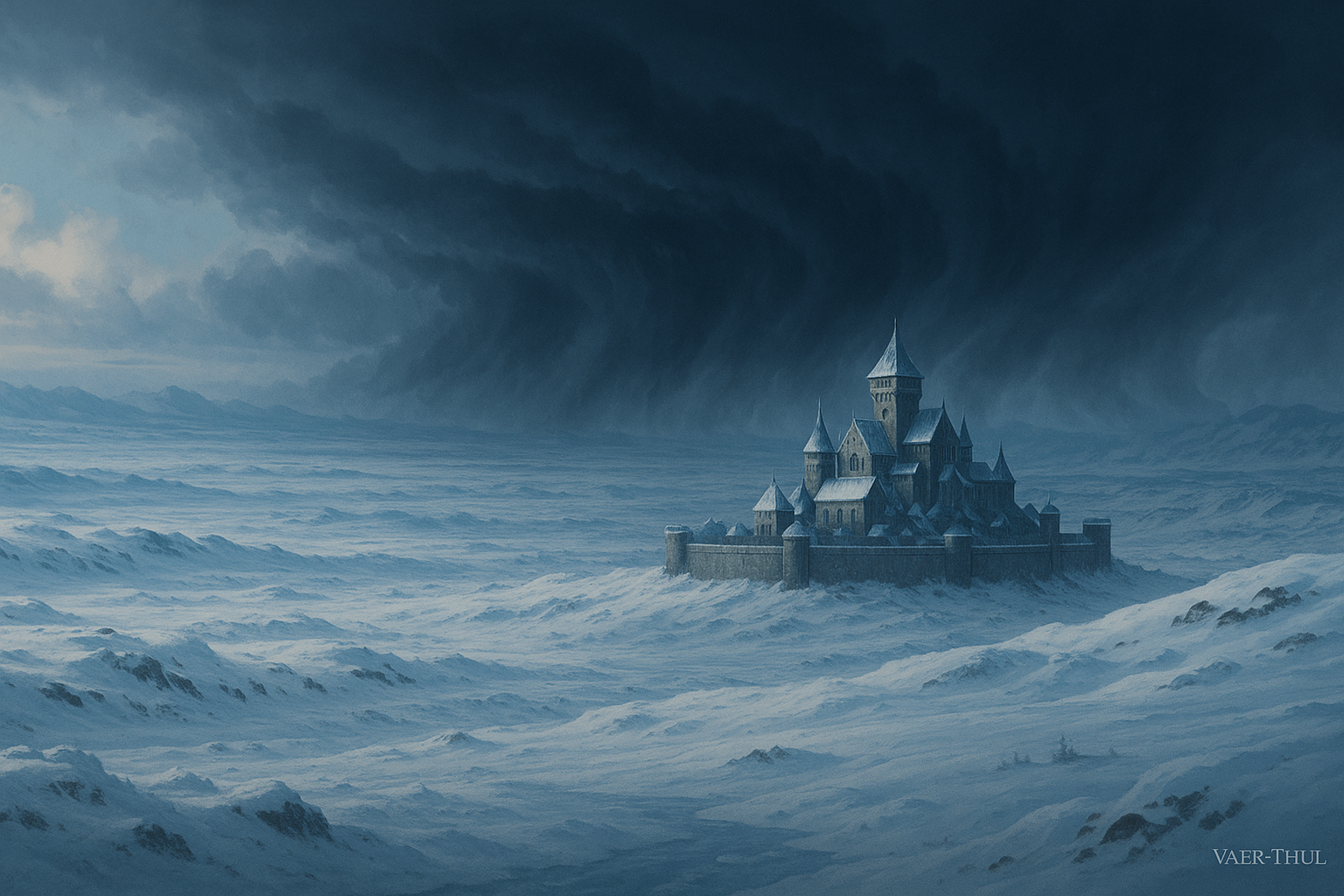
Ras
Ras is a confederation of eight frostbound city-tribes, each shaped by its harsh environment and a culture built around vigilance, cooperation, and respect for the land’s unpredictable nature. The capital, Vaer-Thul (19,200), serves as the intellectual and diplomatic heart of the nation, preserving extensive records and guiding the confederation through environmental uncertainty. Surrounding it are the distinct tribal cities: Thrysshal (9,600), a mountain stronghold of endurance and warrior tradition; Korvessa (14,200), a storm-battered coastal city where sailors study auroras for guidance; Eshath’s Gate (11,300), a frozen-harbor settlement attuned to sudden sea-freezes; and Thryss-Aluun (7,900), a mystical cavern-city where scholars interpret frost patterns and crystal resonance.
The outer frontier is shaped by the smaller but equally vital tribes: Brinewatch (1,420), a disciplined outpost known for its cautious scouts and ritualized patrol traditions; Oskyr’s Landing (1,670), a migratory sled-based city that follows seasonal routes and heeds shifts in wind and stillness; and Leth’raen (5,300), a frostwood-edge settlement whose hunters read the land’s silence as keenly as tracks in snow. Together, these cities create a diverse yet tightly interwoven nation, bound by shared survival, ancient agreements, and a deep cultural understanding that the frostlands hold mysteries older and more powerful than any single tribe.
Structure
Ras functions as a unified tribal confederation anchored by its capital, Vaer-Thul, home to the High Council—a governing body composed of the High Speaker, representatives from each of the seven tribes, and the Archivist-General. While each tribe retains autonomy through its own chieftain or council, all are bound by the Confederation Charter, an ancient agreement ensuring mutual defense, resource sharing, and collective response to the land’s unpredictable conditions. This structure allows the tribes to maintain their cultural identities while relying on Vaer-Thul for coordination, political stability, and interpretation of long-standing records concerning unusual climate patterns and unexplained disappearances across Ras.
Supporting this political framework is the Sentinel Network, a loose but vital organization of scouts, weather-readers, and navigators spread throughout the nation. Their observations feed into the Archive of Frosted Memory, a neutral institution that preserves centuries of environmental data, travel logs, and tribal warnings regarding regions where storms form too quickly or the wind is unnaturally still. Through these systems, Ras stays vigilant, adapting to dangers that no tribe has ever fully understood but which shape both tradition and policy in ways that ensure the confederation’s survival.
Culture
Ras’s cultural identity is rooted in endurance, cooperation, and deep respect for the harsh frostland environment. While united under the capital of Vaer-Thul, each tribe has developed its own traditions, values, and methods of survival—shaped by geography, resources, and generations of interpreting the land’s unpredictable behaviors.
Vaer-Thul — Culture of the Capital
A scholarly and diplomatic culture that values record-keeping, rational decision-making, and unity. Citizens are trained from youth to read environmental signs, emphasizing caution and preparedness. They treat silence before storms with particular seriousness, viewing it as a sign to suspend travel or council meetings.
Thrysshal — Culture of the Highland Peaks
A warrior culture centered on endurance trials, blizzard training, and respect for the mountains. Valor is earned through surviving “the white calm,” a sudden stillness in the air believed to precede dangerous weather. Songs and oral sagas celebrate those who push into the higher passes, even when some never return.
Korvessa — Culture of the Storm Coast
A seafaring culture forged by relentless winds and icy waters. Weather-reading is a revered skill, and sailors memorize the shifting colors of the auroras as part of their training. Sudden quiet along the coast is treated as a spiritual omen, prompting whole communities to halt fishing for the day.
Eshath’s Gate — Culture of the Northern Iceflow
A culture defined by navigation, superstition, and ritual. Mariners bless their boots before stepping onto frozen inlets, believing the ice “remembers.” Folk tales warn that venturing too far into mirror-smooth icefields during abrupt temperature drops invites misfortune.
Brinewatch — Culture of the Far Frontier
A small, fiercely disciplined culture where every family traces heritage through generations of frontier wardens. Ceremonies honor scouts who set out and never returned, and patrol captains carry journals to note any sudden environmental changes. The people speak softly during the long night, out of respect for the quiet.
Oskyr’s Landing — Culture of the Frost Nomads
A nomadic culture valuing flexibility, swift decision-making, and collective survival. They perform “wind tests” before relocations; if the air falls unnaturally still, they delay movement. Stories told around caravan fires emphasize listening to intuition and respecting paths that “the frost itself has closed.”
Thryss-Aluun — Culture of the Crystal Seekers
A mystical, introspective culture centered on studying auroras, frost fractals, and underground crystal formations. Meditation practices involve observing patterns in ice, believed to reveal shifts in the land’s deeper balance. The people claim that sometimes the crystals resonate faintly, though no clear cause has been found.
Leth’raen — Culture of the Frostwood Guardians
A hunter and tracker culture that pays close attention to sound—or its absence. They teach young guardians to recognize when the forest grows unnaturally quiet, treating silence as a sign to retreat or wait out unseen dangers. Ritual offerings are left at the frostwood’s edge before long hunts.
Public Agenda
The primary public agenda of Ras focuses on collective survival, territorial stability, and the preservation of knowledge in a land defined by unpredictable frostland conditions. The High Council prioritizes improving weather prediction, maintaining safe travel routes between tribes, and strengthening infrastructure against sudden freezes and whiteouts. Efforts are continually directed toward supporting the Sentinel Network, expanding the Archive of Frosted Memory, and encouraging cooperation between tribes to better understand recurring anomalies in climate patterns. Ensuring that each city has adequate supplies, trained navigators, and emergency shelters is considered a national responsibility, not a local one.
Alongside survival efforts, the agenda emphasizes cultural unity and environmental stewardship. Tribal leaders are encouraged to share records, maintain open communication, and uphold traditions that promote safety and caution in the wilderness. Programs are in place to train scouts, researchers, and young leaders to recognize subtle environmental shifts, documenting anything unusual for communal benefit. Maintaining harmony between tribes, preserving ancient agreements, and responding swiftly to unreturned patrols or unexplained phenomena remain central to Ras’s governance. Through these measures, the confederation strives to navigate a landscape that demands respect, vigilance, and unwavering solidarity.
Assets
Ras’s greatest assets lie in its natural resources and geographic advantages within the frostlands. Rich deposits of cold-forged minerals and enchanted ice crystals are extracted from mountain and cavern systems, providing materials valued for their durability and magical conductivity. Coastal cities benefit from access to hardy fish species, preserved icewater stocks, and unique sea-ice formations that serve as both defensive barriers and seasonal trade routes. The nation’s vast frostwood forests offer resilient timber adapted to extreme temperatures, essential for construction and caravan-building. Together, these resources support trade with neighboring regions and strengthen Ras’s economic resilience.
Equally important are the nation’s knowledge assets and survival expertise. The Archive of Frosted Memory houses centuries of environmental records, navigational patterns, and tribal observations, making it an unparalleled repository for studying climate behavior and unexplained atmospheric shifts. The Sentinel Network—composed of scouts, weather-readers, and navigators—serves as a living asset, guiding travel and contributing vital information to the tribes. Ras’s warriors, hunters, and shipwrights possess highly specialized skills adapted to sudden whiteouts, shifting ice, and eerie stillness in the land. These cultural and intellectual assets collectively empower Ras to endure and thrive despite the unpredictable forces that shape its frozen territory.
Demography and Population
Ras is home to approximately 70,590 residents distributed across eight major city-tribes, each shaped by its surrounding environment and traditional ways of life. The population includes a diverse blend of Humans, Snow Elves, Goliaths, Dwarves, Sea Elves, Tieflings, and mixed ancestries, with each tribe reflecting a different dominant demographic based on geography. Mountainous regions naturally support Goliath-majority communities, while coastal areas are home to Sea Elves and seasoned human mariners. Snow Elves are woven throughout the confederation as scholars, mystics, navigators, and hunters, often occupying roles tied to environmental interpretation and arcane tradition.
Population density varies greatly, with the capital Vaer-Thul serving as the most diverse and populous settlement at 19,200 residents, while remote outposts like Brinewatch and Oskyr’s Landing remain sparsely populated due to harsh conditions and long travel distances. Growth is gradual but steady, supported by intertribal cooperation, shared resource distribution, and cultural emphasis on survival skills. Patterns of migration within Ras often respond to environmental shifts—unexpected freezes, sudden stillness in the air, or regions deemed unsafe after patrols fail to return. These subtle pressures have shaped demographic distributions for generations, reinforcing tight-knit communities and a governing structure built on vigilance and unity.
Military
The military of Ras is organized as a decentralized but highly cooperative defense network, with each tribe maintaining its own specialized forces adapted to local terrain. Mountain tribes field hardy climbers and shock troops capable of fighting in blizzard conditions, while coastal settlements maintain swift naval units skilled in navigating shifting iceflows. Scouts and outriders form the backbone of Ras’s defensive posture, trained to operate in low-visibility conditions, track disturbances in the snowpack, and respond quickly to sudden environmental changes. Although each tribe retains autonomy over its forces, they unite under the High Council during periods of heightened risk, conducting coordinated patrols and joint training exercises that emphasize survival, communication, and rapid mobilization.
Complementing these forces is the Sentinel Network, a semi-military organization composed of elite trackers, navigators, and weather-readers drawn from every tribe. Their role is to monitor remote stretches of Ras, identify dangerous shifts in the environment, investigate unreturned patrols, and relay their findings to both local leaders and Vaer-Thul. The military also maintains a reserve of arcane specialists—primarily Snow Elf mages—who support operations with protective wards, battlefield illumination, and environmental manipulation. Training across Ras stresses discipline, adaptive tactics, and respect for the land’s unpredictability; soldiers are taught to treat sudden silence, abrupt temperature drops, or unnaturally calm air as immediate signs to halt and reassess. Through a combination of specialized roles and shared vigilance, the military of Ras remains prepared for threats both known and unknown across its frozen domain.
Technological Level
Ras possesses a practical, survival-driven technological base shaped entirely by its unforgiving frostland environment. The tribes excel in cold-weather engineering, constructing insulated dwellings, geothermal-heated structures, sled-platform caravans, and reinforced coastal vessels designed to withstand shifting ice. Metalworking is centered on cold-forged alloys mined from the mountains, producing tools and weapons resistant to extreme temperatures. Their communication systems rely on signal flares, aurora-reflective markers, and long-range horn codes—methods proven reliable during blizzards when visibility fails. Magical integration is subtle but significant: arcane lanterns, frost-resistant charms, and enchanted navigation stones are commonplace, blending traditional craftsmanship with practical spellwork.
Scientifically, Ras is defined by its rigorous study of weather, ice, and environmental patterns. Scholars in Vaer-Thul and Thryss-Aluun maintain centuries of observational records, developing theories on temperature shifts, aurora behavior, and unusual atmospheric stillness. Their understanding of meteorology is advanced by necessity, enabling accurate predictions of storms, freezes, and travel hazards. Specialized researchers also study frostwood growth cycles, crystal formations, and anomalies in sound travel across snowfields. While their scientific models cannot explain every phenomenon—particularly abrupt silences or extreme cold spikes—the people of Ras approach these unknowns with disciplined curiosity, maintaining a culture where observation, caution, and adaptation serve as the backbone of technological advancement.
Religion
Religion in Ras is non-institutional and decentralized, shaped more by reverence for the land than by devotion to specific deities. Most citizens follow a spiritual philosophy known as The Path of the Frost, which teaches respect for nature’s power, the importance of communal survival, and the belief that the world communicates through subtle signs—shifting winds, aurora patterns, or sudden quiet across the snow. Shrines are simple stone or ice markers placed along travel routes, where travelers offer carved tokens or a handful of frostwood shavings to acknowledge the land’s guidance and mercy. Clerics and shamans exist, but they serve as interpreters of environmental symbolism rather than messengers of distant gods.
While major temples are rare, many tribes maintain ancestral reverence practices, honoring those who safeguarded their people in generations past. These rituals often focus on memory, vigilance, and gratitude, emphasizing lessons learned from lost patrols or unexplained disappearances. Some mystics believe that the land holds ancient intentions—neither benevolent nor cruel—which occasionally “whispers” through temperature shifts or uncanny stillness. This belief fosters humility and caution rather than fear, shaping a religious culture that values interpretation over dogma and collective wisdom over prophecy. In Ras, faith is not about worshipping higher powers but about listening intently to a world that seldom speaks, yet demands to be understood.
Laws
The legal structure of Ras emphasizes collective safety, resource stewardship, and intertribal harmony, reflecting the necessity of cooperation in a harsh frostland environment. Core laws mandate open travel routes between tribes, fair distribution of essential goods such as food, timber, and cold-forged metal, and strict penalties for hoarding or obstructing aid. Every tribe is required to maintain accurate records of weather patterns, patrol movements, and unusual environmental occurrences, submitting copies to Vaer-Thul for archiving. Tampering with or falsifying these records is considered a severe offense, as such information is vital for predicting hazards and safeguarding travelers. Disputes between tribes are handled by the High Council, whose rulings are binding and designed to preserve unity.
Individual conduct is governed by laws centered on respect for life, caution in the wilderness, and responsibility toward the community. Travelers must register journeys beyond their city’s boundaries, and ignoring official advisories concerning sudden freezes or unexplained silences is grounds for legal censure if others are endangered. Crimes such as sabotage, abandonment during storms, and negligence in reporting missing persons are treated with particular seriousness. Punishments range from fines and service obligations to banishment in extreme cases. Across Ras, the law is less about imposing authority and more about reinforcing the behaviors necessary for survival: vigilance, honesty, preparedness, and mutual protection in a land where nature often changes without warning.
Agriculture & Industry
Agriculture in Ras is shaped by the realities of a frozen landscape, relying on cold-resistant crops, geothermal greenhouses, and carefully managed frostwood forests. Supplemental food sources come from extensive fishing along the storm coast, deep-ice harvesting, and herding of hardy tundra animals adapted to the environment. Many tribes cultivate specialized algae and mosses beneath heated stone structures, providing nutritional staples during long winters. Because sudden freezes and whiteouts can disrupt production at any moment, agricultural practices emphasize redundancy, storage discipline, and communal distribution. Each tribe contributes to shared reserves, ensuring stability even when certain regions become temporarily inhospitable.
Industry in Ras centers on resources unique to the frostlands: cold-forged metals, enchanted ice crystals, frostwood timber, and expertly crafted survival gear. Mountain cities mine durable ores used in weapons, tools, and sled mechanisms, while coastal settlements produce ice-reinforced vessels capable of traversing shifting seas. Artisans specialize in layered winter armor, insulated architecture, and arcane devices that help predict weather changes or illuminate travel routes. Many industries rely on a deep understanding of environmental behavior, and workers are trained to halt operations when the land grows unnaturally still or temperatures drop too quickly. Together, agriculture and industry form a resilient economic backbone—one built on adaptation, careful planning, and respect for the unpredictable nature of Ras.
Trade & Transport
Trade in Ras operates through a tightly coordinated network that prioritizes essential goods, seasonal predictability, and intertribal cooperation. Each tribe contributes its regional specialties—mountain-forged metals, coastal fish and oil, frostwood timber, enchanted ice crystals, and agricultural yields from geothermal greenhouses—to a shared market system managed through Vaer-Thul. Caravans and trade ships follow established routes that are updated frequently based on Sentinel reports, with traders trained to monitor sudden shifts in wind, temperature, or aurora patterns. Bartering is common, as the value of goods often fluctuates with environmental conditions. External trade is limited but prized, typically conducted through ports during stable weather windows when distant merchants can safely approach.
Transport across Ras is defined by adaptability and caution. Overland travel relies on reinforced sled caravans pulled by hardy beasts or enhanced with arcane propulsion, designed to withstand whiteouts and shifting ice. Coastal movement uses ice-hull vessels crafted to navigate frozen inlets and unpredictable seas. All transport is governed by strict protocols: no long-distance travel is permitted when the air becomes unnaturally still, and every caravan includes trained navigators capable of rerouting at a moment’s notice. Waystations positioned between major cities provide shelter, supplies, and updated environmental reports, ensuring travelers can respond quickly to unexpected conditions. Through this system of vigilance and cooperation, the people of Ras maintain movement and commerce in a land where the environment can change without warning.
Education
Education in Ras is deeply practical and community-centered, designed to prepare citizens for life in an unpredictable frostland. From a young age, children are taught essential survival skills—reading weather patterns, navigating snow-covered terrain, managing emergency shelters, and interpreting subtle environmental cues such as sudden temperature shifts or unusual silence. Basic literacy, arithmetic, and storytelling traditions are integrated with lessons on resource stewardship, tribal history, and the importance of maintaining accurate records for the Archive of Frosted Memory. Each tribe oversees its own schooling, but all follow shared principles emphasizing vigilance, cooperation, and respect for the land. Apprenticeships are common, with youths learning specialized trades such as metalworking, shipbuilding, agriculture, mysticism, or scouting through hands-on mentorship.
Advanced education is centered in Vaer-Thul and Thryss-Aluun, where students study arcane theory, environmental science, cartography, medicine, and long-term climate observation. Scholars collaborate closely with the Sentinel Network, analyzing travel logs and unusual atmospheric data to refine understanding of the region’s behavior. Many educational paths require fieldwork in remote areas, where students learn to document anomalies and respond to sudden changes in the environment. While differing in regional focus, all educational institutions in Ras share a common mission: to cultivate citizens who are adaptable, knowledgeable, and able to contribute to the safety and prosperity of the confederation in a land where even small oversights can become life-threatening.
Infrastructure
Infrastructure in Ras is engineered for endurance, efficiency, and rapid adaptation to extreme conditions. Cities are constructed with reinforced frostwood, cold-forged metal braces, and insulated stone, forming structures that can endure sudden temperature drops and heavy snow accumulation. Many urban centers incorporate geothermal vents or arcane heating nodes to maintain habitable interiors during prolonged freezes. Roadways between tribes are marked with tall ice-stakes and reflective aurora markers, allowing travelers to navigate even during near-zero visibility. Essential facilities—such as granaries, workshops, and waystations—are equipped with multiple layers of insulation and emergency supplies, ensuring they remain functional during unexpected weather shifts. Communication towers, signal horns, and flare posts are strategically placed to relay information quickly across long distances.
Transport infrastructure is equally robust and versatile. Sled routes are maintained by teams of engineers and navigators who monitor ice stability, while coastal settlements keep specialized docks capable of accommodating vessels during both thawed and frozen periods. Waystations positioned at fixed intervals offer shelter, heating, and updated environmental reports for caravans and patrols. Arcane infrastructure plays a subtle but critical role: enchanted lantern arrays illuminate major travel paths, and minor warding circles reinforce the structural integrity of buildings exposed to harsh winds. Infrastructure across Ras is not simply built—it is continually observed, repaired, and adjusted to ensure that the confederation remains connected and secure in a landscape where the environment can shift with little warning.
Mythology & Lore
The mythology of Ras is rooted in reverence for the frostland and the belief that the world communicates through signs carried by wind, light, and silence. Ancient oral traditions describe the land as alive and watchful, its moods revealed through auroras, shifting ice, and sudden stillness across the snowfields. Legends tell of ancestral spirits who once guided the tribes through long winters, marking safe paths with faint glimmers in the frost. Stories passed down through generations speak of travelers who ignored subtle warnings—the quiet before a storm, the unnatural drop in temperature—and vanished into the wilderness, becoming part of the land’s memory. These tales serve less as fearmongering and more as cultural instruction, encouraging respect, discipline, and humility in the face of nature’s power.
One of the most enduring myths centers on the Silent Region, a remote northern expanse where storms are said to form without warning. According to tradition, blizzards there appear in perfect stillness before erupting with violent force, as though summoned by an unseen will. Elders claim that the storms carry whispers or echoes that do not match the wind, and that the snow in this region falls with an unusual heaviness, obscuring tracks and sound alike. Some tribes believe the Silent Region is the resting place of an ancient guardian or the site of a long-forgotten event that unsettled the balance of the land. Whether omen or natural phenomenon, the myth persists across all tribes, shaping travel customs and reinforcing the belief that some parts of Ras should only be approached with utmost caution—and never alone.
Divine Origins
The origins of Ras trace back to a migration of early tribes seeking refuge from turbulent conflicts in warmer lands to the south. Drawn by the promise of untouched territory and resilient natural resources, these settlers gradually adapted to the frostlands, developing techniques for surviving the relentless cold and reading subtle environmental signs. Over generations, scattered camps grew into established tribes, each specializing in their region’s terrain—mountains, coasts, forests, and open tundra. Oral histories describe the early years as a time of harmony with the land, though marked by unexplained disappearances and sudden storms that shaped the settlers’ deep respect for caution and communal vigilance. As the tribes expanded, they united through the Confederation Charter, forming the foundation of modern Ras.
Legends say that long before the tribes arrived, the frostlands held ancient powers or phenomena that shaped the balance of the region. Elders speak of shimmering lights that guided lost travelers, ice formations older than any recorded memory, and the Silent Region—an area where storms erupt with unnatural speed, as if reacting to invisible forces. While scholars debate whether these tales reflect natural climate patterns or remnants of forgotten events, they agree that the land itself influenced the development of Ras’s identity. The nation’s origins are thus a blend of adaptation, cooperation, and a persistent awareness that the frostlands harbor mysteries older than any tribe, encouraging generations to watch the horizon with equal parts curiosity and respect.
Tenets of Faith
The faith of Ras is unified under a guiding philosophy known as The Path of the Frost, a belief system centered on respecting the land and interpreting its subtle signals. Its followers uphold core tenets that emphasize vigilance, humility, and collective responsibility. The first tenet, “Listen to the Quiet,” teaches that silence in the snow—whether before a storm or deep in the wilderness—often carries meaning and must never be ignored. The second tenet, “Honor the Balance,” urges citizens to preserve resources, maintain harmony among tribes, and recognize that every action may echo through the environment. A third principle, “Share the Warmth,” reflects the cultural emphasis on cooperation and communal survival, requiring aid to be given freely to travelers, the injured, and the lost.
The final and most mysterious tenet, “Respect the Unknown,” stems from ancient accounts of unpredictable storms and unusual atmospheric behavior, particularly around the Silent Region. Elders teach that some forces within the frostlands move unseen, shaping the land in ways that defy full understanding. Rather than inspiring fear, this tenet fosters reverence and caution, reminding the people of Ras that humility before the environment is essential for survival. Through these principles, the Path of the Frost provides moral guidance, spiritual grounding, and a shared framework for interpreting the land’s ever-shifting moods.
Ethics
The ethical framework of Ras is grounded in the belief that survival is a collective responsibility, and that individuals must act with integrity to protect both their tribe and the confederation as a whole. Core values include honesty, vigilance, and self-restraint—behaviors essential for living in a land where even small oversights can lead to disaster. Ethical teachings encourage citizens to speak truthfully about environmental risks, share knowledge that could prevent harm, and adhere to travel advisories and community protocols. Deceit that endangers others, negligence in reporting missing travelers, or disregarding signs of dangerous weather are considered serious moral failings. Rashness is viewed as a threat to communal survival, while thoughtful caution is praised as a civic virtue.
Equally important is the ethic of interdependence and mutual respect, emphasizing that no one survives the frost alone. Helping those in need—whether by offering shelter during a freeze, sharing supplies with stranded caravans, or guiding newcomers through dangerous terrain—is seen as an ethical duty rather than an act of generosity. The people of Ras also hold a deep moral respect for the land, believing that wastefulness or disregard for natural cues disrupts the fragile balance that sustains life. This ethic extends to a cultural humility: the acceptance that some forces within the frostlands remain beyond understanding, and that acting with patience and reverence is the most responsible path forward.
Worship
Worship in Ras is quiet, personal, and deeply intertwined with the natural world. Rather than venerating specific deities, the people honor the forces and rhythms of the frostlands, believing that the land itself carries wisdom in its winds, storms, and silences. Worship is commonly expressed through simple rituals: placing carved tokens in snowdrifts before a journey, whispering thanks to the auroras after safe passage, or leaving offerings of frostwood shavings near waystones. These acts are seen as gestures of gratitude and respect rather than supplication, reflecting a worldview where humans acknowledge their small but purposeful place within the vast landscape. Formal temples are rare; instead, shrines appear spontaneously along trade routes, carved into cliffs, or built into sheltered glades where travelers can pause and reflect.
Communal worship occurs during seasonal gatherings, where tribes meet to share stories, honor the memory of lost explorers, and reaffirm their commitment to interpreting the land’s subtle signs. Songs and chants often echo themes of balance, patience, and humility, reminding listeners that the frostlands are both provider and challenger. Some tribes perform quiet vigils during unusual weather events, believing that moments of stillness or sudden storms may signal shifts in the land’s deeper harmony. While varied in practice, all worship in Ras is guided by the same principle: to live attentively and respectfully within a world whose mysteries cannot be fully understood, yet whose presence is felt in every breath of cold air.
Priesthood
The priesthood of Ras—known collectively as the Frostkeepers—serves not as intermediaries between mortals and gods but as interpreters of the land’s subtle signs. Frostkeepers arise from all eight city-tribes and are chosen for their exceptional ability to read weather patterns, sense shifts in the environment, and recall generations of oral tradition. Their training combines practical survival knowledge, meditation practices, and rigorous study within the Archive of Frosted Memory. Rather than commanding authority, Frostkeepers guide their communities through counsel, advising when to travel, when to harvest, and when to remain sheltered. Their insight often proves invaluable during sudden calms in the wind or unexpected cold surges, which the people see as moments requiring heightened awareness.
Frostkeepers conduct rituals, maintain shrines, and lead seasonal gatherings, but their true role lies in preserving continuity and caution. They teach the tenets of the Path of the Frost, encourage stewardship of shared resources, and mediate disputes where environmental risk plays a factor. Many undertake pilgrimages to remote regions—including areas near the Silent Region—to deepen their understanding of the land’s unpredictable moods. While they claim no direct communion with higher powers, their calm presence and measured intuition grant them significant respect. To the people of Ras, a Frostkeeper’s silence during a moment of eerie stillness carries more weight than a hundred warnings, for they are trained to listen closely to a world that rarely speaks aloud.
Granted Divine Powers
Frostkeepers do not claim to wield “divine” power in the traditional sense; instead, their abilities are viewed as gifts of heightened perception and harmony with the frostlands. Through years of meditation, discipline, and exposure to the harsh environment, many develop an uncanny sensitivity to subtle shifts in temperature, wind patterns, and atmospheric pressure. These talents, often dismissed as superstition by outsiders, have proven reliable in predicting storms, identifying unstable ice, and sensing when travel conditions may abruptly change. Some Frostkeepers appear able to detect disturbances from great distances, especially during moments when the land grows unusually quiet. Whether these abilities stem from innate talent, rigorous training, or something deeper within the frost itself is a matter of philosophical debate.
A rarer few demonstrate abilities bordering on the arcane—minor blessings that manifest as gentle warming auras, protective wards against biting winds, or faint luminescence during rituals held beneath the auroras. These effects are subtle and never dramatic, yet they offer comfort and safety during long nights and treacherous journeys. Frostkeepers insist these gifts are not miracles but symbiotic exchanges with the land, earned through humility, patience, and respect. Scholars have documented such phenomena for generations but have yet to determine their exact nature. To the people of Ras, the explanation hardly matters; what they know is simple: when the air falls still and dangers unseen move across the frost, the presence of a Frostkeeper can mean the difference between disaster and safe return.
Political Influence & Intrigue
Frostkeepers do not claim to wield “divine” power in the traditional sense; instead, their abilities are viewed as gifts of heightened perception and harmony with the frostlands. Through years of meditation, discipline, and exposure to the harsh environment, many develop an uncanny sensitivity to subtle shifts in temperature, wind patterns, and atmospheric pressure. These talents, often dismissed as superstition by outsiders, have proven reliable in predicting storms, identifying unstable ice, and sensing when travel conditions may abruptly change. Some Frostkeepers appear able to detect disturbances from great distances, especially during moments when the land grows unusually quiet. Whether these abilities stem from innate talent, rigorous training, or something deeper within the frost itself is a matter of philosophical debate.
A rarer few demonstrate abilities bordering on the arcane—minor blessings that manifest as gentle warming auras, protective wards against biting winds, or faint luminescence during rituals held beneath the auroras. These effects are subtle and never dramatic, yet they offer comfort and safety during long nights and treacherous journeys. Frostkeepers insist these gifts are not miracles but symbiotic exchanges with the land, earned through humility, patience, and respect. Scholars have documented such phenomena for generations but have yet to determine their exact nature. To the people of Ras, the explanation hardly matters; what they know is simple: when the air falls still and dangers unseen move across the frost, the presence of a Frostkeeper can mean the difference between disaster and safe return.
Sects
Though unified under the broader philosophy of the Path of the Frost, the people of Ras have developed several distinct sects that reflect regional interpretations of the land’s signals and spiritual meaning. The Stillwind Circle, prominent in Thrysshal and Leth’raen, focuses on the significance of silence across the frost—especially the eerie calm that precedes sudden storms. Its members meditate outdoors during quiet moments, seeking to understand what the land “withholds.” The Auroral Wardens, centered in Korvessa and Eshath’s Gate, study the shifting colors of the sky. They believe the auroras are a tapestry of warnings and blessings woven by ancient forces, and they train initiates to read changes in color or motion that others might dismiss. Meanwhile, the Deepglint Scholars of Thryss-Aluun explore the meanings hidden in frost fractals and crystal vibrations, treating these natural patterns as echoes of the land’s shifting balance.
Vaer-Thul and Oskyr’s Landing host the largest sect, known as the Keepers of the Memory, whose purpose is to preserve oral tradition and interpret inconsistencies in historical records. They emphasize the importance of shared knowledge and the practical value of understanding past anomalies—whether unusual weather events, vanished patrols, or shifts in longstanding migration routes. While each sect maintains unique rituals, symbols, and methods of interpretation, none claim to possess absolute truth. In fact, disagreements between sects are encouraged as healthy discourse, reflecting the belief that Ras is too vast and too old for any single viewpoint to capture fully. Together, these sects weave a diverse yet cohesive spiritual framework that guides the nation’s relationship with its environment and reinforces the caution required to thrive within it.


Comments