
Pepji
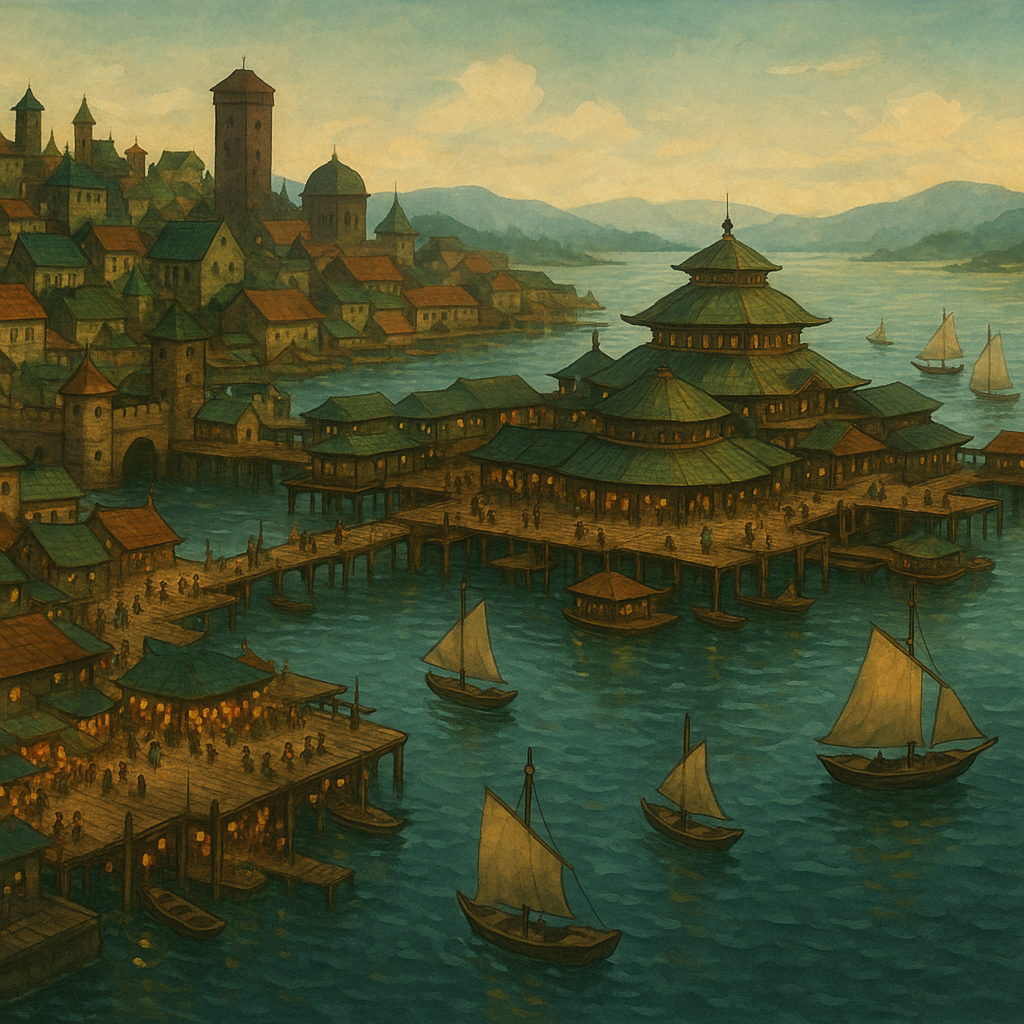
The nation of Pepji is a water-bound confederation defined by vast lakes, branching rivers, and cities that blur the line between land and sea. At its heart lies Kelrath-Moro, a sprawling hybrid metropolis of stone shorelines and floating platforms that serves as Pepji’s political, economic, and cultural core. Pepji is predominantly goblin-led, though Humans and River Elves form powerful secondary populations, especially in trade, navigation, and administration. Rather than a centralized monarchy, Pepji operates through a fluid system of councils, fleets, and clan alliances, reflecting a worldview shaped by shifting currents and seasonal floods. Mobility is power in Pepji—cities move, councils relocate, and influence flows along waterways rather than fixed borders. Night markets, floating neighborhoods, and clan-fleet docks dominate daily life, creating a nation that is constantly in motion yet deeply interconnected.
Politically, Pepji is pragmatic, adaptive, and quietly formidable. Goblin ingenuity drives shipbuilding, logistics, and modular architecture, while River Elves provide ecological stewardship and Humans anchor long-term trade relations. The Shifting Council, headquartered in Kelrath-Moro, embodies Pepji’s philosophy: leadership must adapt to conditions, not resist them. Pepji controls crucial freshwater trade routes and lake ports that link multiple regions, granting it immense leverage despite its non-imperial posture. Militarily, Pepji favors patrol fleets, river control, and economic pressure over conquest, making it difficult to threaten and even harder to pin down. To outsiders, Pepji may appear chaotic or informal—but beneath the surface lies a sophisticated system of alliances, maritime law, and cultural cohesion that allows the nation to thrive wherever water flows.
Structure
The government of Pepji is a layered, flexible system built around clan authority, river control, and swamp survival, with goblins holding most political power through ancient clan-fleet traditions. At the top sits the Marsh-Throne, a hereditary position held by a goblin monarch known as the Reed-King or Reed-Queen, who rules not from a palace but from the Drifting Hall, a massive stilted barge that moves seasonally between major ports. The monarch’s authority depends heavily on support from the Clan-Fleet Council, a coalition of the largest goblin mariner clans who oversee ferry routes, salvage rights, marsh protection, and naval readiness. Humans, elves, gnomes, and half-elves sit on advisory committees, but true legislative power comes from the clans who control boats, trade networks, and passage rights through the swamp midlands.
Beneath the national leadership is the Swampward Administration, a bureaucratic network that governs settlement zones, marsh regions, and the southern mountain foothills. It includes the Waterway Stewards (river management), Portmasters’ League (trade regulation), and Tinker-Guild of Tinkford (engineering oversight). Each town or village is led by a Wetwarden, a local governor appointed jointly by the monarch and the Clan-Fleet Council, responsible for safety, trade flow, and swamp navigation laws. The military arm—called the Fenwatch Orders—is decentralized and answers first to local Wetwardens and only second to the Marsh-Throne. Together, this structure makes Pepji deeply adaptive: a nation where political power floats—sometimes literally—on the strength of clan alliances, waterway mastery, and the ability to keep the swamp kingdom thriving.
Culture
The culture of Pepji is shaped by its goblin majority, its swamp-midland environment, and its deep connection to rivers, deltas, and lake routes. Life in Pepji revolves around movement, watercraft, and adaptability—values that stem from centuries of living atop shifting marshes and unpredictable waterways. Goblin clan-fleets form the cultural backbone, each clan known for its unique style of boatmaking, ferry shouting, racing traditions, and night-market crafts. Homes are built on stilts, rafts, or pontoons; neighborhoods shift with tides; and festivals often occur on floating platforms anchored only loosely to the shore. Music is fast, rhythmic, and drum-heavy—meant to echo across foggy waters—and storytelling is done through bold gestures, quick jokes, and communal performances around torches reflecting off marsh pools. Clan colors, carved mast-icons, and pattern-painted hulls serve as Pepji’s version of heraldry.
Pepji’s multicultural contributions enrich this goblin foundation. River elves blend water rituals into daily life, teaching respect for reeds, currents, and the spirits believed to dwell in the dark fen pools. Humans introduce structured trade norms and agriculture along the few arable banks, while gnomes elevate Pepjiran craft with ingenious devices—water clocks, pulleys, buoy lanterns, and swamp-safe engines. Together, they create a culture defined by cooperation in chaos: a society where agility is prized, creativity is essential, and humor is a survival tactic. Meals feature smoked fish, marsh herbs, eel stews, and fermented kelp drinks. Hospitality means offering a warm lantern and a dry plank to stand on. Above all, Pepjiran culture celebrates resilience—because in a land where the ground itself can shift beneath you, identity must flow like water: adaptable, communal, and proudly alive.
Public Agenda
The public agenda of Pepji centers on safeguarding the waterways, swamps, and trade networks that allow the kingdom—and its goblin clan-fleets—to thrive. The government prioritizes maintaining clear and safe travel channels through the thick midland marshes, dredging shifting riverbeds, and fortifying the port cities that anchor Pepji’s economy. Expanding and protecting ferry routes across Lake Kelreth remains a top priority, both to strengthen ties with Rilt’kej and to ensure Pepji retains control over the flow of goods moving between the northern lake and the southern mountains. Environmental stewardship is equally important: invasive reeds, shifting mudflats, and predatory fen wildlife require constant management. Investments in buoy lantern systems, foghorn networks, and gnome-designed water clocks reflect a public focus on improving navigation and reducing accidents in the treacherous marsh channels.
Socially, the agenda pushes for unity between goblin clan-fleets and the minority populations living in the wetlands and mountain foothills. Policies center on strengthening local Wetwardens, improving food security in swamp settlements, and ensuring that mountain routes remain open for trade during seasonal storms. The Reed-Monarch’s court also seeks to elevate Pepji’s influence on regional diplomacy by positioning the nation as the indispensable waterway broker between Skalzij, Rilt’kej, and the inland passes. Efforts are underway to enhance port defenses, expand salvage rights, and develop advanced flood-management systems to protect vulnerable midland communities. Above all, Pepji’s agenda strives to reinforce its identity as a resilient, adaptive swamp kingdom—one where prosperity depends on mastering water, maintaining flexible alliances, and ensuring that no clan or settlement is left to struggle alone in the shifting fens.
Assets
Pepji’s assets arise from its mastery of water, its adaptable goblin fleet culture, and the natural wealth hidden in its sprawling marshlands. Its greatest material strength is its network of navigable swamp channels, lakeland inlets, and river deltas, which function as living highways for trade. The Clan-Fleet Drydocks of Vesh’ti Roam are among the finest boatmaking facilities in the region, producing fast ferries, salvage craft, and shallow-hull barges that other nations struggle to match. Pepji’s coastline along Lake Kelreth grants it control over ferry routes that connect northern agriculture to southern markets, while its four port cities—Reedhollow, Mosswharf, Tinkford, and Croakfen Hold—serve as vital trade hubs moving herbs, fish, engineered goods, and marshcraft supplies. Its swamp midlands also provide unique natural resources: medicinal algae, rare marsh fungi, reeds for boat construction, and deepwater fish found nowhere else. These exports make Pepji indispensable to neighboring nations even without vast farmland or mineral wealth.
Pepji’s technological and infrastructural assets are equally crucial. Gnome-engineered buoy lanterns, water clocks, ropebridge systems, and foghorn towers allow ships to navigate deadly marshes that outsiders find impossible to cross. The Fenwatch Towers scattered across the midlands help monitor tides, wildlife migrations, and shifting swamp hazards, while the Mountain Gate at Stonefall Crest secures Pepji’s influence over southern land routes. Cultural assets also play a major role in the kingdom’s identity: the agile goblin racing crews, elite swamp scouts from Gritmarsh, and river-elf tide-readers of Reedhollow all form specialized groups whose knowledge can’t be replicated. Even the floating markets of Kelrath-Moro—constantly drifting, shifting, and expanding—act as a mobile economic powerhouse. Altogether, Pepji’s assets form a web of mobility, ingenuity, and environmental expertise, making the kingdom far more powerful than its swampy landscape suggests.
Demography and Population
Pepji has an estimated population of ~215,000, concentrated primarily along its major lakes, rivers, and floating urban centers. The nation is goblin-led, with goblins making up roughly 48–52% of the population, dominating civic administration, logistics, shipbuilding, and trade coordination. Humans comprise about 28–30%, often serving as merchants, diplomats, scribes, and long-term contract administrators within the council system. River Elves account for roughly 15–18% of the population and are most prevalent in ecological management, navigation, water law, and spiritual stewardship of lakes and floodplains. Smaller minorities—including halflings, a few tritons, and rare gnomish engineers—exist mostly in port cities and trade hubs, rarely exceeding 4–5% collectively.
Population density is highest in major water cities, especially Kelrath-Moro (≈42,000), with secondary concentrations in floating lake ports, river confluences, and seasonal trade moorings. Inland settlements are smaller, often semi-nomadic or modular, expanding and contracting with flood cycles and trade seasons. Pepji’s population is unusually mobile; many citizens are registered to clans, fleets, or platforms rather than fixed land parcels. Intermixing between goblins, humans, and river elves is common, producing bilingual communities and shared customs rather than rigid ethnic districts. This demographic fluidity reinforces Pepji’s political philosophy: identity is shaped by function, affiliation, and movement, not static borders—making the nation resilient, adaptive, and culturally cohesive despite its ever-shifting physical landscape.
Military
Pepji’s military is built around water control, mobility, and denial rather than conquest, reflecting the nation’s geography and political philosophy. Its primary force, the Lakeward Fleets, consists of fast patrol barges, armored clan-vessels, and modular war-platforms that can detach, regroup, or vanish into reed-choked channels with remarkable speed. Goblin tacticians excel at layered defenses—floating barricades, chained platforms, retractable docks, and disguised kill-zones—turning Pepji’s lakes and rivers into hostile terrain for invaders. River Elves serve as navigators, scouts, and hydro-mages, manipulating currents, fog, and submerged obstacles, while Human officers often coordinate logistics and long-term strategy. Rather than large standing armies, Pepji maintains fleet-registries, requiring clans and trade houses to provide armed vessels when the Shifting Council issues a call to muster.
On land, Pepji relies on amphibious militias and rapid-response strike crews trained to fight from boats, docks, and flooded streets. Urban centers like Kelrath-Moro are designed as defensive puzzles—streets that flood on command, council halls that relocate, and entire neighborhoods capable of drifting away from a threatened shoreline. Pepji avoids direct warfare whenever possible, favoring economic pressure, river blockades, and selective raids to force negotiations. When war is unavoidable, their tactics are unsettlingly efficient: ambushes launched from beneath platforms, night assaults guided by lantern-signals, and sudden collapses of enemy supply lines. Outsiders often underestimate Pepji’s forces due to their informal structure, but veteran commanders know the truth—to fight Pepji is to fight the water itself, and few enemies emerge unbroken from its grasp.
Technological Level
Pepji is a leader in aquatic engineering, modular construction, and applied mechanics, driven largely by goblin innovation and necessity rather than formal academia. Its cities—especially Kelrath-Moro—are built upon vast networks of interlocking floating platforms, adjustable pylons, and counterweighted anchors that allow entire districts to rise, sink, rotate, or relocate with changing water levels. Goblin engineers specialize in compact mechanical systems: collapsible bridges, retractable docks, flood-gates hidden beneath market streets, and buoyancy regulators that can be repaired or reconfigured in minutes. River Elves contribute advanced knowledge of hydrology, sediment flow, and ecological balance, ensuring that Pepji’s constructions work with water rather than against it. Human scholars and scribes document these systems meticulously, producing practical manuals that spread standardized designs across the nation’s fleets and ports.
Scientifically, Pepji favors experimentation, observation, and iteration over theory-heavy scholarship. Innovations are tested directly on the water—if a platform floats, holds, and survives a storm, it is deemed successful. This has led to major advancements in river navigation, freshwater desalination, lantern-based signaling, and night-illumination technologies, all crucial to Pepji’s famous nocturnal markets and patrols. Goblin alchemists develop waterproof sealants, rot-resistant timbers, and glowing algae used for lighting and navigation. River Elf arcanists blend magic with engineering to stabilize currents, soften waves, and create submerged sensor-wards that detect movement near docks or bridges. While Pepji lacks grand universities, its floating workshops and fleet-forges function as decentralized research hubs, making the nation one of the most practically advanced freshwater civilizations in the world—unflashy, adaptable, and relentlessly effective.
Religion
Religion in Pepji is practical, pluralistic, and deeply tied to water, favoring lived belief over rigid doctrine. Rather than a single state religion, Pepji recognizes a River Accord of Faiths, a loose spiritual framework that honors deities and spirits associated with flow, adaptation, cleverness, and survival. Goblins commonly revere Trickster and Craft-aligned gods (such as Garl Glittergold–like figures or regional goblin deities), valuing ingenuity, improvisation, and communal cleverness as sacred traits. River Elves venerate water and nature-aligned deities, spirits of lakes, currents, and seasonal floods, believing rivers are living entities that must be listened to rather than controlled. Humans tend toward pragmatic worship—honoring gods of trade, luck, protection, and contracts—often maintaining small shrines aboard ships or floating homes. Faith in Pepji is rarely exclusive; most citizens honor multiple powers depending on circumstance, offering prayers before voyages, negotiations, construction, or storms.
Worship is conducted through floating shrines, moving altars, and seasonal rites rather than permanent temples. The most important religious events coincide with natural cycles: flood-season blessings, lake-turn ceremonies, and night-vigil festivals where lanterns are released across the water to honor ancestors and lost sailors. Priests and shamans—called Current-Keepers—serve as mediators between people, spirits, and councils, offering guidance on omens, water safety, and communal harmony. They hold no centralized authority but wield significant influence, as ignoring spiritual warnings is widely believed to bring structural failure, bad trade, or political misfortune. In Pepji, religion reinforces a core national belief: nothing static survives. Just as platforms drift and councils move, faith must remain flexible, responsive, and rooted in the realities of water, community, and change.
Laws
Law in Pepji is governed by the Current Code, a flexible legal framework built on precedent, practicality, and environmental awareness rather than rigid statutes. The guiding principle is simple: any action that endangers the flow of water, trade, or communal safety is a crime against all. As such, offenses like sabotaging platforms, blocking channels, falsifying cargo weights, hoarding flotation materials, or polluting lakes and rivers are treated as severe crimes. Pepji law prioritizes repair over punishment—most sentences involve restitution, forced labor on platforms or fleets, or mandatory service maintaining waterways and infrastructure. Violence is judged by impact rather than intent; a brawl that damages docks or causes flooding is punished more harshly than one that ends quickly and cleanly. Contracts are sacred, especially those tied to trade or fleet obligations, and breaking a sworn agreement before witnesses or a council can result in seizure of vessels, loss of clan standing, or permanent trade blacklisting.
Legal authority rests with the Shifting Council, whose rulings move with the city itself. Councils convene on floating halls or mobile platforms, and jurisdiction follows water routes rather than land borders. Goblin magistrates dominate legal proceedings, valued for their sharp memory, improvisational reasoning, and ability to untangle complex disputes quickly. River Elves serve as environmental arbiters, empowered to halt construction or trade if waterways are threatened, while Human scribes maintain records to ensure continuity as councils relocate. Pepji law recognizes clans, fleets, and platforms as legal entities, allowing groups—not just individuals—to be fined, sanctioned, or rewarded. Foreigners are welcome but strictly bound to local law; ignorance is no defense, and violations affecting water or trade are punished swiftly. Ultimately, Pepji’s legal system mirrors its cities: adaptable, interconnected, and unforgiving of those who refuse to move with the current.
Agriculture & Industry
Agriculture in Pepji is shaped almost entirely by water management, aquatic cultivation, and adaptive food systems rather than traditional farmland. The nation relies heavily on floating farms, reed-islands, and anchored wetland plots where goblins and River Elves cultivate water-grains, lake tubers, algae crops, lotus-fruit, and medicinal marsh plants. Fish pens, eel runs, and shell-nurseries are integrated directly into city platforms, allowing food production to occur beneath homes, markets, and council halls. River Elves oversee ecological balance, ensuring harvesting does not disrupt spawning cycles or water quality, while goblin farmers constantly modify flotation beds to follow nutrient-rich currents. Small pockets of shoreline agriculture exist, but Pepji’s true strength lies in its ability to grow food wherever water flows, making it unusually resilient to droughts or land-based disruptions.
Industry in Pepji is dominated by shipbuilding, modular construction, salvage craft, and light manufacturing, all optimized for wet environments. Goblin engineers excel at producing collapsible hulls, interlocking platforms, waterproof mechanisms, and replaceable components that can be assembled or repaired directly on the water. Kelrath-Moro hosts massive clan-fleet yards where vessels are built in sections, allowing damaged ships to be cannibalized for parts within hours. River Elves contribute advanced techniques in living-wood shaping, rot-resistant materials, and current-calibrated architecture, while Humans focus on trade goods, recordkeeping tools, and standardized fittings used across fleets. Pepji is also renowned for its night-industry—lantern crafting, glowing algae cultivation, signal systems, and stealth-friendly materials designed for low-light operations. Together, these industries make Pepji an economic power not through raw output, but through efficiency, adaptability, and control of freshwater trade, allowing the nation to outproduce and outmaneuver rivals in any environment where water is present.
Trade & Transport
Trade is the lifeblood of Pepji, flowing along lakes, rivers, and mobile ports rather than fixed roads or borders. The nation controls a dense network of freshwater routes that connect inland regions, border states, and coastal intermediaries, giving Pepji outsized economic influence despite its modest land footprint. Kelrath-Moro, as the largest lake port, anchors this system—its clan-fleet docks and night markets serving as clearinghouses for grain, fish, textiles, timber, metal goods, and rare wetland resources. Goblin trade clans manage contracts and distribution with ruthless efficiency, while Human merchants handle long-term trade agreements and foreign diplomacy. River Elves act as guarantors of water access and ecological compliance, ensuring trade does not damage the waterways that sustain Pepji’s power. Trade is regulated through licenses tied to fleets and platforms rather than individuals, allowing commerce to continue seamlessly even as settlements shift location.
Transport within Pepji is almost entirely waterborne and modular, relying on barges, skimmers, tug-vessels, and semi-submerged cargo platforms that can be linked together into temporary convoys. Roads exist only in short stretches along stable shorelines; the true highways are channels mapped and constantly remapped by goblin navigators. Cargo is moved in standardized floating units that can be detached, rerouted, or hidden during emergencies, making Pepji’s supply chains remarkably resilient. Night transport is common and deliberately favored—lantern-coded signals, glowing algae markers, and sound-dampened hulls allow fleets to move discreetly after dark. River Elves guide traffic through shallow or hazardous waters, while goblin crews maintain rapid repair teams that can stabilize damaged vessels mid-journey. To outsiders, Pepji’s transport system appears chaotic; in reality, it is one of the most efficient freshwater logistics networks in the world, designed to adapt instantly to floods, conflict, or political change—always moving, never stalled, and impossible to fully blockade.
Education
Education in Pepji is decentralized, practical, and apprenticeship-focused, shaped by the belief that knowledge must move as fluidly as water. There are no grand universities; instead, learning happens aboard fleet-schools, workshop-platforms, and council barges that travel between settlements. Goblin youths are taught from an early age through hands-on instruction—navigation, buoyancy math, basic engineering, contract law, and problem-solving under pressure. River Elf elders instruct students in hydrology, ecological balance, water-reading, and seasonal cycles, emphasizing long-term stewardship of lakes and rivers. Human instructors contribute literacy, recordkeeping, diplomacy, and trade arithmetic, ensuring Pepji’s famously complex agreements and logistics remain functional. Education is communal and ongoing; adults routinely retrain as technologies shift or fleets change roles, making lifelong learning a cultural norm rather than an exception.
Advanced education takes place within specialized guild-fleets rather than fixed institutions. Engineers apprentice in floating dryyards, learning modular construction and rapid repair; navigators train aboard night-running vessels, mastering lantern codes, current memory, and stealth movement; and council scribes study law and negotiation directly under Shifting Council magistrates. Knowledge is validated through demonstrated competence, not examinations—if a platform holds, a contract stands, or a convoy arrives intact, the lesson is considered learned. River Elf scholars and goblin innovators jointly maintain living archives, waterproof record systems that move with the councils to prevent loss through flood or conflict. Education in Pepji is designed not to create scholars detached from reality, but adaptive thinkers capable of solving problems in motion, ensuring the nation remains clever, resilient, and always one step ahead of the current.
Infrastructure
Pepji’s infrastructure is defined by mobility, modularity, and resilience, built to thrive in a landscape where water levels shift constantly. Cities like Kelrath-Moro are constructed from vast networks of interconnected floating platforms, stabilized by adjustable anchors, weighted pylons, and flexible joint systems that allow districts to rise, drift, or reorient without structural failure. Buildings are designed light and wide rather than tall, distributing weight evenly and allowing rapid disassembly if relocation is required. Beneath the platforms run hidden maintenance channels containing buoyancy regulators, ballast tanks, and emergency seal systems. Shore-based infrastructure exists only where land is reliably stable and is intentionally minimal—dock pylons, flood-resistant storehouses, and modular causeways that can be detached during high water or conflict. River Elves oversee environmental integration, ensuring structures do not disrupt currents, fish migration, or sediment flow.
Transportation, communication, and utilities are integrated directly into Pepji’s infrastructure. Floating roadways, tug-paths, and chain-guided channels replace traditional streets, while lantern towers, sound-signaling buoys, and mirrored markers allow rapid coordination across lakes at night or in fog. Freshwater distribution is managed through filtration beds and algae purification systems built beneath residential platforms, while waste is processed through submerged reclamation frames that break down refuse safely. Fire risk is mitigated through firebreak spacing and water-fed suppression lines embedded in every district. Critical government buildings—such as council halls, armories, and granaries—are mounted on independent mobile platforms, ensuring continuity of governance even if parts of a city must disperse. Pepji’s infrastructure is not meant to resist change but to move with it, turning instability into strength and making the nation extraordinarily difficult to disrupt, besiege, or cripple.
Mythology & Lore
Pepji mythology begins with the tale of the First Flood, when the world was said to be rigid and unmoving, and the waters rebelled against stone and soil alike. According to legend, the rivers broke their banks not in anger but in search of freedom, reshaping the land until only those who adapted survived. Goblin myths claim their ancestors were the first to listen—to currents, creaks of drifting wood, and the warnings carried in ripples—learning that survival belonged not to the strongest, but to the clever and flexible. River Elves tell a parallel story, speaking of ancient water-spirits who taught them to read flow and balance, warning that any people who tried to cage water would eventually be swallowed by it. Humans feature in later myths as the “Anchored Ones,” newcomers who learned—sometimes painfully—that permanence was an illusion. Together, these stories form a shared origin belief: the world is alive, and it favors those who move with it.
Central to Pepji’s mythology is the figure of The Ever-Drifting Council, a semi-mythic predecessor to the modern Shifting Council. Said to have convened on a single raft that grew as others joined it, the council survived storms, wars, and betrayals by never remaining in one place long enough to be destroyed. Many Pepji tales warn against hubris—cities that tried to build too tall, leaders who refused to relocate, fleets that ignored omens and were swallowed whole. Folklore is rich with water-spirits, trickster currents, and “listening beasts” that sense danger before it arrives. Night-market stories often feature clever goblins outwitting floods or spirits through wit rather than force, reinforcing Pepji’s cultural reverence for intelligence, adaptability, and cooperation. In Pepji belief, fate is not written—it flows, and those who survive are those who learn when to drift, when to steer, and when to let go.
Divine Origins
The origins of Pepji trace back to an era when vast lakes and braided rivers began to overtake the lowlands, forcing early inhabitants to abandon rigid settlements or perish. Goblin clans were among the first to survive this transformation, not by resisting the floods, but by adapting to them—binding driftwood into rafts, anchoring homes to reeds, and learning to live atop the water rather than against it. These early clans formed loose flotillas that followed seasonal currents, trading with Human riverfolk and River Elves who already understood the rhythms of waterways. Over time, shared survival gave rise to cooperation, and cooperation evolved into governance. The earliest councils were informal gatherings held on floating platforms, where disputes were settled, routes negotiated, and resources shared before the water carried everyone onward again.
Pepji truly coalesced as a nation during the Age of Anchors, when goblin engineers perfected modular floating structures that could be linked, detached, and relocated at will. This innovation allowed permanent—but mobile—cities like Kelrath-Moro to emerge, drawing merchants, artisans, and diplomats from across the region. The Shifting Council was formalized during this period, enshrining the belief that leadership must remain as flexible as the waters it governed. River Elves became stewards of ecological balance, Humans anchored long-term trade relationships, and goblin clans refined the systems of fleets, platforms, and councils that still define Pepji today. Rather than carving borders into land, Pepji defined itself through movement, water control, and shared adaptability, becoming a nation not rooted in territory—but in the flow that connects all things.
Tenets of Faith
Faith in Pepji is guided by the Five Flow Tenets, principles believed to be taught by the water itself rather than decreed by distant gods. The first is Adaptation—the belief that survival belongs to those willing to change course when conditions shift. Stubbornness is seen not as strength but as spiritual blindness. The second tenet is Balance, emphasizing harmony between use and preservation of waterways; taking too much, building too rigidly, or ignoring ecological signs is considered a moral failure. The third is Cleverness, highly prized among goblins, which teaches that wit, foresight, and cooperation triumph over brute force. Outsmarting danger is seen as a sacred act. The fourth tenet, Shared Current, asserts that no one travels alone—communities, fleets, and councils must move together or risk disaster.
The final tenet is Listening, the spiritual practice of observing signs in water, wind, and behavior before acting. River Elves exemplify this through their rituals of current-reading, while Humans and goblins apply it through careful negotiation and planning. These tenets shape everyday behavior: leaders are expected to relocate if necessary, merchants must adjust prices during shortages, and builders must design for failure as much as success. Faith in Pepji is not about obedience to fixed doctrine, but about awareness—understanding when to push forward and when to drift. To live rightly is to move with the flow, trusting that those who remain flexible, fair, and clever will endure long after rigid powers break apart.


Comments