
Nunulgab Empire
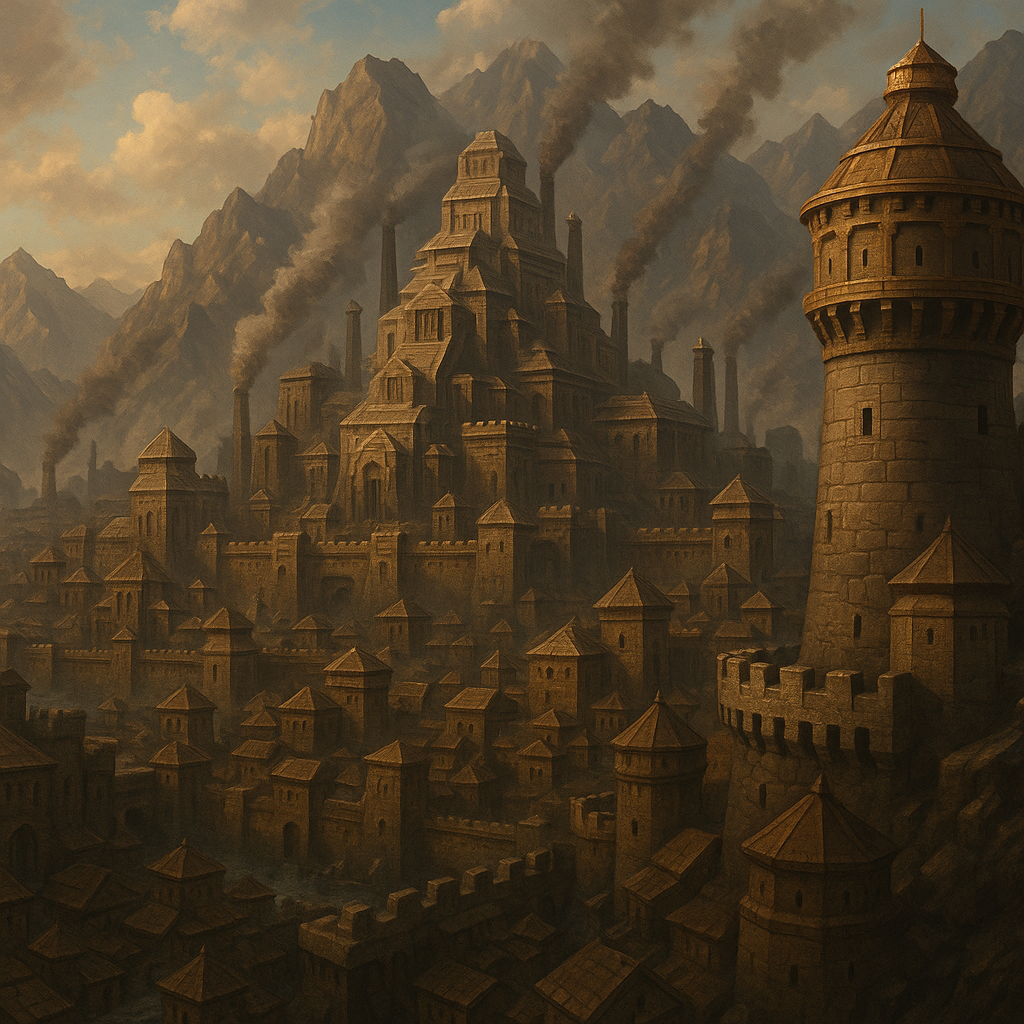
The Nunulgab Empire is a formidable dwarven naval–industrial state built on discipline, engineering mastery, and an unshakable belief in order. Rising from the unification of ancient stone clans under the legendary Balgron Nunulgab, the empire forged its identity not through conquest or divine mandate, but through the precision of its forges, the strength of its shipyards, and the efficiency of its vast bureaucratic machine. Its cities—many carved into mountainsides or built atop fortified river valleys—pulse with industry day and night. The port of Shar dominates northern trade routes, while Garam, the empire’s capital, stands as a towering fusion of fortress, factory, and administrative heart. With its disciplined Stone Legions, unmatched Iron Navy, and layered fortifications, Nunulgab has become one of the most resilient and strategically positioned nations in Redredan.
Culturally, the empire is shaped by a quiet, craftsmanship-based spirituality centered on the mythic Founding Hammers, whose teachings emphasize endurance, precision, and unity. Religion is subdued, expressed through the quality of one’s craft rather than prayer, and overseen by humble guild-like priestly orders rather than political theocracies. High Elves and other minorities enrich the empire with arcane knowledge and specialized skills, blending seamlessly into its technocratic order. Though often perceived as stoic or rigid, the Nunulgab people value community, duty, and flawless workmanship—believing that a nation is strongest when every citizen functions as a perfectly crafted component within a larger machine. Positioned beside the expansionist Grand Duchy of Skorkush, the empire stands as a calculated, immovable counterforce—a bastion of engineering, stability, and industrial power in an increasingly turbulent world.
Structure
The Nunulgab Empire is governed by a rigid, hierarchical technocratic monarchy, where ultimate authority lies with the High Imperator, a ruler selected not by bloodline or divine mandate but by the Council of Iron, a body of senior engineers, admirals, generals, and administrators. Leadership is determined through merit, age, and proven service to the Empire—those who have strengthened its navy, expanded its infrastructure, or maintained the stability of its industrial cities rise highest. Beneath the High Imperator sit three central ministries: the Admiralty of Deep Waters, controlling the navy and all coastal defenses; the Forge Ministry, overseeing industry, weapons production, and engineering advancements; and the Stone Ledger, the bureaucratic civil authority that manages taxation, law enforcement, and the empire’s massive government-employed population.
Regional governance is divided into Stonemarches, each led by a Stonewarden responsible for maintaining order, fortifications, and agricultural output in the surrounding villages. Dwarven cities are heavily self-regulated by guild councils composed of artisans, shipwrights, engineers, and military officers, though the central ministries hold veto power over all major decisions. High Elven enclaves, such as Nelssad, operate with limited autonomy under imperial oversight, serving as centers of arcane research and diplomatic liaison. Every level of society ultimately supports the Empire’s triad of priorities: stability, naval supremacy, and industrial strength. In Nunulgab, the state is not merely a government—it is a machine, and every citizen is a gear expected to function with precision.
Culture
The culture of the Nunulgab Empire is defined by discipline, craftsmanship, and absolute civic duty, shaped by dwarven values and reinforced through generations of industrial and naval dominance. Dwarves make up the overwhelming majority of the population, and their cultural emphasis on endurance, precision, and communal responsibility permeates every aspect of life. Citizens grow up believing that stability is sacred, chaos is dangerous, and the empire survives only because each person performs their role with unwavering reliability. While other nations glorify heroism, Nunulgab glorifies competence—the engineer who keeps the foundry running, the sailor who never misreads a tide, and the administrator who ensures food reaches mountain villages are celebrated as much as military leaders. Festivals center around ship launchings, engineering achievements, and the renewal of fortifications rather than religious rites or ancestral myths.
Though the empire is predominantly secular, its people exhibit a near-religious reverence for craft and structure. High Elven enclaves add a layer of cultural sophistication through artistry, arcane illumination, and scholarly pursuits, but even their work is expected to serve imperial function. Social mobility exists, but only through merit and proven service to the state; laziness or inefficiency is a cultural taboo. Music is rhythmic and work-focused, architecture is monumental and geometric, and public squares display statues of foremen, admirals, and master builders. Identity in Nunulgab is collective—citizens take immense pride in belonging to a nation known for its unbreakable stonework, unmatched shipyards, and relentless internal order. Where other countries celebrate freedom or devotion, Nunulgab celebrates function, unity, and the enduring strength of the empire.
Public Agenda
The Nunulgab Empire’s public agenda focuses on preserving stability, expanding industrial capacity, and strengthening naval supremacy. With a militarized bureaucracy and a population deeply tied to state employment, the government prioritizes efficient production, well-maintained infrastructure, and continuous technological advancement. Major public works—harbor expansions, foundry upgrades, river fortifications, and the construction of new ironclad vessels—are announced as patriotic duties, each contributing to the empire’s long-term security. Leaders emphasize the importance of internal unity, warning citizens that only a disciplined and industrious society can withstand the ambitions of neighboring powers. Education, propaganda, and civic festivals all reinforce the central message: the Empire endures because its people keep the machine running.
Externally, Nunulgab presents itself as a practical, defensive, and unyielding regional power. Its agenda includes securing trade routes, maintaining fortified borders, and countering the influence of the Grand Duchy of Skorkush, whose divine-mandate militarism poses a perpetual threat. While Nunulgab rarely initiates aggressive expansion, it aggressively defends its interests—especially along disputed borders and maritime corridors. Diplomacy is conducted with a tone of calculated neutrality: the empire seeks peace when it is profitable, alliances when they are mutually beneficial, and deterrence when necessary. Above all, the public agenda stresses that Nunulgab must remain strong, self-reliant, and ever-prepared, for prosperity rests on vigilance, and peace is only guaranteed by power.
Assets
The Nunulgab Empire’s greatest assets lie in its industrial might, naval infrastructure, and vast dwarven workforce, all of which form the backbone of its military and economic power. The empire’s major cities—Khiz, Nulbunar, Khundindur, Barag, and the colossal port of Shar—house some of the largest foundries, shipyards, and engineering guilds in the region. These facilities produce everything from ironclad hulls and artillery pieces to refined tools and precision-built machinery. Extensive underground resource networks allow Nunulgab to mine vast quantities of ore, stone, and minerals, giving it near self-sufficiency in raw materials. Its coastal position combined with dwarven engineering skill makes Shar one of the most formidable naval manufacturing centers in the world, capable of launching fleets at a pace unmatched by its rivals.
Beyond industry, the empire benefits from an extremely disciplined population, a fortified landscape, and a massive state-run bureaucracy. Over two-thirds of the capital’s workforce is directly employed by the government, giving Nunulgab unparalleled administrative cohesion and logistical efficiency. Its mountain villages provide elite mountaineers and scouts, its highland communities harvest consistent agricultural yields, and its network of fortified cities ensures no invasion comes without severe cost. The empire’s system of naval routes, fortified river crossings, and defensive stoneworks provides layered protection against external threats. In addition, High Elven enclaves contribute advanced arcane expertise, enhancing navigation, shipcraft, and communication. Together, these assets make the Nunulgab Empire a self-sustaining, heavily armored powerhouse—a nation whose strength comes not from divine blessing or noble lineage, but from the precision of its people and the relentless rhythm of its industry.
Demography and Population
The Nunulgab Empire is overwhelmingly dwarven, with nearly 90% of its population belonging to various dwarven clans spread across industrial cities, fortified highland villages, and strategic port settlements. This dwarven majority forms the cultural, military, and administrative backbone of the empire. Large urban centers like Barag, Nulbunar, Khundindur, and the massive port city of Shar house dense populations of craftsmen, shipwrights, soldiers, and civil servants. Rural villages—many with populations between 2,000 and 9,000—serve as agricultural hubs, highland training grounds, and logistical outposts that support the empire’s vast bureaucracy and war machine. Dwarven society is tightly interconnected; family clans often specialize in specific trades, from metallurgy to naval construction, creating a population that is both culturally unified and economically efficient.
While dwarves dominate, a significant High Elven minority—centered primarily in the city of Nelssad and several smaller elven villages—contributes arcane expertise, scholarly knowledge, and diplomatic refinement. These elves are integrated into society but maintain their own traditions, often serving as navigators, archivists, engineers of delicate machinery, or magical consultants within the empire’s industrial infrastructure. Small pockets of humans, gnomes, and possibly deep gnomes exist within several cities, primarily as traders, specialized craftsmen, or independent artisans drawn to Nunulgab’s economic opportunities. Though demographically small, these groups add niche skills and help connect the empire to external markets. Overall, the Nunulgab population is characterized by density, specialization, and disciplined civic identity—a nation built not on racial diversity but on the united strength of a people who see themselves as living components of a greater imperial machine.
Territories
The Nunulgab Empire occupies a rugged, strategically advantageous stretch of land defined by towering highlands, deep river valleys, and a heavily fortified northern coastline. Its interior is a labyrinth of mountains and stone ridges, perfectly suited for dwarven settlement and defensive engineering. These highlands contain rich mineral veins, natural caverns, and geothermal pockets that fuel the empire’s industrial cities and clan forges. Major rivers flow from the southern mountains toward the northern sea, carving channels ideal for transport, powering waterwheels, and enabling fortified river-crossings. Villages like Naram, Kindulurgat, and Ulukkzargu thrive in elevated plateaus, serving as both agricultural communities and natural training grounds for mountaineers and scouts. The terrain itself is an asset—difficult for invaders to traverse, rich in resources, and easily shaped by dwarven stonecraft into bastions of defense.
To the north, the empire extends to a broad, windswept coastline anchored by the immense port city of Shar. Here, sheer cliffs, engineered harbors, and breakwaters protect the empire’s naval shipyards and coastal fortresses. This coastline is the beating heart of Nunulgab’s maritime power, enabling rapid deployment of fleets and securing dominance over northern trade lanes. To the east, the empire borders the Zilaran Empire, and along this frontier lies a series of watchposts, trade outposts like Khatharb, and fortified checkpoints—regions where political tension and military readiness are constant. Farther west, the terrain softens into wooded foothills and fertile river plains, supporting farming villages such as Zakib, Ahagzah, and Shunalarak. Altogether, the Nunulgab Empire’s territory forms a natural fortress, a land of stone and steel where geography and engineering combine to make the nation nearly unconquerable.
Military
The Nunulgab Empire maintains one of the most disciplined and technologically advanced militaries in the region, built on dwarven engineering, rigorous training, and a relentless industrial output. Its forces are divided into three primary branches: the Iron Navy, the Stone Legions, and the Artillerist Corps. The Iron Navy is the pride of the empire, operating out of the massive port city of Shar and several fortified coastal arsenals. Known for their heavily armored hulls, rune-stabilized engines, and precision naval artillery, Nunulgab ships dominate the northern sea, projecting imperial power and securing vital trade routes. The Stone Legions, composed of hardened dwarven infantry, excel in defensive warfare, tunnel combat, and fortified assaults. They fight as cohesive, unbreakable phalanxes supported by shield walls, pike units, and rune-infused heavy armor. Complementing them is the Artillerist Corps—a specialized division of engineers and gunners responsible for siege engines, coastal batteries, explosive ordinance, and mobile artillery platforms.
Unlike the divine-fueled legions of Skorkush, Nunulgab’s military strength lies in discipline, precision, and logistical mastery. Every soldier undergoes extensive technical training, learning to operate machinery, maintain weapon systems, and function as part of a vast, interlocking war apparatus. The empire’s mountainous terrain allows it to maintain a network of fortified passes, stone citadels, and concealed artillery nests, ensuring any invading force pays a catastrophic price. High Elves within the empire serve primarily as navigators, arcane tacticians, and battlefield analysts, using their magical insight to support naval maneuvers and long-range artillery accuracy. The empire rarely wages aggressive war; instead, it focuses on deterrence, constructing defenses so formidable that potential enemies—including the expansionist Grand Duchy of Skorkush—must think twice before provoking the Iron Empire. Together, the fleet and the legions form a military machine defined not by brute force or religious zeal, but by engineering supremacy and an unshakable defensive doctrine.
Technological Level
The Nunulgab Empire is one of the most technologically advanced nations in Redredan, rivaled only by the Grand Duchy of Skorkush in industrial capacity—but far surpassing it in precision engineering, naval innovation, and applied sciences. Dwarven mastery of metallurgy produces steel alloys unmatched elsewhere, allowing the empire to build reinforced ship hulls, high-pressure boilers, durable artillery barrels, and complex mechanical devices. Enormous foundries in cities like Barag, Khiz, and Nulbunar operate day and night, powered by waterwheels, geothermal vents, and early rune-engine prototypes. The empire excels in naval engineering, producing ironclads, submersible scouting pods, rotating turret cannons, and rune-stabilized navigation systems that grant their fleets superior maneuverability in hostile waters. Scientific study focuses on structural integrity, material refinement, ocean currents, combustion mechanics, and long-range signaling—fields that directly serve military and industrial needs.
Magic exists in Nunulgab, but it is treated as a scientific discipline rather than a mystical art. High Elven enclaves contribute arcane theory, which dwarven engineers translate into practical innovations: pressure-sealed runes, heat-distribution wards in forges, magically reinforced hull plating, and enchanted mapping instruments. Scholars collaborate through state-funded research guilds, where discoveries are immediately evaluated for military or infrastructural application. The empire’s emphasis on rigorous testing, accurate record-keeping, and cross-guild collaboration makes its intellectual culture methodical and innovation-driven. While other nations glorify grand spellcasters or divine miracles, Nunulgab prizes the engineer, the mathematician, and the naval inventor—those whose work can be measured, reproduced, and deployed across the empire. In Nunulgab, technology is not just a tool—it is the foundation of national identity and the engine of imperial survival.
Religion
Religion in the Nunulgab Empire is notably subdued and culturally secondary, especially compared to zeal-driven neighbors like the Grand Duchy of Skorkush. The dwarves of Nunulgab hold a quiet, ancestral reverence for the Forge-Fathers—a collective of mythic craftsmen, engineers, and explorers believed to have shaped the earliest mountain halls. These figures are not worshiped through temples or divine mandates, but through practice: maintaining one’s tools, honoring craftsmanship, and taking pride in precise, honest labor. Shrines are small alcoves in workshops or shipyards where offerings of polished metal, engraved runes, or completed craft pieces symbolize gratitude rather than supplication. Religion here is not a system of commandments; it is a cultural code centered on discipline, work, and respect for the materials that sustain the empire.
High Elf enclaves contribute a more arcane spiritual philosophy, venerating the concept of Luminous Order—a belief that logic, structure, and harmonious design reflect a grand cosmic pattern. This belief blends seamlessly with dwarven stoicism, reinforcing the empire’s cultural emphasis on order and function over devotion. While priests exist, they serve as historians, rune-keepers, and cultural stewards rather than political authorities. They bless new forges, sanctify ship launches, and maintain genealogical records, but do not influence policy or war. In Nunulgab, faith is quiet, practical, and deeply personal—something lived through one’s craft and duty rather than declared in public. It stands in stark contrast to Skorkush’s fiery theocracy, making Nunulgab a nation where the forge, not the gods, shapes destiny.
Laws
The legal system of the Nunulgab Empire is built on the principles of order, precision, and functional stability, reflecting its dwarven foundations and bureaucratic culture. Laws are drafted and maintained by the Stone Ledger Ministry, a vast civil apparatus that ensures uniformity across cities, highland villages, and coastal ports. Every citizen—regardless of race—is bound to strict codes governing labor obligations, industrial safety, military readiness, and civic conduct. Crimes that disrupt production, sabotage infrastructure, or endanger naval operations are considered the highest offenses, often resulting in heavy fines, conscription penalties, or long terms of enforced labor in state foundries. Fraud, negligence, and failure to maintain essential tools or equipment are treated with unusual seriousness, as they threaten the empire’s delicate machine-like efficiency. Above all, Nunulgab law enforces predictability—procedures must be followed, records must be kept, and orders must be executed exactly as given.
The empire also regulates social hierarchy with carefully codified merit-based statutes. Advancement is determined through examinations, service records, and technical achievement, ensuring that leadership is earned rather than inherited. High Elves, humans, and minority groups have defined legal status: respected, protected, but always required to operate within dwarven administrative expectations. Trade routes, river access, and coastal waters are tightly controlled by naval law, with unauthorized shipbuilding or unregistered cargo treated as subversion of the state. While Nunulgab’s laws may appear rigid, citizens value them for providing fairness, clarity, and security in a world threatened by expansionist neighbors like the Grand Duchy of Skorkush. In the Empire, justice is not about mercy or symbolism—it is about maintaining the machinery of civilization so that no weak link can endanger the whole.
Agriculture & Industry
Agriculture in the Nunulgab Empire is surprisingly robust despite its rugged highland terrain, thanks to terraced farming, engineered irrigation channels, and highly disciplined rural communities. Dwarven villages such as Nuzah, Kharakzdus, and Shathazdush maintain vast networks of stone-reinforced fields that grow hardy crops—barley, root vegetables, mountain grains, and cold-resistant fruits. Livestock herds of goats, sheep, and highland cattle are common, bred for endurance and thick hides used in both military gear and civilian trade. River valleys support more fertile farmland, worked by mixed dwarven and elven communities, while engineered aqueducts ensure steady water supply even during seasonal droughts. Although Nunulgab cannot match the agricultural abundance of lowland nations, its efficiency and meticulous planning ensure stable, predictable yields, with surpluses routed through naval villages like Gunbamunz for export.
Industry, however, is where Nunulgab truly surpasses its neighbors. The empire is a towering industrial powerhouse driven by dwarven metallurgy, deep mining networks, and enormous state-run foundries that operate continuously. Cities such as Barag, Khiz, Nulbunar, and Shar produce steel alloys, ship components, artillery pieces, pressure boilers, precision tools, and rune-stabilized machinery. Shipyards in Shar and along the northern coast build ironclads, scouting submersibles, cargo vessels, and fortified warships at a speed unmatched elsewhere. Mining towns extract vast quantities of ore and stone, feeding smelters that supply both the empire’s military and its export economy. High Elves contribute refined arcane techniques—heat-channeling runes, resonance-infused stone, and magical durability treatments—that elevate dwarven craft to near perfection. Together, agriculture sustains the people while industry fuels the empire’s military engine, naval supremacy, and economic stability, making Nunulgab one of the most formidable manufacturing nations in Redredan.
Trade & Transport
Trade in the Nunulgab Empire is dominated by industrial exports and tightly controlled commercial routes, reflecting the nation’s emphasis on precision manufacturing and naval power. The massive port city of Shar serves as the empire’s primary trade hub, exporting steel ingots, ship components, precision tools, artillery mechanisms, refined ore, and rune-treated materials to surrounding nations. Imports are limited and regulated, focusing on luxury goods, specialized arcane reagents, rare crops, and foreign timber unsuitable for mining regions. Overland trade with neighboring states—particularly the tense frontier near the Zilaran Empire—is mediated through fortified outposts like Khatharb, where inspections, documentation, and tariffs are strictly enforced. The empire’s disciplined approach to commerce ensures that no strategic materials fall into hostile hands and that every trade exchange strengthens the imperial machine.
Transport within Nunulgab is exceptionally efficient thanks to a vast network of stone highways, fortified mountain passes, river routes, and naval corridors. Dwarven engineering keeps these routes in immaculate condition: roads are reinforced with carved bedrock, lined with waystations, and patrolled by military escorts to deter bandits or foreign spies. River transport is common in central regions, where barges carry ore and agricultural goods between industrial hubs. In the highlands, carved tunnels and elevated stone bridges allow seamless travel across treacherous terrain, linking villages like Naram and Kindulurgat to larger cities. The true heart of transport, however, is the empire’s ironclad naval fleet, which moves goods and soldiers across the northern sea with unmatched security. Naval convoys ensure trade safety, while coastal artillery ensures no foreign vessel approaches unchallenged. Together, Nunulgab’s trade and transport systems reflect a nation where every road, river, and harbor is engineered to serve the state’s stability and strategic power.
Education
Education in the Nunulgab Empire is highly structured, state-regulated, and profoundly practical, designed to produce competent workers, engineers, administrators, and soldiers rather than philosophers or theologians. From childhood, dwarven students undergo rigorous instruction in mathematics, metallurgy, structural engineering, navigation, and civic duty—subjects that directly support the empire’s industrial might. Schools are operated by the Stone Ledger Ministry, ensuring standardized curricula across all cities and villages. Apprenticeships begin early, with children entering forge-guilds, shipyards, mining schools, or administrative academies by adolescence. Literacy and numeracy are nearly universal among dwarves, not for cultural prestige but because accurate record-keeping and technical precision are essential to the empire’s function. Even physical education is structured around endurance training, tool handling, and disciplined drills, preparing youth to serve effectively in the Stone Legions or Iron Navy.
High Elves within the empire contribute significantly to the educational landscape, running specialized academies focused on arcane theory, runic application, alchemical refinement, and celestial navigation. Their instruction is more scholarly, but even these institutions operate under imperial oversight and emphasize practical outcomes over abstract study. Advancement in society is tied directly to examinations administered by the state, meaning education is the primary pathway to higher rank in the bureaucracy or officer corps. Rural villages host smaller but efficient learning halls that train farmers, miners, and craftsmen in the latest imperial methods. Across the empire, education is not about personal expression or enlightenment—it is about ensuring that every citizen becomes a precise, reliable component of the imperial engine, capable of upholding Nunulgab’s industrial supremacy and military strength.
Infrastructure
Infrastructure in the Nunulgab Empire is among the most advanced and meticulously maintained in Redredan, built on centuries of dwarven stonecraft and powered by the empire’s vast industrial machine. Every major city is connected by reinforced stone highways, carved directly into bedrock and engineered to withstand weather, war, and heavy industrial transport. Enormous mountain tunnels, tiered bridges, and fortified passes form a seamless network across the rugged interior, allowing troops and supplies to move rapidly despite harsh terrain. Coastal regions boast massive breakwaters, drydocks, naval foundries, and gun emplacements, especially around Shar—the empire’s maritime heart. Aqueducts, waterwheels, geothermal conduits, and rune-stabilized power shafts drive the empire’s forges and mills, ensuring consistent energy for production. Every road, docking tower, and transport line was built with longevity in mind; infrastructure is not simply functional—it is monumental.
Rural infrastructure mirrors this discipline. Even small villages maintain precision irrigation channels, stone granaries, and efficient transport routes to nearby river ports or highland stations. Defensive structures are integrated into everyday life: watchtowers overlook farmland, fortified depots store grain and ore, and carved signal columns relay warnings across vast distances using synchronized rune-light. Communication is equally advanced, with state-run messenger guilds, arcane relay stations staffed by High Elven technicians, and naval semaphore towers lining the northern coast. The empire invests heavily in continuous maintenance—crews from the Stone Ledger Ministry travel year-round to repair roads, strengthen bridges, and update fortifications. As a result, the Nunulgab Empire’s infrastructure is not merely impressive; it is the skeletal frame of the nation, a living machine that enables its military readiness, economic strength, and absolute internal control.
Mythology & Lore
Nunulgab’s mythology is rooted not in gods of conquest or sky-born miracles, but in the Founding Hammers, a triad of ancestral figures revered as the first great engineers of dwarven civilization. According to legend, these three—Thuldar the Forger, Braldun the Navigator, and Marn Stoneward—emerged from the deepest caverns during the world’s earliest ages, shaping tunnels that resisted collapse, carving harbors that defied storms, and teaching dwarves to read the mineral veins of the earth like scripture. Rather than commanding worship, the Founding Hammers taught through action, leaving behind tools, runes, and architectural marvels that dwarves still uncover today. Myths describe them as tireless workers who believed that creation—not devotion—was the highest calling. Their stories emphasize endurance, competence, and mastery of craft, forming the spiritual backbone of the empire’s cultural identity.
Over centuries, countless tales have grown around these legends: Thuldar’s Great Forge that never cooled, Braldun’s voyage beneath the waves in a stone-hulled submersible, and Marn’s construction of the “Endless Pillar,” a mythical support said to hold up the mountains themselves. While scholars debate their literal existence, the people of Nunulgab treat these myths as moral engineering lessons rather than holy doctrine. High Elves within the empire have woven their own interpretations, viewing the Founding Hammers as embodiments of cosmic order and symmetry, blending arcane theory into dwarven tradition. Across the empire, mythology is carried not by priests but by master craftsmen, naval architects, and stonemasons—each retelling shaped to inspire discipline, innovation, and respect for the materials that sustain the nation. In Nunulgab, myths are not reminders of divine power—they are blueprints for how a civilization endures.
Divine Origins
The Nunulgab Empire traces its origins to the Great Unification of the Stone Clans, a historical moment when scattered dwarven mining holds across the northern highlands banded together in response to a devastating series of cave-ins, coastal raids, and resource shortages. In the age before the empire, dwarven clans lived independently: some carved out immense underground forges, others controlled river crossings or highland terraces, and a few maintained early naval outposts on the northern sea. But the threats from rival states—and the constant pressure of the inhospitable terrain—forced the clans to confront a simple truth: survival required cooperation on a scale never seen before. Under the leadership of the master-engineer Balgron Nunulgab, the clans united into a single political body, adopting his name as a symbol of solidarity. Balgron introduced standardized engineering practices, a unified code of stonecraft, and shared military protocols—laying the foundation of the empire’s technocratic future.
From this unification grew a rapidly advancing industrial society. Dwarven forges expanded into massive foundries, river channels were redirected into power sources, and the northern coast transformed into a chain of fortified harbors. The newly formed government—the earliest version of the Stone Ledger Ministry—created detailed census systems, infrastructure plans, and standardized guild laws that would evolve into the empire’s infamous bureaucratic machine. As High Elven scholars and arcane engineers migrated to Nelssad and other enclaves, they integrated their knowledge with dwarven pragmatism, accelerating technological progress. Over centuries, the Nunulgab Empire became known not for divine blessing or noble bloodlines, but for the strength of its engineering, the discipline of its citizens, and the unshakable unity forged in the mountains. What began as a coalition against hardship grew into one of Redredan’s most formidable powers—a nation built, quite literally, by its own hands.
Tenets of Faith
The Nunulgab Empire’s spiritual philosophy centers on the Doctrine of the Three Hammers, a set of practical, ancestral tenets inspired by the mythic Founding Hammers—Thuldar the Forger, Braldun the Navigator, and Marn Stoneward. The first tenet, “Work Shapes the World,” teaches that creation is the highest form of reverence; a well-crafted tool or finely laid stone honors the ancestors more than prayer. The second, “Hold Fast Against Pressure,” emphasizes endurance and stability in the face of hardship, mirroring the mountains that cradle the empire. The third, “Measure Twice, Act Once,” is both a literal engineering principle and a spiritual exhortation toward thoughtful action, precise judgment, and disciplined living. These tenets guide daily life, reinforcing the cultural belief that the divine is found in competence, effort, and reliability.
Additional branches of the Doctrine have formed over the centuries. The fourth tenet, “Strength in Structure,” asserts that community, organization, and unity give people the same resilience as reinforced stone—reflecting the empire’s bureaucratic cohesion. The fifth, “Honor the Material,” encourages respect for the tools, metals, wood, and stone that support civilization; waste and careless work are considered spiritual failings. High Elves interpret a sixth, more abstract tenet—“Pattern Reveals Purpose”—as a sign that understanding the laws of nature and magic is a sacred pursuit. Across the empire, these tenets function not as commandments of a deity but as codes of craftsmanship and civic virtue, shaping a society where faith is expressed through the precision of one’s work and the steadfastness of one’s character.
Ethics
Ethics in the Nunulgab Empire stem from a deeply ingrained belief that responsibility, precision, and reliability are moral imperatives. A person’s worth is measured not by their birth or ambition, but by the consistency and quality of their work. To fail one’s duty—whether as a shipwright, soldier, administrator, or farmer—is seen not only as a practical flaw but a moral one, because it endangers the stability of the whole. Honesty, discipline, and accuracy are core virtues; negligence, waste, and disorder are considered ethical transgressions on par with lying or theft. The dwarven majority views life as a system of interlocking gears: if one refuses to turn properly, the entire machine falters. Therefore, citizens are taught from childhood that fulfilling one’s role with excellence is the highest expression of integrity.
The empire also maintains strong ethical expectations around community and structure. Decisions must be measured, actions purposeful, and authority respected so long as it functions effectively. Loyalty to the empire is not demanded out of blind nationalism but out of a shared belief that the Empire’s order protects its people from the chaos and conquest-driven neighbors beyond its borders. High Elves and minority groups are expected to uphold these ethical standards as equal partners in the imperial system. Even kindness is interpreted through this lens—not as sentimental charity, but as ensuring others can perform their work safely and with dignity. In Nunulgab, ethics are not abstract ideals; they are practical, lived obligations, forming the invisible mortar that holds the empire’s vast industrial and military structure together.
Worship
Worship in the Nunulgab Empire is subtle, practical, and woven into daily labor rather than conducted through grand ceremonies or priestly authority. Most dwarves honor the Founding Hammers—Thuldar, Braldun, and Marn—through their craft, believing that precise workmanship is a form of devotion. Workshops often contain small alcoves with carved stone reliefs or ancestral tools, where workers place offerings such as polished metal scraps, perfectly shaped rivets, or well-used hammers retired with dignity. These quiet gestures are meant to show gratitude for skill, guidance, and the raw materials of the earth. Seasonal rituals exist, but they are modest: the First Firing, when a new forge is lit; the Keel Blessing, performed before a ship’s maiden voyage; and the Stonefast Oath, sworn by engineers before beginning major construction. In Nunulgab, worship is not about appeasing divine beings but about honoring the legacy of creation and the discipline required to maintain it.
High Elven enclaves add a layer of arcane spirituality, practicing contemplative rites that align with their belief in Luminous Order—the idea that mathematical harmony and magical symmetry reflect the universe’s deeper truth. Their ceremonies involve rune-light patterns, meditation over geometric diagrams, and the symbolic “Placing of the First Line” before beginning any arcane or engineering project. These elven rituals blend seamlessly with dwarven customs, reinforcing the shared cultural value that intention, precision, and structure are sacred acts. Public temples are rare; instead, the forge, the drydock, the design hall, and the engineer’s table serve as places of quiet reverence. In Nunulgab, worship is not an interruption of work—it is expressed through work, reflecting a society where faith is measured not by prayer, but by the quality of what one builds and the steadfastness of one’s duty.
Priesthood
The Nunulgab Empire does not maintain a traditional priesthood; instead, its spiritual duties fall to a respected but modest group known as the Keepers of the Three Hammers. These individuals are not clergy in the religious sense but master craftsmen, archivists, and cultural stewards chosen for their skill, wisdom, and lifelong dedication to their craft. A Keeper is recognized by their flawless workmanship and deep understanding of the Founding Hammers’ teachings. They lead small rites in forges, shipyards, and stone halls—blessing new tools, overseeing oath-swearing ceremonies, and preserving ancestral techniques. Their role is practical and symbolic: they ensure that craftsmanship remains sacred and that every worker understands the cultural weight behind precision, discipline, and quality. Keepers hold no political authority, and unlike war-priests in Skorkush, they never dictate policy or military action. Their influence comes through respect, mentorship, and the moral credibility earned through years of impeccable work.
High Elven communities contribute a parallel tradition known as the Order of Luminous Trace, a circle of arcane theorists and spiritual mathematicians who approach faith through structure, geometry, and cosmic harmony. Though technically distinct from the dwarven Keepers, the two groups often collaborate in major imperial projects—High Elves providing magical insight into runic stability while dwarven Keepers ensure physical precision. Together, these bodies form a decentralized spiritual network that supports the empire’s cultural values without interfering in its governance. Their ceremonies are quiet, focused, and professional: the laying of the First Beam, the Rune Alignment Rite before naval departures, and the Hammer’s Rest when retiring old tools. In Nunulgab, the “priesthood” is less a religious caste and more a guild of living exemplars, guiding the people not through divine doctrine, but through the dignity of perfect craft and the preservation of ancestral knowledge.
Granted Divine Powers
Unlike nations driven by divine mandate, the Nunulgab Empire does not possess overt miracles or battlefield blessings. However, the dwarves believe that exceptional craftsmen and engineers may, on rare occasions, receive “the Touch of the Hammers”—a subtle form of ancestral inspiration rather than true divine magic. Those who bear this gift exhibit uncanny intuition with materials: knowing exactly where stone will fracture, hearing tonal imperfections in metal no one else detects, or crafting mechanisms that function flawlessly on the first attempt. This is not spellcasting, but a heightened craftsmanship bordering on supernatural insight. A shipwright might feel the “right” curvature of a hull before drawing it, or a stonemason might lay supports so perfectly that even earthquakes cannot shift them. The empire sees these talents as the Founding Hammers gently guiding the most devoted artisans, rewarding discipline and mastery with precision beyond normal skill.
High Elven practitioners within the Order of Luminous Trace sometimes display a related but distinct phenomenon known as “Geometric Resonance.” When deeply attuned to rune matrices or structural arcana, they may momentarily perceive patterns in light, sound, or motion that reveal flaws or impending failures in magical designs. Some can predict imbalance in pressure systems, sense instability in runes, or make split-second navigational adjustments far too precise to be coincidence. These abilities are quiet, analytical, and entirely in harmony with Nunulgab’s rational culture. They are not seen as divine gifts, but rather as the highest form of enlightenment—the moment when intellect, training, and ancestral guidance align perfectly. In the Nunulgab Empire, power does not manifest as miracles; it manifests as flawless craftsmanship, foresight, and mastery, the closest thing to divinity a dwarven empire could ever accept.
Political Influence & Intrigue
Despite its disciplined exterior, the Nunulgab Empire harbors a quiet but constant undercurrent of political maneuvering driven not by nobles or priests, but by guilds, ministries, and industrial power blocs. The three great ministries—the Admiralty of Deep Waters, the Forge Ministry, and the Stone Ledger—compete fiercely for funding, prestige, and influence over the High Imperator’s decisions. Admirals push for expanded naval fleets and new shipyards, while Forge-masters argue for redirecting resources into experimental engines or siege technologies. The Stone Ledger, which controls census records, taxation, and internal logistics, subtly influences political outcomes by determining which projects move forward and which stall. These rivalries rarely erupt into open conflict, but they shape policy, strain alliances, and determine which cities rise in wealth and which fade. Political power in Nunulgab is earned through efficiency, innovation, and the support of one’s guild—not through bloodline or divine sanction.
Externally, the empire navigates a tense geopolitical landscape, particularly along its border with the expansionist Grand Duchy of Skorkush. Frontier cities like Khatharb sit at the center of diplomatic pressure, espionage, and trade manipulation. Skorkush’s divine-mandate militarism clashes ideologically with Nunulgab’s rationalist technocracy, creating an ongoing cold war of influence. Naval skirmishes over contested waters are rare but always possible, and both nations engage in sabotage attempts—Skorkush targeting foundries and shipyards, Nunulgab targeting supply lines and priestly infrastructure. Meanwhile, High Elven enclaves within the empire maintain subtle ties to foreign arcane academies, occasionally causing tension when their intellectual loyalties conflict with imperial priorities. In this environment, true intrigue is quiet, methodical, and strategic: a war of logistics, trade leverage, and industrial supremacy, with each nation waiting for the other to make a misstep.
Sects
The Nunulgab Empire hosts several small but culturally significant sects, each interpreting the Doctrine of the Three Hammers through a different professional or philosophical lens. The largest and most respected is the Hammerwright Sect, composed of master smiths and engineers who believe Thuldar the Forger left hidden principles within metal and fire. Their rituals revolve around perfect forge temperatures, alloy purity, and the symbolic quenching of flawed tools. The Stonewardens, inspired by Marn Stoneward, focus on architecture, geology, and structural integrity; they treat every foundation as a sacred act and every collapse as a moral failing. A third sect, the Deepcurrent Brotherhood, venerates Braldun the Navigator and consists of shipwrights, sailors, and naval cartographers who believe the sea carries echoes of ancestral guidance. They practice rituals of tide reading, ship blessing, and coordinated oar chants believed to harmonize with ancient patterns.
High Elven intellectuals within the empire formed their own arcane-leaning sect known as the Order of the Luminous Trace, which views the Doctrine as expressions of cosmic geometry and mathematical perfection. They believe every rune, gear, and architectural curve reflects a universal pattern that the Founding Hammers glimpsed but did not fully reveal. While philosophically distinct from the dwarven sects, they collaborate frequently—particularly with the Stonewardens—to refine arcane resonance in naval engines and defensive runes. Political sects are rare, as Nunulgab culture discourages public displays of ideology, but subtle factionalism exists: Hammerwrights tend to support the Forge Ministry, Deepcurrents align with the Admiralty, and Stonewardens often reinforce the power of the Stone Ledger. Together, these sects do not divide the empire—they enrich it, acting as specialized custodians of tradition, innovation, and the disciplined spiritual philosophy that binds Nunulgab society.

Comments