
Moshield Empire
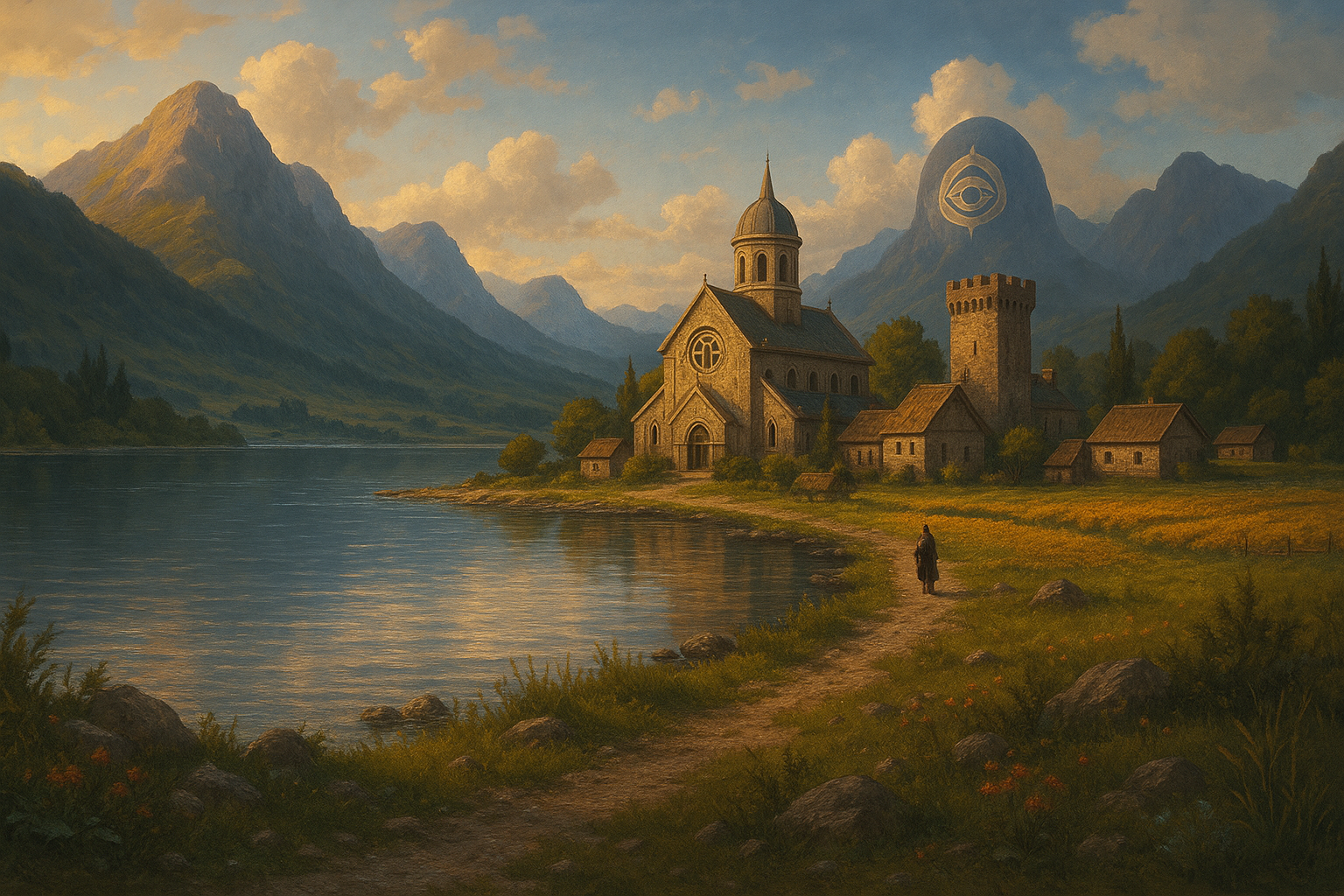
The Moshield Empire is a realm defined by its tranquil lakes, rolling river valleys, and soft teal horizons where mist rises gently each morning. Its settlements cluster along calm shorelines, built of warm stone and weathered wood, with stilts, piers, and arched bridges anchoring daily life to the water. Fields of wildflowers stretch inland until they meet gradual hills and distant mountains, creating a landscape that feels both open and sheltered—a natural cradle where fishing villages, ferry-towns, and quiet temples thrive. Everywhere, the reflective surface of Lake Qosx dominates the empire’s identity, mirroring sunlight, moonlight, and the spirits of the people who depend on it.
Though peaceful in appearance, the land possesses a subtle spiritual gravity that shapes the culture of its inhabitants. The people believe the lake holds memory, clarity, and ancient wisdom, and their architecture reflects this with circular windows, flowing roofs, and sanctuaries positioned at the water’s edge for meditation and ritual. Travelers speak of the unusual serenity the landscape inspires—of paths that quiet the mind, of water that seems to listen, and of nights where the stars shimmer twice: once in the sky, and once in the lake’s still surface. This natural beauty, combined with the empire’s deep emotional connection to its waterways, makes Moshield a nation whose very terrain feels alive, patient, and watchful.
Structure
The Moshield Empire is ruled by the High Sovereign, a hereditary human monarch whose authority spans every province, river district, and lakeside territory. The government beneath the Sovereign is organized into regional administrative zones, each overseen by a Provincial Steward appointed from among the noble families of major cities like Whitcairn, Fagongmine, and Houndreach. These stewards manage taxation, city defenses, agricultural coordination, and oversight of trade flowing through Moshield’s dense freshwater network. The empire prides itself on being a model of structured governance, with human-led leadership supplemented by dwarven advisors from Nulbahar, elven magistrates from Thvethent on matters of river law, and goblin marsh-runners serving as scouts and border guides.
At the operational level, the empire relies heavily on powerful civic guilds. The Ferrymen’s Concord oversees ferry routes, barge transport, and lake crossings, ensuring goods and people move safely between cities. The Autumn Admiralty administers the empire’s freshwater naval forces, protecting merchants from bandits and maintaining peace across the lakes. Meanwhile, the Dwarven Waterworks Guild is responsible for bridges, levees, and water-flow engineering that keep settlements stable during flooding seasons. While the High Sovereign sets broad policy, these guilds effectively manage the daily life of the empire, making Moshield a nation where civic order, waterborne trade, and well-maintained infrastructure form the backbone of public governance.
Culture
The people of the Moshield Empire are defined by their deep connection to the lakes and rivers that shape nearly every aspect of life. To them, water is both livelihood and heritage—something to be respected, navigated, and carefully understood. Most citizens grow up learning to row before they can ride a horse, and every major festival includes flotilla parades, river-songs, and lantern ceremonies cast across the water. Moshield society values resilience, adaptability, and communal responsibility; lakeside life teaches that storms, floods, and shifting waterways must be faced together. Fishing traditions are strong, barge families often pass down route knowledge for generations, and riverside craftsmanship—boat-building, net-weaving, and pier carpentry—is considered an honored skill.
Though predominantly human in leadership and culture, the empire is notably diverse. Dwarves contribute engineering traditions, especially in high-precision stonework and water-control systems. Elves of Thvethent bring refined arts, ritual music, and river-poetry that influence Moshield’s festivals and healing practices. Goblin villages supply hardy marsh-runners, herbalists, and storytellers who maintain lively oral traditions of local legends and lake tales. This blend creates a culture that is practical yet superstitious, communal yet proud, and deeply tied to place. Moshielders speak often of “knowing the water,” a phrase that encompasses intuition, tradition, and an unspoken belief that the lakes themselves shape the character of the people. Whether through craftsmanship, song, or shared hardship, the Empire’s culture is unified by one truth: life flows with the water.
Public Agenda
The Moshield Empire publicly presents itself as a nation focused on stability, prosperity, and the safe management of its vast freshwater network. Its foremost agenda is maintaining reliable trade routes across its lakes and rivers, promoting inter-city commerce, and ensuring the safe transport of goods between major hubs like Moshield, Fagongmine, and Littasinf. The government emphasizes the importance of maintaining well-kept harbors, dredged waterways, and secure ferries to support economic growth. Public initiatives often highlight agricultural cooperation, fishing expansions, and the modernization of barge fleets to improve efficiency throughout the empire.
Equally important is the stated commitment to public safety and regional unity. The empire invests heavily in the Autumn Admiralty to deter piracy, banditry, and waterfront crime. Civil campaigns encourage citizens to report unsafe conditions around the lakes, follow seasonal flood advisories, and adhere to regulated fishing schedules to prevent resource depletion. The government also champions cultural cohesion, promoting festivals, flotilla parades, and water-based traditions meant to reinforce a shared national identity among humans, dwarves, elves, and goblin communities. To the outside world, Moshield’s agenda appears peaceful and pragmatic—focused on safeguarding its waterways, strengthening its internal infrastructure, and fostering a harmonious, interconnected society.
Assets
The Moshield Empire’s greatest asset is its vast interconnected lake-and-river system, which forms the backbone of its economy, transportation network, and cultural identity. The lakes provide abundant freshwater fish, fertile shoreline farmland, and natural trade routes linking nearly every major settlement. Cities like Littasinf and Whitcairn are vital commercial hubs, while Autumn stands as the empire’s premier naval and shipping center. The dense freshwater network allows goods, grain, lumber, stone, and crafted wares to move with exceptional ease, giving Moshield a logistical advantage few inland nations can match. Its fishermen, barge companies, and ferrymen’s guilds form a sophisticated transport economy that keeps the empire well-fed and well-supplied.
The empire also benefits from a diverse population offering specialized strengths. Dwarves of Nulbahar contribute advanced stonework, hydrological engineering, and precise craftsmanship used in bridges, piers, and flood control systems. Elves of Thvethent bring arcane knowledge, healing arts, and finely tuned river rituals that guide seasonal practices. Goblin villages supply seasoned marsh-runners, skilled trappers, and herbalists who know the region’s wetlands intimately. Additional assets include rich farmland around cities like Heartvasin and Houndreach, strong timber reserves, and numerous ferries, barges, and patrol boats constructed in local shipyards. Altogether, the Moshield Empire’s assets present a picture of a nation whose strength lies in resources, waterways, craftsmanship, and interconnected communities.
Demography and Population
The Moshield Empire is a predominantly human nation, with humans making up roughly 75–80% of the population. Most human communities cluster around major lakes and rivers, forming dense pockets of settlement supported by fishing, farming, barge transport, and shoreline craftsmanship. Cities like Moshield, Fagongmine, Littasinf, and Whitcairn are thriving centers of commerce and governance, while human villages such as Smoothtown, Ironholdhol, Grimestals, and Britthgro maintain steady agricultural production. Culturally, humans form the leadership class, dominate administrative positions, and set political direction for the empire.
Alongside humans, the empire incorporates several minority populations whose contributions shape regional culture. Dwarves (about 8–10%) primarily reside in Nulbahar and a handful of smaller highland or lakeside communities, where they specialize in stonework, water engineering, and construction. Elves (about 6–8%) are most notable in Thvethent, bringing traditions of river magic, healing arts, and refined craftsmanship that influence local festivals and rituals. Goblins (4–6%) live largely in marshland villages like Sios, Froi, and Kluir, valued for their keen knowledge of wetlands, foraging, scouting, and trapping. Multi-racial interaction is common in trade hubs and fishing cities, while rural communities tend to retain cultural traditions tied to specific economies. Altogether, the empire is a mosaic of interconnected peoples shaped by shared reliance on the lakes and rivers that bind them together.
Military
The strength of the Moshield Empire lies in its formidable freshwater navy, renowned across the region for its speed, coordination, and mastery over river and lake warfare. Headquartered in the naval city of Autumn, the Moshield Fleet consists of patrol boats, fast-response cutters, reinforced barges, and shallow-draft warships capable of navigating even narrow waterways. Their primary duties include deterring piracy, escorting merchants, responding to storms and accidents, and maintaining order along the empire’s vast freshwater routes. Naval officers undergo rigorous training in navigation, night operations, and water-safety protocols, making the Admiralty one of the most respected institutions in the empire. Seasonal regattas and naval demonstrations further reinforce the fleet’s role as both protector and symbol of national pride.
Complementing the navy are the Riverwardens, a disciplined land-force responsible for guarding bridges, harbors, ferries, levees, and shoreline communities. These soldiers specialize in fighting on unstable terrain, using polearms, nets, harpoons, and ranged weapons ideal for water-adjacent combat. Human troops form the bulk of the forces, but dwarven engineers serve as combat sappers and fortification specialists, while goblin marsh-scouts excel in reconnaissance along wetlands and hard-to-reach riverbanks. Although the empire maintains only a modest standing army compared to landlocked nations, its military is highly adaptable and exceptionally well trained for the unique environments it defends. Together, the navy and Riverwardens give the Moshield Empire a reputation as a nation whose power flows with the water—swift, coordinated, and ever watchful.
Technological Level
The Moshield Empire possesses a moderate but highly specialized technological level, shaped almost entirely by its dependence on lakes and rivers. While not as industrialized as dwarven nations or as magically driven as elven realms, Moshield excels in hydrology, boatcraft, water engineering, and environmental sciences. Human shipwrights—supported by dwarven metalworkers—have developed advanced freshwater vessels, including reinforced barges, collapsible sailcraft for river travel, and shallow-draft patrol ships used by the Autumn Admiralty. Water-level gauges, flood-warning towers, and canal locks are common infrastructure, reflecting a pragmatic approach to managing seasonal shifts and unpredictable currents.
Scientific study in the empire focuses heavily on river ecology, weather patterns, fish migration, and medicinal plants found along wetlands and lake shores. Elves of Thvethent contribute refined knowledge of herbalism, healing arts, and limited ritual water-magic used in public health and agriculture. Dwarves of Nulbahar introduce innovations in masonry, pressure-resistant stonework, and the mechanics of dams, piers, and levees. While arcane technology is present, it is modest and practical—rune-lit buoys, enchanted compasses, stabilized docks—not the grand spellcraft found elsewhere in the world. Overall, the scientific culture of Moshield is one of applied problem-solving: every invention exists to make life safer, travel smoother, and the empire’s waterways more predictable. It is not a nation of grand theoretical breakthroughs—it is a nation of clever, steady, water-bound ingenuity.
Religion
Religion in the Moshield Empire centers on a collection of water-based deities and spirits collectively known as the Watersouls, a pantheon believed to guide the lakes, rivers, tides, and the cycles of rainfall. The most revered figure among them is The River-Mother, seen as the giver of life, fertility, and safe passage. Shrines to her appear on bridge pilings, ferry docks, and river crossroads, where travelers leave flowers, fish scales, or small coins for good fortune. Another major figure is The Lantern-Bearer, a guardian spirit said to light the way for boats caught in fog or storms; lantern festivals across Moshield honor this deity with floating lights set adrift on the water. Minor Watersouls include spirits of currents, whirlpools, storms, and springs—ranging from protective to mischievous depending on local folklore.
While the pantheon is widely respected, Moshield’s religious culture is practical and communal rather than dogmatic. Worship focuses on blessings for safe travel, good harvests, strong nets, and calm waters. Villages often have shore-priests who perform rites before fishing seasons, weddings, or long voyages. Elven priests in Thvethent bring a more ritualistic and musical form of worship, adding river-songs and symbolic water dances to major festivals. Dwarves contribute traditions of stone-altars and carved river runes, while goblin communities maintain older animist practices tied to marsh spirits and bog-creatures. The overall belief system promotes respect for nature, humility before the water’s power, and a shared understanding that the lakes hold both bounty and mystery. To the public, the religion of Moshield is a comforting cultural constant—an anchor in a world where water is life.
Laws
The laws of the Moshield Empire are centered around maintaining public order, waterway safety, and steady economic flow across the lakes and rivers. The empire enforces strict regulations on boating, fishing rights, flood season travel, and dock operations. Every vessel—whether a fishing skiff or a merchant barge—must be registered with its local harbor office and inspected regularly for safety. Fishing quotas are set each season to prevent depletion of lake stocks, and violations can result in heavy fines or temporary loss of fishing privileges. Unauthorized nighttime travel on certain lakes during storm months is also prohibited, a rule the public understands as an effort to prevent accidents and drownings. Seasonal flood zones are marked with warning posts, and ignoring flood advisories is considered a punishable offense.
Beyond water-specific laws, the empire maintains a clear legal structure based on hierarchical stewardship, communal responsibility, and protection of trade routes. Theft or sabotage of boats, nets, bridges, or levee systems is treated harshly due to the essential nature of these resources. Assaults against ferrymen, Riverwardens, or dock officials carry elevated penalties. Land-based crimes—such as property disputes, hunting violations, or improper land-clearing near riverbanks—are managed by local magistrates, often with the input of elven advisers in river regions or dwarven engineers in stonework-heavy districts. Goblin marshlands follow empire-wide law but apply local customs to minor disputes. Overall, the legal system of Moshield is perceived as fair, practical, and deeply concerned with preserving the balance between people and water, ensuring safe travel and stable livelihoods for all who depend on the lakes.
Agriculture & Industry
Agriculture in the Moshield Empire thrives along the fertile lakeshores and river valleys that cut through the region. Humans dominate farming, cultivating grains, potatoes, barley, and wetland vegetables that flourish in moist soil. Many villages, such as Smoothtown, Ironholdhol, and Britthgro, are known for their abundant harvests. Lakeside communities supplement crops with freshwater fish, mussels, and aquatic plants, forming a diverse and reliable food system. Seasonal flooding enriches the soil, and dwarven-built irrigation channels improve yield consistency. Goblin marsh villages contribute unique crops—marsh herbs, water-root vegetables, and medicinal plants—while elves of Thvethent maintain orchards and vine-gardens along stable riverbanks. Overall, the empire enjoys a steady agricultural surplus, allowing it to support sizable cities and a standing naval force.
Industry in Moshield is shaped by its waterways. The empire excels in boatbuilding, rope-making, net weaving, carpentry, and waterborne tradecraft. Shipyards in Autumn and the capital of Moshield produce everything from small fishing craft to large patrol barges. Dwarven settlements contribute metalwork, brickmaking, and stone engineering, forging tools, fittings, and structural supports used in piers and harbors throughout the empire. Many cities specialize in specific crafts: Whitcairn is known for textiles, Fagongmine for lumber and milling, and Nulbahar for precision stonework. The interconnected lake system acts as a natural industrial highway, allowing raw materials to be ferried quickly between production centers. While the empire does not rival the heavy industry of dwarven nations, its craftsmanship is admired for durability, water-resistance, and practicality. Moshield’s economy is ultimately driven by what the water provides, what boats can carry, and what its people can build with their hands.
Trade & Transport
Trade in the Moshield Empire is almost entirely built around its expansive lake-and-river system, which forms one of the most efficient internal trade networks on the continent. Barges, ferries, and cargo boats travel continuously between cities like Moshield, Littasinf, Whitcairn, and Fagongmine, moving grain, fish, lumber, stone, woven goods, and crafted wares. Because the waterways form natural highways, merchants enjoy fewer bandit threats and lower transport costs compared to land-locked nations. Market towns along key junctions—especially Thvethent and Heartvasin—serve as economic crossroads where human, dwarven, elven, and goblin traders mingle, creating vibrant multicultural marketplaces. Export goods primarily include freshwater fish, riverstone tools, lumber, textiles, and finely crafted boats, while imports often consist of metals, salt, horses, and rare arcane supplies.
Transport in the empire is dominated by the Ferrymen’s Concord, a powerful guild responsible for regulating boat travel, maintaining ferry lines, and managing public docks. Their standardized schedules and well-trained crews make Moshield famous for its reliable intercity travel. Roads do exist—especially connecting inland villages like Grimestals, Britthgro, and Hilley—but they are secondary to water routes and mainly used for short-distance transport or during winter freezing. The Autumn Admiralty patrols major waterways to keep shipping lanes safe and to deter river bandits or smugglers. Dwarven-engineered bridges and lock-systems keep channels navigable, while goblin marsh-runners guide vessels through shallow wetlands that other sailors avoid. Thanks to this layered system of ferries, barges, patrol craft, and shoreline infrastructure, the empire has earned a reputation as a nation where the water itself is the road, and movement is constant, dependable, and central to everyday life.
Education
Education in the Moshield Empire is practical, community-focused, and deeply shaped by the demands of life on the water. Most children learn basic literacy, numeracy, and history through small village schools or local tutors sponsored by the provincial stewards. Beyond these fundamentals, education quickly becomes vocational: children in lakeside towns grow up learning to row, tie knots, navigate with shoreline markers, recognize safe and unsafe currents, and understand the rhythms of fishing seasons. Many youths apprentice under their parents or community guilds, learning skills such as boatbuilding, net weaving, carpentry, or farming. In rural villages, elders teach oral traditions, seasonal knowledge, and practical survival skills, especially in marshland communities where goblin guides train the next generation in wetlands navigation and herb-lore.
Higher education tends to cluster in larger cities, where specialized guildhalls and academies offer instruction in more advanced disciplines. The Dwarven Waterworks Guild trains engineers in stonecraft, levee design, and irrigation systems, while the Elven Hall of Thvethent teaches healing arts, river-rituals, herbalism, and limited arcane studies. Naval academies in Autumn prepare officers in navigation, weather reading, logistics, and command. Though the empire does not emphasize grand scholarly pursuits or abstract philosophy, it places great value on applied knowledge, ensuring each citizen can contribute to their community’s stability and safety. Education in Moshield is ultimately about preparing people to live with, work with, and respect the water—reflecting a culture where practical wisdom is considered far more important than lofty theory.
Infrastructure
The Moshield Empire’s infrastructure is centered around its extensive network of lakes, rivers, and wetlands, creating a landscape defined by docks, canals, levees, and ferry systems rather than grand roads or towering fortresses. Most major settlements feature well-maintained harbors, piers constructed from dwarven-cut stone, and broad wooden boardwalks that serve as public markets, meeting spaces, and transport hubs. Dwarven engineers from Nulbahar design and maintain the empire’s stone bridges, canal locks, and flood-control channels, ensuring that water levels remain stable during seasonal surges. Many villages have elevated walkways to protect homes and storage sheds from rising waters, and rural communities rely on a network of small ferry crossings to stay connected. Even the capital, Moshield, is known more for its waterfront districts than for walls or battlements.
Transport infrastructure is equally water-focused. The Ferrymen’s Concord maintains ferry stations at nearly every crossroads lake or river, operating reliable routes that connect even remote farming villages. The Autumn Admiralty supports navigational safety through lighthouse beacons, rune-lit buoys, and shoreline watchtowers that guide ships during fog or storms. Inland, roads are present but secondary—typically simple dirt or gravel paths used for moving livestock or transporting goods during winter freezes. Many marshland villages maintain their own narrow plank-bridges, causeways, and pole-anchored routes to navigate difficult terrain. Overall, the infrastructure of Moshield is admired for its practical durability, its integration with the natural landscape, and the way it allows a sprawling freshwater empire to function as a unified whole.
Mythology & Lore
The mythology of the Moshield Empire is a rich tapestry woven from lakeshore superstitions, river legends, and ancient tales carried by ferrymen and fishermen. Central to the empire’s folklore is the belief that the lakes were once tended by the Watersouls, a family of benevolent spirits who shaped the waterways and taught early settlers how to read currents, predict storms, and forage safely along flooded banks. The most beloved figure is The River-Mother, said to have carved the riverbeds with her hands and filled them with life to feed the early people. Many villages tell stories of her walking across the water on misty mornings, blessing nets and calming storms. Another well-known mythic figure is The Lantern-Bearer, a mysterious guardian who appears during fog or heavy rain to guide lost travelers back to shore using a single golden lantern. Parents teach children to look for the Lantern-Bearer’s glow whenever the horizon disappears into gray.
Yet not all myths are gentle. Many lakes hold stories of deep spirits, neither evil nor kind, who guard forgotten places beneath the water. Fishermen in Littasinf speak of The Still One, a lake spirit who punishes those who disrespect the water by stealing oars or tangling nets during calm weather. Villages near wetlands whisper of Marsh-Knockers, invisible tricksters who drum on boat hulls to warn of hidden sandbars. Some dwarven communities around Lake Kibilbun tell of The Stone-Sleeper, an ancient giant said to rest beneath the lakebed, causing tremors and unusual water currents when it stirs. Elven tales add a poetic note, describing rivers as living threads woven by fate, with each lake representing a different emotion: joy, sorrow, longing, or memory. Though these myths vary wildly from place to place, they share a common theme—the water is alive with stories, and those who live beside it must show respect, humility, and understanding.
Divine Origins
According to official history, the Moshield Empire began as a loose collection of lakeside settlements founded by early human clans who migrated into the fertile water basin many centuries ago. These early groups relied heavily on fishing, farming, and small-scale trade conducted by canoe and barge. Over time, the settlements grew into prosperous towns linked by shared waterways and seasonal gatherings, eventually forming the Lake-Clan Compact, a cooperative alliance meant to coordinate flood response, maintain ferry routes, and mediate disputes. As trade expanded and interdependence deepened, the Compact gradually evolved into a centralized political body, uniting under a charismatic chieftain believed to have been the first true High Sovereign of Moshield. Oral tradition claims this leader carried a shield adorned with water symbols—said to represent protection for all who lived by the lakes—giving the empire its name.
The empire’s expansion accelerated with the arrival of dwarven artisans and elven migrants who settled around key river crossings and high-resource areas. Dwarves introduced stone engineering, helping stabilize shoreline infrastructure, while elves contributed healing arts, river lore, and agricultural innovations. Goblin tribes, long present in the region’s wetlands, joined the growing empire through trade pacts and marshland treaties that recognized their role as skilled guides and scouts. Through mutual benefit, shared waterways, and strong leadership, the disparate communities of the basin coalesced into a unified nation known for cooperation, resilience, and respect for the water. Though the empire has weathered political disputes, economic shifts, and the challenges of a changing landscape, its people still look back on these origins as a testament to how the lakes brought them together—turning isolated clans into a single, interconnected realm.
Tenets of Faith
The faith of the Moshield Empire is guided by a simple but deeply rooted set of spiritual principles known as the Watersoul Tenets, believed to express the will of the River-Mother, the Lantern-Bearer, and the lesser spirits of the lakes. These tenets are not rigid commandments but shared moral values repeated in stories, rituals, and seasonal festivals.
1. “Respect the Water, and it will respect you.”
Citizens are taught to approach lakes and rivers with humility—never acting carelessly or arrogantly. Littering, wasting water, or disrespecting docks and boats is considered spiritually improper.
2. “Share the Shore.”
The lakes belong to everyone. This tenet encourages hospitality, fairness in trade, and mutual aid during floods or storms. Villages often help each other repair levees or docks.
3. “Take only what the water gives.”
A cultural guideline for fishing and harvesting, it promotes sustainable practices and discourages greed. Taking more than one's fair share is seen as an insult to the Watersouls.
4. “Light guides the lost.”
Stemming from Lantern-Bearer legends, this tenet inspires charity and guidance. Helping travelers, offering lanterns during fog, or aiding a stranded boat is considered a sacred duty.
5. “Currents change, so must we.”
A philosophical principle encouraging flexibility, adaptation, and emotional resilience. People are taught to navigate hardships like they would shifting currents.
6. “Calm the waters within.”
A moral reminder to control anger and fear, valuing introspection and emotional balance. Many villages practice simple breathing rites before fishing or traveling.
7. “What flows together, grows together.”
This tenet promotes unity among humans, dwarves, elves, goblins, and other peoples of the empire. Diversity is seen as a natural part of the water’s path.
Ethics
The ethical framework of the Moshield Empire is built on principles of responsibility, community, and respect for the natural world, especially the lakes and rivers that sustain everyday life. Because water can give life as easily as it can take it away, citizens are taught from childhood to act with caution, humility, and foresight. Recklessness near the lakes—whether fishing carelessly, ignoring storm warnings, or navigating in hazardous conditions—is seen not just as foolish but ethically irresponsible, endangering both the individual and the community. Honesty is valued because trust is essential for cooperative work on boats and docks; a single lie about weather, currents, or equipment can cost lives. Generosity is encouraged, especially toward travelers or those who have suffered loss from storms or floods.
Moshield ethics also emphasize collective duty and interdependence. Helping maintain docks, responding to community emergencies, and sharing food during hard seasons are seen as moral obligations. Disputes are ideally resolved through calm discussion, reflecting the cultural ideal of “keeping one’s waters smooth.” Conflict or aggression is discouraged unless necessary for defense or justice. Additionally, fair trade practices and stewardship of shared resources—like fisheries and floodplains—are strong ethical expectations. Exploiting common goods for personal gain is widely condemned. Across the empire, people strive to embody values of balance, patience, cooperation, and steady-mindedness, reflecting a culture shaped by nature’s rhythms and the shared belief that harmony with one another mirrors harmony with the water itself.
Worship
In Moshield theology, Qosx is revered as the god of depth, memory, and still waters—a spirit believed to dwell within the vast Lake Qosx itself. Worshippers see Qosx as a deity who “remembers all things touched by water,” giving the lake an aura of ancient wisdom. People pray to Qosx for clarity of mind, guidance in difficult decisions, and the preservation of family history and traditions. It is said that those who sit quietly at the lake’s edge during dusk may feel Qosx “share a memory,” a sensation described as a sudden flash of emotion or a vivid thought that does not seem entirely one’s own. This is publicly regarded as a blessing, a sign that Qosx is watching over the faithful.
Qosx’s worship is peaceful but unusually introspective. The faithful believe the god does not speak through words or signs but through impressions, dreams, and shifts in one’s thoughts after time spent near the water. Priests teach that Qosx “communicates in currents of the mind,” encouraging meditation, quiet reflection, and deep emotional stillness. Lantern offerings and ripple-reading ceremonies are common, where worshippers observe patterns in the water as symbolic messages. Some lakeside families even practice the Rite of Returning—whispering their strongest memories into a bowl of lake water before pouring it back into Qosx’s domain. The empire sees these rites as sacred traditions, believing that Qosx gently gathers these memories to safeguard them for future generations.
Priesthood
The priesthood of Qosx is known as the Keepers of the Deep Remembrancer, a quiet and contemplative order whose duty is to guide worship, preserve oral history, and maintain lakeside shrines. Unlike priesthoods of other nations, the Keepers are not grand temple-builders or political authorities. Instead, they are listeners, trained to read the lake’s surface, interpret ripples, and meditate upon the impressions they believe Qosx sends through dreams and intuition. Many Keepers spend long hours near the shoreline in silent reflection, claiming that true communion with Qosx is found not in ceremony but in stillness.
The Keepers’ rituals emphasize memory, clarity, and emotional calm. They teach breathing practices called “drawing the still water,” where followers visualize lowering their thoughts into the lake’s depths to find guidance. During rites, Keepers may ask worshippers to recount their most cherished memories aloud, helping them “anchor those memories within Qosx’s eternal reflection.” The people believe the Keepers have an unusual gift: an innate sense of when emotions shift in a room, allowing them to mediate disputes and comfort the grieving with uncanny precision. This is seen as evidence of Qosx’s blessing. The priesthood avoids loud festivals and rarely gives public sermons, preferring to work in small gatherings or one-on-one conversations.
Granted Divine Powers
“The Gifts of Still Waters”
Followers of Qosx believe the lake god grants quiet, subtle blessings rather than dramatic miracles. These powers are considered rare, gentle, and deeply personal—signs that Qosx has touched a worshipper’s spirit with insight or emotional clarity.
The three most commonly recognized gifts are:
1. The Calm Mind
Many claim that prolonged prayer or meditation at Lake Qosx brings a deep mental stillness—
a clarity of thought that helps soothe grief, resolve arguments, or make difficult decisions.
Some Keepers describe this as hearing “your own thoughts more clearly,”
or feeling as if the lake has washed away inner noise.
(GM note: This parallels the Aboleth’s subtle psychic influence, perceived as peace.)
2. The Memory’s Echo
Worshippers sometimes report experiencing vivid recollections of childhood, lost loved ones, or forgotten lessons after performing the Rite of Returning (whispering a memory into water).
This is understood as Qosx returning a cherished memory to them.
Occasionally, the memory is clearer than it ever was before.
(GM note: Publicly a blessing; secretly, it mimics how an Aboleth manipulates or shares memories.)
3. The Stillwater Sense
A rare blessing said to grant sensitive worshippers the ability to detect changes in emotions or atmosphere during social interactions. A person “touched by Qosx” may:
- sense when someone is hiding sadness
- feel tension before arguments erupt
- notice when a room’s mood shifts
- intuit the right words during conflict
This is viewed as divine empathy, a holy attunement to the emotional currents around them.
Political Influence & Intrigue
The Moshield Empire is a human-led realm shaped entirely by the lakes and rivers that define its geography and its spirit. Its people—humans, dwarves, elves, and goblins alike—live in a society built on cooperation, resourcefulness, and reverence for the water that sustains them. Fishing, ferry-trade, and lakeside farming form the lifeblood of the empire, while dwarven engineers maintain canals, locks, and flood defenses that keep the landscape habitable. Worship revolves around Qosx, the Deep Remembrancer, believed to dwell within Lake Qosx itself. Through serene rituals, memory offerings, and waterside meditation, the people see themselves as caretakers of both their environment and their shared history. In daily life, calmness, patience, and communal duty define their values. Harmony with the water is harmony with each other.
Politically, the empire maintains an image of stability, but the interplay between noble houses, trade guilds, ferrymen, and lakeside priesthoods creates a quiet undercurrent of intrigue. The High Council debates water-rights, trade tolls, and regional protections, while influential guilds—like the Ferrymen’s Concord and the dwarven engineering houses—subtly shape national policy. The Keepers of Qosx, though insisting on neutrality, wield spiritual influence through their interpretations of the lake’s “moods,” often consulted during crises. Despite these tensions, Moshield projects unity and balance to the outside world: a realm that thrives on cooperation, respects tradition, and believes wholeheartedly that their god watches over them from the depths. To the public, the nation is strong, peaceful, and guided by the still waters of Qosx—its silent guardian.
Sects
The sole religious sect of the Moshield Empire is the Stillwater Tradition, a quiet, unified faith centered on introspection, memory, and emotional clarity. Rather than enforcing doctrine or hierarchy, the tradition teaches that Qosx communicates through subtle impressions, calm thoughts, and the reflective nature of water itself. Its practitioners—guided by the Keepers of Qosx—observe simple, peaceful rites such as lantern releases, ripple-reading, and the sharing of memories with the lake. Because the faith emphasizes inner stillness over debate and communal harmony over dogma, no competing sects have ever formed; worshippers believe that Qosx reveals the same gentle truths to all who listen with a calm mind. The Stillwater Tradition thus acts as a spiritual anchor for the empire, offering guidance, comfort, and continuity across every lakeside village and river-crossing settlement.


Comments