
Kingdom Of Hagroth ("HAG-ROTH")
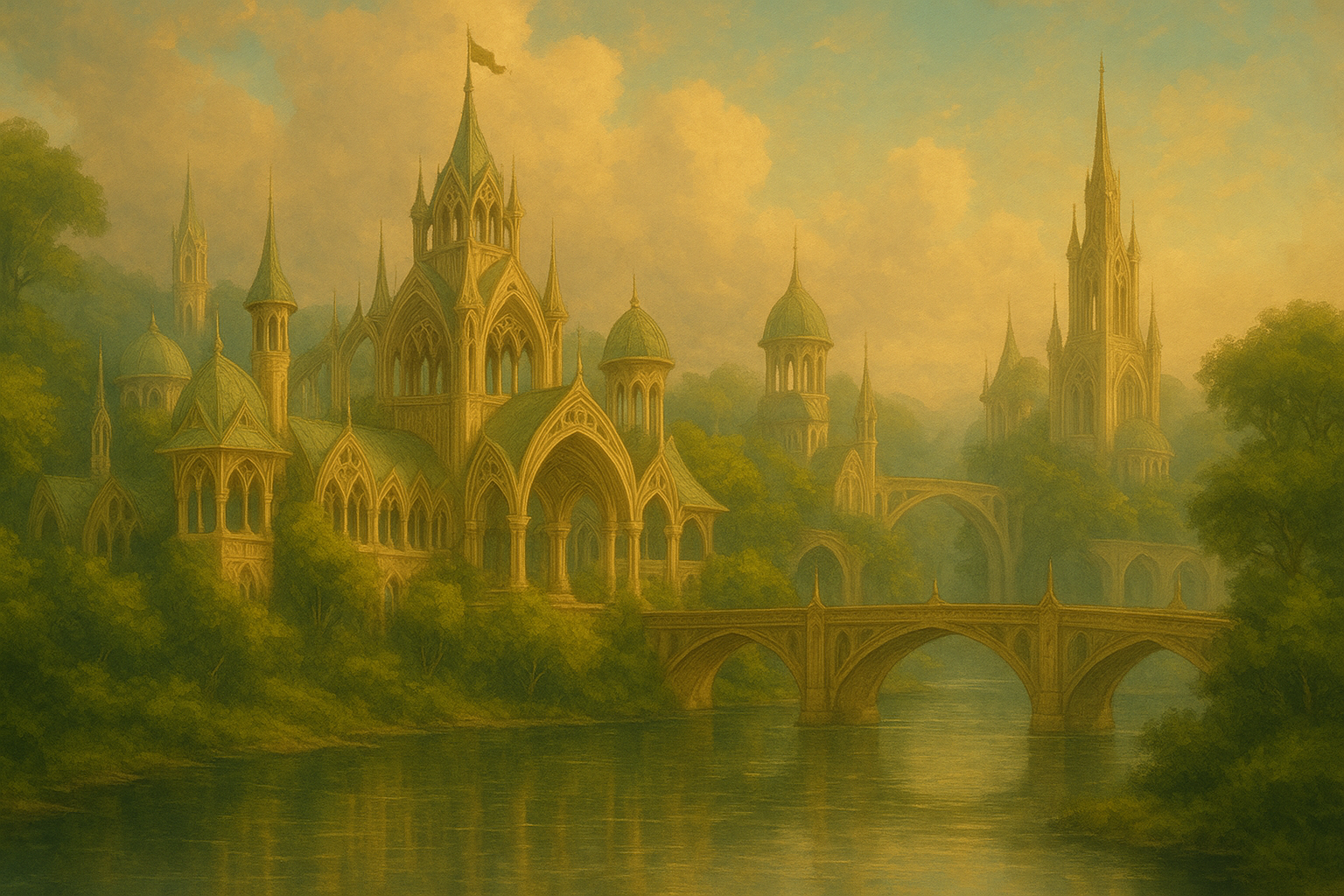
The Kingdom of Hagroth is a woodland-elven–dominated monarchy located in the western stretch of Redredan, bordered by Tuhal to the east and Dal-did to the south. Hagroth is a land of dense forests, elevated hunting traditions, and a fiercely independent culture rooted in survival and mastery of the land. Though ruled primarily by woodland elves, Hagroth also contains thriving human port communities and several Orc villages that contribute significantly to the kingdom’s agriculture and frontier resilience.
Hagroth is renowned across Redredan for producing the finest hunters, trackers, and forest scouts in the western continent. The kingdom’s capital, Hagroth, is modest in size but serves as the heart of elven governance, spiritual tradition, and the legendary Huntmaster Orders.
Structure
The Kingdom of Hagroth is governed by a woodland-elven hereditary monarchy, but real power is shared between the crown and the Council of Clans, a body of influential elven family lines that oversee sacred groves, regional territories, and long-standing cultural traditions. The monarch sets national policy, commands the Huntmaster Orders, and serves as spiritual guardian of the forests, while the clans handle day-to-day governance, resource management, and adjudication of disputes across the kingdom’s woodland regions.
Supporting this structure are two integrated councils: the Harbor Assembly, representing human port stewards who manage trade, shipwright guilds, and tax collection along the western rivers; and the Frontier Pact-Circle, composed of elected orc chieftains who oversee agriculture, border defense, and settlement security in the southern clearings. These bodies do not rival elven authority but provide indispensable regional governance, forming a balanced system where elven tradition, human commerce, and orc frontier strength function as the three pillars of Hagroth’s stability.
Culture
Hagrothi culture is built on reverence for the living forest and the belief that survival is earned through harmony, discipline, and mastery of one’s craft. Woodland elves shape much of this identity: their traditions emphasize quiet strength, patience, ritualized hunting, and deep respect for ancestral groves and animal spirits. Music, storytelling, and dance often mimic the rhythms of the wild—soft, fluid, and purposeful—while craftsmanship favors natural materials shaped with precision rather than excess. To outsiders, Hagrothis seem solemn, but within their communities they are warm, wry, and fiercely loyal.
Humans and orcs contribute equally vital threads to the culture. Human port-folk infuse Hagroth with a lively merchant energy—festivals, market days, sea shanties, and vibrant craft guilds—balancing the elves’ stoicism. Orc villages maintain traditions of communal feasting, oath-sharing, and athletic competition, reinforcing values of strength and resilience. Across all peoples, Hagrothis share a simple truth: the land provides, but only for those who respect it. This mutual understanding binds the kingdom into a single, proud cultural identity.
Public Agenda
Hagroth’s public agenda centers on preserving the integrity of its forests, maintaining self-sufficiency, and upholding the traditions that define its identity. The monarchy and clan leaders prioritize sustainable land stewardship, protection of sacred groves, and strict regulation of foreign logging or expansion. Strengthening the Huntmaster Orders is a perpetual priority, ensuring Hagroth remains the uncontested authority on scouting, tracking, and forest defense in western Redredan.
Equally important is maintaining balanced coexistence among its peoples. The Harbor Assembly’s agenda focuses on fair trade policies, controlled port expansion, and preventing outside powers from gaining influence over coastal commerce. Meanwhile, the Frontier Pact-Circle pushes for improved border fortifications, agricultural support, and protection of orc village autonomy. Together, these priorities form Hagroth’s public-facing mission: guard the land, empower its communities, and never allow the kingdom’s fate to be shaped by outsiders.
Assets
Hagroth’s greatest asset is its unmatched mastery of forestcraft—the hunters, scouts, and trackers trained by the Huntmaster Orders are considered the finest in western Redredan, capable of navigating dense woodland, detecting threats long before they surface, and controlling the kingdom’s deep terrain with precision. This natural advantage is reinforced by the kingdom’s vast, resource-rich forests, which provide rare hardwoods, medicinal plants, animal products, and alchemical reagents found nowhere else on the continent.
Economically, Hagroth benefits from its human-run western port towns, which act as reliable trade arteries for lumber, pelts, herbal goods, and specialized elven craftsmanship. Meanwhile, the fertile southern clearings maintained by orc communities serve as the backbone of the kingdom’s agriculture and frontier defense. The combined strengths of elven precision, human maritime skill, and orc resilience create a nation whose assets are strategic rather than industrial, making Hagroth valuable not for its size or wealth, but for its people, its terrain, and the irreplaceable skills rooted in its forests.
Demography and Population
Hagroth’s population is concentrated in three distinct cultural zones: the central and northern old-growth forests where woodland elves form the majority; the western river and coastal ports dominated by humans; and the southern clearings where orc communities maintain agricultural and defensive settlements. Woodland elves make up roughly 55% of the population, humans around 30%, and orcs approximately 12%, with the remaining 3% consisting of mixed minorities such as halflings, gnomes, and a small number of half-elves.
Population centers tend to be modest in size, as Hagrothi society favors distributed settlements over sprawling cities to preserve the land and avoid overuse of forest resources. The capital, Hagroth, is the largest forest-settlement, while the human ports collectively host the kingdom’s densest urban life. Overall, the population is steady and resilient, growing slowly but maintaining high cohesion due to shared cultural respect for the land and the kingdom’s strict limitations on foreign immigration.
Military
Hagroth’s military is built around elite forest warfare, emphasizing mobility, stealth, and mastery of terrain rather than heavy formations or large standing armies. At its core are the Huntmaster Orders, highly trained elven ranger-knights who serve as scouts, wardens, and rapid-response skirmishers. These orders—such as the Silverleaf Stalkers, Briarguard, and Rootbind Circle—specialize in ambush tactics, tracking, infiltration, border reconnaissance, and spiritual guardianship of sacred groves. They form the kingdom’s strategic backbone, capable of neutralizing threats long before they reach major settlements.
Supporting them are the Frontier Clans, primarily orc militias and mixed-race forest fighters stationed in the southern and southeastern borderlands. These units excel in endurance combat, fortification building, and repelling large predators or enemy incursions. Human forces contribute naval and river patrols, archers, and organized town militias, especially in the western ports. Rather than rely on mass conscription, Hagroth maintains a compact, highly specialized defense network, designed to fight on home terrain where every tree, trail, and ridge can become a weapon.
Technological Level
Hagroth’s technological and scientific level is practical, nature-aligned, and specialized, rather than industrial. The kingdom excels in woodcraft, herbal medicine, alchemy, tracking sciences, and environmental engineering—fields that enhance survival and forest mastery without disrupting the land. Elven artisans produce exceptional bows, gliders, lightweight armor, and living-wood structures using techniques passed down through ancestral groves. Their knowledge of plant lore and natural remedies is considered among the best in Redredan, supported by centuries of careful observation and spiritual attunement.
Humans contribute advances in shipbuilding, navigation, and toolmaking, while orc communities lead in agricultural innovation, soil enrichment, and rugged frontier construction. Hagroth does not pursue heavy metalworking, siegecraft, or mechanical industry, viewing such technology as harmful to the forest. Instead, its scientific achievements focus on terrain mapping, animal behavior studies, forest acoustics, sustainable farming, and hybrid herbal-alchemical disciplines—giving Hagroth a uniquely sophisticated understanding of natural science without stepping into industrialization.
Religion
The Great Stag stands at the heart of Hagrothi spirituality and cultural identity, revered as the Forest’s First Guardian and the living embodiment of balance between predator, prey, and land. According to elven lore, the Great Stag was the first creature to walk the ancient woods, its hoofprints shaping the early paths that later became sacred trails. It is depicted as an enormous silver-antlered spirit-beast whose presence signals renewal, protection, and the forest’s approval. Sightings—rare and often dreamlike—are treated as divine omens marking turning points in the kingdom’s fate.
The Great Stag’s symbolism crosses all racial lines in Hagroth. Elves view it as the patron of hunters and guides; humans honor it on riverfront shrines for safe trade and prosperous seasons; and orc villages carve its likeness into gateposts to invite strength and wisdom to their communities. Festivals, oaths, and rituals often invoke the Great Stag’s name, and many Huntmaster Orders bear antler motifs in their armor and banners. For Hagrothis, the Great Stag is more than a symbol—it is the soul of the kingdom, a reminder that power comes from living in harmony with the forest, not ruling over it.
Laws
Hagroth’s laws are rooted in forest stewardship, communal responsibility, and respect between races, forming a legal system that blends elven tradition with practical governance. Cutting ancient trees, overhunting, or damaging sacred groves is strictly forbidden, punishable by exile or heavy reparations to the affected clan. Disputes are settled first within local communities, then by clan elders, and finally by the monarch’s judgment if needed. Humans and orcs operate under their own local customs but remain bound to kingdom-wide rules on trade fairness, land use, and inter-community conduct. Violence within the kingdom is judged harshly unless in clear self-defense, while oath-breaking—especially in matters of trade, patrol duty, or forest guardianship—is considered a grave offense. Overall, Hagroth’s laws center on one principle: the land and its people must be protected from exploitation, whether by outsiders or by their own hand.
Agriculture & Industry
Hagroth’s agriculture is concentrated in the southern clearings and river valleys, where orc and human communities cultivate hardy grains, root vegetables, and shade-tolerant crops suited to forest edges. These settlements use sustainable rotation techniques, enriched soils, and small-scale livestock herding to protect the land’s fertility. Elven agriculture focuses on forest-symbiotic methods—orchards interwoven with wild groves, mushroom cultivation in shaded enclaves, and foraged goods harvested under strict seasonal rules. Together, these practices ensure steady food supplies without disrupting the natural balance.
Industry in Hagroth is artisan-driven and eco-focused, avoiding heavy production. Elves excel in fine woodworking, bowmaking, herbal medicine, alchemy, and living-wood construction. Humans operate the kingdom’s shipyards, mills, and trade workshops, producing tools, rivercraft, and processed goods like smoked fish and lumber. Orc settlements contribute frontier materials—stonework, durable timber, and agricultural exports. Hagroth’s economy thrives on quality over quantity, valuing craftsmanship, natural products, and sustainable forest resources rather than large-scale industrialization.
Trade & Transport
Trade in Hagroth relies on a balanced exchange between forest goods and maritime commerce, with human-run port towns acting as the kingdom’s economic gateways. These ports facilitate the export of fine elven woodcraft, herbal remedies, alchemical components, rare hardwoods, and high-quality pelts, while importing metalwork, spices, cloth, and tools not easily produced within the forest. Internal trade flows through a network of forest paths, elevated walkways, and river routes, allowing small caravans and messenger riders to travel efficiently without disturbing the land.
Transport is intentionally lightweight and environmentally integrated. Elven couriers use narrow woodland trails and treetop paths, moving swiftly and silently between clans and sacred sites. Human merchants rely on river barges and coastal vessels to navigate goods along the kingdom’s western edge, while orc frontier communities maintain fortified road segments designed for durability rather than speed. Hagroth avoids heavy roads or large caravans, choosing instead a distributed, low-impact transit system that preserves the forests while keeping the kingdom connected and economically stable.
Education
Education in Hagroth is highly specialized rather than broadly academic, placing it on par with other nations in some fields while lagging in others. Elven instruction emphasizes environmental knowledge, survival skills, herbal medicine, craftsmanship, spiritual traditions, and the sciences of tracking, mapping, and forest ecology. In these areas, Hagroth is considered world-leading, exporting some of the most skilled scouts, alchemists, and naturalists in Redredan. Apprenticeship is the dominant model, with young elves learning directly under masters or Huntmaster mentors.
Human and orc communities maintain more practical, trade-oriented education—shipbuilding, agriculture, metal tools, and local governance—giving Hagroth a well-rounded but non-universal system. However, the kingdom invests little in formal mathematics, engineering, arcane study, or large-scale scholarship compared to more urbanized nations. As a result, Hagroth’s education is exceptionally deep but intentionally narrow: unparalleled in natural sciences and craft traditions, modest in literacy and theory, and limited in fields unrelated to forest survival or local trades.
Infrastructure
Hagroth’s infrastructure is intentionally lightweight, decentralized, and integrated into the natural environment, avoiding large-scale construction that would disrupt the forests. Elven settlements rely on elevated walkways, root-woven platforms, treetop bridges, and living-wood architecture that blends seamlessly with their surroundings. Trails and messenger routes are narrow but expertly maintained, allowing swift movement for scouts and couriers without carving scars into the land. Water systems are natural rather than engineered—springs, streams, and rain-catchers sustained by careful forest stewardship.
In human port towns and orc frontier villages, infrastructure is more conventional but still modest. River docks, mills, storehouses, and small harbors support trade and transport, while fortified earthworks and stone watchtowers protect southern settlements. Roads are minimal and primarily local, with only a few reinforced routes connecting major ports to the forest interior. Overall, Hagroth favors resilient, low-impact construction that maintains mobility and defensive readiness while preserving the kingdom’s ecological integrity.
Mythology & Lore
Hagrothi mythology is deeply tied to the living spirit of the forest, portraying the land not as a backdrop but as an ancient, conscious force with its own desires and memory. The central myth holds that the world began as a single, endless woodland tended by three primal spirits—Root, Leaf, and Beast—whose harmony shaped all life. Root formed the deep, unseen foundations; Leaf brought growth, change, and the turning of seasons; and Beast set the rhythm of predator and prey, ensuring balance through motion. Together, they wove the first forest, and from its heart emerged the Great Stag, the first guardian and symbol of unity.
Other myths tell of wandering spirits born from storms, river currents, and old trees, each with lessons tied to humility, endurance, or respect for the natural order. Humans add tales of river-spirits guiding ships through fog, while orcs recount ancestral guardians who carved the first clearings under the Stag’s watchful eye. These stories rarely depict gods demanding worship; instead, they teach that the divine exists within the land itself, and that harmony comes from understanding the forest’s will rather than bending it. For Hagrothis, mythology is less a set of commandments and more a living narrative that reinforces their identity as stewards of a sacred, sentient world.
Divine Origins
Hagroth’s belief system originated from the earliest woodland elf clans, who lived in isolation long before neighboring nations emerged and survived entirely through their ability to read the forest’s rhythms. Lacking written language at the time, they interpreted natural patterns—animal migrations, tree growth, seasonal shifts, echoes in deep groves—as expressions of a living will guiding their survival. Over generations, these observations solidified into a spiritual framework centered on Root, Leaf, and Beast, later reinforced by rare, profound encounters with the Great Stag that early clans viewed as divine affirmation. As humans and orcs integrated into the region, they adapted these older elven teachings into their own traditions, cementing the belief system as a unified cultural inheritance rather than a doctrine imposed from above.
Ethics
Hagrothi ethics revolve around balance, accountability, and coexistence, shaped by the belief that every action affects the living forest and, by extension, the entire community. Choices are judged not by individual gain but by their impact on the land, neighbors, and future generations. Honesty, restraint, and respect for boundaries—whether territorial, spiritual, or personal—are core values, as is the expectation that strength should protect rather than dominate. Wastefulness, arrogance, and exploitation are seen as moral failings, while cooperation, craftsmanship, and mindful living are celebrated. In Hagroth, the ethical ideal is simple: live in a way that leaves the world better, quieter, and more harmonious than you found it.
Worship
Hagroth practices soft, experiential worship rather than formal temple-based religion. Worship is expressed through rituals woven into daily life: offerings of crafted goods left at sacred groves, quiet moments of reflection beneath ancient trees, seasonal hunts performed in honor of the Great Stag, and songs or stories shared to acknowledge the spirits of Root, Leaf, and Beast. Elves often meditate or “listen” to the forest at dawn, humans maintain small river-shrines for safe passage, and orcs conduct communal feasts where thanks are given to earth and ancestor spirits. There are no grand churches or mandatory ceremonies—Hagrothi worship is intimate, humble, and deeply tied to the landscape, focused on gratitude, balance, and maintaining harmony with the living world.
Political Influence & Intrigue
Political intrigue in Hagroth is subtle but ever-present, driven less by open power grabs and more by clan rivalries, regional interests, and differing visions of forest stewardship. Woodland elven clans quietly maneuver for influence within the Council of Clans—some advocating stricter preservation of sacred groves, others pushing for expanded cooperation with human merchants or orc frontier leaders. These disputes rarely erupt into open conflict, but they shape appointments to the Huntmaster Orders, control over key trade routes, and access to spiritually significant territories. Behind every polite elven debate lies generations of tradition, pride, and carefully guarded secrets.
Humans and orcs introduce their own political pressures. Port stewards lobby for more autonomy over tariffs and trade agreements, sometimes clashing with conservative elven clans wary of foreign influence. Orc chieftains push for better defenses, resource allocations, and recognition of frontier hardships, creating leverage through their essential role in agriculture and border security. External powers also court Hagroth—seeking its scouts, herbs, and hardwoods—forcing the monarchy to play a delicate game of neutrality. Overall, Hagrothi politics is a web of quiet maneuvering, cultural negotiation, and strategic alliances, where influence is gained not through force but through patience, reputation, and mastery of the kingdom’s complex social landscape.
Sects
1. The Rootbind Circle (Elven Core Sect)
The oldest and most respected sect, focused on communion with ancient trees, soil memory, and the deep forest spirits. Rootbinders serve as spiritual guides, grove-tenders, and interpreters of omens. They practice meditation, ritual carving, and seasonal rites tied to growth and decay.
2. The Antlerwardens (Great Stag Devotees)
A cross-racial sect centered around reverence for the Great Stag, viewed as the guardian of balance. Antlerwardens carry carved antler charms, perform dawn rituals, and lead ceremonial hunts meant to honor—not challenge—the Stag. Many Huntmasters belong to this sect.
3. The River-Cantors (Human Port Sect)
A human-developed sect blending forest animism with river and wind spirits. They worship through offerings cast into water, chants for safe passage, and rites to calm storms. River-Cantors maintain shrines along docks and trade routes.
4. The Hearth-Blood Fellowship (Orc Ancestral Sect)
An orc-rooted interpretation of Hagrothi belief, honoring both the forest spirits and the ancestral guardians who first carved the southern clearings. Their rituals involve communal feasts, fire-pit storytelling, and oath-binding ceremonies. Strength is sacred, but only when used to protect.
5. The Leafwhisper Circle (Seasonal-Change Sect)
A sect that venerates the spirit of Leaf, focusing on cycles, transformation, and renewal. They oversee festivals marking planting, harvest, and solstices. Leafwhispers are known for herbal knowledge, alchemy, and reading omens in wind patterns and foliage.
6. The Beastcallers (Wild-Spirit Sect)
A small but powerful sect devoted to the spirit of Beast, emphasizing predator-prey balance and the raw instincts of the natural world. They tame or bond with forest animals, act as wardens against dangerous creatures, and perform rites of controlled bloodletting to honor life’s cycles.

Comments