
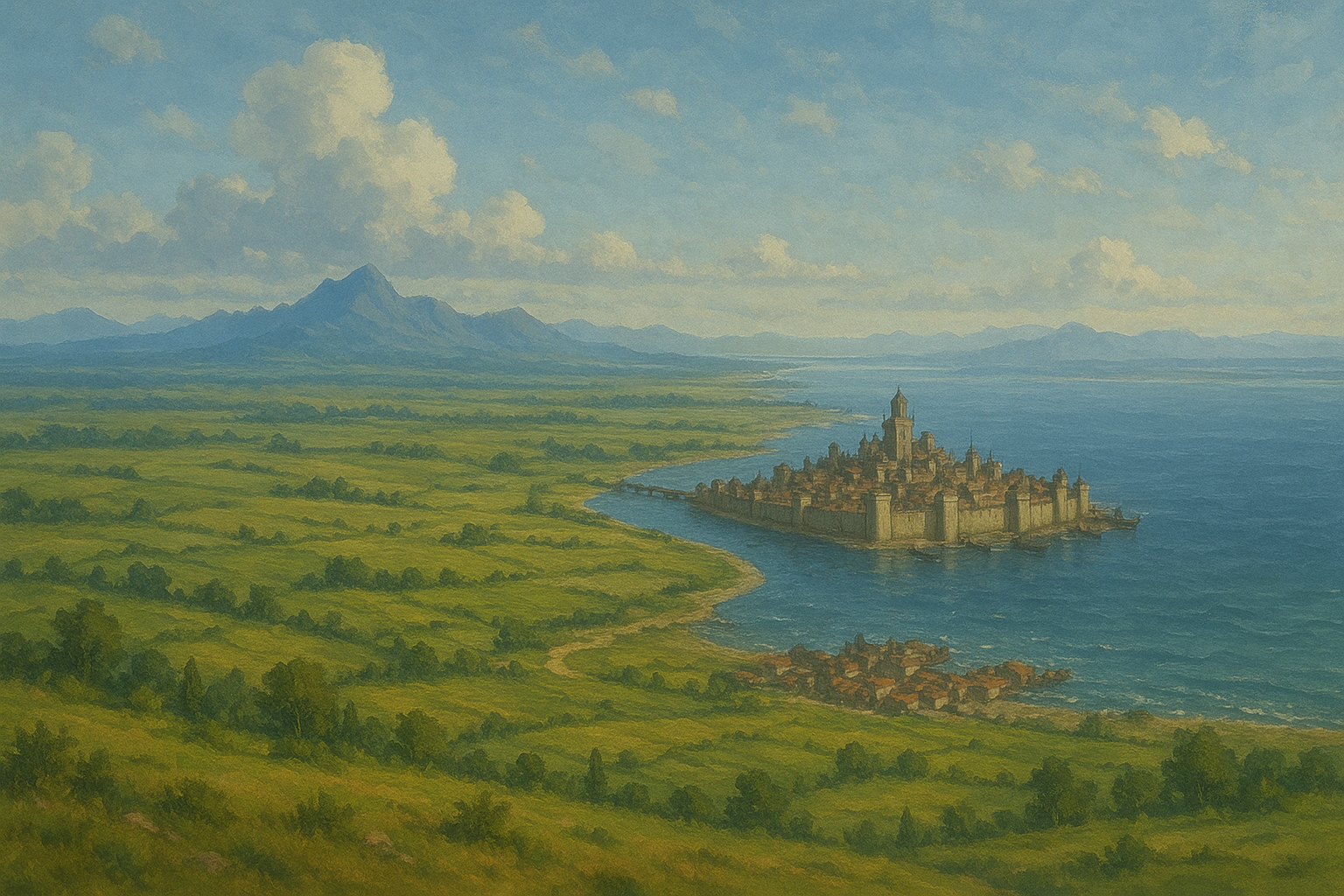
Kingdom of Dal-did ("DALL-DID")
The Kingdom of Dal-did is a highly structured, aristocratic woodland-elven realm defined by rigid hierarchy, centralized authority, and a deep belief that order is the foundation of civilization. Its noble houses rule from the exclusive capital of Khul, governing a network of cities, villages, and agricultural districts with meticulous precision. Religion and politics are inseparable: the Sanctified Court of the Antler—an elite noble priesthood—sanctions the divine mandate that legitimizes the kingdom’s stratified society. Dal-did’s culture values control, discipline, and refinement, producing advanced urban planning, efficient agriculture, and codified magical and scholarly systems unmatched by neighboring realms.
With a population exceeding 100,000 and nearly all of it woodland elven, Dal-did stands as a powerful and highly organized nation in western Redredan. Its disciplined army, prosperous farmlands, and regulated trade routes give it economic stability and political leverage, while its religious doctrine reinforces strict obedience and social roles. Though outwardly calm and orderly, Dal-did is driven by subtle noble rivalries and ambitions of regional influence—particularly over its less hierarchical elven neighbor, Hagroth. It is a kingdom that views itself not merely as a political entity, but as the divinely ordained center of elven civilization, destined to shape the world through structure, law, and ceremonial authority.
Structure
The Kingdom of Dal-did is governed by a rigid, aristocratic woodland-elven monarchy centered in the capital city of Khul, where only nobles are permitted to reside. Power is concentrated among a hereditary High Court made up of ancient elven houses, each controlling specific territories, agricultural domains, or military responsibilities throughout the kingdom. These noble families appoint governors to oversee cities and villages, creating a tightly stratified hierarchy in which authority flows downward and loyalty upward. Unlike Hagroth’s clan-based governance, Dal-did’s political system is formal, bureaucratic, and heavily codified, with strict protocols governing land use, inheritance, military service, and interregional administration.
Beneath the High Court is the Provincial Directorate, a council of appointed officials responsible for taxation, agricultural regulation, enforcement of noble decrees, and oversight of urban centers such as Sharithyr and Wetheashe. Woodland elves dominate every administrative layer, while non-elven populations—rare in Dal-did—hold no significant political power aside from the isolated dwarven leadership in Gatharak. This structure creates a kingdom defined by discipline, central oversight, and an unwavering belief that elven nobility alone is suited to shape the destiny of Dal-did.
Culture
Dal-did’s culture is shaped by discipline, hierarchy, and pride in elven refinement, creating a society that values order over freedom and tradition over improvisation. Woodland elves dominate every cultural institution, from the arts to governance, and they cultivate an image of elegance, precision, and intellectual superiority. Craftsmanship emphasizes symmetry and flawless execution, music is meticulously composed rather than improvised, and public ceremonies are highly choreographed displays of unity and noble authority. Dal-didians believe that stability and progress come from structure—not from the wild intuition celebrated in Hagroth—and this conviction permeates daily life.
Social stratification is openly embraced: nobles are viewed as the natural stewards of civilization, common elves as the foundation of productivity, and outsiders as peripheral at best. Urban centers like Sharithyr foster scholarly study, disciplined martial arts, and controlled agricultural science, while the villages practice orderly farming rituals and seasonal observances approved by noble decree. Dal-didians take pride in their efficiency, their urban sophistication, and their capacity to shape the land to their needs—seeing themselves as the pinnacle of elven civilization and the rightful cultural center of western Redredan.
Public Agenda
Dal-did’s public agenda centers on strengthening centralized authority, expanding agricultural production, and asserting itself as the cultural and political heart of elven civilization. The High Court promotes initiatives that reinforce noble power—such as standardized laws, controlled settlement expansion, and increased oversight of provincial governance—aiming to maintain a perfectly ordered society free from the “chaos” they associate with decentralized neighbors like Hagroth. Economic policy focuses on improving crop yields, regulating river trade, and developing urban centers into hubs of learning and elven advancement.
Externally, Dal-did seeks to project influence across western Redredan, positioning itself as the rightful leader among elven nations and a stabilizing force in regional politics. Diplomatic efforts often aim to pressure or sway smaller woodland communities, manage borders with precision, and counterbalance Hagroth’s cultural sway. The kingdom’s official stance emphasizes unity under noble guidance, controlled modernization, and the belief that Dal-did’s disciplined governance is the model by which neighboring realms should measure themselves.
Assets
Dal-did’s greatest assets lie in its highly organized urban centers, fertile agricultural lands, and the disciplined efficiency of its woodland-elven population. Cities like Sharithyr function as economic and administrative powerhouses, producing finely crafted goods, processed agricultural products, scholarly works, and advanced elven architecture. The kingdom’s river systems provide reliable transport routes and irrigation, allowing Dal-did to maintain abundant crop yields and food stability that many neighboring nations envy. Its strict bureaucratic systems ensure minimal waste and predictable economic output, making Dal-did a dependable trade partner—even if politically demanding.
Militarily, Dal-did benefits from a well-drilled, hierarchical elven army that excels in formation tactics, urban defense, and coordinated strategy. Though not as individually skilled in wilderness combat as Hagroth’s hunters, Dal-did’s forces are unmatched in discipline and large-scale cohesion. The kingdom also possesses a rare resource: a centralized knowledge base concentrated in Sharithyr’s academies and Wetheashe’s guild houses, giving Dal-did intellectual capital in administration, agronomy, architecture, and magical theory. Combined, these assets position Dal-did as a realm of structure, abundance, and strategic influence in western Redredan.
Demography and Population
Dal-did’s population of just over 100,000 is overwhelmingly woodland elven, who make up roughly 92% of the kingdom and dominate its political, cultural, and economic institutions. Most elves live in the dense network of farming and hunting villages surrounding the major cities, while the nobility inhabits Khul exclusively. Urban centers like Sharithyr and Wetheashe house the kingdom’s scholarly, administrative, and artisan classes, creating a clear divide between rural laborers and urban elites. This demographic concentration supports Dal-did’s centralized governance but also reinforces a rigid caste-like social order.
Non-elven populations are rare and hold limited influence. The dwarves of Gatharak account for about 1.5% of the population and maintain autonomy only because of their specialized engineering skills and isolation in the swamplands. Humans, halflings, and other races collectively form the remaining 6–7% of the populace, typically restricted to labor roles or small merchant enclaves with no political rights. Dal-did’s demographic structure reflects its worldview: a kingdom built by elves, for elves, with strictly controlled diversity and a societal hierarchy that few outsiders ever penetrate.
Military
Dal-did’s military is a highly structured, hierarchical elven force built around precision, discipline, and large-scale coordination rather than the individualistic mastery favored by Hagroth. The core of the army is the Regal Phalanx, professional woodland-elf infantry trained in formation warfare, shield walls, and synchronized tactics designed for open field and urban engagements. Supporting them are specialized divisions such as the Silver Line Bow Corps, renowned for long-range volley fire and mechanical discipline, and the Riverward Sentinels, who patrol Sharithyr’s waterways and secure agricultural transport routes. Officers are exclusively noble-born, reinforcing Dal-did’s belief that military leadership is a privilege of status, not merit.
While their forces do not match Hagroth’s rangers in stealth or forestcraft, Dal-did’s army excels in logistics, siege defense, and territorial control, enabling the kingdom to mobilize quickly and maintain long campaigns with minimal disorder. The navy stationed at Telmethondra is modest but efficient, focusing on river dominance and coastal patrols rather than deep-water combat. Every village is required to provide trained militia units who drill under noble instructors, creating a reserve force that can be activated with remarkable speed. The result is a military machine that, while less flexible than those of wilder realms, is unmatched in organization and capable of exerting steady, overwhelming pressure in any conflict where order and structure prevail.
Technological Level
Dal-did maintains a highly advanced technological and scientific level by elven standards, shaped by its urban density, disciplined governance, and strong scholarly tradition. Unlike Hagroth’s intuitive, nature-driven sciences, Dal-did pursues systematic study, standardized methods, and controlled experimentation, making its academies in Sharithyr and Wetheashe centers of architectural engineering, agricultural optimization, hydrology, magical theory, and urban planning. Their irrigation networks, crop-rotation schedules, and alchemical processing facilities are among the most efficient in western Redredan, allowing the kingdom to sustain large populations with predictable output. Dal-didians excel in mathematics, logistics, metallurgy, and codified magical research—fields often neglected by their forest-dwelling cousins.
Their technology emphasizes precision and infrastructure over innovation for innovation’s sake. Dal-did produces refined tools, durable stone-and-timber architecture, advanced surveying instruments, and meticulously designed defensive structures. Magical study is tightly regulated but fairly widespread among the upper classes, resulting in reliable enchantments, disciplined spellcasting formations, and standardized arcane support for military and agricultural use. While they cannot rival the raw wildcrafting or intuitive spirit-binding traditions of Hagroth, Dal-did stands as the region’s hub for applied sciences, structured magic, and organized technological progress, embodying the belief that civilization advances through order, not improvisation.
Religion
Dal-did practices a strict, institutionalized form of elven animism, derived from the same ancient spiritual roots as Hagroth but transformed into a state-regulated doctrine. Where Hagroth’s faith is intimate and nature-bound, Dal-did’s religion is ritualized, hierarchical, and tightly controlled by the noble priesthood, known as the Sanctified Court of the Antler. They venerate the same core spirits—Root, Leaf, and Beast—but reinterpret them as symbols of order, hierarchy, and civilization rather than wild harmony. The Great Stag is not seen as a wandering guardian but as the Divine Sovereign, a mythical embodiment of rightful rule and the sacred mandate of the elven nobility.
Worship takes place in formalized sanctuaries built within or near cities, where rituals follow strict liturgical scripts and priests maintain extensive codices detailing proper offerings, rites, and moral expectations. Commoners participate in seasonal ceremonies, but only nobles may perform high rites or interpret divine signs, reinforcing their authority as both political and spiritual leaders. While the religion acknowledges natural spirits, it places emphasis on structure, purity of tradition, and the spiritual superiority of elven civilization, creating a belief system that legitimizes Dal-did’s rigid social hierarchy and distinguishes it sharply from its more organic, decentralized counterpart in Hagroth.
Laws
Dal-did’s laws are highly codified, rigid, and explicitly hierarchical, designed to preserve noble authority and maintain strict social order. Every citizen is bound by the Edicts of Khul, a comprehensive legal code regulating land use, agricultural output, trade, military obligations, spiritual conduct, and personal behavior. Elves of noble birth hold legal privileges unavailable to commoners, including exclusive rights to own certain lands, interpret sacred doctrine, and command military forces. Violations of noble authority—disobedience, dishonor, or failure to meet quotas—are treated as serious offenses, often punished through fines, labor conscription, or relocation to lower-status villages.
Religion is entwined with law, and acts deemed spiritually impure—such as unauthorized cutting of sacred trees, improper ritual conduct, or performing rites reserved for nobility—carry heavy penalties enforced by both civil officials and the Sanctified Court of the Antler. Non-elven residents, though few, have limited legal standing and must abide by all regulations without receiving the full rights granted to elven citizens. Dal-did’s legal philosophy is clear: order is maintained when every being knows their place, fulfills their role, and respects the absolute authority of the noble class.
Agriculture & Industry
Dal-did’s agriculture is systematic, large-scale, and engineered for maximum efficiency, reflecting the kingdom’s emphasis on order and output. Noble-directed farming districts use structured crop rotations, irrigation canals, and regulated seasonal schedules to maintain consistent yields that feed both urban centers and military forces. Woodland elves manage orchards, grain fields, and specialized plantations with mathematical precision, while fishing villages like Dalranen provide steady river and lake harvests. Nothing is left to chance—every field, orchard, and waterway is mapped, monitored, and expected to meet production quotas established by the Provincial Directorate.
Industry in Dal-did is driven by its urban craftsmanship, regulated workshops, and centralized processing centers. Sharithyr produces fine elven textiles, metal tools, architectural materials, and magical components, while Wetheashe specializes in administrative craft guilds, scholarly products, and precision woodworking. Smaller villages contribute hunting goods, preserved foods, leatherwork, and agricultural surplus. The dwarves of Gatharak supply swamp-hardened timber, stonecutting, and unique engineering solutions. Unlike Hagroth’s artisanal, land-harmonious approach, Dal-did’s industry is methodical and scale-oriented, built on coordination, quotas, and the belief that true elven civilization advances through structure, not wilderness intuition.
Trade & Transport
Trade and transport in Dal-did operate through a centralized, state-regulated network designed to maximize efficiency and maintain strict noble oversight. Major trade flows move through Sharithyr, the kingdom’s primary river city, where goods from rural villages—grain, textiles, crafted tools, magical components, and processed foods—are taxed, inspected, and redistributed for export. Telmethondra, though smaller, serves as Dal-did’s maritime outlet, sending refined products downstream and importing controlled quantities of metals, rare herbs, and foreign luxuries deemed acceptable by the High Court. Internal commerce is carefully monitored through permits and standardized tariffs, ensuring that no settlement operates outside noble authority.
Transport relies on a sophisticated system of stone-paved roads, irrigation canals, and guarded river routes, enabling predictable movement of goods and troop mobilization. Caravans and barges operate on fixed schedules enforced by provincial officials, while noble inspectors travel frequently to confirm quotas, road conditions, and the obedience of local administrators. The military secures major road junctions, and only authorized individuals may cross certain borders or enter Khul. Dal-did’s transport network is not flexible or spontaneous; it is designed for control, stability, and logistical precision, allowing the kingdom to project influence outward while ensuring every corner of its territory remains tightly connected to, and dependent upon, noble governance.
Education
Education in Dal-did is highly formalized, centralized, and deeply tied to social hierarchy, with the noble class receiving the most advanced and prestigious instruction. Young nobles are educated in Khul or Sharithyr’s elite academies, where they study mathematics, law, administration, magical theory, history, and military command. Their curriculum is designed to produce effective governors, officers, and spiritual authorities who can uphold the carefully maintained order of Dal-didian society. Instruction is rigorous, examination-based, and overseen by noble-appointed scholars who ensure that only the most disciplined minds rise to positions of influence.
Common elves receive practical education within guild houses or village schools, focusing on agriculture, craftsmanship, standardized record-keeping, and obedience to the Edicts of Khul. Magical study is restricted to those granted permission by the Sanctified Court, and literacy, while common among elves, varies by class and region. Non-elven residents rarely receive formal schooling beyond what is necessary for labor roles. By regional standards, Dal-did is considered highly educated, but its knowledge system is intentionally stratified—designed not for universal enlightenment, but to reinforce the kingdom’s rigid hierarchy and maintain the noble class’s intellectual dominance.
Infrastructure
Dal-did’s infrastructure is highly developed and meticulously maintained, reflecting its emphasis on order and efficient governance. Stone-paved highways link every major city and village, enabling fast troop movement and reliable agricultural transport, while engineered irrigation canals support large-scale farming across the kingdom’s fertile plains. Urban centers like Sharithyr feature structured districts, fortified walls, administrative compounds, and regulated marketplaces, all built according to standardized architectural plans. River routes are reinforced with docks, locks, and patrol stations, and even remote villages are connected through well-marked roads and storage depots. Everything—from bridges to granaries—is inspected on fixed schedules by provincial officials, ensuring that Dal-did’s infrastructure remains not just functional, but a testament to the kingdom’s belief in discipline, precision, and centralized control.
Mythology & Lore
Dal-did’s mythology centers on the divine mandate of order, interpreting ancient elven cosmology through a lens of hierarchy and structured creation. According to Dal-didian lore, the primal spirits Root, Leaf, and Beast did not merely shape the world—they established the first cosmic hierarchy, assigning every living thing a rightful place and purpose. The Great Stag is revered not as a wandering guardian, but as the First Sovereign, the being who accepted the spirits’ mandate and brought structure to the early wilderness. His antlers are said to represent the branching paths of destiny, each limb a symbol of lawful order extending across the world.
Other myths recount how lesser spirits and ancestors pledged themselves to this hierarchy, forming the foundations of noble authority and elven civilization. Tales often portray disorder, wild magic, or unregulated growth as corrupting forces that threaten the world’s original structure. Heroes in Dal-didian legends restore balance not through personal glory, but by reaffirming duty, obedience, and the sacred laws that mirror the cosmos. These stories reinforce the kingdom’s belief that society thrives only when it reflects the structured harmony established at creation, with the nobility standing as the spiritual and mortal inheritors of that ancient mandate.
Divine Origins
Dal-did’s belief system originated during the early consolidation of elven clans who settled the fertile plains east of the great forests. Unlike their Hagrothi kin—who embraced the wild, shifting language of the forest—these clans found their survival depended on controlled farming, predictable seasons, and strict communal organization. Over generations, they interpreted the primal spirits not as untamed forces to harmonize with, but as architects of cosmic order whose will was revealed through the stability of the land. As agriculture expanded and cities formed, the emerging noble houses claimed descent from the first elves who “heard” the structured intentions of Root, Leaf, and Beast. Their codification of ritual, law, and hierarchy gradually transformed practical necessity into theological doctrine, giving rise to a religion that justified noble rule as the fulfillment of a divine, orderly creation.
Tenets of Faith
1. Order Is Sacred
All things in the world possess a rightful place assigned by the primal spirits. To disrupt hierarchy is to disrupt creation itself.
2. The Nobility Are the Chosen Stewards
Noble bloodlines inherit the divine mandate of the Great Stag, serving as interpreters of cosmic law and guardians of societal order.
Harmony Is 3. Achieved Through Structure
Balance does not arise naturally, but through discipline, law, and adherence to established roles within the kingdom.
4. Ritual Purity Upholds the Realm
Proper observance of rites—conducted at the correct times, by the correct individuals—is essential for maintaining the spiritual health of Dal-did.
5. The Land Responds to Discipline
Agriculture, architecture, and magic flourish when guided by technique and intention, reflecting the spirits’ preference for precision over chaos.
6. Disorder Is a Spiritual Corruption
Unregulated magic, wild growth, or defiance of noble authority is viewed as a threat to cosmic structure and must be swiftly corrected.
7. The Great Stag Is the First Sovereign
His example teaches that leadership is a burden of duty, not personal glory, and that authority exists to preserve order above all else.
8. Knowledge Must Serve Stability
Learning, magic, and scholarship are not pursuits for personal power but tools meant to strengthen the realm and uphold divine hierarchy.
9. Duty Is the Highest Virtue
Every citizen is expected to fulfill their assigned role diligently, for the strength of Dal-did depends on collective obedience to cosmic design.
Ethics
Dal-didian ethics revolve around duty, obedience, and the preservation of hierarchical order, reflecting the belief that morality is defined by how well one upholds their assigned role within society. Actions are judged not by individual intent but by their impact on the kingdom’s stability: fulfilling obligations, respecting authority, and maintaining ritual purity are seen as the highest virtues. Disorder—whether through defiance, emotional impulsiveness, or unregulated pursuits—is viewed as inherently immoral, while discipline, precision, and adherence to tradition are celebrated as reflections of cosmic harmony. In Dal-did, to act ethically is to reinforce the structure that sustains both civilization and the divine order.
Worship
Worship in Dal-did is formal, ritualized, and overseen by the noble-led Sanctified Court of the Antler, reflecting the kingdom’s belief that spiritual practice must mirror cosmic order. Ceremonies occur in structured sanctuaries rather than open nature, following precise liturgies that dictate who may speak, what offerings are appropriate, and how each rite must be performed. Commoners participate through seasonal observances, harvest rituals, and communal recitations, while nobles conduct the high rites that affirm their divine mandate. Worship focuses on reinforcing hierarchy, honoring the Great Stag as the First Sovereign, and expressing gratitude for the structured world crafted by Root, Leaf, and Beast.
Priesthood
The priesthood of Dal-did, known as the Sanctified Court of the Antler, is an exclusively noble institution that combines spiritual authority with political power. Membership is hereditary or granted by appointment from the High Court, ensuring that only those of proven lineage may interpret divine law or conduct high rites. Priests serve as theologians, ritual leaders, judges of religious purity, and advisors to provincial governors, making them central to both governance and faith. Their training involves rigorous study of codified scripture, ceremonial precision, and the symbolic meaning of hierarchy within the cosmos.
The Sanctified Court is divided into ranks—Antler-Bearers who lead major rituals, Horn-Readers who interpret omens and doctrine, and Branch-Stewards who oversee local sanctuaries and enforce religious discipline across villages and cities. Their authority extends into every aspect of Dal-didian life, from education and agricultural rites to legal judgments involving spiritual offenses. To defy a priest is to challenge not only religious doctrine but the divine structure of the kingdom itself, making the priesthood one of the most influential and feared institutions in Dal-did.
Granted Divine Powers
The priesthood of Dal-did does wield divine power, but in a form that reflects the kingdom’s obsession with hierarchy and structured ritual rather than spontaneous miracles. Members of the Sanctified Court of the Antler channel what they call Ordered Blessings—spiritual manifestations granted only when rites are performed with absolute precision and by those of proper noble lineage. These powers are not freely given; they are conditional, ritual-bound, and often subtle, reinforcing the belief that divine authority rewards discipline, not passion.
Priests may invoke The Sovereign’s Aegis, a protective ward used in ceremonies or to shield designated nobles; Edicts of Binding, spells that calm unrest or suppress unregulated magic; and Harvest Harmonies, blessings that improve crop yields when performed at sanctioned times. High-ranking Antler-Bearers can call upon The Stag’s Mandate, a rare and revered power that grants temporary clarity, heightened authority, or spiritual intimidation, often settling disputes without violence. These divine abilities are respected but also feared, for they remind citizens that the gods of Dal-did do not act through compassion or whim—they act through structure, hierarchy, and the unwavering precision of sacred order.
Political Influence & Intrigue
Political intrigue in Dal-did is a quiet but ever-shifting game of noble rivalry, where ancient elven houses maneuver for influence within both the High Court and the Sanctified Court of the Antler. Each noble line controls key agricultural zones, military divisions, or religious offices, creating overlapping spheres of power that breed competition disguised as graceful diplomacy. Alliances are forged through arranged marriages, ritual sponsorships, and shared interpretations of doctrine, while rivalries simmer beneath polite conversation. Because only nobles may live in Khul, the capital is a cloistered arena of whispered negotiations, strategic favors, concealed scandals, and doctrinal disputes presented as theological debate.
Externally, Dal-did exerts influence through economic leverage, religious authority, and political pressure on neighboring realms—especially Hagroth. The High Court uses trade restrictions, agricultural quotas, and diplomatic overtures to assert dominance, while the priesthood quietly works to bring smaller elven communities under Dal-didian spiritual doctrine. Border settlements are subtly courted or coerced, and Dal-did’s disciplined military presence ensures its neighbors understand the cost of defiance. In Dal-did, power is not seized by force—it is accumulated through subtle coercion, ritual legitimacy, and the unshakable confidence of a kingdom convinced it is destined to lead all elvenkind.
Sects
1. The Sovereign Antler (Official Sect)
The authoritative, state-sanctioned sect controlling all major doctrine. It teaches that the Great Stag chose the noble houses as earthly stewards of cosmic order. Nearly all nobles belong to this sect, making it both a religious and political institution.
2. The Rooted Doctrine
A conservative sect emphasizing the primacy of Root, seeing the cosmic hierarchy as fixed and unchangeable. They oppose reforms, resist foreign influences, and advocate for stricter control over commoners. Priests from this group often serve as inquisitors.
3. The Leafbound Synod
A more progressive sect within the priesthood that focuses on controlled adaptation. They argue that while hierarchy is divine, societies must grow and adjust methodically. They encourage scholarly study, new agricultural techniques, and limited magical innovation.
4. The Horn-Seers
Mystics who claim to receive structured visions from the antlers of the Great Stag. Unlike Hagroth’s intuitive seers, Dal-didian Horn-Seers interpret visions through strict symbolic codes. Their predictions often influence political maneuvering within the High Court.
5. The Order of the Perfect Measure
A guild-like sect of ritual theorists, mathematicians, and magical scholars who believe that the universe can be understood through precise calculation. They develop new ceremonial forms and exacting standards for blessings. They are admired for their scholarship but often viewed as overly rigid even by Dal-didian norms.
6. The Purifying Lineage
A hardline sect that promotes strict bloodline purity among the nobility, claiming divine favor flows only through “unbroken ancestral lines.” While not officially endorsed, many nobles privately fund or support them, making them politically dangerous.
7. The Quiet Branch
A small, semi-heretical sect mostly among commoners who believe the spirits care more for diligence and community harmony than noble lineage. They remain tolerated only because they avoid open defiance and keep their gatherings discreet.


Comments