
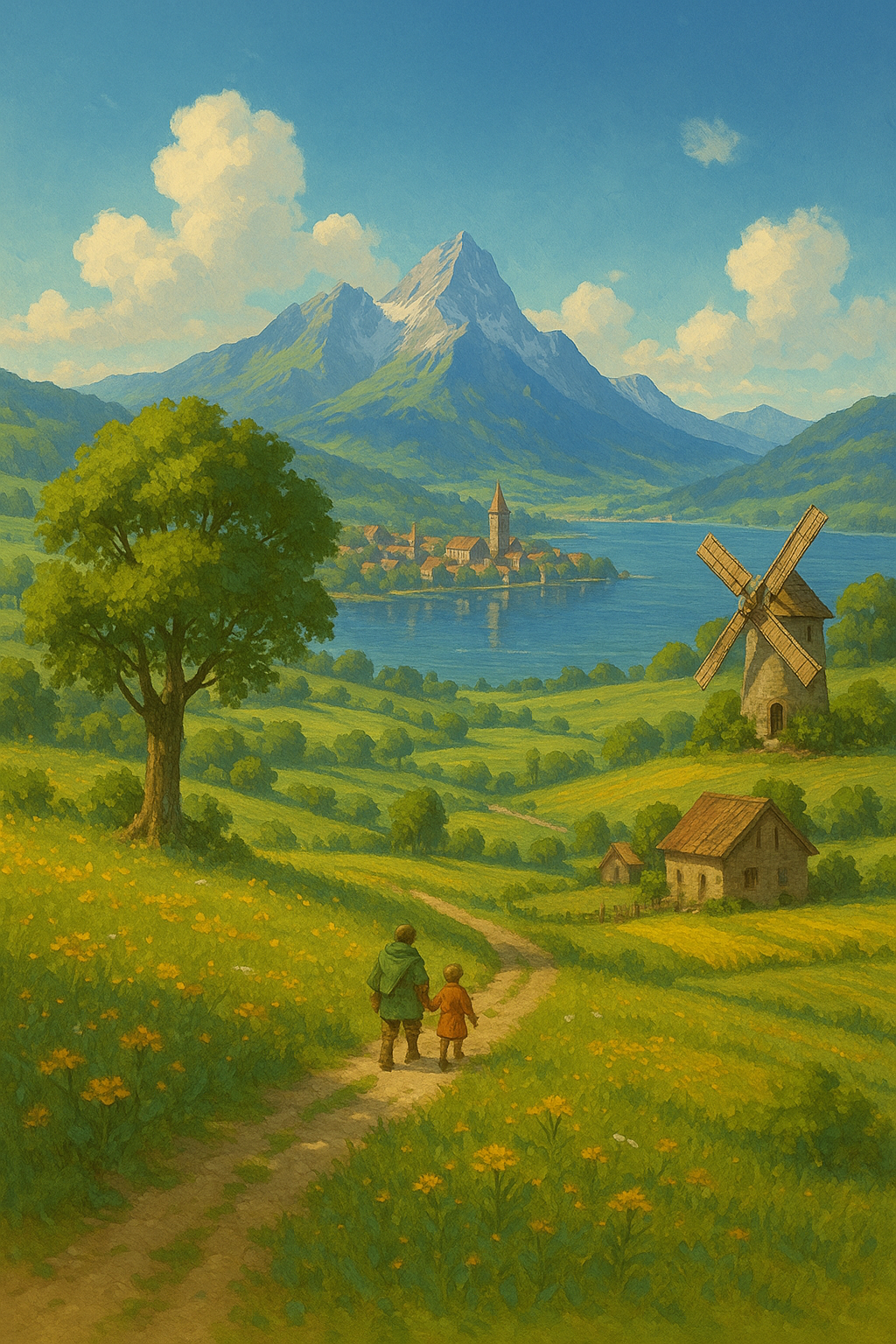
Kingdom of Coth
Structure
Coth is governed by the Council of Seven Crowns, a political system born from the nation’s founding by seven culturally distinct groups—humans, halflings, half-elves, gnomes, dwarves, hobgoblin refugees, and mixed peoples. Each group contributed a symbolic “crown” to represent their commitment to unity and survival in a land surrounded by more powerful nations. The Council consists of seven representatives, each chosen according to the traditions of their community, and no national decision may pass without a majority of their approval. At the head of this council is the High Crown, a ceremonial monarch whose position rotates every ten years among the seven groups, preventing any single culture from seizing long-term dominance. Though the High Crown oversees diplomacy and inter-kingdom relations, true authority lies with the collective voice of the Council.
Supporting the Council are the Harmonist Clerks, a neutral civil order responsible for maintaining records, drafting legislation, and mediating disputes to ensure that all groups remain fairly represented. Each settlement also elects a Speaker, who meets with the Council twice per year to share local concerns and secure resources. This structure—designed around negotiation rather than force—has allowed Coth to flourish as a peaceful crossroads nation. Its government embodies the kingdom’s greatest strength: its commitment to cooperation, cultural harmony, and consensus-driven decision making in a region dominated by far larger and more aggressive powers.
Culture
Coth’s culture is defined by its origins as a refuge for migrants, exiles, and displaced peoples from surrounding empires. Rather than forming around a single dominant race or tradition, Coth grew into a vibrant patchwork society where human merchants, halfling farmers, half-elven wanderers, gnomish tinkerers, dwarven builders, and peaceful hobgoblin defectors live side by side. This blend created a national ethos centered on hospitality, cooperation, and mutual respect. Markets overflow with mixed culinary traditions, festivals weave together stories from each clan, and public spaces are designed to accommodate the customs of all seven founding groups. Diversity is not simply tolerated—it is celebrated as the heart of Coth’s identity, and children grow up learning multiple languages, songs, and practical skills from different cultures.
Cothians value community, craftsmanship, and personal responsibility over rigid hierarchy or martial prestige. Artisanship is a point of pride, with each group contributing skills: halflings bring agricultural mastery, gnomes innovation, dwarves engineering, humans diplomacy, half-elves scholarship, and hobgoblins discipline and precise organization. Storytelling is central to daily life—taverns, hearths, and public plazas echo with tales of journeys, heritage, and unity. The nation’s cultural motto, “Seven Threads, One Cloth,” reflects the belief that every person, regardless of background, strengthens the whole. In a region shaped by conquest and authoritarian rule, Coth stands out as a peaceful, collaborative, and culturally rich kingdom where identity is shared, not imposed.
Public Agenda
The Kingdom of Coth publicly positions itself as a neutral mediator and cultural bridge between the major powers that surround it. Its foremost priority is maintaining stability within its borders by promoting peaceful coexistence among its diverse peoples. Coth invests heavily in supporting local markets, maintaining open trade routes, and encouraging cultural exchange festivals that reinforce unity among its seven founding groups. The Council of Seven Crowns regularly hosts diplomatic gatherings in Velmoor, aiming to ease regional tensions and prevent conflicts that could spill into Coth’s lands. To the outside world, the nation champions dialogue, shared prosperity, and the value of multicultural cooperation as the antidote to war and division.
Economically, Coth’s agenda focuses on developing its role as a trade conduit and artisan center in the region. The kingdom supports small-scale farming, sustainable resource management, and the export of handcrafted goods produced by halfling farmers, dwarven smiths, gnomish artisans, and hobgoblin engineers. Infrastructure improvements—especially along rivers and trade roads—are framed as investments in regional peace and economic interdependence. Above all, Coth seeks to preserve its sovereignty not through military might, but through alliances, goodwill, and the consistent demonstration that a peaceful crossroads nation can serve as an essential, stabilizing presence in a continent shaped largely by empires.
Assets
Coth’s greatest asset is its identity as a neutral crossroads nation, a place where merchants, diplomats, refugees, and travelers from every surrounding kingdom meet peacefully. Positioned at the confluence of major rivers and maritime lanes, Coth has become an essential trade corridor connecting the great powers of the region. Its bustling capital, Velmoor, draws artisans, scholars, and negotiators from across the continent, all relying on Coth’s stability to conduct business and diplomacy. The kingdom’s rich cultural diversity fuels a thriving artisan economy: dwarven metalwork, gnomish engineering devices, halfling agricultural exports, hobgoblin precision tools, and mixed-heritage artistry form a tapestry of goods rarely found concentrated in a single market.
But the crown jewel of Coth’s assets is the Treaty of Harmonious Sovereignty, a multinational agreement signed decades ago by neighboring empires and kingdoms. The treaty legally designates Coth as a protected neutral state, forbidding military aggression, territorial encroachment, or covert destabilization efforts within its borders. In return, Coth provides diplomatic mediation, guarantees open trade routes, and maintains safe passage for merchants and envoys from all signatory nations. This treaty—renewed every ten years—has elevated Coth from a vulnerable patchwork kingdom to a recognized linchpin of regional stability, ensuring that even the most powerful nations benefit more from Coth’s peace than its conquest.
Demography and Population
Coth is one of the most culturally diverse nations on the continent, with a total population of roughly 69,000 people spread across its seven settlements. Humans form the largest demographic group at 38% (≈26,000 citizens), followed by halflings at 20% (≈14,000) and half-elves at 16% (≈11,000). Gnomes make up 12% (≈8,000), while dwarves contribute 9% (≈6,000). The remaining 5% (≈3,500) consists of peaceful hobgoblin defectors, goblins, mixed-heritage families, and smaller minority groups who have integrated into Cothian society over the generations. This demographic blend reflects the kingdom’s origins as a refuge for migrants and exiles, creating a population where multilingualism, cultural fusion, and shared traditions are everyday life.
Population distribution follows these cultural patterns: Velmoor, with over 21,000 residents, is the most cosmopolitan and features every major group in significant numbers. Riverwatch (≈14,200) and Seabrink (≈10,500) hold large halfling, gnome, and half-elven communities tied to farming and maritime trade. Thornmar, home to nearly 12,900 residents, contains the highest concentration of hobgoblins—almost 40% of the settlement—alongside humans and dwarves who contributed to its engineering-focused culture. Smaller villages like Meadowfall, Ironmere, and Greenhollow collectively house about 10,000 people, each having distinct cultural blends that sustain Coth’s agricultural, artisanal, and medicinal traditions. In total, the kingdom’s demographic makeup forms a harmonious mosaic, unified under the Council of Seven Crowns and strengthened by the belief that diversity itself is Coth’s greatest asset.
Military
Coth maintains a modest defensive force known as the Wardens of the Seven Crowns, a symbol of unity among the kingdom’s founding peoples. Because the Treaty of Harmonious Sovereignty forbids foreign aggression within Coth’s borders, the kingdom has no need for a large army. Instead, its military focuses on border safety, internal stability, escort duties, and rapid response to emergencies. Each cultural group contributes specialized units: halflings serve as agile scouts familiar with river and farmland terrain; dwarves craft and maintain superior defensive infrastructure; gnomes operate communication devices; humans and half-elves fill officer and administrative roles; and hobgoblins, renowned for discipline, serve as elite guardians stationed in Thornmar. Despite their differences, the Wardens train together, emphasizing cooperation over hierarchy and showcasing the harmony that defines Coth.
Coth’s greatest military strength lies not in numbers or weaponry, but in its role as a neutral mediator protected by international law. The Wardens enforce domestic peace, safeguard trade routes, and act as impartial peacekeepers during disputes between local communities. Patrols along the rivers and coastal roads ensure the safe passage of diplomats and merchants from signatory nations, strengthening Coth’s reputation as a secure crossroads. In times of crisis—natural or political—the Wardens mobilize swiftly to protect civilians and uphold the Treaty’s stipulations. Though small in size, Coth’s military is widely respected as a disciplined, culturally integrated force whose purpose is not conquest, but the preservation of unity, safety, and the peace upon which the kingdom thrives.
Technological Level
Coth’s technological development is shaped by its position as a crossroads nation—its innovations come not from centralized research institutes, but from the blending of many cultures’ knowledge systems. Halflings contribute advanced agricultural practices, irrigation methods, and seed preservation that keep Coth’s farmland highly productive despite its modest size. Gnomes bring practical engineering skills, creating compact tools, clever mechanisms, and precise river gauges that support trade and navigation. Dwarves refine metallurgy, producing high-quality hinges, tools, and artisanal weapons prized across the region. Humans and half-elves expand Coth’s intellectual horizons through diplomacy, record-keeping, and the maintenance of shared scholarly traditions. Because each culture excels in different fields, Coth’s scientific strength lies in collaboration, with mixed workshops, communal forges, and open learning halls serving as centers of innovation.
Coth’s most notable technological achievements revolve around infrastructure, navigation, and sustainable design. The kingdom’s multi-race engineering teams developed hybrid construction techniques—dwarven stone foundations reinforced with gnomish locking mechanisms and halfling timber frameworks—resulting in buildings that are sturdy, flexible, and capable of withstanding seasonal floods. Riverwatch and Seabrink house some of the best waterwheel systems and tidal markers in the region, aiding farmers and maritime traders alike. Thornmar’s hobgoblin-born precision engineering has also produced some of Coth’s finest bridges and fortified overlooks, designed not for war, but for structural efficiency and longevity. Although Coth does not pursue advanced military technologies, its peaceful innovations—ranging from herbal medicine in Greenhollow to navigational lantern arrays in Seabrink—have earned it a reputation as a nation where craftsmanship, cooperation, and clever design flourish without the shadow of empire.
Religion
Coth is one of the few nations on the continent without an official or state-sponsored religion. Because its population was formed by migrants, exiles, and displaced peoples from many cultures, the kingdom naturally evolved into a spiritual mosaic rather than a unified faith system. Humans bring small household shrines and ancestor-prayers; halflings maintain seasonal festivals tied to harvest cycles; dwarves practice traditional craft-honoring rites; gnomes tend philosophical circles focused on curiosity and innovation; half-elves conduct quiet ceremonies tied to nature and memory; and hobgoblin defectors preserve a gentler, discipline-based reinterpretation of their once-militaristic traditions. Coth’s government neither endorses nor restricts any of these beliefs, instead encouraging open coexistence and mutual respect. As a result, religious expression in Coth is intensely personal, often practiced at home, in community halls, or at shared outdoor landmarks rather than in formal temples.
What makes Coth unique is how interwoven its spiritual traditions have become. In Velmoor and Riverwatch, it is common to see blended ceremonies where a halfling seed-offering is paired with a half-elven remembrance chant, or where gnomish storytelling circles incorporate dwarven blessing rituals for crafted goods. Major festivals, such as the Seven Lights Celebration, pull traditions from each cultural group, symbolizing unity through shared heritage. Even those who claim no religion at all participate in the kingdom’s communal rites, seeing them as cultural expressions rather than divine obligations. Coth’s spiritual life is therefore less about gods and doctrine, and more about community, tradition, gratitude, and coexistence—a natural extension of the kingdom’s founding principle that many peoples can thrive together without needing to think, pray, or worship the same way.
Laws
The legal system of Coth is built upon the principle of communal fairness, reflecting the kingdom’s origins as a refuge for many cultures. Rather than imposing a single cultural code, the Council of Seven Crowns created the Harmonized Statutes, a legal framework that blends the most widely shared values of humans, halflings, dwarves, gnomes, half-elves, and peaceful hobgoblin defectors. These statutes emphasize personal responsibility, nonviolence, and restorative justice. Crimes such as theft, assault, fraud, and property damage focus primarily on restitution, reconciliation, and community service rather than harsh punishment. Because Coth depends on cooperation between its many peoples, the law prioritizes mediation and negotiation, often facilitated by the Harmonist Clerks, who serve as impartial arbiters. Equality before the law is absolute—no cultural group, noble lineage, or foreign visitor is granted special exemption.
Externally, the laws of Coth strongly support its status as a neutral, protected nation, especially under the Treaty of Harmonious Sovereignty. Acts that threaten neutrality—such as espionage on behalf of foreign powers, attempts to militarize Cothian land, or efforts to destabilize public unity—are among the few crimes that carry severe penalties, including permanent exile. The kingdom also bans slavery, indentured servitude, religious coercion, and discriminatory practices between its cultural groups, all viewed as direct threats to national harmony. River and road laws are highly organized, ensuring safe passage for traders and diplomats from every signatory nation. Through these statutes, Coth balances personal freedom with community well-being, creating a legal system that protects its people while preserving the peace that allows the kingdom to thrive.
Agriculture & Industry
Agriculture in Coth is a cooperative, high-skilled endeavor shaped heavily by halfling expertise, gnomish innovation, and dwarven engineering. The fertile lowlands around Riverwatch and Meadowfall produce the bulk of the kingdom’s grain, vegetables, and fruit, enhanced by halfling crop-rotation techniques that maintain soil richness year-round. Gnomes contribute clever irrigation systems, waterwheel-driven mills, and compact farming tools that make small communities highly efficient. The riverbanks support thriving fisheries, while orchards and herbery gardens provide medicinal plants stewarded by half-elven practitioners. Because Coth values sustainability and long-term stability, agricultural practices are designed to minimize ecological strain—shared land agreements ensure every community has access to farmland without overworking the terrain.
Industry in Coth is centered on artisanship and skilled craftsmanship rather than mass production. Dwarven smiths in Ironmere and Thornmar produce finely crafted tools, hinges, decorative metalwork, and specialty weapons that are traded across the region. Gnomish workshops specialize in mechanical devices, navigation instruments, clocks, and clever household mechanisms prized for their reliability. Humans and half-elves dominate textile production, pottery, cartography, and bookbinding, while hobgoblin defectors contribute precision engineering techniques used in bridges and infrastructure. Because the Treaty of Harmonious Sovereignty protects Coth from military demands, industry focuses on peaceful goods rather than wartime manufacture. The result is a thriving artisan economy known for its quality, uniqueness, and cultural blend—making Coth a preferred stop for traders seeking goods crafted with ingenuity rather than force.
Trade & Transport
Trade is the lifeblood of Coth, fueled by its strategic position at the convergence of major river routes and land corridors used by neighboring empires. As a neutral state protected by the Treaty of Harmonious Sovereignty, Coth serves as a safe marketplace where merchants from rival nations can trade without fear of political interference or conflict. Velmoor’s Grand Exchange hosts goods from across the continent—spices from distant kingdoms, dwarven steel, elven herbal remedies, gnomish clockwork, and halfling agricultural surpluses. Cothian exports focus on artisanal quality over scale: precision tools from Thornmar, waterwheel components from Riverwatch, textiles and pottery from Meadowfall, and medicinal plants cultivated in Greenhollow. Because the kingdom is trusted as an impartial mediator, foreign diplomats and trade caravans often treat Coth as the ideal place to negotiate treaties, settle disputes, or store goods for redistribution.
Transport within Coth is highly efficient, reflecting its multicultural engineering strengths. The kingdom maintains a well-coordinated network of river ferries, stone-paved roadways, and coastal barges overseen jointly by gnomish mechanics, halfling navigators, and hobgoblin structural planners. The major river connecting Riverwatch to Velmoor acts as a natural highway, moving people, crops, and crafted goods between settlements with speed and safety. Seabrink’s modest but well-organized port links Coth to maritime trade, while dwarven-built bridges and tunneling techniques ensure year-round overland routes remain sturdy even during flooding seasons. Strict neutrality laws protect foreign caravans, making travel through Coth safer than nearly anywhere else on the continent. Together, this transport network not only sustains the kingdom’s economy, but reinforces Coth’s role as a trusted crossroads nation whose infrastructure is designed to unite rather than divide.
Education
Education in Coth is decentralized, community-driven, and built on the principle that every culture has something worth teaching. Instead of rigid state-run academies, each settlement maintains learning halls where humans, halflings, half-elves, dwarves, gnomes, and hobgoblin defectors share their knowledge openly. Children typically begin schooling in mixed-heritage classrooms, learning reading, writing, basic numeracy, and at least two languages—usually Common plus the tongue of their family’s cultural group. As they grow older, they choose a “Track of Craft,” apprenticing under artisans, engineers, farmers, healers, scribes, or navigators, depending on local needs and personal interest. These apprenticeships are overseen by the Harmonist Clerks, who ensure every community has equal access to mentors and that no single culture dominates the curriculum.
Higher learning in Coth takes the form of Guild Schools, specialized institutions where advanced skills are taught collaboratively across racial traditions. Velmoor hosts the Hall of Seven Disciplines, where scholars study diplomacy, history, herbalism, and cartography. Thornmar runs the Precision Works Academy, combining hobgoblin discipline with gnomish creativity and dwarven craftsmanship. Seabrink’s Tidewatch College focuses on navigation, currents, and coastal ecology. Education in Coth values practical problem solving, multicultural literacy, and cooperation over prestige or competition. Because the kingdom rejects militaristic and dogmatic schooling common in larger empires, Coth has earned a reputation for producing level-headed diplomats, ingenious artisans, and exceptionally adaptable citizens who see diversity not as a challenge, but as a tool for understanding the world.
Infrastructure
Coth’s infrastructure reflects the combined expertise of its diverse peoples, producing a landscape where dwarven durability, gnomish ingenuity, halfling practicality, and hobgoblin precision come together seamlessly. Roads between major settlements are paved with stone foundations crafted by dwarves and reinforced with gnomish interlocking mechanisms that prevent shifting during floods. Halfling-designed water channels and irrigation ditches run alongside farmland, ensuring steady crop yields year-round. The kingdom’s iconic river ferries—built in Thornmar and operated from Riverwatch—serve as dependable transport arteries connecting every community. Bridges, watch platforms, and shoreline retaining walls demonstrate a unique hybrid engineering style: dwarven masonry for strength, hobgoblin measurements for alignment, and gnomish pulleys and counterweights for maintenance efficiency.
Urban infrastructure is equally harmonious. Velmoor’s Grand Exchange is a masterpiece of mixed architectural traditions, with wide halfling courtyards, dwarven load-bearing frameworks, and elegant half-elven facades. Seabrink’s docks utilize wave-powered pumps designed by gnomish techs, enabling consistent water levels for cargo handling. Thornmar’s Precision District is famed for its gridlike layout and perfectly aligned workshops, each equipped with standardized ventilation, water access, and tool stations. Public utilities—such as lantern networks, communal wells, message posts, and emergency shelters—are maintained cooperatively by the Harmonist Clerks and local guilds. Instead of military bastions, Coth invests in infrastructure that protects economic stability and community well-being, ensuring its towns remain connected, safe, and welcoming to travelers from every neighboring kingdom.
Mythology & Lore
Though Coth has no unified religion, it does possess a shared mythology that emerged naturally over centuries of coexistence. The most widely known tale is that of The Seven Wanderers, a mythic retelling of the kingdom’s founding in which seven travelers—each from a different people—follow a guiding light across the night sky until it rests upon the land that would become Coth. In the stories, the “Guiding Star” taught them that harmony could be stronger than conquest, and that survival required cooperation instead of dominance. While historians consider the myth symbolic rather than literal, its themes influence festivals, songs, and murals throughout Coth. Each culture interprets the Wanderers differently—halflings see them as ancestral caretakers, dwarves as wise builders, humans as diplomats, gnomes as seekers of knowledge—but all agree the land itself was chosen, in some mysterious way, to be a refuge.
Another common thread in Cothian mythology is the belief in Places of Quiet Power, natural sites where the boundaries between the world and memory seem thinner. Greenhollow’s Whispering Stones are said to echo past voices during certain winds, while the River of Lanterns near Velmoor is believed to guide souls safely to rest when candles are set afloat on its currents. These myths are not enforced dogma but shared cultural touchstones—stories that unify the population without prescribing belief. They reinforce the idea that Coth is a land shaped not by gods or conquerors, but by the will of its people and the quiet magic of cooperation. In a world ruled by empires and divine mandates, Coth’s mythology remains refreshingly simple: the greatest miracles come from many hands working together.
Divine Origins
Coth began not as a kingdom, but as a meeting point for refugees fleeing war, collapsing empires, droughts, and authoritarian rule. Humans escaping border conflicts settled first along the riverbanks, soon joined by halfling caravans searching for farmland untouched by famine. Gnomish tinkers arrived next, seeking a stable home where their inventions would not be seized for military use. Dwarven builders, displaced by an internal succession struggle, followed and carved the first stone foundations. Half-elves, long wanderers between cultures, found in Coth the rare promise of belonging. Finally, small bands of hobgoblin defectors—disillusioned with the rigid militarism of their former homeland—asked for sanctuary and were cautiously welcomed. Over several generations, these disparate groups intermingled, shared resources, and slowly built a cooperative community that valued survival and peace over conquest or hierarchy.
As threats from surrounding powers grew, the need for unity became undeniable. To prevent internal conflict and ensure fair representation, the leaders of the seven founding groups forged the Council of Seven Crowns—each crown symbolizing one people’s commitment to shared governance. This pact transformed a fragile settlement network into a functioning kingdom with a rotating High Crown and a legal system built on consensus rather than domination. When neighboring empires recognized the region’s stability and economic importance, they drafted the Treaty of Harmonious Sovereignty, guaranteeing Coth’s neutrality in exchange for open trade and diplomatic access. From these origins, Coth emerged as a rare political experiment that succeeded not through force, but through cooperation—proving that a kingdom of many cultures could stand as one.
Tenets of Faith
1. The First Light — Seek Harmony Over Strife
Conflict is the last resort; cooperation is the first.
2. The Shared Hearth — All Peoples Deserve a Place at the Table
Hospitality and protection of travelers are sacred traditions.
3. The Seven Threads — Diversity Strengthens the Whole
Every craft, culture, and voice contributes to the kingdom's health.
4. The Open Hand — Give Before You Take
Mutual aid is expected; greed is frowned upon.
5. The Honest Path — Truth Sustains Peace
Deception within the community is considered deeply shameful.
6. The Steward’s Duty — Guard the Land and One Another
Nature, infrastructure, and communal safety are responsibilities shared by all.
7. The Guiding Star — Choose Actions That Honor the Future
Long-term thinking is valued over immediate gain.
Ethics
The ethical foundation of Coth centers on the belief that unity is a collective responsibility, not an abstract ideal. Because its people come from seven different cultures—and many more in the generations since—Cothians value empathy, cooperation, and compromise as moral imperatives. The guiding principle is simple: an action is ethical if it strengthens the community and unethical if it harms it. This philosophy encourages honesty, humility, and generosity in daily life. Neighbors share tools, farmers donate surplus food during lean seasons, and artisans teach their skills freely to apprentices from other cultural backgrounds. Conflict is considered a failure of understanding rather than a natural state, and most disputes are resolved through mediation rather than punishment. To a Cothian, ethical behavior means showing respect for those different from oneself and honoring one's obligations to friends, family, and community.
Cothian ethics also stress responsible stewardship of both land and labor. Wastefulness, exploitation, and environmental damage are viewed as ethical transgressions because they undermine the kingdom’s long-term stability. Similarly, taking advantage of another’s vulnerability is one of the gravest social offenses, often resulting in communal disdain even when not legally punished. The influence of the Seven Wanderers myth reinforces a cultural expectation that every individual should “leave the path clearer for those who follow,” encouraging fairness, forethought, and restraint. Ultimately, Coth’s ethical worldview is neither religious nor authoritarian—it is a shared cultural code shaped by centuries of coexistence, where morality is defined not by divine decree, but by the everyday choices that preserve harmony in a nation of many peoples.
Worship
Worship in Coth is highly personal, informal, and varied, reflecting the kingdom’s origin as a refuge for many cultures rather than a people united under a single faith. Shrines exist, but they are small, household spaces—mantles with ancestor tokens, halfling seed bowls kept near windows, dwarven craft-stones placed above hearths, gnomish memory-lamps burning softly in workshops, and half-elven nature charms tied to doors and gardens. Hobgoblin defectors maintain simple meditation alcoves where discipline, clarity, and reflection take the place of traditional martial devotion. Because no deity or doctrine holds primacy in Coth, worship is never mandated nor publicly preached; individuals tend their own spiritual practices quietly, and families pass down rituals that emphasize gratitude, remembrance, and harmony rather than cosmic allegiance.
What unites Cothians is not a shared god, but a shared rhythm of communal rites rooted in cultural fusion rather than theology. Festivals such as the Lantern Drift, the Festival of Seven Threads, and the Hearth-Restoring revolve around honoring ancestors, celebrating harvests, and renewing social bonds. These events incorporate elements from every founding culture—halfling songs, dwarven blessing cups, gnomish light sculptures, half-elven dances, and hobgoblin precision-led processions—creating a sense of spiritual unity without imposing uniform belief. To an outsider, Coth may appear irreligious; to a Cothian, spirituality is simply woven into daily life through kindness, cooperation, and the honoring of traditions old and new. In this way, worship in Coth becomes an expression of identity, heritage, and shared purpose rather than dogma or revelation.
Priesthood
Coth has no formal priesthood, a natural consequence of its diverse population and its longstanding commitment to religious neutrality. Without a state-sponsored faith or unified deity, there is no hierarchical clergy, no temples, and no centralized religious authority. Instead, spiritual guidance is provided informally by Elders, Hearthkeepers, and Story-Weavers—respected community members who maintain traditions, lead seasonal rituals, preserve oral histories, and mediate spiritual questions. These individuals are chosen by reputation rather than appointment: a skilled herbalist might become a healer-elder, a revered storyteller may lead festival rites, and a disciplined hobgoblin mentor might oversee meditative practices. Their roles vary widely from settlement to settlement, reflecting the cultural composition of each community.
Although the Elders and Hearthkeepers fulfill some functions of a priesthood, they wield no institutional power and are expected to encourage cooperation rather than doctrine. They do not interpret divine will or enforce religious law; instead, they help families honor their heritage and ensure that the shared myths of Coth—such as the Seven Wanderers—remain symbols of unity rather than tools of division. During major festivals, groups of these informal leaders collaborate to blend customs from each culture into a single harmonious celebration. In this way, Coth maintains spiritual cohesion without clergy, embracing a model in which wisdom flows upward from the community rather than downward from religious authority.
Granted Divine Powers
Coth has no formal divine magic tied to deities, priesthoods, or religious institutions. Because the kingdom does not worship a unified god—or even agree on a shared cosmology—there is no tradition of clerics, paladins, or sanctioned miracle-workers. The kingdom’s spiritual life is cultural rather than divine, shaped by ancestor rites, nature-based customs, craft-blessings, and meditative practices. These traditions provide comfort, moral guidance, and community identity, but they do not channel literal divine power. Cothians view magic through a practical lens: arcane study is respected, druidic herbalism is common, and alchemy is admired—but miracles are regarded as stories, not realities. This absence of divine intervention reinforces Coth’s belief that its strength comes from cooperation, not celestial patronage.
That said, Cothian folklore occasionally describes Wanderer’s Touches—rare, subtle events that feel meaningful but defy easy explanation. A lantern drifting upriver during the Festival of Seven Threads, crops growing unexpectedly well in a struggling village, or the Whispering Stones echoing a long-forgotten melody. These phenomena are interpreted as signs of good fortune or ancestral guidance rather than divine miracles. No Cothian claims to wield such power, and no magic in the kingdom is formally attributed to gods. To outsiders, Coth may appear spiritually quiet; to its people, the absence of divine authority is itself a gift. It allows every individual, family, and culture to define spirituality on their own terms while leaving magic—when it does appear—in the realm of personal study, natural mystery, or rare coincidence rather than divine will.
Political Influence & Intrigue
Despite its peaceful reputation, Coth is quietly one of the most politically complex nations on the continent. Its neutrality and valuable trade position attract diplomats, information brokers, and foreign agents who all seek subtle influence within the Council of Seven Crowns. Since no single crown may act alone, outside powers attempt to sway individual representatives, hoping to shift the balance toward policies favorable to their interests. These efforts range from economic incentives to offers of “mutual security agreements,” and occasionally to quiet blackmail or covert pressure. Coth’s Harmonist Clerks work tirelessly to detect undue foreign influence, but their role is delicate—they must expose manipulation without provoking diplomatic crises. As a result, much of Coth’s political intrigue occurs in polite conversation, coded correspondence, and subtle negotiations rather than open scandal.
Internally, the Council’s consensus-driven system creates its own form of intrigue. Cultural blocs sometimes disagree on trade tariffs, refugee intake, or river-use rights, and ambitious Speakers from major settlements may attempt to rally popular support to influence council votes. However, these tensions rarely escalate into overt conflict; the memory of Coth’s refugee origins serves as a constant reminder of what is at stake. Instead, political maneuvering is often channeled into persuasion, debate, and coalition-building. Thornmar’s hobgoblin engineers, for instance, frequently align with gnomish guilds on infrastructure issues, while half-elven leaders from Riverwatch often mediate disputes between human and halfling populations. Coth's influence on the international stage is subtle but profound: it shapes trade networks, mediates peace talks, and serves as the quiet meeting ground where empires negotiate terms they would never publicly acknowledge. In a world defined by power and war, Coth’s greatest intrigue lies in its ability to make peace into a political force.
Sects
Coth does not have religious sects in the traditional sense, as no unified deity or state-sanctioned faith exists. Instead, Coth’s “sects” take the form of philosophical and cultural circles—loose communities centered around shared traditions, values, and interpretations of the Seven Wanderers myth. The most common is the Circle of the First Light, a group that emphasizes diplomacy, cooperation, and peaceful conflict resolution. Its followers believe that the Guiding Star represents wisdom through unity and often serve as mediators in local disputes. Another prominent group is the Hearthbound, a halfling-led tradition that teaches stewardship of land, family, and harvest cycles; it blends ancestor veneration with practical communal rituals. Meanwhile, the Craftkeepers, influenced heavily by dwarven and gnomish customs, focus on ethics of labor, creation, and responsibility—treating craftsmanship as a sacred act that honors one’s heritage.
More unique to Coth are mixed-heritage sects that formed only after the kingdom’s founding. The Path of Seven Threads is the closest Coth has to a unifying spiritual philosophy, teaching that each culture contributes a vital “thread” to the national tapestry. Members often organize festivals, maintain public shrines to the Wanderers, and lead inclusive ceremonies during seasonal celebrations. There is also the Quiet Watch, a subtle sect rooted in hobgoblin discipline traditions, which practices meditation, mental clarity, and communal vigilance against threats to harmony. None of these sects seek converts, enforce doctrine, or claim divine truth; instead, they offer frameworks for living ethically within Coth’s diverse society. They coexist peacefully, overlapping in festivals and community rites, enriching the kingdom’s cultural fabric without fracturing its unity.

Comments