
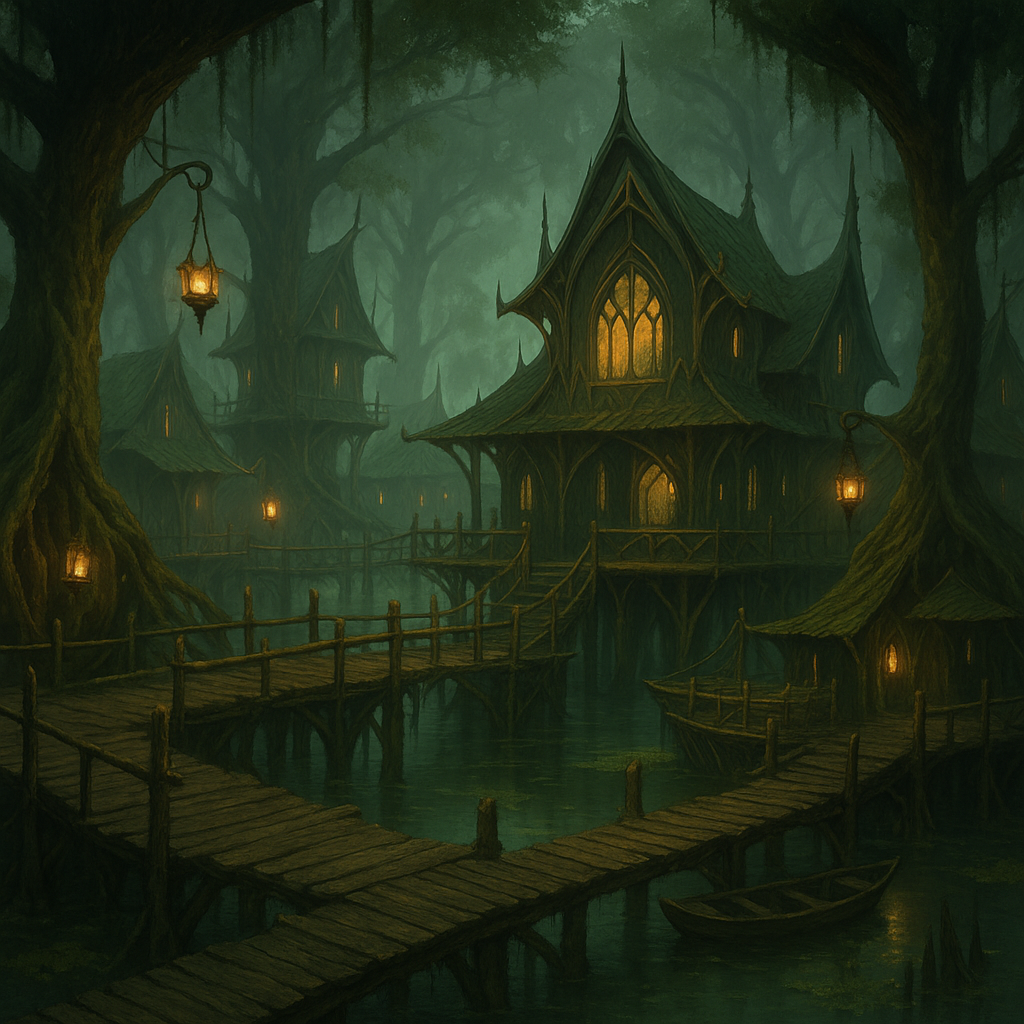
Kingdom of Asadhel ("AS-ADD-HELL")
The Kingdom of Asadhel is a tri-racial swamp–forest realm where elves, goblins, and orcs have formed an unlikely but enduring alliance within the dense Bogroot Timberlands. Elves dominate the elevated drylands and major cities, weaving their culture around stewardship of the misty forests and sacred lakes. Goblins control the watery lowlands, mastering the marshes through boatcraft, trade, and ingenious engineering that keeps the kingdom’s channels open. Orc communities thrive along the bog’s firmer edges, providing much of Asadhel’s food, hunting prowess, and agricultural stability. Together, these groups form a decentralized but cooperative society guided by the elvish Crown and the spiritual Keepers of Lanananeas.
Life in Asadhel revolves around balance—between land and water, races and roles, and the demands of survival within the ever-shifting wetlands. Villages and cities rise on wooden walkways, root-grown platforms, and natural ridges, blending seamlessly with the environment. The military excels in ambush tactics, swamp navigation, and naval maneuvers, making the kingdom difficult to invade and uniquely adapted to its terrain. Culturally rich and spiritually unified by reverence for the living land, Asadhel stands as a resilient, quietly powerful nation whose strength lies not in conquest, but in the harmony of its people and the marshlands they call home.
Structure
The Kingdom of Asadhel is ruled by an elvish monarch seated in Gafdonande, supported by the Council of Boughs, a small circle of high-elven advisers who oversee trade, waterways, agriculture, and forest–swamp stewardship. Beneath them operate the Marshwardens, regional commanders responsible for security, travel routes, and managing the difficult terrain of the Bogroot Timberlands. Goblin-controlled cities like Froi and Gneabrin maintain their own Clanhouses, granting them autonomy over fishing, commerce, and naval operations, while Orc villages are organized under Bogrim Tribal Councils that handle hunting rights, farmland, and local order.
At the local level, day-to-day governance is handled by Village Circles, small councils of elders chosen for experience and wisdom, regardless of race. Spiritual cohesion across the kingdom is maintained by the Keepers of Lanananeas, druids who tend the sacred lakes and mediate disputes between elves, goblins, and orcs. Together, these structures create a decentralized but cooperative government well-suited to the blended swamp–forest terrain and diverse populations of Asadhel.
Culture
The culture of Asadhel is shaped by its swamp–forest landscape, where elves, goblins, and orcs have learned to live in layered harmony. Elves value balance with the land, building cities on the dry rises and treating the wetlands as sacred, believing the mist carries ancestral memory. Their art and music often echo natural rhythms—dripping water, reed wind, and the calls of bog creatures. Goblins contribute a practical, adaptive spirit; their lowland life fosters craftsmanship in boats, traps, and water-based trade, making them indispensable to the kingdom’s economy. Orc communities emphasize honor, cooperation, and seasonal cycles, maintaining traditions of communal hunts and harvest feasts tied to the ebb and flow of the swamp.
Across all peoples, Asadhel’s culture celebrates coexistence with the wild. Festivals revolve around the lakes, with lantern-lit processions over walkways and floating platforms. Storytelling is central: elves recount myths of living waters, goblins share tales of clever survival, and orcs preserve heroic sagas of the marsh hunt. Magic is seen not as domination but negotiation—druids, wardens, and seers mediate between the needs of mortals and the moods of the land. This shared reverence for the Bogroot Timberlands binds the kingdom’s diverse races into a unified cultural identity.
Public Agenda
The Kingdom of Asadhel’s public agenda centers on preserving the delicate balance between its forest rises and swamp lowlands. Protecting waterways, maintaining clean passage through the bog routes, and safeguarding Lake Lanananeas are top priorities, as these sustain both the kingdom’s food supply and its spiritual heritage. The Crown also promotes unity among elves, goblins, and orcs by supporting shared festivals, trade agreements, and cooperative stewardship projects that strengthen inter-racial stability.
Externally, Asadhel aims to secure its borders without provoking conflict. The kingdom invests in diplomacy with neighboring states, regulates foreign access to its lakes and marsh routes, and maintains a defensive naval presence through its goblin ports. Its public message is one of cautious openness: Asadhel welcomes trade and knowledge exchange but remains vigilant in protecting its land, people, and the natural rhythms that define its identity.
Assets
Asadhel’s greatest assets stem from its unique geography. The kingdom controls extensive waterways—Lake Lanananeas, Lake Froth, and the surrounding marsh channels—which enable efficient travel, fishing, and trade. Its forests provide valuable hardwoods, alchemical plants, and rare swamp herbs coveted by healers and mages. Goblin-engineered boats and elvish-crafted platforms allow the kingdom to move people and resources through terrain that would cripple other nations. The combination of fertile bog-rims and forest clearings also gives Asadhel a steady supply of crops, game, fish, and medicinal flora.
Militarily and strategically, Asadhel benefits from natural defenses. Dense wetlands, shifting ground, and fog-laden forests make large-scale invasions nearly impossible without local guidance. Orc hunting bands and elvish marshwardens excel in this terrain, forming a highly adaptive defensive force. The goblin-controlled navy at Kleab provides rapid response capability through the lakes and rivers. Culturally, the kingdom’s greatest non-material asset is its unity—three races contributing different strengths to create a resilient, resource-rich, and strategically secure nation.
Demography and Population
The Kingdom of Asadhel is a tri-racial society dominated by elves, who make up roughly 60% of the population and inhabit the elevated forest rises and major cities such as Gafdonande, Syllemar, and Elrandesthei. Goblins, comprising about 25%, live primarily in the swamp lowlands and lake regions where their engineering and watercraft skills thrive, giving them strong influence in cities like Gneabrin, Froi, and the naval port of Kleab. Orcs represent around 15% of the kingdom’s population, residing mostly in the bog-rim villages where solid ground allows for hunting, farming, and close-knit tribal communities.
Population density follows the terrain: the drier forest islands support large urban centers of 10,000–19,000 residents, while the surrounding wetlands host smaller agricultural and fishing villages ranging from a few hundred to several thousand. The mixed ecology creates a patchwork of communities that depend on one another—elves provide governance and magical stewardship, goblins manage trade routes and naval strength, and orcs supply much of the kingdom’s food and labor force. The overall distribution reflects a stable, interdependent demographic structure shaped by the Bogroot Timberlands.
Military
Asadhel’s military is highly adaptive to swamp–forest combat and built around three cooperating racial forces. Elvish Marshwardens form the strategic core: stealth-focused rangers, druids, and wardens who navigate the Bogroot Timberlands with unmatched precision. They specialize in ambush tactics, camouflage magic, and controlling terrain through roots, mist, and wildlife. Goblin naval units provide mobility and rapid deployment, operating shallow-draft boats and reedcraft that move effortlessly through lakes and water channels. Their flotillas at Kleab form the backbone of Asadhel’s defensive navy, patrolling trade routes and responding quickly to threats along the kingdom’s waterways.
On land, Orc bog-riders and hunt-clans serve as Asadhel’s shock troops. Skilled in close-quarters combat and marshland traversal, they excel at holding choke points and countering monster threats that emerge from deeper swamps. All three forces train jointly, allowing for flexible mixed-unit operations where elves guide terrain strategy, goblins manage movement and logistics, and orcs deliver decisive force. This combined-arms approach—supported by natural defenses like fog, dense foliage, and shifting wetlands—makes Asadhel exceptionally difficult to invade and ensures the kingdom’s military remains one of adaptation, precision, and environmental mastery.
Technological Level
Asadhel’s technological level centers on environmentally integrated innovation, blending elvish craftsmanship with goblin engineering and practical orcish mechanics. Elves excel in bio-architecture, creating elevated walkways, reinforced tree structures, and naturally grown platforms that function as buildings and bridges. Their scientific focus leans toward herbal alchemy, swamp ecology, and druidic geomancy, allowing them to manipulate plant growth, stabilize wet ground, and purify marsh waters. Goblins contribute practical technologies suited to wetland life—lightweight boats, waterwheel mechanisms, clever pulley systems, and durable marsh tools—advancing the kingdom’s transport and trade infrastructure.
While Asadhel does not pursue heavy industry, its scientific knowledge of ecosystems, medicinal plants, and water control surpasses most nations. Orcs strengthen this with efficient farming techniques adapted to bog-rim soils, developing tools and cultivation methods suited to shifting terrain. Magic and science intertwine seamlessly: mapping the tides of swamp fog, predicting seasonal floods, and brewing complex reagents for healing or defense. As a result, Asadhel’s technological level is not metallic or mechanical but organic, adaptive, and specialized—perfectly suited to life within the Bogroot Timberlands.
Religion
Religion in Asadhel is centered on reverence for the land itself, rather than devotion to singular deities. Elves, goblins, and orcs alike believe the Bogroot Timberlands are alive with ancient spirits—manifest in the mists, waters, roots, and shifting wetlands. The most honored of these spirits is the Heart of Lanananeas, the guardian presence believed to dwell within the great lake at Gafdonande. Rather than temples, worship takes place at natural sites: reed circles, old tree hollows, moss-carved stones, and lakeside platforms. Druids of the Keepers of Lanananeas serve as mediators between people and land, interpreting omens from ripples, fog patterns, and wildlife behavior.
Each race expresses this shared belief in its own way. Elves focus on harmony and stewardship, offering songs and crafted charms to honor the spirits. Goblins practice practical rites tied to fishing, travel, and safe passage through the marsh, leaving offerings along water routes. Orcs emphasize ancestral reverence, believing their honored dead join the swamp spirits and guide hunts and harvests. Despite varied traditions, all faiths in Asadhel recognize the same truth: the land watches, remembers, and gives life—and must be respected in return.
Laws
Asadhel’s legal system is grounded in restorative justice and environmental stewardship, reflecting the belief that harm done to a person or the land must be repaired rather than merely punished. Most disputes—whether between elves, goblins, or orcs—are settled by local Village Circles, which focus on compensation, community service, and reconciliation. Damaging wetlands, polluting waterways, or overharvesting sacred groves are considered serious offenses, often requiring long-term restitution under the guidance of the Keepers of Lanananeas. Because travel through the swamp is dangerous, laws also mandate shared responsibility for safety along major routes, with harsh penalties for ambushing or misleading travelers.
Crimes that threaten the stability of the kingdom—treason, large-scale theft, necromancy, or violent rebellion—are judged directly by the Crown or Marshwardens. Even then, executions are rare; exile into the deep, unclaimed bogs is considered a far more fitting fate, leaving offenders to the judgment of the swamp itself. Across all races, Asadhel’s laws emphasize cooperation, respect for the land, and the preservation of delicate balance within the Bogroot Timberlands.
Agriculture & Industry
Agriculture in Asadhel is shaped by the swamp–forest terrain, relying on bog-rim farming, raised bed cultivation, and selective harvesting of marsh plants. Orc villages provide much of the kingdom’s staple crops—root vegetables, hardy grains, and swamp rice—grown on elevated soil mounds that resist flooding. Elvish settlements cultivate fruit-bearing canopy orchards and medicinal herbs, while fishing villages like Nilkeh supply abundant lake fish and wetland game. Wild foraging is a respected tradition, yielding mushrooms, mosses, and rare alchemical plants unique to the Bogroot Timberlands.
Industry focuses on light, terrain-adapted production rather than heavy manufacture. Goblins excel in boatbuilding, ropework, tanning, and crafting durable tools suited for damp environments, supporting Asadhel’s extensive waterway trade. Elves specialize in fine woodcraft, woven goods, alchemical reagents, and bio-architecture—structures grown or shaped from living materials. Orc clans contribute leatherworking, hunting supplies, and preserved foods essential for travel. Together, these industries form a resilient, eco-integrated economy that thrives without disrupting the land’s natural balance.
Trade & Transport
Trade in Asadhel flows primarily along its lakes and marsh channels, making waterborne commerce the backbone of the kingdom’s economy. Goblin port cities like Kleab and Gneabrin handle the bulk of imports and exports, moving goods such as medicinal herbs, hardwoods, fish, woven elvish crafts, and alchemical reagents. Inland, elvish markets specialize in high-quality goods—canopy fruits, enchanted woodwork, and refined reagents—while orc villages contribute grain, hides, and preserved foods. Because roads through the swamp are unreliable, trade routes are carefully maintained by Marshwardens and require cooperation from all three races to remain safe and navigable.
Transport relies on shallow-draft boats, reed barges, and elevated walkways that connect major settlements without disturbing the wetlands. Goblin engineers build agile watercraft ideal for maneuvering through reed-forests, while elvish bio-structures form bridges and resting platforms along common routes. Long-distance travelers often move by water, guided by guilds familiar with shifting currents and seasonal floods. This system of fluid, interconnected waterways allows Asadhel to move people and goods efficiently through terrain that outsiders find impenetrable, reinforcing the kingdom’s control over regional trade.
Education
Education in Asadhel is largely informal and community-based, shaped by practical needs rather than structured academies. Most learning takes place within families, tribes, or village circles, where skills like hunting, fishing, herbcraft, farming, and boat handling are passed down through generations. Elves tend to have the strongest traditions of literacy and recordkeeping, but even they focus more on oral storytelling and practical magic than formal scholarship. Goblins learn trades through apprenticeships in boatbuilding, trapping, and marsh engineering, while Orcs emphasize physical skills, survival knowledge, and communal responsibilities.
There are no major universities in Asadhel; instead, the closest equivalent are the Keeper Lodges, small druidic circles where promising individuals are taught swamp lore, spiritual customs, and environmental stewardship. Access to these teachings is limited, contributing to the kingdom’s overall lower formal education level compared to neighboring nations. Despite this, Asadhel’s people possess deep practical knowledge of the Bogroot Timberlands, making them exceptionally skilled in navigating and surviving their environment—even if traditional academic education is rare.
Infrastructure
Infrastructure in Asadhel is shaped by necessity rather than grand design, relying on lightweight, terrain-adapted construction instead of heavy permanent roads or stoneworks. Elevated wooden walkways, vine-bound bridges, and root-supported platforms connect many settlements, keeping travel above unstable marsh ground. Waterways serve as the kingdom’s true highways—maintained by goblin engineers who clear channels, reinforce banks, and build reed docks for transport and fishing. Most settlements, especially villages, are modest in scale, relying on local materials like hardwood, reeds, and woven moss rather than imported stone or metal.
Public works are minimal but purposeful. Watchposts, spirit markers, and shallow beacon towers guide travelers through fog-prone wetlands, while communal longhouses double as meeting halls, storage facilities, and storm shelters. Larger cities such as Gafdonande boast more durable structures, often grown or shaped using elvish bio-crafting, but even these blend seamlessly with the environment. Asadhel’s infrastructure prioritizes function, subtlety, and harmony with the land, allowing the kingdom to operate effectively despite its challenging swamp terrain.
Mythology & Lore
Asadhel’s mythology centers on the belief that the Bogroot Timberlands are alive with ancient consciousness, born from the union of water, mist, and forest. The most revered figure is the Heart of Lanananeas, a primordial spirit said to dwell within the capital’s great lake. Legends claim it shaped the first elves from drifting starlight reflected on its waters, taught goblins the ways of the marsh currents, and granted orcs the strength to hunt and farm along the bog’s edges. Many tales describe the land responding to mortal deeds—the mist thickening in warning, roots shifting to protect the innocent, or waters swallowing the cruel.
Myths often revolve around travelers encountering mysterious creatures or receiving guidance from spirits hidden in fog or hollow trees. Elves recount stories of Mistwalkers, benevolent beings who appear during moonlit floods. Goblins tell of clever water spirits who reward or punish marsh-sailors based on respect for the currents, while Orc tales honor Ancestor-Bound Hunters who rise from the reeds to defend their kin. Though each race imagines these beings differently, all believe the swamp remembers every story and that harmony with the land is both a blessing and a responsibility.
Divine Origins
Asadhel is believed to have formed when early elvish clans settled around Lake Lanananeas, drawn by its unusually fertile shores and the strange, guiding presence said to emanate from its depths. These clans built the first elevated settlements on the dry forest rises, gradually unifying under a single monarch once they realized the surrounding marshlands offered natural protection from outside threats. Over time, migrating goblin groups arrived through the waterways, their skill with boats and marshcraft making them invaluable allies. The elves granted them autonomy along the lowlands, and their cooperation strengthened the region’s stability.
The kingdom fully took shape when orc tribes, displaced from harsher territories, sought refuge along the bog’s outer edges. Instead of conflict, the elves recognized their strength and agricultural knowledge, integrating them as essential stewards of the swamp’s borderlands. This unlikely alliance—elves of the high roots, goblins of the waters, and orcs of the bog-rim—formed the cultural and political foundation of Asadhel. United by the challenging landscape and the shared belief that the land itself was alive, they built a kingdom defined by cooperation, adaptation, and respect for the Bogroot Timberlands.
Tenets of Faith
The faith of Asadhel is not bound to strict doctrine, but several shared tenets guide the spiritual lives of elves, goblins, and orcs alike. The first is Reverence for the Living Land — the belief that the swamp–forest is a conscious presence deserving respect. Followers must avoid needless harm to the waters, trees, or wildlife, as all are considered extensions of the land’s spirit. The second tenet is Balance Above All, emphasizing that every action—hunting, harvesting, building—must be done in proportion to what the land can give. A third tenet, Honor the Ancestral Echo, teaches that the spirits of the dead linger in the mist and roots, watching over their descendants.
A fourth core tenet is The Swamp Remembers, reminding believers that wrongdoing cannot be hidden from the land’s memory; justice will eventually flow back to the wrongdoer. The final tenet, Walk With Care, encourages humility, patience, and awareness—virtues necessary to survive both the physical dangers of the Bogroot Timberlands and the mysteries of its spirit world. Though expressed differently among races, these shared tenets form the spiritual glue that unites Asadhel’s diverse peoples.
Ethics
Ethical life in Asadhel revolves around the principle of interdependence—the understanding that survival in the Bogroot Timberlands depends on cooperation between people and harmony with the land. Actions are judged not just by intent but by their impact on the broader community and environment. Wastefulness, unnecessary violence, or disrupting the natural balance is seen as deeply unethical, while generosity, resourcefulness, and restraint are considered marks of good character. Because the swamp can be perilous, honesty and reliability are highly valued, particularly among travelers and traders who depend on each other's guidance to navigate shifting waters and fog.
Within social relationships, the highest ethical expectation is reciprocity. Elves emphasize fairness and mutual respect, goblins value ingenuity balanced with responsibility, and orcs stress honoring commitments and protecting the vulnerable. Deceit that endangers others—such as giving false directions in the marsh or withholding warnings about dangers—is treated as a grave moral failing. Overall, Asadhel’s ethics encourage individuals to act with awareness, humility, and care, aligning personal behavior with the well-being of their neighbors and the land that sustains them.
Worship
Worship in Asadhel is quiet, reverent, and deeply tied to the natural world. Instead of temples or grand rituals, most devotion takes place at living shrines—ancient trees, reed circles, lake stones, or mist-covered clearings where the presence of the land’s spirit feels strongest. Offerings are simple and symbolic: woven charms, flowers, polished stones, or small portions of a hunt or harvest. Dawn and dusk are the most sacred times of day, when the light over the swamp shifts subtly and believers pause to give thanks for safe passage, steady waters, and the protection of ancestral spirits.
The Keepers of Lanananeas guide public ceremonies during seasonal changes, performing blessings for planting, safe travel, or the calming of storms. Goblins often place floating lanterns on the water to honor marsh spirits, while Orcs hold night vigils around communal fires where stories of ancestors are shared. Elves tend to sing or whisper prayers directly into the mist, believing it carries their words to the Heart of Lanananeas. Worship in Asadhel is unified by one theme: honoring the living land and acknowledging the unseen forces that shape its rhythms.
Priesthood
Asadhel’s closest equivalent to a priesthood is the Keepers of Lanananeas, a decentralized order of druids, seers, and marsh-guides who serve as interpreters of the land’s will. They do not hold political power, but their wisdom is widely respected, and they act as mediators, healers, and spiritual advisors across elvish, goblin, and orc communities. Keepers are chosen not by lineage but by signs of affinity with the swamp—unusual awareness, dream-visions, or the ability to calm wildlife or read the patterns of mist and water.
Each village or city typically hosts one or two Keepers who perform blessings, read omens, and oversee seasonal rituals tied to planting, storms, or safe travel. In rare cases, senior Keepers gather at the capital’s lakeside sanctum to interpret major signs or advise the Crown on matters that may affect the land’s balance. Though not a strict priesthood, the Keepers serve as the kingdom’s spiritual backbone, unifying its diverse peoples through shared reverence for the Bogroot Timberlands.
Granted Divine Powers
In Asadhel, divine power is not granted by deities but by the living spirit of the Bogroot Timberlands itself. Those who earn the land’s favor—usually Keepers or individuals with deep harmony to the swamp—may receive small but genuine supernatural abilities. These manifest as blessings rather than spells: the ability to calm hostile wildlife, sense changes in water currents, briefly clear fog to reveal safe paths, or coax plants to grow in difficult soil. Such powers are never dramatic or destructive; they reinforce Asadhel’s belief that divine gifts must sustain life, not dominate it.
These blessings are unpredictable and cannot be demanded. Some Orc hunters claim their ancestors guide their steps in dangerous marshes, while Goblin marsh-guides sometimes experience sudden intuition that steers boats away from unseen hazards. Elves most commonly demonstrate subtle abilities tied to perception, healing, or communication with the land. While outsiders may view these as magic rather than divine power, the people of Asadhel see no difference—the land remembers, the spirits watch, and occasionally, they reach out to assist those who honor them.
Political Influence & Intrigue
Political intrigue in Asadhel centers on the delicate balance of power between elves, goblins, and orcs—three groups with different priorities, territories, and relationships to the land. Elvish nobles of the Council of Boughs often compete quietly for influence over trade routes, forest preserves, or Keeper endorsements, while goblin Clanhouses maneuver to expand their control of lucrative waterways and naval operations. Orc tribal leaders occasionally pressure the Crown for expanded farmland or greater autonomy, leading to subtle tensions between dryland and lowland communities. Though open conflict is rare, political disagreements often manifest through resource allocation, route access, or disputes mediated by the Keepers of Lanananeas.
Externally, Asadhel wields influence through control of strategic lakes and marsh channels that neighboring nations depend on for trade. While the kingdom avoids overt aggression, it uses its terrain expertise and naval positioning to negotiate favorable agreements and maintain independence. Foreign powers sometimes seek alliances with individual Clanhouses or tribal councils to sway internal politics, creating a constant undercurrent of quiet manipulation. This complex web of competing interests—tempered by shared reverence for the land—keeps Asadhel stable yet perpetually engaged in subtle political maneuvering.
Sects
Though Asadhel lacks formalized religion, several spiritual sects have emerged around different interpretations of the land’s will. The most respected is the Circle of Still Waters, a Keeper-aligned sect that teaches patience, reflection, and harmony with the swamp’s natural rhythms; its followers include many elves and a number of goblin marsh-guides. The Reedcallers, a goblin-led sect, focus on practical communion with water currents and storms, claiming the swamp speaks through tides and wind. Meanwhile, the Ancestor-Tide sect among orcs honors the spirits of the dead who they believe linger in the bog’s mists, guiding hunts and protecting tribes.
More mysterious are the Deeproot Whisperers, a secretive group of elves and a few keepers who claim to hear faint voices in the land’s oldest trees—often dismissed as eccentric but quietly influential. Opposing them in philosophy, though not openly hostile, are the Fogwalkers, wanderers who believe truth is found only in the ever-changing nature of the swamp, embracing unpredictability over structure. These sects coexist peacefully, their differences reflecting the diverse ways Asadhel’s people interpret the same living landscape.


Comments