
Kharukt ("K-harr-oo-k-t")
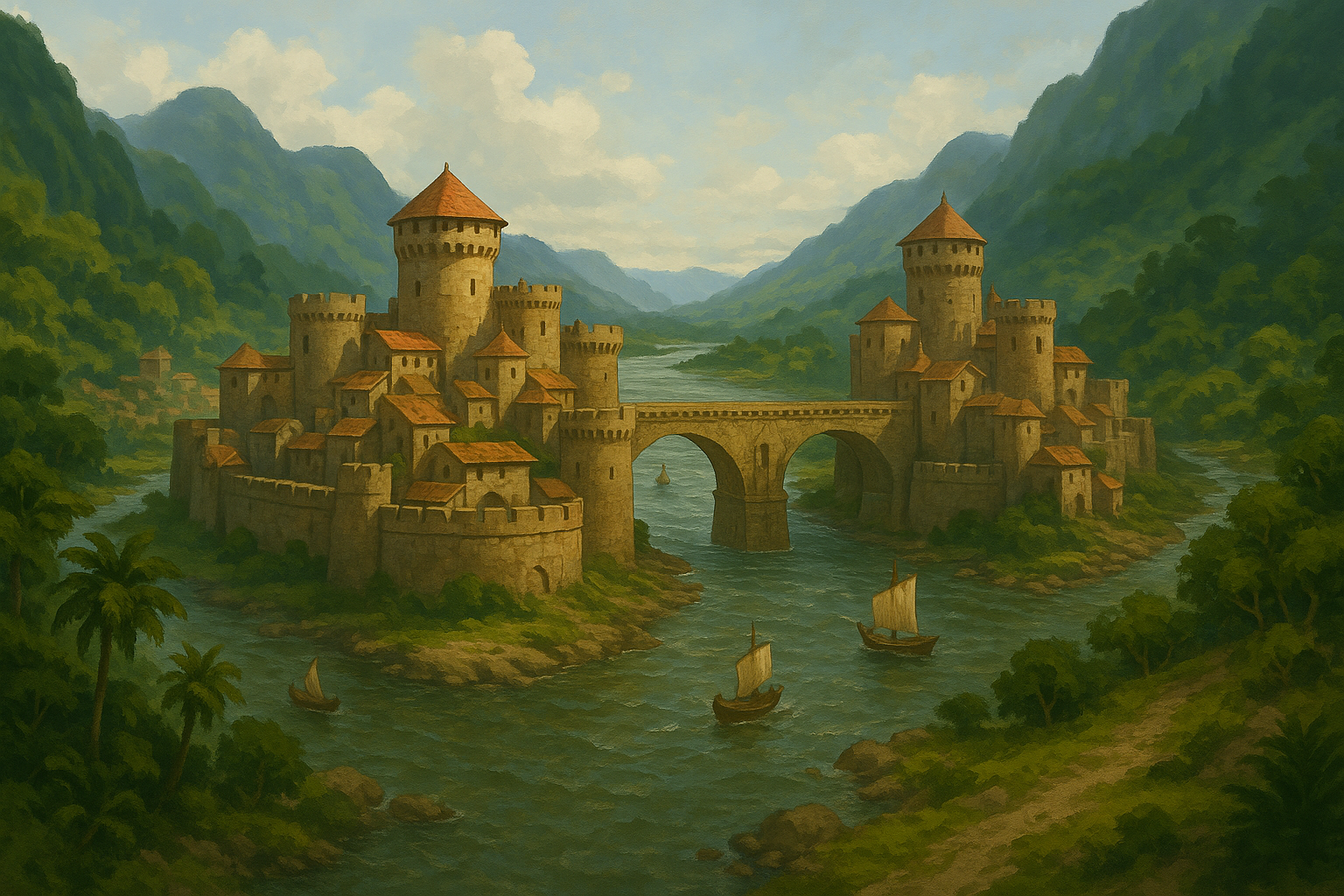
Kharukt is a tropical river-kingdom shaped by dense jungles, warm coastal tides, and the immense waterway carved in myth by Semuanya Himself. Lizardfolk make up the heart of the population, joined by Tortles along the coast, vibrant Tabaxi in the canopy cities, Humans in trade hubs, and Goblins in swamp-engineer enclaves. The nation’s settlements cling to rivers, deltas, and elevated jungle structures, their architecture adapted to monsoons, flooding, and lush vegetation. Governance flows through the Sovereign Tideclaw and the River Conclave, an alliance of racial leaders whose authority reflects the land’s ecological balance. Kharukt’s identity is unified by the Triune Cycle—the worship of Semuanya, Atu-Moro, and Ishra—whose teachings guide survival, patience, and instinct across every aspect of life.
Resilient yet fluid, Kharukt thrives through environmental mastery rather than empire-building. Its river legions, canopy scouts, and amphibious fleets make foreign invasion nearly impossible, while its industries—shipcraft, herbal medicine, jungle textiles, and river-agriculture—anchor regional trade. Diplomatically, Kharukt maintains selective openness with neighbors like Cales, Pepji, and Masheš, using its strategic waterways as leverage. Internally, a shifting dance of clans, priesthoods, and sects influences politics, creating a society where spiritual philosophy and pragmatic survival intertwine seamlessly. Kharukt endures as a kingdom defined not by conquest but by harmony—between river, jungle, tide, and the diverse peoples who depend on them.
Structure
The governance of Kharukt is centered around the Sovereign Tideclaw, a hereditary Lizardfolk ruler chosen through a ritual of endurance, wisdom, and spiritual communion with the great rivers that shape the nation. Though the Tideclaw holds absolute authority in matters of warfare, law, and territorial stewardship, power is balanced by the River Conclave, a council composed of representatives from all major races: Tortle navigators, Tabaxi jungle wardens, Human trade magistrates, and Goblin engineers. Each member of the Conclave oversees one domain of the nation—coastal affairs, jungle preservation, trade regulation, agricultural management, and military logistics—ensuring the governance reflects the diversity of Kharukt’s people and environments. While the Lizardfolk occupy most high offices, other races wield meaningful influence, creating a dynamic leadership model built on cooperation, respect, and shared survival in a land of dense jungles and unpredictable monsoons.
Local governance flows down into Clanships, semi-autonomous regional groups based on geography and racial composition. Coastal settlements like Shal’Korra and Shellreach Haven are ruled by Tideclan Elders—often Tortles or veteran Lizardfolk—who manage ports, fishing rights, and maritime defense. Inland jungle cities such as Treetrail Canopy and Vassh-Kelra rely on Canopy Chieftains and River-Marshal Wardens, leaders chosen for their ability to navigate the dense forests, command scouts, and maintain harmony between jungle tribes. Reedhollow Crossing, with its human majority, operates under a Trade Steward, responsible for the taxation of exports, distribution of rice yields, and negotiation of treaties with neighboring countries. Goblin communities like Sunkenroot Enclave maintain their own Tinker Councils, focusing on engineering, watercraft maintenance, and swamp fortifications. Together, these local bodies create a well-coordinated system in which each region governs itself according to its environment while remaining united under the Tideclaw’s overarching rule.
Culture
The culture of Kharukt is shaped by its tropical jungles, vast coastlines, and the massive river that divides the land, resulting in a society that sees water as both lifeblood and spiritual guide. Lizardfolk traditions dominate public life, emphasizing resilience, ancestral reverence, and harmony with the rhythms of tide and monsoon. Communities build homes on stilts, weave canal networks through dense jungle, and decorate structures with carved river-spirits and vibrant shell mosaics. Tortle influence brings an air of patience, contemplation, and maritime wisdom; coastal towns host long evenings of storytelling, tide-reading, and clan feasts held beside bioluminescent surf. Tabaxi culture adds vibrancy and movement—drums echo through the canopy during festivals, dancers mimic jungle creatures, and painted cloth banners flow like rippling river light. Humans, ever adaptive, blend elements of all groups, contributing the kingdom’s writing systems, market customs, and interregional trade etiquette.
Daily life in Kharukt is communal and deeply tied to nature. Jungle paths are sacred spaces, marked by hanging charms or carved stone to honor predators, ancestors, and the spirits believed to dwell in rainstorms and deep forest pools. The people value agility, craftsmanship, and environmental awareness—children learn to swim before they learn to walk, climb before they can run, and track jungle trails before they wield tools. Music is pervasive, featuring water drums, reed flutes, wooden clappers, and shell chimes that resonate during rituals, hunts, and seasonal tides. While the races vary in temperament, the culture prizes balance: the calm wisdom of Tortles, the fierce discipline of Lizardfolk, the curiosity of Humans, the energetic creativity of Tabaxi, and the clever ingenuity of Goblins. Together, they create a society that thrives amid humidity, stormlight, and tangled vegetation—a vibrant, living tapestry woven from both tradition and adaptation.
Public Agenda
The public agenda of Kharukt centers on preserving its waterways, expanding jungle stability, and strengthening coastal defenses. Because the nation’s lifeblood is the massive river that cuts it in half and the warm coastal seas that border it, the government prioritizes maintaining clear trade channels, healthy mangrove ecosystems, and safe travel routes through both jungle and delta. Controlling the river means controlling the nation’s food supply, military mobility, and communication—so funding goes heavily into watercraft construction, canal maintenance, flood management, and sacred river rituals overseen by the Tideclaw and the River Conclave. Another key initiative is the protection of jungle resources: strict anti-poaching regulations, replanting efforts, and stewardship programs ensure that the rainforest remains abundant enough to sustain Tabaxi hunters, Human farmers, and Goblin tinker communities alike. Stability in the deep jungle is upheld through agreements between Canopy Chieftains and River-Marshal Wardens, all of whom enforce the principle that “the jungle provides if the jungle is respected.”
Externally, Kharukt seeks to strengthen its position as a maritime and river-trade mediator, using its strategic coastal ports and central river corridor to connect inland nations with the open sea. The government actively promotes diplomacy with Cales, Pepji, and Masheš to ensure steady flow of goods, knowledge, and seasonal labor. At the same time, Kharukt works to deter exploitation by foreign states that may covet its timber, medicinal plants, and exotic jungle fauna. Balancing openness with caution is a central tenet of the nation’s agenda. Internally, the Sovereign Tideclaw pushes for racial cohesion programs that blend Lizardfolk discipline, Tortle wisdom, Tabaxi creativity, Human versatility, and Goblin engineering into unified projects—such as floodwall construction, root-bridge expansion, and joint cultural festivals. Overall, the kingdom’s agenda aims to fortify its natural resources, reinforce its spiritual connection to water and jungle, and position itself as a thriving, indispensable power in the tropical south.
Assets
Kharukt’s greatest assets lie in its natural environment, a lush expanse of tropical rainforest, fertile riverbanks, and warm coastal waters that produce abundant resources year-round. The central river provides fish, clean water, transportation, and fertile silt ideal for rice, fruit, and reed cultivation. Its mangrove-lined delta is rich in medicinal plants, rare orchids, and hardwoods prized for shipbuilding and ceremonial crafts. The jungles teem with exotic animals, vibrant dyes, aromatic herbs, and unique minerals found only in the humid undergrowth—materials harvested carefully through sustainable clan systems. Tortle shipwrights along the northern coast produce slow but nearly indestructible vessels made from salt-hardened timber and shell composites, while Lizardfolk communities are renowned for their amphibious armor forged from riverstone and scaled lacquers. Deep within the forest, Tabaxi artisans trade brightly dyed cloths, jungle spices, and carved totems, and Goblin tinkerers create ingenious water-driven mechanisms, traps, and paddlecraft that enhance both daily life and military readiness.
Equally valuable is Kharukt’s strategic position as a bridge between inland trade networks and the open sea. Its ports at Shal’Korra and Shellreach Haven serve as major hubs for timber, spices, fish, medicinal goods, and river-crafted tools flowing outward, while foreign merchants bring steel, cloth, and knowledge in return. Controlling the central river grants Kharukt influence over regional trade routes—an advantage further strengthened by its amphibious forces and deep cultural knowledge of jungle navigation. The kingdom also possesses a significant cultural asset: its people. The disciplined Lizardfolk, wise Tortles, swift Tabaxi, versatile Humans, and inventive Goblins create a society that excels in craftsmanship, exploration, and adaptability. These racial strengths form a cohesive national identity grounded in resilience, cooperation, and reverence for nature. Together, Kharukt’s environmental wealth, diverse labor force, and trade dominance position it as a flourishing and strategically irreplaceable power in the tropical south.
Demography and Population
With a population of roughly 60,000 inhabitants, Kharukt is a vibrant, multi-racial society shaped by the rhythms of its tropical jungles and the great river that divides the land. Lizardfolk make up the largest share at about 45%, forming the backbone of the kingdom’s leadership, military, and river-guardian castes. Their settlements cluster along wetlands, marsh fortresses, and water-carved stone outposts. Tortles account for about 20%, primarily inhabiting the northern coastline and river deltas, where they serve as shipwrights, navigators, herbalists, and village sages. Tabaxi represent around 15%, thriving in the high canopy cities and scattered jungle hunting grounds, contributing energy, artistry, and unparalleled agility to the nation’s cultural fabric. Humans comprise another 15%, largely occupying fertile river settlements, trade hubs, and administrative posts that connect Kharukt to neighboring realms.
Goblins make up the remaining 5%, living in dense swamps or clustered work districts within larger settlements—ingenious problem-solvers who build traps, waterwheels, and experimental paddlecraft used throughout the kingdom. Population density is strongly tied to environment: the majority live along the central river corridor, which provides transport, fertile soil, and food security. Inland jungle populations are more diffuse, residing in elevated canopy towns or hidden enclaves protected by thick vegetation. Coastal populations, dominated by Tortles and mixed communities, enjoy stable food access from fishing and tidal farming. This demographic balance creates a society rich in cultural diversity: disciplined Lizardfolk governance, Tortle wisdom traditions, Tabaxi agility and creativity, Human adaptability, and Goblin ingenuity all blend into a single national identity. Despite disparate origins, the people of Kharukt are unified by waterways, jungle trails, and a shared reverence for nature’s unbroken cycles.
Territories
Kharukt spans a lush stretch of tropical lowland rainforest bordered by warm northern seas and shaped by a massive river that cuts the kingdom from east to west. The northern coastline is lined with mangrove forests, tidal flats, coral shelves, and sandy coves, where Tortle communities thrive as fishermen, sailors, and tide-readers. Inland, the land rises gently into dense, humid jungles filled with towering kapok trees, strangler vines, bromeliad-covered branches, and animal life so abundant that every canopy seems alive with motion. This central jungle is pierced only by ancient Lizardfolk stone causeways and winding Tabaxi hunting trails. The great river—wide, slow-moving, and sacred—serves as the kingdom’s spine, connecting coastal ports with deep-jungle settlements and carrying silt that feeds the farmland around Reedhollow Crossing.
To the south and southeast, the rainforest thickens into swampy lowlands, a maze of wetlands, flooded basins, and misty peat marshes where Goblin enclaves and Lizardfolk spiritual sites are hidden beneath dripping foliage. Natural boundaries—tangled root systems, steep ravines, and river-islands—act as defensive barriers as effective as any fortress wall. Rainfall is heavy and seasonal; monsoons transform riverbanks into flooded plains and refill sacred pools that sustain wildlife. The geography of Kharukt forces every settlement to adapt: canopy cities lifted high above the jungle floor, coastal towns built on stilts, river fortresses anchored half in the water, and swamp villages woven into the living roots of ancient trees. Together, these environments define a kingdom where water, jungle, and coastline merge into one powerful and living territory, fiercely protected and deeply revered by its people.
Military
The military of Kharukt is built around its strength as a river and jungle civilization, relying on amphibious warfare, stealth, and environmental mastery rather than heavy armor or large armies. The backbone of its forces is the Lizardfolk River Legions—disciplined amphibious soldiers trained to fight in water, marsh, and dense undergrowth. These troops wield barbed spears, shell-backed shields, and obsidian-edged weapons designed for swift strikes and grappling in murky terrain. They are supported by Tortle Tide-Guards, slow but nearly unbreakable frontline defenders who form unyielding walls during sieges or river-landings. Tabaxi serve as the military’s jungle scouts, runners, and ambush specialists, navigating tree canopies, tracing enemy movement, and launching precision strikes from above. Human auxiliaries operate supply lines, river barges, and long-range archery units, while Goblin engineers maintain water traps, rope bridges, crude explosives, and paddlecraft.
Kharukt’s greatest strategic strength is its control of the central river and its mastery of jungle terrain. The Riverfleet, composed of wide canoes, reinforced reed-boats, and Tortle-crafted shell vessels, moves troops swiftly along waterways, allowing the military to respond to threats anywhere in the kingdom within days. Hidden river gates, submerged barricades, and flooded kill-zones make invasion nearly impossible for unprepared foreign armies. Jungle warfare is executed through hit-and-fade tactics, environmental traps, and coordinated ambushes that manipulate visibility, noise, and terrain. During monsoon season, elite Stormcaller units—Lizardfolk warriors trained in ritual combat—use the chaos of rain and flooding to launch bold assaults that outsiders find terrifying. While Kharukt does not field massive armies, its forces wield unparalleled mobility, adaptability, and environmental control, making the kingdom’s jungles and waterways into weapons as much as any spear or blade.
Technological Level
Kharukt’s technological development is shaped by its rainforest environment, abundant waterways, and amphibious population, resulting in innovations tailored to survival and efficiency in humid, unpredictable terrain. Lizardfolk engineers specialize in hydraulics, water management, and river fortification, constructing stone weirs, tide-gates, and flood channels that move seamlessly with seasonal monsoons. Their architecture uses claystone, woven reeds, and lacquered scales to create buildings resistant to moisture and rot. Tortles contribute maritime expertise: they craft durable shell-infused hulls, water-tight canoe designs, and tide-measuring instruments that predict seasonal floods with remarkable accuracy. Tabaxi knowledge expands into aerial and arboreal engineering, designing rope bridges, canopy platforms, and elevated pathways that allow entire communities to move above the jungle floor. Goblins, ingenious and chaotic, drive mechanical innovation—experimenting with waterwheels, steam-paddles, crude pressure devices, and jungle traps that blend engineering with guerrilla defense.
In the sciences, Kharukt excels in botany, zoology, meteorology, and herbal medicine, all driven by the biodiversity of its rainforest. Tortle herbalists and Lizardfolk shamans maintain extensive archives of medicinal plants, antivenoms, fungal treatments, and healing resins harvested from deep jungle groves. Tabaxi hunters study animal behavior and tracking patterns, contributing to an advanced understanding of ecology and predator dynamics. Humans serve as record-keepers, mapmakers, and agricultural experimenters, developing rice variants, river crops, and terraced planting techniques adapted to flooding cycles. Kharukt’s knowledge of weather patterns is unparalleled—monsoon prediction, tide mapping, and humidity-based agriculture allow the kingdom to thrive where others would fail. Although lacking in heavy metallurgy or arcane academia, Kharukt’s technology is practical, adaptive, and deeply in harmony with the environment, achieving sophistication through balance with nature rather than dominance over it.
Religion
Religion in Kharukt centers on the Triune Cycle, a spiritual tradition that venerates three primal forces believed to govern the rhythms of jungle, river, and sea. The primary deity is Ssa’thel the Flowing Serpent, spirit of rivers, rain cycles, and renewal, revered most strongly by Lizardfolk who trace their ancestral origins to her sacred waters. She is depicted as a great serpent coiling through the land, her movements shaping tributaries and her breath calling the monsoon clouds. Along the coast, Tortles worship Atu-Moro the Shelled Horizon, a calm, ancient god tied to tides, deep ocean wisdom, long journeys, and patience; his shrines are adorned with spiraled shells, salt stones, and driftwood carvings. Tabaxi hunters and canopy dwellers revere Ishra the Sun-Prowler, a radiant feline deity of agility, passion, instinct, and jungle vitality. Each deity represents one domain of life, but all three are believed to operate in a cyclical balance: water nourishes the jungle, the jungle feeds the coast, and the coast returns storms and tides that replenish the rivers.
Worship in Kharukt is communal and deeply tied to nature. Shrines are rarely buildings—most are river pools, hollowed roots, stone circles, tide markers, or canopy altars where offerings of fruit, woven charms, or water are made. Rituals follow environmental rhythms: river-blessing festivals at the start of monsoon season, sun-chase dances performed by Tabaxi during high summer, and tide-listening vigils conducted by Tortle priests before major voyages. Humans and Goblins adapt these traditions into blended, practical forms of devotion, often thanking spirits for safe travel, successful harvests, or protection from predators. Priesthood roles vary by region but share the common duty of maintaining harmony between people and environment. Above all, the faith of Kharukt teaches that life thrives only when river, jungle, and sea remain in balance, and that disrupting nature’s cycle invites both spiritual and ecological catastrophe.
Laws
The legal system of Kharukt is built around the Doctrine of the Three Currents, a set of foundational principles drawn from river, jungle, and tide—each representing one aspect of order. Laws tied to the River Current focus on survival, coexistence, and the protection of shared resources; crimes such as polluting waterways, overfishing, or obstructing trade routes are treated as severe offenses, punishable by heavy restitution or enforced service in river-cleansing brigades. The Jungle Current governs personal conduct, territorial boundaries, and inter-species respect. Violence, theft, or violating sacred jungle grounds is met with restorative justice overseen by Canopy Chieftains or River-Marshal Wardens, who ensure balance is restored rather than merely punishing offenders. The Tide Current, tied to the coast, regulates trade, foreign relations, and maritime activity—unauthorized foreign docking, smuggling, or tampering with tide markers is met with swift retribution from Tortle Tide-Guards and Lizardfolk River Legions. Through this tripartite system, laws are not abstract codes but living principles that bind every race to nature’s cycle.
Local enforcement aligns with the region’s racial strengths. Lizardfolk adjudicators handle disputes related to water rights, military violations, or ancient customs; their rulings emphasize discipline, honor, and proportional consequences. Tortle legal keepers oversee maritime law, trade negotiations, and border incidents with calm impartiality. Tabaxi outriders enforce jungle laws, catching poachers, smugglers, or trespassers with unmatched agility. Human scribes maintain records, archive rulings, and standardize legal procedures across settlements. Goblin infringements—often involving reckless tinkering—are handled through safety mandates and guild oversight rather than harsh punishment. Importantly, exile is rare, imprisonment even rarer; most sentences involve communal labor, environmental restoration, or ritual atonement performed before natural shrines. At its core, Kharukt’s law system is protective rather than punitive, built not to dominate its people but to preserve harmony between civilization and the powerful forces of river, jungle, and sea.
Agriculture & Industry
Agriculture in Kharukt thrives in the fertile floodplains created by the great river and the nutrient-rich basins of the southern wetlands. Communities cultivate rice, river yams, golden plantains, and redwater beans, all adapted to heavy rainfall and seasonal flooding. Tortles maintain coastal terraced gardens that grow salt-tolerant herbs and fruits, while Human farmers manage larger rice paddies and hillside orchards. Lizardfolk focus on water-adjacent cultivation, tending floating gardens and reed-raised crops that rise with the monsoons. The deep jungle provides an endless bounty of wild spices, tropical fruits, medicinal plants, and edible fungi, harvested sustainably under the watchful eye of Tabaxi foragers and Canopy Chieftains. Fishing remains a vital component of food security—shallow river traps, shellfish farms, and tidal nets supply daily sustenance, while larger coastal boats bring in deep-sea catches. Kharukt’s agricultural practices are deeply intertwined with ecology, ensuring the land remains fertile without requiring heavy deforestation or soil depletion.
Industry in Kharukt is shaped by craftsmanship, nature, and innovation, relying heavily on the distinct talents of its races. Tortle shipwrights build sturdy shellwood vessels prized across the region for their durability and ability to navigate both river and ocean currents. Lizardfolk artisans craft amphibious armor, lacquered shields, and hardened riverstone tools designed for wet environments. Tabaxi clans dominate high-craft industries such as dyed textiles, carved totems, and musical instruments, often traded as luxury goods. Goblins contribute practical inventions—waterwheels, ropeworks, paddlecraft, and simple pressure-driven mechanisms—used to support both daily life and military operations. Timber, medicinal herbs, jungle spices, and fish products form key export goods, while metal imports from Masheš or other highland nations are repurposed into tools and weapons. Kharukt’s industries are not large-scale or mechanized; instead, they are specialized, sustainable, and deeply ecological, growing steadily without disturbing the delicate balance that defines the kingdom’s environment and identity.
Trade & Transport
Trade in Kharukt revolves around its central river artery and the bustling ports along its northern coastline, making the kingdom a natural crossroads between inland nations and the open sea. The river carries boats laden with rice, tropical fruits, hardwoods, spices, medicinal plants, fish oils, shellwork, and jungle textiles, all of which flow outward to Cales, Pepji, and multiple coastal realms. In return, Kharukt imports metalwork, refined tools, woven cloth, and foreign knowledge, which Humans and Tabaxi traders distribute through inland markets. Shellreach Haven functions as a major export center, while Shal’Korra acts as the kingdom’s diplomatic and commercial capital. Jungle goods—especially rare dyes, aromatic resins, and healing herbs—are highly sought after abroad, giving Kharukt economic leverage despite its relatively small population. Trade is strictly regulated by Tideclaw edicts and the Tide Current laws, ensuring sustainable harvests and preventing foreign exploitation of jungle resources.
Transport within Kharukt is dictated almost entirely by waterways and canopy routes, reflecting the terrain’s dense vegetation and swampy lowlands. The Riverfleet—a mix of Tortle-built vessels, Lizardfolk war skimmers, Tabaxi courier canoes, and Goblin paddlecraft—forms the backbone of domestic travel, capable of navigating narrow tributaries and flooded jungles with ease. Inland movement often takes place above ground: rope bridges, elevated walkways, and canopy platforms connect major jungle settlements, allowing Tabaxi runners to deliver messages or small goods faster than any river barge. Humans rely on packed-earth river roads for transporting bulk goods, while Lizardfolk travel by water almost exclusively, using submerged paths known only to their clans. Coastal regions benefit from tide-driven shipping lanes, enabling steady maritime trade despite seasonal monsoons. Together, these transport systems form a fluid network that mirrors the environment—adaptable, diverse, and always moving, binding Kharukt’s settlements into a unified tropical kingdom.
Education
Education in Kharukt is a community-driven, environment-centered tradition shaped by the rainforest, rivers, and coastal tides. Children learn early to swim, climb, and track across varied terrain, reflecting the kingdom’s emphasis on adaptability and ecological awareness. Lizardfolk hatchlings are taught the Cycle Teachings, which include survival skills, river navigation, communal discipline, and the sacred histories of Ssa’thel the Flowing Serpent. Tortle youth apprentice under elders who pass down maritime lore, tide-mapping, herbal medicine, and long-form storytelling. In canopy settlements, Tabaxi children are trained in agility arts, music, hunting, and the reading of jungle sounds—skills used to navigate both literal and social landscapes. Human educators integrate reading, mathematics, diplomacy, and trade knowledge, bridging the many cultures of Kharukt. Goblins learn through tinkering, experimentation, and hands-on construction, contributing inventive mechanisms to daily life.
Advanced learning occurs in specialized centers across the kingdom, each shaped by its environment. The Tide Colleges of Shal’Korra teach diplomacy, watercraft engineering, and the philosophy of the Three Currents. Tortle monasteries along the coast preserve ancient texts, create detailed tidal calendars, and host scholars from abroad seeking knowledge of storms and ocean behavior. In the heart of the jungle, Canopy Academies run by Tabaxi sages teach ecology, art, herbalism, and animal behavior, producing some of the world’s best trackers and naturalists. Reedhollow Crossing houses the River Steward School, where Humans and Lizardfolk study agriculture, irrigation, and flood prediction. Education in Kharukt is not about rigid classroom structures but about mastery through lived experience, guided mentorship, and a deep respect for the land. This approach produces citizens who are versatile, resilient, and attuned to the delicate balance between nature and civilization.
Infrastructure
The infrastructure of Kharukt is a seamless blend of natural architecture, amphibious engineering, and jungle adaptation, shaped by centuries of living in harmony with wetlands, monsoons, and dense rainforest. Lizardfolk construct durable stone-and-reed buildings along rivers, often with elevated platforms and submerged foundations designed to withstand seasonal flooding. Their canal systems, tide-gates, and water channels divert monsoon overflow and support irrigation for floodplain agriculture. Tortles contribute to the kingdom’s coastal and maritime infrastructure: their shipyards, breakwaters, and shellwood docks stabilize the northern coast, while tidal markers and stone lighthouses guide vessels through shallow reefs. Tabaxi design the kingdom’s iconic canopy routes—webs of rope bridges, wooden platforms, and elevated walkways that allow entire communities to travel above the jungle floor. These structures not only enable swift movement through the forest but also protect travelers from predators, floods, and unstable ground.
Transportation and communication rely on a combination of water and jungle ingenuity. River corridors serve as the main highways, supported by networks of docks, ferries, and barge stations that link inland settlements to coastal ports. Goblin engineers maintain essential mechanical infrastructure, including waterwheels, paddlecraft systems, rope winches, and defensive jungle traps. Human-built market squares, storage granaries, and administrative halls act as economic and political anchors in mixed settlements. The kingdom’s waste systems use natural filtration—reed beds, mangrove buffers, and stone sluices—to keep waterways clean, reinforcing the cultural belief that polluted water is a spiritual violation. Long-distance communication is handled through drum signals, smoke glyphs, canopy lantern codes, and river messengers, allowing even the most remote jungle settlement to relay news quickly. The result is a nation whose infrastructure feels alive—flexible, resilient, and deeply intertwined with the land—reflecting a civilization that thrives not by conquering nature, but by growing with it.
Mythology & Lore
Kharukt’s mythology is rooted in the Triune Cycle, a sacred narrative describing how river, jungle, and sea were born from three primal spirits who shaped the land and its people. The oldest myth tells of Ssa’thel the Flowing Serpent, who carved the great river with her coils as she slithered across a barren world, filling the channels with her tears until life blossomed along their banks. Her breath summoned the monsoons, her scales became riverstone, and her shed skin formed the first Lizardfolk. The Tortles believe their ancestor was Atu-Moro the Shelled Horizon, a colossal tortoise who rose from the sea during the First Storm, his back forming the northern reefs and his footsteps creating tidepools that nurtured early life. Tabaxi traditions speak of Ishra the Sun-Prowler, a radiant feline who chased the sun through the jungle canopy, leaving trails of golden light that birthed warmth, instinct, and the vibrant energy of living creatures. Each people holds their ancestor as central, yet all agree the world thrives only when these three spirits move in harmony.
Jungle myths often blur the line between natural phenomena and divine presence. Sudden floods are said to be Ssa’thel thrashing in anger, while rare droughts mark periods when she sleeps beneath the riverbed. Tide surges are Atu-Moro inhaling deeply before storms, and bioluminescent waves are believed to be sparks from his cosmic shell. Ishra’s influence appears in stories of disappearing travelers guided by feline spirits, mysterious paths that appear only in sunlight, and omens carried by jungle predators. Creation tales describe ancient battles against Rotspawn, monstrous beings born from stagnant water or corrupted jungle, vanquished only when the Triune spirits acted together. Even landscape features are mythic: spiraling sinkholes are Ssa’thel’s burrows, ridge-lines are Ishra’s leaps, and scattered island chains are Atu-Moro’s shed scutes. To the people of Kharukt, mythology is more than story—it is the living script of the land, explaining every storm, shadow, and shimmering pool as echoes of the ancient powers that shaped their world.
Divine Origins
The origins of Kharukt trace back to an age when the land was an unbroken mass of dense, choking jungle with no clear path for life to gather. According to Lizardfolk tradition, Semuanya carved the great river with His own passage—an endless, purposeful movement through the wilds as He sought a place of balance and survival. His body pressed the earth aside, forming deep channels; His tail gouged tributaries; and where His claws struck, springs burst forth. When Semuanya finally rested, the river flowed freely, and life poured in behind Him. The first Lizardfolk emerged along these waters, believing themselves shaped from the river’s sacred mud and Semuanya’s unwavering resilience. They built stilt-villages, carved stone altars along the banks, and formed clans defined by Semuanya’s tenets: endure, adapt, survive as one.
In time, other peoples arrived, drawn by the river Semuanya had made. Tortle navigators came from the northern sea, guided by the tidal wisdom of Atu-Moro, and settled along the brackish deltas where river and ocean met. Deep within the canopy, Tabaxi tribes traced their origins to Ishra the Sun-Prowler, who danced across the treetops and taught them the rhythms of the hunt. Human migrants traveled downstream from inland kingdoms seeking fertile soil and stable trade. Goblin tinkers wandered up from the southern wetlands, their curiosity leading them to blend swamp ingenuity with jungle resourcefulness. These groups, shaped by different myths and traditions, found common ground in the opportunities and dangers of the river carved by Semuanya.
Kharukt’s earliest political unity formed during the rise of Zha’Korr the Tideclaw, a Lizardfolk war-chief who rallied diverse settlements to repel an eruption of Rotspawn from the southern swamps. Claiming Semuanya’s blessing and wielding a riverstone blade said to have been unearthed from the god’s original passage, Zha’Korr forged alliances with Tortle elders, Tabaxi chieftains, Human traders, and Goblin engineers. This coalition became the foundation of the modern kingdom. Kharukt was not forged through conquest, but through a shared belief that survival depends on harmony with the land and the river that shaped it. From those origins, a nation emerged—resilient, diverse, and bound by the waters carved by a god who demanded strength, unity, and adaptation.
Tenets of Faith
The faith of Kharukt is structured around the Triune Cycle, and its core teachings center on the balance between survival, journey, and instinct, each represented by one of the three great spirits. Followers of Semuanya, the river-carving god of endurance and community, uphold the Tenet of Unbroken Flow—the belief that strength comes from adaptability and that unity is the highest form of survival. To endure is sacred; to squander or weaken the community is an affront to Semuanya’s example. The second tenet, tied to Atu-Moro, the ancient Tidefather, is Honor the Horizon, teaching that every journey—literal or spiritual—must be met with patience, foresight, and respect for the forces beyond one’s control. The tides teach humility, the sea teaches acceptance, and Atu-Moro’s slow wisdom teaches that all beings must move in accordance with the greater pattern of the world.
The third cornerstone of Kharukt’s faith comes from Ishra the Sun-Prowler, source of vitality, passion, and instinct. Her tenet, Walk the Living Light, encourages followers to embrace courage, creativity, and honest self-expression, for instinct is not chaos but clarity of purpose sharpened by experience. Together, these teachings form a fourth, overarching tenet known as Keep the Cycle Whole—the principle that the river (Semuanya), the sea (Atu-Moro), and the jungle sun (Ishra) must remain in balance or the land itself will suffer. This tenet guides daily life: use only what the land can renew, protect the waters that sustain all life, and honor the spirits dwelling in the canopy, tide, and current. The Triune Cycle is not dogmatic; instead, it is a philosophy of living in harmony with Kharukt’s demanding landscape. To follow the tenets is to ensure not only one’s survival, but the survival of all who share the river carved by a god.
Ethics
The ethical framework of Kharukt is grounded in the principle that survival is a shared responsibility, not an individual pursuit. Rooted in Semuanya’s teachings, the people believe that strength comes from unity—every choice must consider its impact on the clan, the watershed, and the greater Triune Cycle. Waste, selfish hoarding, or actions that weaken communal stability are viewed as violations of the river’s natural order. From Tortle navigators to Tabaxi hunters to Goblin tinkers, each race is expected to act with practical respect, taking only what the land can replenish and contributing to the prosperity of their settlement. Honor in Kharukt is measured not through conquest or wealth, but through the ability to endure hardship, uphold one’s duties, and adapt gracefully to change. Ethical disputes are settled through restorative practices meant to repair the “flow” disrupted by the offender, rather than punish for the sake of punishment.
Atu-Moro’s influence emphasizes patience, foresight, and acceptance, shaping cultural norms around humility and thoughtful decision-making. Rash choices that endanger clan or ecosystem are frowned upon, while slow deliberation and consideration of long-term effects are praised. Ishra’s teachings, however, remind the people to balance caution with instinct, vitality, and courage; it is ethical to act boldly when the moment demands it, so long as the action aligns with truth and communal need. Together, these beliefs form the ethical doctrine known as The Living Cycle—a philosophy that blends duty, adaptability, restraint, and spirited expression. To act ethically in Kharukt is to move as the jungle moves: resilient yet responsive, protective yet vibrant, rooted in one’s role yet free to seize the light when it filters through the canopy. In all things, the question asked is simple: Does this action keep the Cycle whole?
Worship
Worship in Kharukt is a deeply environmental and communal practice, carried out not in grand temples but in the natural spaces shaped by the gods themselves. Followers of Semuanya gather along riverbanks at dawn or dusk, submerging their hands or tails in the current as they recite the Flowing Oaths, reaffirming unity, endurance, and adaptation. Offerings to Semuanya are practical—woven reed charms, polished stones, or carefully caught fish returned to the water—symbolizing the continuous cycle of giving and replenishment. Tortle devotees of Atu-Moro worship at tidepools, beaches, and mangrove roots, often during the turning of tides. Their rituals involve slow, meditative chanting, line-drawn circles in wet sand, and saltwater poured over driftwood effigies to ask for safe journeys, wisdom, or emotional balance. Tabaxi who honor Ishra the Sun-Prowler practice worship in the high canopy or sun-dappled clearings, where they perform dances, leaps, and rhythmic drumming that embody instinct, vitality, and the pursuit of inner truth.
Festivals and communal rites blend these traditions into vibrant celebrations that mark seasonal change, harvest cycles, and moments of national unity. During the Monsoon Descent, all three faiths converge: Lizardfolk bless the rising waters of Semuanya, Tortles measure the deepening tides of Atu-Moro, and Tabaxi ignite lanterns in the canopy to honor Ishra’s guiding light. Worship is rarely silent or solemn—instead, it is woven into daily life through music, cooking, river crossings, and shared labor. Even Humans and Goblins, who may not share deep ancestral reverence, participate through practical devotion: Humans maintain shrines, conduct public ceremonies, and keep ritual records, while Goblins build mechanical offerings—waterwheels, floating lanterns, or carved idols that amuse the spirits. To worship in Kharukt is not merely to praise the gods, but to participate actively in the Cycle that sustains all life, acknowledging the forces of river, jungle, and tide in every action.
Priesthood
The priesthood of Kharukt is organized into three intertwined orders—each devoted to one of the Triune spirits—but all unified under the guiding philosophy of the Living Cycle. The River Wardens, priests of Semuanya, are predominantly Lizardfolk who serve as both spiritual guides and practical caretakers of the waterways. They maintain river shrines, oversee rites of passage, and mediate disputes that threaten communal unity. Their duties blend religion with environmental stewardship: managing fishing rights, monitoring flood patterns, and ensuring the river remains unpolluted. Known for their calm authority and survival wisdom, River Wardens are chosen not for divine calling but for embodying Semuanya’s virtues: endurance, adaptability, and selfless service to the community. In times of crisis, they act as advisors to the Tideclaw, interpreting the river’s signs to guide political or military decisions.
Along the coast, the priesthood of Atu-Moro is upheld by the Tide-Speakers, a slow-moving but revered order dominated by Tortles. They serve as navigators, storm interpreters, and keepers of ancient tide-charts. Their ceremonies often involve rhythmic drumming, water scrying, and reading patterns etched into sand or shells. Tide-Speakers rarely intervene in politics, but their counsel is sought in matters of diplomacy, travel, or natural disaster. In the jungle, the clergy of Ishra the Sun-Prowler—called the Solar Striders—are mainly Tabaxi, trained in dance, storytelling, and instinctive divination. Their worship emphasizes agility, emotional clarity, and creative expression rather than rigid doctrine. They officiate rites of courage, fertility, and personal transformation, often leaping across canopy platforms during ceremonies. Human clerics and scribes act as neutral connectors between the three orders, while Goblins serve as ritual craftsmen designing mechanical offerings, lanterns, and ceremonial devices. The priesthood of Kharukt is not hierarchical but symbiotic—each order reflecting a pillar of the world, each essential for maintaining spiritual balance across river, jungle, and tide.
Granted Divine Powers
The divine powers granted in Kharukt stem from the Triune Cycle, with each deity gifting magic that reflects their domain. Priests of Semuanya, known as River Wardens, gain abilities tied to survival, water manipulation, resilience, and communal protection. They can purify water with a touch, sense contamination miles upstream, and call upon currents to carry messages or guide lost travelers. During rites, Semuanya may grant them temporary scales of hardened riverstone, enhanced regeneration, or the primal instinct to track threats that endanger the community. At higher devotion, River Wardens may summon river spirits, calm floods, or command aquatic beasts in moments of dire need. Their miracles are never ostentatious—they manifest as practical, life-preserving powers meant to ensure the endurance of the clan.
Priests of Atu-Moro, the Tide-Speakers, wield powers tied to tides, foresight, and the deep ocean’s calm. They are known for storm-reading trances that allow them to predict weather shifts with supernatural accuracy. Atu-Moro grants subtle magic: the ability to breathe underwater, walk atop shallow tides, still the sea during voyages, or conjure protective currents around allies. In rare moments of divine favor, they can call forth phosphorescent guardians from the deep or create barriers of swirling saltwater to repel danger. Meanwhile, Solar Striders, the clergy of Ishra, channel powers of light, agility, passion, and clarity. Their divine gifts include enhanced reflexes, sun-dappled illusions, bursts of radiant energy, and the ability to see truth through deception. In battle or ritual, they may leap impossible distances, cloak themselves in shimmering sunlight, or imbue allies with instinctive certainty. Collectively, the Triune Cycle’s powers are not granted for conquest—they exist to preserve the balance between river, jungle, and tide, empowering those who uphold the Cycle’s harmony.
Political Influence & Intrigue
Politics in Kharukt is defined by a delicate balance between the Tideclaw throne, the River Conclave, and the three priestly orders who shape spiritual authority. While the Sovereign Tideclaw officially rules, their power is quietly checked by regional leaders—Tortle Tide-Speakers who control maritime knowledge, Tabaxi Solar Striders who guide jungle settlements, and Human trade stewards who regulate commerce. Beneath this balance lies constant maneuvering: Lizardfolk clans compete for influence over the river’s core settlements, coastal Tortle families vie for control of tide charts and naval routes, and Tabaxi chieftains subtly shape politics through charisma, performance, and social sway. Human traders manipulate negotiations between regions, often positioning themselves as indispensable mediators. Even Goblin guilds, though small, wield disproportionate influence through their monopoly on practical devices, watercraft mechanisms, and booby-trap engineering. No faction seeks open dominance—the Triune Cycle discourages such overreach—but every group subtly works to tilt the Cycle in its favor.
Intrigue deepens along the kingdom’s borders. Pepji’s goblin-dominated swamp lords attempt to gain leverage by influencing Kharukt’s Goblin clans through trade favors, smuggling, and promises of shared inventions. Cales courts Human diplomats and merchant families, hoping to secure priority access to Kharukt’s medicinal plants and rare jungle goods. Masheš mountain envoys quietly encourage Tabaxi scouts to reveal hidden jungle paths, which would grant Masheš strategic transit routes. Meanwhile, the Tideclaw must navigate internal tension: some Lizardfolk elders believe Semuanya’s will calls for tighter central control, while Tabaxi Solar Striders argue for greater autonomy and spiritual freedom. The River Conclave, though outwardly united, often engages in political games disguised as “ecological recommendations” or “ritual advisories.” Kharukt survives not through rigid power, but through a constantly shifting dance of alliances, bargains, and unspoken debts—its politics as fluid and interwoven as the river that binds the land.
Sects
Kharukt’s faith includes several sects—localized spiritual groups that interpret the Triune Cycle through their own cultural lenses. Among the Lizardfolk, the Scalekeepers of Semuanya revere endurance above all else, emphasizing communal strength, ritual fasting, and survival trials; they believe hardship is a form of divine instruction. A more secretive counterpart, the Floodmarked, interpret Semuanya’s power as a sign that the river must periodically “cleanse the weak,” creating quiet tension with moderate River Wardens. Along the coast, the Tortle-led Children of the Horizon practice a philosophical form of Atu-Moro worship, recording the movements of stars and tides to uncover patterns in fate. A sterner sect, known as the Deepstill Communion, believes that emotional attachment disrupts inner balance and advocates for monastic solitude along hidden tidepools. Tabaxi worship branches into energetic sects like the Sunstride Chorus, who view Ishra’s gifts as a call to artistic expression, and the Moonclaw Seekers, who embrace Ishra’s lesser-known nocturnal aspect, practicing silent hunts and vision-quests beneath moonlight.
Not all sects remain fully aligned with temple orthodoxy. The Cyclebound, a mixed-race sect, argue that no deity should dominate worship and seek a perfect balance between river, jungle, and tide—sometimes clashing with those who elevate Semuanya’s role due to Kharukt’s Lizardfolk leadership. Human-led sects such as the Jade Archivists work to collect, transcribe, and interpret sacred stories from all three orders, but critics say their scholarly approach risks diluting oral tradition. Goblins maintain the eccentric but tolerated Sparkflow Congregation, a sect believing inventions and mechanisms are gifts that reveal hidden truths of the Cycle; their rituals involve floating effigies, firecrackers, and mechanical offerings. While sectarian conflict rarely turns violent, the competing interpretations of the Triune Cycle influence politics, trade, and cultural identity across Kharukt. These sects form the spiritual undercurrents of the kingdom—dynamic, sometimes contradictory, yet essential in preserving the richness of its faith.


Comments