
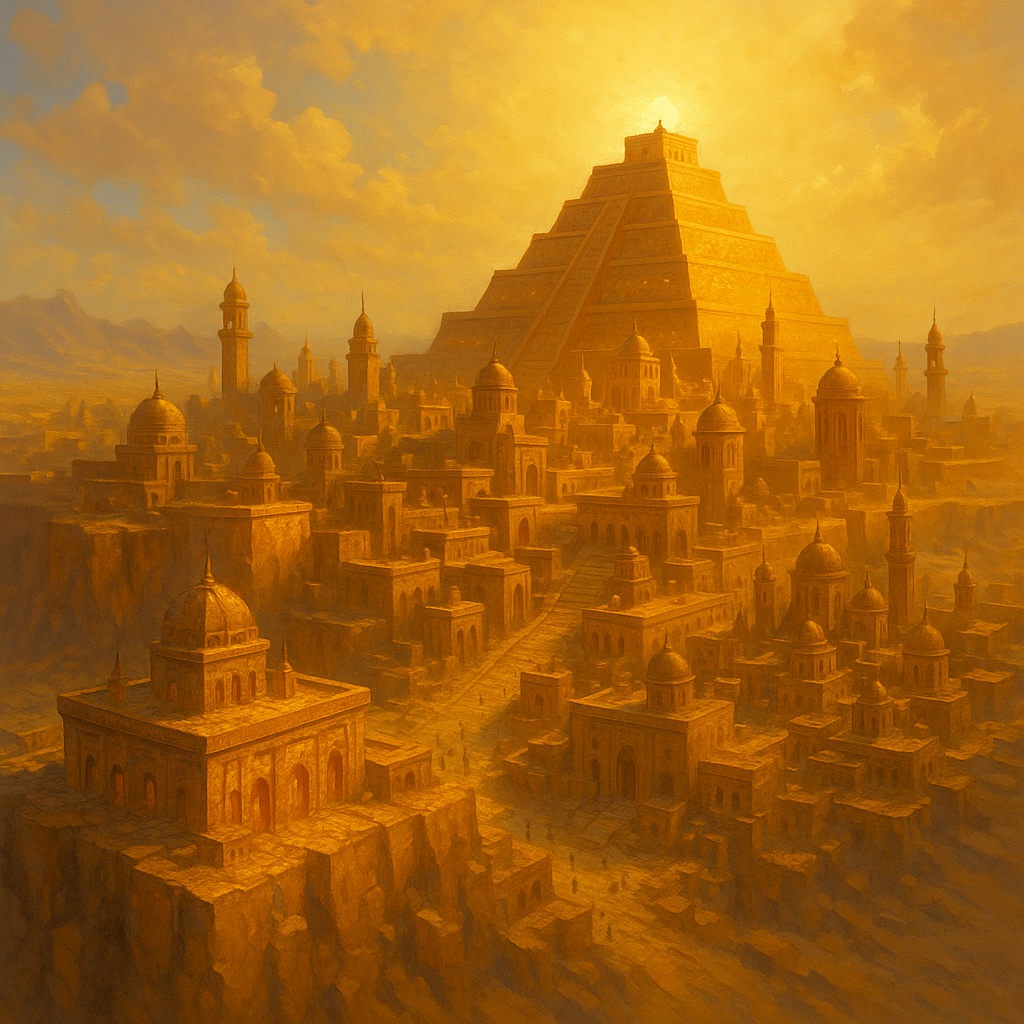
Ath'tis ("Ath-TIS")
The desert kingdom of Ath’tis stands as a radiant civilization shaped by sun, sand, and star-guided wisdom. From its capital, Aurelion’s Crest, a vast metropolis of sunstone terraces and a towering ziggurat, the Radiant Throne rules through a multicultural coalition of Dragonborn nobles, Human merchant leagues, Tiefling scholar-orders, Triton tidecallers, and Tabaxi caravan clans. The kingdom’s faith blends devotion to Pelor, Ioun, Avandra, and Deep Sashelas, forming a spiritual harmony that guides civic law, scholarship, exploration, and seafaring tradition. Ath’tis thrives through mastery of astronomy, desert engineering, bronze metallurgy, lenscrafting, and oasis agriculture—allowing life to flourish even under the relentless sun. Its two great ports, Solmaris and Embercoast Landing, connect the kingdom to distant lands, while inland Sunline Roads and hidden desert oases bind its seventeen settlements into a unified, strategically poised realm.
Yet beneath its brilliance lies a complex web of political maneuvering and ideological rivalry. The Council of Twelve Heliochors balances competing interests—ancient Dragonborn authority, Human economic power, Tiefling prophetic influence, Triton naval leverage, and Tabaxi control of trade routes—resulting in a kingdom where alliances shift like desert winds. Religious sects contend quietly for influence, scholars guard prophetic secrets, and noble houses wage shadowed battles for succession and policy. Despite these tensions, the people of Ath’tis are united by six Radiant Tenets: Illumination, Balance, Endurance, Journey, Craft, and Unity. To them, civilization is an act of faith—one expressed in architecture aligned to the sun, caravans guided by starlight, and a shared belief that their destiny began with the First Dawn. Ath’tis endures as a beacon in the desert: a kingdom of radiant cities, ancient wisdom, and unbroken sunlight.
Structure
The governance of Ath’tis is centered on the Solar Dominion, an ancient ruling framework upheld by the Radiant Throne—traditionally held by a Dragonborn monarch descended from the Sun-Dynasty bloodlines. The monarch’s authority is balanced by the Council of Twelve Heliochors, a political body representing the major racial and regional powers: Human merchant leagues, Dragonborn noble houses, Tiefling astrologer orders, Triton delegations from the archipelago, and Tabaxi caravan clans. Each Heliochor oversees a sphere of governance—trade, agriculture, naval policy, temple oversight, diplomacy, taxation, military logistics, and desert administration. The Radiant Throne sets national direction and religious patronage, but cannot enact sweeping reforms without at least seven Heliochor votes, creating a system where consensus is prized and political maneuvering is constant. The throne and council meet in Aurelion’s Crest within the Amber Sun Hall, a sun-lit amphitheater positioned to catch the first light of dawn each morning.
Below the national level, Ath’tis is divided into regional jurisdictions called Solar Mandates, each governed by a Mandate Steward—most often a Human administrator or a Dragonborn noble. Stewards answer to both the Radiant Throne and their sponsoring Heliochor, maintaining roads, oases, temple funding, and levy systems. Local governance occurs in Sun-Courts, assemblies of citizens led by a priest-arbiter who interprets secular and spiritual law. These courts oversee disputes, marketplace fairness, irrigation rights, and festival organization. Triton communities operate under parallel Tide-Circle Councils, recognized by Ath’tis as autonomous partners linked to naval and ceremonial roles. Meanwhile, Tabaxi caravan elders maintain the Trail Pact Network, managing inland trade security and ensuring access to safe travel routes. The entire structure reflects Ath’tis’s cultural ideal: a kingdom ruled by the sun, guided by knowledge, strengthened by diversity, and united through ritual, where political power flows like sunlight—widespread, layered, and constantly shifting.
Culture
The culture of Ath’tis revolves around sun reverence, maritime tradition, and ancient dynastic identity. Its people see the sun not only as a celestial force but as a symbol of clarity, renewal, and rightful leadership. Public life follows the rhythm of the day: dawn is a time for offerings, midday for labor and trade, and dusk for communal rest and storytelling. Dragonborn noble houses maintain the proud legacies of the Sun-Dynasty, upholding traditions of monumental architecture, formal oratory, and sacred craftsmanship. Humans dominate the artisan quarter, merchant guilds, and scholarly enclaves, blending innovation with preservation as they pass down shipwrighting, irrigation engineering, and solar mathematics. Tieflings shape the kingdom’s spiritual and intellectual depth—astrologers, crypt-keepers, fire-scribes, and interpreters of celestial omens. Tritons contribute the seafaring knowledge and protective mysticism that fuel Ath’tis’s naval power, while Tabaxi bring agility, oral tradition, dance, and desert lore to the kingdom’s cultural mosaic.
Art, music, and ceremony reflect the vibrant diversity of Ath’tan life. Cities are adorned with sunstone reliefs, bronze sails, crystal-tipped obelisks, and stepped plazas, each oriented to capture dramatic sun-angles during solstices. Festivals are central to cultural cohesion: the Dawnfall Festival, where tens of thousands gather to welcome the year’s first sunrise; the Celestial Crossing, where Tieflings chart star-maps projected onto mirrored pools; and the Tidegold Parade, led by Triton choruses through Solmaris Port. Music features resonant drums, bronze chimes, reed flutes, and the rhythmic footwork of Tabaxi desert-dancers. Ath’tis values scholarship, beauty, and ritual precision, believing that harmony between sun, sea, and sand cultivates prosperity. Social conduct emphasizes dignity, hospitality, intellectual curiosity, and subtle artistry—whether in architecture, navigation, cuisine, or politics. Ath’tis is a land where ancient grandeur mingles with living cosmopolitanism, creating a culture that burns with creativity, balance, and radiance.
Public Agenda
The foremost public priority of Ath’tis is to preserve and project the Sun-Dynasty’s stability, ensuring that the Radiant Throne remains a unifying force across coastal ports, desert oases, and plateau cities. This begins with the strengthening of infrastructure and internal cohesion—upgrading sunstone road networks, safeguarding oases, expanding irrigation cisterns, and promoting inter-racial cooperation within the Heliochor Council. The kingdom invests heavily in astronomy, navigation, and desert engineering, believing that mastery of both sky and sand ensures its prosperity. A major agenda focuses on revitalizing older temple districts and protecting ancient Dragonborn tomb complexes, reinforcing national identity and legitimizing dynastic continuity. Meanwhile, Human merchant leagues and Tiefling astrologer orders push for standardized trade measures, fair taxation, and expanded educational access to solar mathematics and navigation arts.
Externally, Ath’tis aims to secure its position as the dominant maritime and cultural mediator of the southern seas. While only two cities lie on the coast, their strategic value drives ongoing expansion of merchant fleets, triton–human cooperation, and advanced shipwright training. Ath’tis pursues mutually beneficial trade with neighbors—especially Masheš and Skorkush—while subtly working to prevent any single nation from overwhelming regional markets. The inland desert remains a priority as well, with the Solar Dominion funding new caravan routes and establishing protected waystations to stabilize commerce and defend against raiders. Diplomatically, Ath’tis champions itself as the keeper of civilization’s dawn, promoting knowledge exchange, celestial scholarship, and multiracial representation within its borders. Its long-term agenda is clear: to balance tradition and innovation, expand economic influence, uphold solar unity, and ensure Ath’tis remains the radiant heart of the region.
Assets
Ath’tis possesses a wealth of natural, economic, and cultural assets that elevate it as one of the region’s most influential kingdoms. Its greatest natural strength lies in its sunstone quarries, found in the desert interior and prized across continents for their light-reactive brilliance and resilience. These stones fuel architecture, sculpture, magical rituals, and international trade. The kingdom’s inland oases—such as Sandmar Fold, Shimmerwaste, and Starflare—provide fertile agriculture and sustain vast networks of caravan routes. Ath’tis also commands deep mineral deposits used for bronze production, enabling superior shipbuilding, ritual implements, and weaponry. On the cultural front, Ath’tis’s astronomical knowledge, solar mathematics, and lenscrafting place it at the forefront of celestial navigation, making its star-maps and solar compasses highly sought after by traders and explorers. The Temple Archives of Aurelion’s Crest and the Mirror-Lens Observatory form an intellectual treasury unmatched in nearby nations.
Economically and militarily, Ath’tis benefits immensely from Solmaris Port and Embercoast Landing, its only two coastal gateways. Through these hubs flow foreign goods, desert spices, triton-crafted coral artifacts, and Ath’tan bronzeworks. Triton partnerships provide access to underwater resources like rare algae dyes and sun-pearls, which fund many temple and civic projects. Although its naval bases are inland command centers rather than coastal docks, they house elite strategists, navigators, and solar-engineers who improve the kingdom’s military technology and global influence. Caravan infrastructure, maintained by Tabaxi clans and Human merchant guilds, ensures strong trade across deserts that might otherwise isolate Ath’tis. The Solar Dominion’s most intangible yet powerful asset is its dynastic legitimacy and cultural prestige—the belief among citizens and neighbors alike that Ath’tis is the keeper of solar wisdom and the inheritor of an unbroken line of radiant kings. This aura of ancient authority grants Ath’tis soft power as luminous as any army or fleet.
Demography and Population
Ath’tis is home to approximately 122,000 people, distributed unevenly between its dense interior cities and its two highly strategic coastal ports. Humans make up the largest share at roughly 46%, forming the backbone of the merchant class, agricultural workforce, artisan guilds, and administrative stewards. Dragonborn comprise 28%, heavily concentrated in Aurelion’s Crest, Helion’s Step, and Auratomb Ridge, where their ancient Sun-Dynasty bloodlines maintain cultural and political prestige. Tieflings represent around 12%, typically found in scholarly enclaves and temple districts, serving as astrologers, archivists, ritual keepers, and lenscrafters. Tritons account for 9%, residing primarily in Solmaris Port, Embercoast Landing, and a handful of mixed inland communities that celebrate their aquatic heritage through craft and ceremony. The remaining 5% Tabaxi population plays a crucial role in caravan life, acting as scouts, diplomats, traders, and desert navigators.
Population density reflects the kingdom’s geography: the desert interior contains the largest number of settlements, yet the two coastal ports—Solmaris Port and Embercoast Landing—house nearly a fifth of the total population due to intense trade activity. Aurelion’s Crest alone holds over a quarter of Ath’tis’s citizens, its sunstone terraces and temple districts forming the cultural and political heart of the nation. Inland oasis towns such as Sandmar Fold, Shimmerwaste Oasis, and Starflare Oasis sustain medium populations thanks to reliable wells and trade corridors. Triton–human blended communities are rare but valued for their hybrid knowledge of watercraft, survival techniques, and maritime lore. Overall, Ath’tis’s population is highly stratified yet culturally integrated, united by solar traditions and a shared reverence for the cycles of day, night, and desert life. Despite the arid landscape, its people thrive through cooperation, innovation, and a deep sense of dynastic identity.
Military
The military of Ath’tis is divided into two primary branches: the Solar Phalanx and the Dawnward Navy Command. Though only two cities touch the sea, Ath’tis maintains a sophisticated naval command structure from its inland fortresses—Sunspear Bastion and Tidalwatch Hold—where navigators, strategists, and tide-scholars coordinate coastal defense with fleets stationed in Solmaris and Embercoast. Dragonborn form the elite Sunshield Guard, heavy infantry who fight in radiant bronze armor etched with solar sigils, while Humans comprise the bulk of the phalanx ranks, serving as spearmen, desert archers, and disciplined formation fighters. Tieflings occupy crucial support roles as fire-scribes, battle astrologers, tacticians, and arcane artillery operators who harness solar magic for battlefield illumination or blinding bursts. Tritons serve as specialized coastal units—naval scouts, underwater messengers, and harpoon fighters—while Tabaxi excel as scouts, skirmishers, and rapid-response desert outriders.
The kingdom’s military doctrine is shaped by its terrain: desert warfare, defensive fortification, and rapid caravan interception. Inland routes are secured by sunstone watchtowers, Tabaxi reconnaissance teams, and mounted patrols known as Dune-Lancers, who excel at hit-and-run tactics in shifting sands. Ath’tis invests heavily in logistical mastery, maintaining well-stocked oasis depots and water caches to sustain long-range forces. The Solar Dominion places equal importance on magical and celestial warfare—battle astrologers predict enemy movements based on star patterns, and solar priests bless weapons before campaigns. The navy, while small in number, is technologically advanced, utilizing triton-designed hulls, sun-compass navigation, and incendiary “dawnfire oils” used to burn hostile vessels. Although Ath’tis avoids reckless expansion, its military is widely respected for discipline, precision, and its elite cadre of Dragonborn officers who uphold ancient codes of honor. In times of crisis, the Radiant Throne can summon the Sun Legion, a kingdom-wide mobilization in which every oasis, caravan, and port contributes fighters—unifying Ath’tis under a single blazing banner.
Technological Level
Ath’tis stands at the forefront of astronomy, navigation, and solar-energy based craftsmanship, making it one of the most scientifically advanced nations in the region. Scholars in Aurelion’s Crest and Dawnbreaker Hearth maintain detailed heliocentric charts, star libraries, and mirrored observatories that track celestial patterns with extraordinary precision. These studies influence everything from agricultural timing to naval expeditions, as battle-astrologers and navigators rely on solar mathematics to interpret omens, forecast storms, and chart safe sea paths. The kingdom excels in lenscrafting, bronze metallurgy, and sunstone architecture, using reflective surfaces to illuminate underground chambers, power arcane devices, and focus controlled solar heat for industrial applications. Tiefling fire-scribes and Human lenswrights collaborate to produce magnifying arrays, horizon compasses, and sun-forged alloys that outperform conventional metals in both durability and ritual potency. Ath’tis’s intellectual culture prizes experimentation and disciplined observation, blending magic with natural science in ways that feel both ancient and futuristic.
Beyond celestial studies, the kingdom leads the world in desert survival technology and irrigation engineering. Oases such as Sandmar Fold and Shimmerwaste rely on deep cistern systems, subterranean qanat tunnels, solar pumps, and temperature-regulating architecture to sustain life in the harsh interior. Tabaxi caravaneers contribute advanced mapping of wind patterns, sand currents, and underground aquifers, while Dragonborn architects develop monumental structures that use passive cooling, sun-shaded alcoves, and airflow channels to maintain comfort in arid climates. Tritons introduce biological innovations—algae-dye cultivation, coral reinforcement techniques, water filtration methods—that blend seamlessly with Ath’tan engineering. Although Ath’tis lacks widespread industrial machinery, it compensates with precision craftwork, arcane-enhanced technology, and centuries of accumulated knowledge preserved in temple archives. Innovation is seen not as rebellion against tradition, but as the highest expression of the Sun-Dynasty’s mandate: to seek clarity, harness light, and turn knowledge into prosperity.
Religion
Religion in Ath’tis centers on the Solar Pantheon, a radiant triad of deities who embody the cycles of day, night, and renewal. At the head stands Aureth-Sol, the Dawnfather, patron of kingship, clarity, and righteous rule. His light is believed to sanctify both the Radiant Throne and the daily labor of the people, making dawn rituals essential across the kingdom. Complementing him is Iskura the High Ember, goddess of knowledge, fire, prophecy, and transformation; Tiefling astrologers and fire-scribes claim her inspiration in every star chart and ritual flame. Completing the triad is Kelthis the Horizon Walker, a guardian of journeys, change, and the meeting of sea and desert. Tabaxi caravaneers and Triton navigators honor Kelthis at the start of every voyage, offering polished stones or drops of scented oil to guide them safely across shifting terrain. Though these three deities form the core, Ath’tan theology also acknowledges minor spirits—sun-wraiths, oasis guardians, wind serpents, and ancestral dynastic phantoms—who play small but meaningful roles in daily worship.
Religious practice in Ath’tis is deeply woven into public life. Temples are not towering cathedrals but sun courts, open-air sanctuaries built of pale stone and mirrored bronze designed to catch dramatic rays at sunrise and sunset. Priests perform Lightbearer rites, illuminating sacred paths with crystal lamps, while pilgrimages to Helion’s Step and Auratomb Ridge are considered acts of devotion and cultural pride. Astrology plays a crucial role; celestial alignments are consulted for everything from naval departures to coronations, marriages, and major construction projects. Festivals like the Solstice Blaze, Night of the Returning Stars, and Celestial Crossing unite the kingdom in synchronized rituals of fire, song, and elaborate dance. Despite the diversity of races, the Solar Pantheon provides a unifying spiritual identity: Dragonborn uphold its ancient lineage, Humans preserve its rituals, Tieflings interpret its secrets, Tritons extend its reach to the sea, and Tabaxi carry its symbols through the desert. In Ath’tis, faith is not merely belief—it is the light through which every aspect of life is understood.
Laws
Ath’tan law is founded on the Codex Solaris, an ancient set of principles said to originate from the earliest Dragonborn sun-kings and refined by centuries of scholars and astrologer-priests. The Codex emphasizes clarity, balance, and the preservation of social harmony, mirroring the predictable cycles of the sun. Crimes involving deceit, fraud, or record-tampering are treated with particular severity, as they are seen as offenses against truth itself—the sacred domain of Aureth-Sol. Violent crimes are judged through a combination of priestly testimony, witness accounts, and celestial divination, with sentencing delivered in public Sun Courts. Punishments favor restitution, labor service, and ritual purification over execution, except in the gravest offenses such as treason, temple desecration, and the deliberate destruction of desert water sources. Tiefling fire-scribes maintain legal records, Human stewards interpret civil statutes, and Dragonborn magistrates preside over major trials, ensuring that the law reflects both tradition and practical governance.
The legal structure places heavy emphasis on commerce regulation, oasis protection, and inter-racial fairness. Caravan routes are safeguarded by law, and interfering with a trade convoy is treated as a national threat. Water rights are sacred: hoarding, poisoning, or obstructing access to wells is considered a high crime equal to attacking a noble. Temples enforce astral contracts, magically sealed agreements overseen by Iskura’s priesthood that bind merchants, nobles, and naval officers to their promises. Within the kingdom, racial tensions are mitigated by strict statutes guaranteeing representation in local Sun Courts and prohibiting caste discrimination outside of hereditary noble roles. Triton communities retain partial autonomy under Tide-Circle Accords, while Tabaxi caravaneers operate within the Trail Pact system, legally recognized as mobile civic entities. Across all regions, the ultimate principle remains constant: law is the reflection of light, and to live outside it is to walk in shadow. Ath’tis believes that justice, like the sun, must be both bright and measured—guiding, revealing, and sustaining the kingdom in equal measure.
Agriculture & Industry
Agriculture in Ath’tis thrives through oasis-based farming, deep-well irrigation, and solar-engineered techniques that allow life to flourish in an otherwise arid landscape. Settlements like Sandmar Fold, Shimmerwaste Oasis, and Starflare Oasis serve as agricultural hubs, cultivating dates, grains, saffron, figs, sun-root vegetables, medicinal herbs, and desert beans using sunken gardens cooled by stone-lined pits. Triton-inspired filtration systems purify groundwater, while Tabaxi caravaneers transport fresh produce across great distances with minimal spoilage. Livestock consists primarily of desert goats, sunscale reptiles, and hardy sand-striders, all adapted to survive on sparse vegetation. Agricultural workers use mirror-arrays and shade sails to maximize usable sunlight without scorching crops, a technique pioneered by Tiefling lenswrights. Though the kingdom’s farmland is limited, careful management and the cultural reverence for water ensure steady yields that support its population and export economy.
Industrial output forms the backbone of Ath’tis’s wealth. The kingdom excels in bronze metallurgy, sunstone quarrying, glassmaking, dye production, ceramics, and shipwrighting. Dragonborn smiths craft sunsteel-tipped spears and ceremonial armor, while Human artisans create intricate mosaics, architectural reliefs, and illuminated manuscripts. Tieflings dominate scholarly and arcane industries—lenscrafting, fire-forging, astrology devices, and solar-charge crystals used in both ritual and navigation. Inland cities like Goldenwake Anchorage produce rare mineral dyes, including the famed Goldwake Blue and Emberred, prized across the continent. In Solmaris and Embercoast Landing, triton artisans shape coral-inlay jewelry, bioluminescent ornaments, and underwater-forged harpoons sold to foreign traders. Caravans rely on Tabaxi craftsmanship—leatherworks, desert textiles, and wind-drum communication tools. The synergy of these industries creates an economic engine that shines as brightly as the sun Ath’tis worships: a kingdom whose mastery of light, metal, stone, and magic cements its status as a radiant industrial power.
Trade & Transport
Trade is the lifeblood of Ath’tis, flowing through a dual system of maritime commerce and desert caravan networks that connect the kingdom to distant regions. Although Ath’tis has only two coastal ports, Solmaris Port and Embercoast Landing function as immense commercial funnels, importing foreign grain, lumber, textiles, rare fish, pearls, and exotic curiosities while exporting Ath’tan bronzeworks, dyes, sunstone carvings, lenscrafted instruments, saffron, ceramics, and solar navigation tools. Triton merchants serve as diplomatic intermediaries for underwater trade, supplying coral artifacts and bioluminescent materials unavailable elsewhere. Inland, Human merchant guilds manage caravan schedules, while Tabaxi caravan-masters guide convoys across the dunes using stellar navigation, wind-pattern memory, and secret waystations known only to their clans. The Radiant Throne enforces strict tariffs and trade protections, ensuring Ath’tis remains a dominant economic mediator along the southern trade corridor.
Transportation in Ath’tis blends practical engineering, desert lore, and celestial science. The kingdom’s primary highways—the Sunline Roads—are paved with pale stone that reflects heat, making long-distance travel more bearable. Oases along these routes serve as protected rest points, stocked with water caches and guarded by local Sun-Courts or caravan militias. Tabaxi outriders patrol the desert trails, while Humans operate large sand-sled caravans pulled by durable beasts like sunscale lizards and long-horned dune goats. In the ports, ships use sun-compasses, tide-charts, and triton-crafted hull reinforcements to navigate foreign waters with exceptional accuracy. Inland naval command centers coordinate maritime movements using signal mirrors, rooftop lenses, and fire-beacon towers that stretch deep into the desert. Lightweight gliders and kites—an Ath’tan invention—are sometimes used for message carrying between distant settlements. Whether by sea or sand, transport within Ath’tis is a disciplined, elegant system built on precision planning and the ancient belief that travel is a sacred alignment between horizon, duty, and destiny.
Education
Education in Ath’tis is shaped by the belief that knowledge is a form of light, a gift of the Solar Pantheon meant to illuminate the mind and strengthen the kingdom. Learning begins in Sun-Court Academies, public instruction halls where children of all races study reading, numeracy, civic law, desert survival, and the foundational myths of the Sun-Dynasty. Human tutors and Tiefling fire-scribes collaborate to teach students how to interpret seasonal cycles, track basic star patterns, and understand solar rituals that structure daily life. Dragonborn scholars instruct in discipline, rhetoric, and dynastic history, ensuring that even common citizens grasp the cultural significance of their kingdom’s heritage. Triton elders occasionally visit inland schools to teach ocean lore and tide behavior, enriching students’ understanding of the foreign waters Ath’tis trades with. Educational access is broad—any child may attend—but advancement into specialized study requires aptitude, discipline, and sponsorship from temple orders, guilds, or noble houses.
Higher learning is concentrated in prestigious institutions such as the Mirror-Lens Observatory, the Aurelion University of Solar Arts, and the Ember Archive of Flame-Scribed Knowledge. These centers produce the kingdom’s finest navigators, astrologers, architects, lenswrights, engineers, and combat strategists. Students study astronomy, solar mathematics, lenscrafting, desert engineering, bronze metallurgy, shipwrighting, historical recordkeeping, ritual law, and magical disciplines tied to light and fire. Tiefling astrologers teach advanced star-language, used in navigation and prophecy; Dragonborn masters lead programs in moral philosophy and leadership; Humans excel in artisan design and trade sciences; Tabaxi contribute desert-mapping, communication drumming, and wind-motion mathematics; Tritons teach hydrodynamics and aquatic biology. Advancement is merit-based and often competitive, with final examinations determined through elaborate practical trials—charting desert routes, crafting solar devices, interpreting celestial events, or constructing scale models of sun-aligned architecture. In Ath’tis, education is not merely preparation for life—it is the foundation of civic duty, a sacred tradition that ensures the kingdom remains brilliant, innovative, and united beneath the eternal sun.
Infrastructure
Infrastructure in Ath’tis is a testament to its unique blend of solar engineering, desert survival ingenuity, and monumental craftsmanship. The kingdom’s hallmark is its Sunline Road Network, a series of pale-stone highways stretching from Aurelion’s Crest to every major oasis and settlement. These roads are designed to reflect heat rather than absorb it, allowing caravans to travel safely even under intense midday sun. Along the Sunlines lie fortified waystations, each equipped with deep cisterns, shade towers, rest barracks, and signal mirrors used for long-distance communication. Oasis cities maintain elaborate qanat systems—subterranean water channels carved by Human and Dragonborn engineers—to filter and distribute fresh water. Tiefling lenswrights install sun-lens arrays throughout settlements, capturing and redirecting sunlight into underground chambers, workshops, and temple halls. Even small villages possess cooling architecture: thick sunbaked walls, airflow vents, and stone courtyards that create pockets of breathable shade. Together, these systems make it possible for Ath’tis to flourish in a realm where heat could otherwise dominate life.
Urban infrastructure blends beauty with practicality. Aurelion’s Crest is built around a vast network of sunstone terraces, drainage channels, rooftop gardens, and elevated walkways that keep the city cool and navigable. Massive bronze and crystal heliostats sit atop key buildings, rotating to track the sun and illuminate public squares. Ports like Solmaris and Embercoast incorporate advanced drydocks, coral-mesh seawalls, triton-designed slipways, and signal-tower complexes that communicate with inland naval command centers via mirrored beacons. Inland settlements rely on specialized wind-sail mills that grind grain or pull water from deep aquifers, powered entirely by desert gusts. The kingdom also maintains a network of fire-beacon towers, allowing messages to travel from coast to capital in minutes when visibility is clear. Across the kingdom, infrastructure is built not merely for function but to honor the Solar Pantheon—carefully aligned with celestial events, constructed from luminous materials, and infused with the belief that civilization must reflect the radiance of the sun.
Mythology & Lore
The mythology of Ath’tis begins with the First Dawn, when the sun was said to descend as a living flame and carve the desert into a shape fit for civilization. From this divine fire emerged Aureth-Sol, the Dawnfather, who shaped the Dragonborn from molten sunstone and breathed into them the will to build, rule, and illuminate. Tiefling fire-scribes claim that their ancestors were formed from the sparks that fell from Aureth-Sol’s wings—embers that retained the power to read the stars and decipher cosmic patterns. According to legend, Iskura the High Ember, goddess of prophecy and flame, taught early Ath’tans the arts of lenscraft, metallurgy, and written language. It was she who lit the first Eternal Flame in the heart of Aurelion’s Crest, declaring that knowledge must outshine ignorance. Kelthis the Horizon Walker, guardian of journeys, is said to have shaped the dunes with his staff, creating hidden pathways only the clever or worthy can find. Tabaxi oral tradition adds that Kelthis first appeared to wandering clans as a shimmering mirage-cat who walked atop the sun itself.
Mythic stories also explain the roles of other races within Ath’tis. Tritons believe that when Aureth-Sol’s first sunrise hit the sea, a wave of golden light sank beneath the surface and transformed into a radiant tide-spirit named Vaeluun, who became the progenitor of Triton culture and their pact with the kingdom. Humans trace their lineage to the Shadow of the Dawn, the moment when the new sun cast its first silhouette across the sands—an omen interpreted as a call to adaptability and resilience. Many myths revolve around the Celestial Wheel, the idea that the sun, stars, and desert winds form an interconnected system of omens guiding all things. Ath’tan children grow up hearing tales of sun-wraiths that guard sacred tombs, wind serpents that predict sandstorms, and ancestral phantoms who test the courage of travelers. These stories are more than entertainment; they form a living cultural framework that binds the people of Ath’tis together under the belief that their kingdom was not merely built—but destined—to shine.
Divine Origins
The origins of Ath’tis trace back to the Age of First Light, when scattered Dragonborn clans migrated into the desert after following what they believed to be the physical descent of the sun. According to early stone tablets, the clans discovered a radiant plateau—now Aurelion’s Crest—where sunstone veins glowed at dawn as if lit from within. Interpreting this as a divine mandate, the clans united under the first Sun-King, Aurethian Solbrand, who forged a pact of unity known as the Dawn Oath. This oath bound the settlements to a shared destiny: to build a civilization worthy of the Solar Pantheon’s favor. Humans, already present in nomadic tribes along the desert fringes, were welcomed as essential partners, being skilled traders and adaptive survivors. Over generations, Tiefling mystics emerged as interpreters of celestial omens, guiding the growing kingdom with their flame-scribed prophecies. As Ath’tis expanded, it absorbed oasis communities, desert caravans, and coastal villages, all drawn to the stability and shared purpose offered by the Sun-Dynasty.
The kingdom’s transformation into a regional power began during the Era of Twin Horizons, when Triton envoys first arrived from the northeastern waters. Their mastery of currents, coral crafting, and maritime defense filled a gap that the inland-born Dragonborn and Humans lacked, forging a partnership that turned Ath’tis into a formidable naval and trade authority despite having only two coastlines. Tabaxi clans, long respected for their agility and desert lore, joined the alliance as guides and messengers, establishing caravan routes that stitched together the kingdom’s far-flung settlements. Over centuries, Ath’tis weathered droughts, sandstorms, internal feuds, and foreign threats, each trial ultimately strengthening its identity as a people shaped—not broken—by the desert sun. Today, Ath’tis stands as the Radiant Kingdom, a nation whose origins lie in the conviction that light reveals all truths, and whose continued existence depends on unity, knowledge, and the shared belief that their destiny began with the first sunrise.
Tenets of Faith
The faith of Ath’tis is guided by the Six Radiant Tenets, principles believed to originate from the very first Sun-King and refined by generations of priest-astrologers. The first is Illumination, the belief that truth must be sought openly and fearlessly, for deception is a path into shadow. The second is Balance, the sacred harmony between sun and night, fire and water, desert and sea—reminding citizens that extremes are dangerous without moderation. The third is Endurance, a reflection of life in the desert: survival is a spiritual act, and perseverance honors the will of Aureth-Sol. The fourth tenet, Journey, embodies the teachings of Kelthis the Horizon Walker, asserting that change, travel, and self-discovery are essential to growth. The fifth is Craft, a tenet upheld by Iskura the High Ember, teaching that labor—artistic, scholarly, or martial—is a form of worship. Finally, the sixth tenet is Unity, the conviction that Ath’tis thrives when its many races, traditions, and callings stand together beneath the same sun.
These tenets shape every aspect of Ath’tan life, from governance to personal behavior. Illumination guides legal proceedings and scholarly work, demanding honesty and clear reasoning. Balance influences agriculture and diplomacy alike, encouraging sustainable resource use and fair negotiations. Endurance is celebrated in desert marches, naval voyages, and rites of adulthood. Journey inspires pilgrimage, trade, and exploration, treating travel as both practical necessity and spiritual insight. Craft elevates artisans, lenswrights, navigators, bronze-smiths, and storytellers, considering each act of creation a spark of the divine. Unity underpins the Solar Dominion’s multicultural structure, teaching that Dragonborn nobility, Human merchants, Tiefling scholars, Triton navigators, and Tabaxi caravaneers all contribute essential strengths to the Radiant Kingdom. In Ath’tis, faith isn’t limited to temples—it is a radiant blueprint for how to live, grow, and endure as a people shaped by the brilliance of the sun.
Ethics
Ethics in Ath’tis are shaped by the belief that one’s actions must reflect the sun itself—clear, steady, and life-giving. Honesty is the highest moral value, not merely as a social virtue but as a spiritual mandate. Deception is viewed as a form of “walking in shadow,” a state that distances the soul from Aureth-Sol’s illumination. Citizens are expected to speak plainly, keep accurate records, honor agreements, and acknowledge mistakes openly. Respect for knowledge and learning is another core ethic; spreading misinformation or destroying records is considered a profound moral failing. Self-discipline, emotional restraint, and measured judgment are praised, especially among leaders who are expected to emulate the consistency of the sun’s path across the sky. The desert itself informs these values—wastefulness, neglect, or misuse of water and food are treated not just as practical errors but as ethical breaches that endanger the entire community.
Ath’tan ethics also emphasize collective responsibility and the dignity of craft. Every person, regardless of race or station, is expected to contribute meaningfully to the well-being of the kingdom—whether by farming oasis crops, shaping bronze, guiding caravans, studying the stars, or defending the borders. Mastery in one’s craft is considered a moral pursuit, a way of honoring Iskura the High Ember, and half-hearted or sloppy work is frowned upon. Loyalty to community and family is central, yet so is respect for the autonomy of the individual’s journey, echoing Kelthis’s teachings that each path is sacred. Generosity, especially in times of drought or hardship, is highly esteemed; those who hoard wealth at the expense of others face social disdain and sometimes legal scrutiny. Compassion is valued but always balanced with practicality—Ath’tans believe that mercy without wisdom is as dangerous as sun without shade. In every aspect of life, the kingdom’s ethics reinforce the guiding principle that to be good is to cast no shadow.
Worship
Worship in Ath’tis is a daily rhythm woven into public life, expressed not through grand temples but through sun-courts, open-air sanctuaries aligned precisely with dawn and dusk. At sunrise, citizens pause whatever they are doing—lighting hearths, beginning caravan journeys, opening market stalls—to face the east and offer a moment of silence to Aureth-Sol, letting the first rays fall upon their hands or forehead. Midday belongs to Iskura the High Ember; fire-scribes ignite controlled ritual flames in bronze bowls, symbolizing clarity of mind and the pursuit of knowledge. Evening rites honor Kelthis the Horizon Walker, where travelers, sailors, or desert caravans offer polished stones or drops of scented oil to guide their next journey. These practices are simple yet deeply respected, requiring only breath, sunlight, and intention. Worship is not rigid—each race expresses devotion differently—but the daily cycle of light serves as a unifying spiritual compass.
Festivals and communal ceremonies deepen these bonds. The Solstice Blaze fills Aurelion’s Crest with towering pyres of resinous wood, illuminating the city in gold as Tieflings chant star-poems and Dragonborn sun-guards perform ceremonial marches. The Night of Returning Stars celebrates Iskura through hours of stargazing, lens rituals, and fire-dances led by Tabaxi performers. Tritons host the Tidegold Offering in coastal waters, singing beneath the waves to bless the year’s naval voyages. Even everyday tasks carry spiritual weight: artisans whisper prayers before shaping bronze, farmers bury sun-warmed stones at the start of planting season, and caravan-leaders perform small sand-tracing rituals before crossing the open desert. In Ath’tis, worship is less about obeying doctrine and more about living in harmony with light, craft, and movement—an ever-present recognition that the sun watches, the stars speak, and every path across sand or sea is sacred.
Priesthood
The priesthood of Ath’tis is organized into three great orders, each devoted to one of the major deities who guide the Radiant Kingdom. The Order of Pelor, composed largely of Dragonborn and Humans, serves as the moral and ceremonial heart of the state. These priests lead the dawn rituals, bless civic leaders, and maintain the great sun-courts of Aurelion’s Crest. Their golden tabards and radiant holy symbols are believed to channel Pelor’s warmth, and their authority in matters of justice and public ethics is widely respected. The Emberbound Order of Ioun, dominated by Tieflings and scholars, preserves Ath’tis’s vast libraries, astral maps, and prophetic flame-scripts. They operate observatories, teach advanced mathematics and star-lore, and advise government officials on omens and celestial cycles. Meanwhile, the Horizon Wardens of Avandra—a diverse order including Tabaxi, Humans, and Tritons—serve as spiritual guides to travelers, sailors, and caravans. They maintain shrines along caravan trails and coastal routes and bless all who embark on long journeys. Their rites emphasize freedom, adaptability, and personal destiny.
A fourth, smaller but culturally vital order exists along the coast: the Tidecallers of Deep Sashelas, predominantly Triton clerics who bless outgoing vessels, teach hydromancy, and protect underwater sacred sites. These priests bridge the gap between land and sea, overseeing pacts that bind Triton communities to the Radiant Throne. All four orders serve under the Radiant Synod, a council of high priests who unify doctrine, mediate disputes, and advise the monarch. Each order retains its own hierarchy—Sun Speakers of Pelor, Flame-Scribes of Ioun, Dawnstriders of Avandra, Wave-Seers of Deep Sashelas—but all share responsibilities such as maintaining sacred fires, consulting on legal matters, teaching youth, and interpreting divine signs. Though their priorities sometimes differ, the priesthood as a whole remains united by the belief that the gods illuminate the path forward: Pelor lights the world, Ioun reveals the truth, Avandra opens the way, and Deep Sashelas carries the people safely across the tides.
Granted Divine Powers
Priests of Ath’tis receive divine gifts that reflect the nature of their patron deity and the culture that surrounds them. Clerics of Pelor channel healing light strong enough to purify disease, mend grievous wounds, and calm sand-scorched minds; they are beloved in desert communities where life is harsh and water scarce. In battle, Pelor’s chosen radiate searing brilliance capable of blinding foes or igniting weapons with holy fire—effects seen as the sun’s own judgment. Clerics and sages of Ioun wield powers of foresight, arcane clarity, and heightened intellect. They can call upon flashes of prophetic insight, consult runes that glow with shifting fire-script, or temporarily enhance a companion’s memory, perception, or ability to learn. Their magic not only reveals truth but protects it; many can conjure wards of knowledge that prevent lies, illusions, or forbidden tampering with ancient texts. These gifts are highly prized in Ath’tis, where scholarship is nearly as sacred as faith itself.
Followers of Avandra, the Horizon Wardens, possess divine abilities tied to luck, travel, and freedom. They bless caravans with tailwinds, steady footsteps, and uncanny protection from desert hazards. Their miracles often manifest subtly: a lost wanderer stumbling upon an oasis, a sandstorm parting at a critical moment, or a caravan avoiding an ambush through sudden intuition. More direct powers allow them to enhance mobility, break magical restraints, or teleport short distances—extensions of Avandra’s creed that the path forward must always remain open. Finally, the Tidecallers of Deep Sashelas wield the divine magic of oceanic grace, water shaping, and protective tides. Though most live near the coast, their blessings reach inland sailors and diplomats, offering clean water, resistance to drought, or soothing “wave-mending” magic that restores mental clarity. A handful can summon spectral aquatic creatures, breathe underwater, or create brief tidal surges used for both ritual and defense. Individually unique yet collectively harmonious, these divine gifts create a priesthood whose powers mirror the kingdom’s essence: radiant, wise, free-moving, and forever shaped by the meeting of desert sun and distant sea.
Political Influence & Intrigue
Despite its radiant public image, Ath’tis is a kingdom where power moves in shadows cast by the sun, shaped by rival factions, priestly orders, noble bloodlines, and merchant guilds. The Radiant Throne rules in name, but the true political battlefield lies within the Council of Twelve Heliochors, where Dragonborn nobles, Human trade magnates, Tiefling astrologer-scribes, Triton emissaries, and Tabaxi caravan elders all fight—quietly or boldly—for influence. Dragonborn Sun-Houses jockey to preserve their ancestral authority, using ancient claims, military prestige, and Pelor’s priesthood to sway decisions. Human merchant guilds form temporary alliances to lobby for tariffs, caravan rights, and harbor privileges, often bribing or blackmailing lesser officials. Tiefling members of Ioun’s Emberbound Order subtly manipulate political tides through prophecies, information control, and the threat—spoken or implied—of revealing or withholding crucial celestial insights. Triton delegations wield influence by threatening to restrict naval intelligence or underwater resources. Every vote within the Heliochors is a negotiation dressed in ceremony, and every decision births a web of consequences.
The priesthoods play their own sophisticated political roles. Pelor’s Order acts as moral authority but often backs Dragonborn noble interests, especially on matters of law or dynastic succession. Ioun’s priests quietly shape policy through research monopolies, controlling access to astronomy, historical records, and magical knowledge; many nobles fear crossing them, lest an inconvenient prophecy surface. Avandra’s Horizon Wardens influence caravan politics, often siding with Tabaxi or Human traders to protect travel freedoms, though their unpredictable loyalties make them both valued allies and dangerous opponents. Along the coast, Tidecallers of Deep Sashelas serve as kingmakers in naval policy—no admiral wants to risk a voyage without their blessing—and they hold leverage through alliances with Triton communities abroad. Beneath all this, espionage thrives: coded messages carved in sunstones, caravan couriers passing whispered secrets, nobles hiring astrologers to sabotage rivals with ominous star-readings. Political life in Ath’tis is a dazzling but perilous game—a kingdom where light reveals truth, but every truth casts a shadow, and the brightest courts hide the deepest intrigue.
Sects
Ath’tis hosts a constellation of religious sects, each interpreting the will of the gods through the lens of desert life, solar symbolism, and dynastic tradition. The largest is the Dawnbearers of Pelor, a conservative sect emphasizing order, discipline, public virtue, and the divine right of the Radiant Throne. They believe light must be controlled, focused, and channeled—much like the kingdom itself. Opposing their rigidity are the Children of the Shifting Dawn, a reformist Pelorian sect that teaches the sun’s warmth belongs to all and advocates for expanding civic rights to Tritons and Tabaxi while curbing noble privilege. Among scholars, the most influential sect is the Flamescribed Chorus of Ioun, who pursue prophecy and knowledge as sacred duties. They argue that revelation can override tradition, causing tension with the Dawnbearers whenever a prophecy suggests political change. A rival Iounite group, the Quiet Luminaries, rejects prophecy entirely, believing truth emerges only from disciplined observation and rational study; they often serve as neutral adjudicators in scholarly disputes.
Avandra’s followers are equally diverse. The Sandstride Companions are beloved caravan priests who preach freedom, compassion, and the sanctity of travel, and they maintain hidden desert shrines used as emergency shelters. More radical are the Wind-Breakers, an outlaw sect who reject all borders—including those of kingdoms—and secretly help smuggle refugees or fugitives through the desert. Along the coasts, Triton-led sects dedicated to Deep Sashelas flourish. The Tidecall Covenant focuses on maintaining harmony between land and sea, blessing naval voyages and advising coastal officials. In contrast, the Pearl Eclipse Brotherhood argues for greater Triton autonomy and occasionally withholds magical support from naval expeditions to pressure inland leaders. Though these sects vary in doctrine, they coexist due to an unspoken understanding: Ath’tis needs all their strengths—light, knowledge, freedom, and tide—to endure. Their interplay shapes not only spiritual life but the cultural and political currents that run beneath the kingdom’s radiant surface.


Comments