
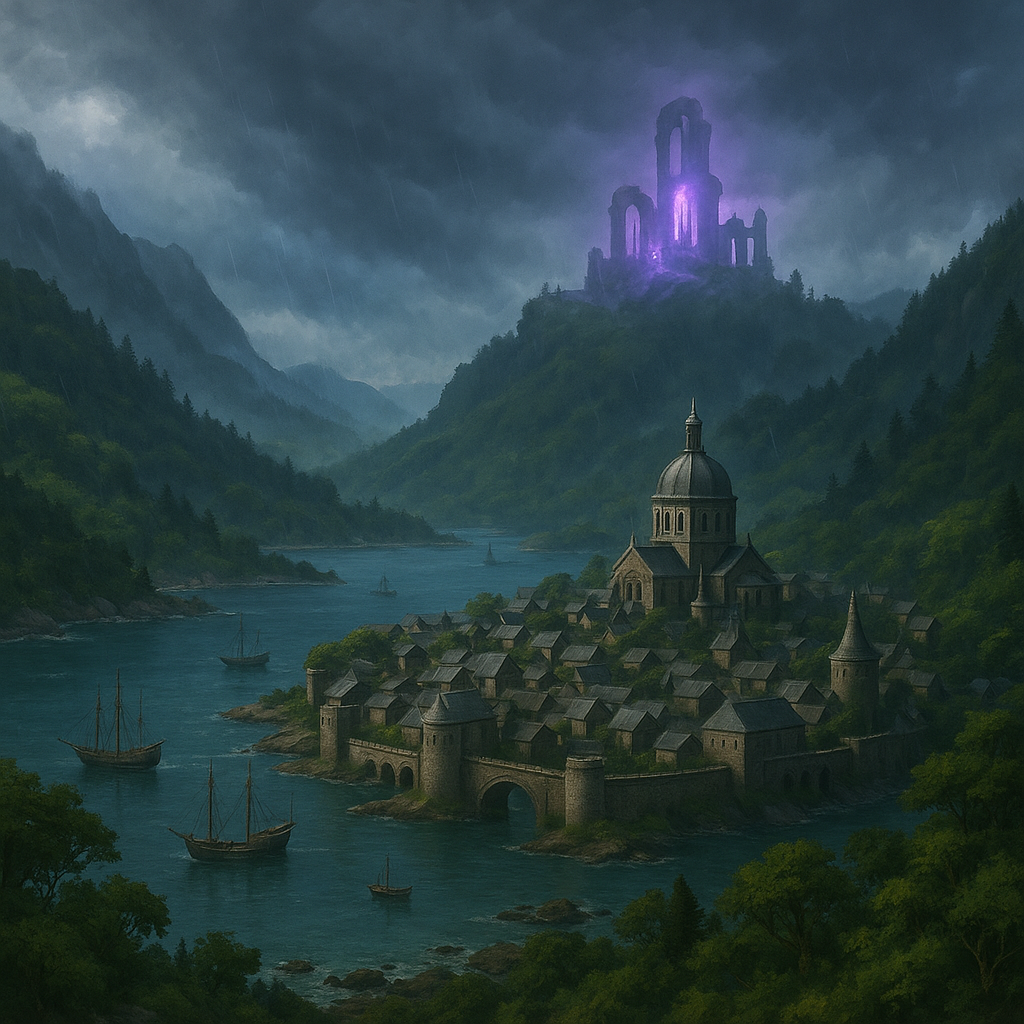
Ath'jes ("a-th-jess")
Ath’jes is a disciplined island-kingdom shaped by storms, celestial observation, and centuries of intentional isolation. Nestled in a landscape reminiscent of New Zealand’s rugged coasts and lush valleys, its people have forged a society defined by silence, restraint, and profound reverence for the Stars, Sea, and Land. The capital, Vaelor’thun, serves as both spiritual and intellectual heart of the nation, where Star-Seers chart the heavens and maintain the prophecy of the Astral Heir—a cosmic savior destined to return when the skies align. Diverse communities of Star-Elves, Sea Elves, Wood Elves, Goliaths, Humans, and Half-Elves coexist in unified purpose, bound by cultural discipline, ecological stewardship, and a shared belief that the island itself is an ancestral guardian.
Despite its modest wealth, Ath’jes wields considerable influence through its Silent Navy, storm-hardened craftsmanship, and advanced celestial sciences. Its infrastructure blends practicality with spiritual alignment: observatories crown cliff faces, monolith circles frame ritual grounds, and ports are engineered to withstand violent ocean winds. All foreign contact is tightly controlled through a single fortress harbor, protecting the kingdom’s sovereignty and sacred sites. Education, religion, law, and daily life all emphasize balance, clarity, and readiness for the prophesied return of the Astral Heir. Ath’jes stands as one of Redredan’s most resilient and enigmatic realms—quiet, enduring, and guided by the belief that destiny flows from the stars above and the storms that shape its shores.
Structure
Ath’jes operates under a centralized royal governance system led from its capital, Vaelor’thun, where the Star-Elf nobility maintains both political leadership and cultural stewardship. The monarchy oversees national policy, foreign relations, magical regulation, and the protection of ancient celestial traditions that define Ath’jes identity. Advisory councils made up of scholars, trade representatives, and military commanders assist the royal family, ensuring that decisions reflect the needs of both urban and rural populations. Each major city—Thrysshal, Eshath’s Gate, and Korvessa—maintains local governors who manage day-to-day administration, collect taxes, and enforce civil law while remaining accountable to the crown.
Beyond the royal seat, Ath’jes functions through a network of regional councils and autonomous tribal enclaves, each with distinct cultural influences from Wood Elves, Goliaths, Sea Elves, Half-Elves, and humans. These councils handle local disputes, resource allocation, and community rituals, while ensuring their practices align with national decrees. Ports like Korvessa and Eshath’s Gate maintain additional maritime councils responsible for trade routes, harbor security, and naval coordination. This balanced structure—central authority supported by regional autonomy—allows Ath’jes to maintain unity across diverse populations, efficiently manage coastal and inland territories, and preserve the mystical and cultural heritage that binds the kingdom together.
Culture
Ath’jesan culture is defined by discipline, silence, and a deep spiritual bond with the natural forces that shape their island home. Across its diverse peoples—Star-Elves, Sea Elves, Wood Elves, Goliaths, Humans, and Half-Elves—there is a shared identity rooted in celestial observation, maritime resilience, and a reverence for the land as a living ancestor. Ath’jesans value self-control and thoughtful speech, holding silence as a sacred practice used during storms, at sunrise, at monoliths, and under significant celestial alignments. Tradition emphasizes duty, memory, and the tri-fold balance of stars, sea, and land, while social status derives from mastery, service, reputation, and reliability rather than wealth or lineage. Cultural roles reflect ancestral strengths: Star-Elves as scholars, Sea Elves and Stormclan Humans as sailors, Wood Elves as forest wardens, Goliaths as guardians of sacred sites, and Half-Elves as interpreters and diplomats.
Daily life and artistry mirror this quiet strength—minimalist stonework carved with astronomical motifs, monolith etching as a revered art, and music that is soft, harmonic, and reflective. Ath’jesans follow strict etiquette rooted in respect and restraint: quiet voices, minimal eye contact, visible hands, punctuality, and a distaste for boasting or interruption. Their festivals and rituals honor storms, forest paths, returning ships, and celestial alignments, reinforcing unity across tribes. Education teaches star-reading, storm prediction, seamanship, survival, and silence discipline from childhood onward. Foreigners are treated with caution but not hostility, expected to honor silence customs and avoid sacred areas. Altogether, Ath’jes is a nation shaped by storm and stone, guided by the stars, and sustained by a cultural ethos of calm strength, collective duty, and reverence for the ancient forces that bind their island together.
Public Agenda
Ath’jes maintains a unified public agenda centered on isolation, sovereignty, and the preservation of its ancestral homeland. The kingdom carefully restricts foreign influence, enforces strict naval oversight of surrounding waters, and protects sacred lands believed to hold deep celestial significance. Stewardship of monolith circles, ancient forests, and cliff sanctuaries is treated as both a civic and spiritual responsibility, while ecological damage is viewed as a moral violation. Maritime vigilance remains essential to national identity—citizens are raised to respect the sea’s power, support disciplined naval patrols, and prioritize rapid defense of territorial waters. Alongside this, the state invests heavily in celestial observation, maintaining observatories, training omen-readers, and preserving astral knowledge as part of national strategy.
Cultural continuity forms the backbone of Ath’jesan society. The public agenda emphasizes silence rituals, oath traditions, and intergenerational discipline, encouraging a unified identity across its diverse races. Controlled trade and self-sufficiency ensure independence from mainland powers, while surplus storage and storm-season planning reflect the island’s pragmatism. Education in stormcraft, seacraft, and starcraft is treated as a civic duty, ensuring every citizen can navigate the island’s challenges. Though Ath’jes has historical grievances with neighboring powers, its long-term vision favors stability over expansion, prioritizing sovereignty, balance, and the enduring protection of its homeland above all else.
Assets
Ath’jes possesses a wealth of strategic and natural assets that make it influential despite its modest economic scale. Storm-hardened timber, rare tideglass, and rich deep-sea fisheries give the kingdom valuable materials for shipbuilding, navigation, and high-demand arcane tools. Its rugged cliffs, narrow harbors, and violent seas form a natural defense system, supported by meticulously maintained charts of deep-water routes and storm cycles. The kingdom’s Silent Navy—feared for its precision, discipline, and mastery of storm combat—bolsters Ath’jes’s maritime dominance, while Korvessa’s famed shipwright guilds produce stormproof vessels rivaling the finest in Redredan. The monolith fields, aligned with celestial events, serve as spiritual and astronomical sites that underpin prophecy, ritual, and cultural identity.
Ath’jes’s intellectual and cultural assets are equally significant. The Star Archives contain centuries of celestial records, allowing prediction of climate shifts, magical phenomena, and seasonal dangers. A highly disciplined, literate population trained in navigation, stormcraft, and silence discipline contributes to a stable, unified society. Tidecasters and storm-mages provide rare magical advantages, especially during celestial alignments where monolith resonance enhances ritual power. Strong racial harmony, strict environmental stewardship, and a focus on self-sufficiency ensure internal stability, while controlled trade through a single monitored port preserves sovereignty. Together, these assets make Ath’jes a resilient, strategically vital kingdom defined by discipline, knowledge, and a profound bond with sea and stars.
Military
The military of Ath’jes is built on precision, discipline, and intimate knowledge of the sea and sky, making it one of the most respected defensive forces in Redredan despite its relatively small size. The heart of its strength lies in the Silent Navy, a fleet of reinforced longships, storm-hardened vessels, and stealth-sail craft designed for maneuvering through treacherous waters and violent storms. Sailors and officers are trained from childhood in storm navigation, tidecraft, and celestial reading, allowing them to predict natural hazards and adapt instantly to shifting conditions. The navy maintains strict patrols around the island’s perimeter, guarding against intrusion, piracy, and foreign influence while ensuring Ath’jes’s isolation and sovereignty remain intact. Their mastery of silence discipline—moving without unnecessary sound—gives them a feared reputation in ambush and night operations.
Complementing the navy are specialized ground and coastal forces drawn from Goliaths, Wood Elves, Star-Elves, and disciplined human clans. These units guard monolith sites, forest sanctuaries, cliff paths, and the critical entry port of Eshath’s Gate, ensuring that sacred land and strategic positions are never compromised. Many warriors undergo training in storm combat, oath-binding rituals, and ritual observation, blending martial prowess with spiritual duty. Tidecasters and storm-mages serve as magical support, stabilizing ships, shielding units during extreme weather, and interpreting environmental shifts that may signal danger. Together, Ath’jes’s military forms a seamless, vigilant defense network—small in number but unmatched in coordination, preparedness, and harmony with the land and sea they protect.
Technological Level
Ath’jes maintains an impressive technological and scientific foundation shaped by its isolation, maritime traditions, and celestial scholarship. Its shipwrights are renowned for advanced stormproof engineering, producing vessels with reinforced keels, salt-hardened timbers, and enchantment-ready rigging. Tideglass instruments—unique to the island—enable Ath’jesans to craft highly accurate navigational tools, scrying lenses, and atmospheric gauges. Architecture emphasizes geometric stonework designed to withstand violent weather, while coastal infrastructure blends practicality with ritual precision. Although Ath’jes does not pursue mass industrialization, its craftsmanship is meticulous, efficient, and tailored to the demands of a storm-lashed island.
Scientifically, Ath’jes excels in astronomy, meteorology, and environmental interpretation, fields that carry both practical and spiritual importance. The Star Archives hold centuries of eclipse cycles, comet records, tide charts, and storm journals, forming one of the most advanced celestial knowledge centers in Redredan. Scholars and omen-readers use this data to predict climate patterns, navigate monsoon seasons, and time ritual events aligned with celestial movements. Their study of tides, winds, and atmospheric shifts has produced sophisticated models of sea behavior, while woodland researchers preserve knowledge of herbal medicines and ecological balance. In Ath’jes, technology and science are not separate from culture—they are woven into daily life, ensuring the island remains disciplined, self-sufficient, and guided by the stars.
Religion
Religion in Ath’jes is a quiet, disciplined spiritual tradition centered on celestial order, natural balance, and reverence for the island itself. Instead of worshiping gods, Ath’jesans follow a belief system built on the Stars, the Sea, and the Land, each symbolizing knowledge, unpredictability, and ancestral heritage. Silence is sacred—observed during storms, sunrise, and celestial alignments—as a form of listening to the world’s guidance. Ritual life revolves around monolith circles and cliffside sanctuaries where Star-Seers read cosmic patterns, while Tidekeepers conduct rites honoring the ocean’s temper. A foundational belief shared across tribes is the prophecy of the Astral Heir, a cosmic savior said to descend during a rare alignment of moons and stars to restore harmony, reclaim the people, or guide Ath’jes into a new era. This prophecy is not loudly preached but woven quietly into cultural memory.
Priestly roles—Star-Seers, Tidekeepers, and Grovewardens—serve as interpreters of celestial signs, environmental omens, and the ancient rites tied to the island’s past. They maintain sacred records, lead seasonal ceremonies, and advise the ruling councils when spiritual and environmental concerns converge. Prophecy in Ath’jes is not treated as dramatic revelation but as a meticulous science rooted in generations of observation, with the Astral Heir’s return seen as a distant but inevitable culmination of cosmic cycles. Religious instruction is woven into daily life: children learn silence discipline, omen-reading, and the sacred history of the island from an early age. Worship remains understated and introspective, reinforcing the belief that Ath’jes endures through harmony, discipline, and readiness for the day when the stars reveal their long-promised champion.
Laws
The laws of Ath’jes are built on discipline, collective responsibility, and the preservation of island harmony. Every citizen is expected to uphold silence customs, respect sacred sites, and act with restraint in speech and action. Legal codes strictly regulate foreign contact, resource management, navigation rights, and protection of monolith fields, reflecting the belief that the island itself is a living ancestor whose balance must not be disturbed. Oath-breaking is one of the gravest offenses, as spoken vows are treated not only as social contracts but spiritual threads tying individuals to the land and community. Violations of environmental stewardship—such as damaging tideglass caves or sacred groves—carry severe penalties, for these places are tied to celestial rituals and the long continuity of Ath’jesan identity.
Justice in Ath’jes emphasizes restoration, discipline, and communal stability. Minor disputes are settled through silence councils, where parties speak only when invited and truth is measured by clarity of thought, not persuasion. More serious crimes are overseen by tribunal panels composed of Star-Seers, Tidekeepers, and civic judges, ensuring that decisions consider both practical outcomes and spiritual implications. A unique aspect of Ath’jesan law is the Oath of the Astral Heir, an ancient decree requiring citizens to maintain readiness, unity, and moral discipline so that the people remain worthy when the prophesied cosmic savior returns. While symbolic, this oath reinforces social cohesion and lawful conduct, reminding Ath’jesans that their actions ripple across generations and that harmony must be protected until the stars reveal their champion.
Agriculture & Industry
Agriculture in Ath’jes is shaped by resilience, sustainability, and a deep respect for the land as a sacred ancestor. Coastal communities cultivate sea greens, kelp, and tide-grown vegetables, while inland groves—managed primarily by Wood Elves—produce hardy root crops, herbs, and moss-bread ingredients. Fishing is the kingdom’s agricultural backbone, sustained by rich deep-sea currents and tightly regulated by Sea Elves to prevent overharvesting. Storm seasons demand careful planning, so Ath’jes maintains communal storage halls stocked with smoked fish, dried kelp, preserved roots, and storm-season grains. Every farming, fishing, or foraging practice is reinforced by ritual observance, ensuring ecological balance is preserved for future generations and honoring the belief that the land must remain whole until the stars signal the next turning of destiny.
Industry in Ath’jes focuses on precise, high-value craftsmanship rather than mass production. Shipbuilding is the crown of Ath’jesan industry, especially in Korvessa, where storm-hardened timbers and enchanted rigging produce some of the most reliable vessels in Redredan. Tideglass refining provides advanced instruments for navigation, scrying, and celestial observation, while artisans in Vaelor’thun craft tools, astronomical devices, minimalist stonework, and ritual implements etched with geometric patterns. All industries operate with strict resource discipline—exports are carefully controlled to maintain sovereignty, and sacred materials such as tideglass and certain timbers may only be harvested with priestly approval. Together, agriculture and industry form a balanced system grounded in practicality, spiritual duty, and the long-standing belief that Ath’jes must remain self-sufficient and steadfast until the prophesied Astral Heir returns.
Trade & Transport
Trade in Ath’jes is tightly controlled and intentionally limited, reflecting the kingdom’s commitment to sovereignty, ecological preservation, and protection of celestial knowledge. All foreign commerce is funneled through Eshath’s Gate, the sole authorized entry point where goods, ships, and travelers are inspected under strict protocols. Exports consist only of carefully regulated materials—storm-hardened timber, tideglass instruments, and precision-built navigational tools—while imports are restricted to essential metals, rare herbs, or items that cannot be produced on the island. Ath’jes interacts with foreign markets from a position of cautious strength, influencing regional trade through its superior craftsmanship and naval dominance while avoiding entanglements that might threaten cultural purity or spiritual obligations tied to the Astral Heir’s prophesied return.
Transport across the island is highly efficient and engineered with practicality and ritual significance. Coastal routes rely on reinforced longships and tide-skiffs guided by celestial markers and deep-water charts, while inland movement uses elevated stone paths and forest trails maintained by Wood Elf wardens. Storm seasons require flexible travel schedules, coordinated through signal flares, tideglass indicators, and silence horns that carry over long distances. Every journey—whether between villages or across the sea—is treated with seriousness, preparation, and respect for the natural forces that govern Ath’jesan life. This disciplined transport network not only supports economic stability but reinforces the kingdom’s identity: a people guided by stars, shaped by storms, and always vigilant as they await the celestial signs of the Astral Heir.
Education
Education in Ath’jes is a lifelong, communal discipline shaped by the island’s storms, stars, and cultural ideals of silence and precision. Children are taught early to read celestial patterns, understand storm behavior, practice silence rituals, and navigate both forest and coastline with confidence. Basic instruction blends practical skills—seamanship, survival craft, herbal knowledge—with historical and spiritual teachings drawn from monolith inscriptions and ancestral records. Every citizen, regardless of lineage, learns the sacred triad of Starcraft, Stormcraft, and Seacraft, ensuring that Ath’jes maintains a universally competent population capable of contributing to the kingdom’s survival. Respect, restraint, and clarity of thought are emphasized even in youth, forging a society where discipline is as natural as breath.
Advanced education is centered in Vaelor’thun and the major port-cities, where Star-Seers, Tidekeepers, and master artisans train students in astronomy, omen-reading, shipbuilding, cartography, and the mathematical sciences. Apprenticeships are the backbone of Ath’jesan mastery, pairing students with skilled mentors in fields ranging from tideglass engineering to storm navigation. Spiritual training is subtle but ever-present: scholars study celestial cycles to prepare for the prophesied return of the Astral Heir, integrating prophecy with scientific observation. Through rigorous practice and cultural alignment, Ath’jes produces a populace that is not only educated but united in purpose—disciplined guardians of their island, attuned to the forces that shape their destiny.
Infrastructure
Infrastructure in Ath’jes is built on resilience, precision, and harmony with the island’s natural forces. Cities and villages are constructed using storm-hardened timber, reinforced stone, and minimalist designs engineered to withstand powerful winds and coastal surges. Architecture emphasizes clean geometric lines and celestial alignment, with sacred monolith sites integrated directly into urban planning rather than displaced. Coastal settlements feature elevated docks and tide-resistant seawalls, while inland routes follow fortified stone paths maintained by Wood Elf wardens. Communication across the island relies on silence horns, signal flares, and tideglass reflectors that function even during violent storms. Every structure, from observatories to shipwright halls, is built with the expectation of enduring the island’s harshest seasons.
Transport infrastructure is equally sophisticated, blending practicality with Ath’jes’s spiritual and maritime traditions. Reinforced longships and tide-skiffs dominate coastal travel, guided by precise navigational charts and celestial markers. Inland movement utilizes maintained forest trails, cliffside stairways, and sheltered storm-houses spaced at regular intervals for travelers caught in sudden weather shifts. Infrastructure is intentionally centralized around Eshath’s Gate, the kingdom’s sole sanctioned port for foreign visitors, allowing strict control over trade, security, and cultural preservation. Throughout the island, the layout of roads, harbors, observatories, and shrine-routes reflects a unified philosophy: Ath’jes must remain self-sufficient, defensible, and spiritually aligned as it waits for the celestial signs foretelling the return of the Astral Heir.
Mythology & Lore
Mythology in Ath’jes centers on the belief that the island was shaped by ancient celestial forces and entrusted to its people as both sanctuary and trial. The earliest legends speak of star-guided migrations, storms that tested the ancestors’ resolve, and monoliths that hummed with cosmic resonance during rare alignments. Ath’jesans believe that every natural phenomenon—tides, eclipse patterns, storm cycles—carries meaning, reflecting a universe that communicates through signs rather than speech. Silence plays a key role in these myths: the ancestors taught that only in stillness can one hear the guidance of the stars, a teaching preserved in rituals observed during storms and sacred nights. Many stories emphasize endurance, humility, and the duty to preserve harmony between sea, sky, and land.
Central to Ath’jesan mythology is the prophecy of the Astral Heir, a cosmic savior believed to descend when the moons align and the monoliths awaken in unified resonance. According to ancient inscriptions, the Astral Heir is neither god nor monarch, but a being of celestial lineage destined to restore balance, reclaim lost knowledge, and guide the island into a new era. Interpretations vary across races and sects—some see the Heir as a literal celestial descendent, others as a symbolic return of ancestral wisdom—but all agree the event will mark a turning point in Ath’jes’s destiny. This prophecy silently shapes the kingdom’s discipline, cultural restraint, and preservation of ancient rites; the people believe they must remain worthy of the Heir’s arrival, maintaining harmony and vigilance until the stars once again speak clearly.
Divine Origins
The origins of Ath’jes trace back to a migration of Star-Elves, Sea Elves, and human seafarers who followed celestial signs across turbulent waters to a remote, storm-lashed island. According to ancient inscriptions, these ancestors were guided by an extraordinary triple-moon alignment, which they interpreted as a summons toward a new homeland. Upon arrival, they discovered monolith fields whose geometric patterns matched their star-charts—a revelation seen as confirmation that the island was destined for them. Over generations, the settlers learned to read the storms, navigate the treacherous coasts, and build a society grounded in discipline and harmony with the natural forces that shaped their new world. From the beginning, Ath’jes developed as a people defined not by conquest or expansion, but by survival, silence, and reverence for the celestial order they believed had delivered them.
Myths hold that the founders also received a prophecy during the island’s first great alignment: one day, a being known as the Astral Heir would return to reclaim the people or guide them into a new era. This prophecy became the spiritual cornerstone of Ath’jesan identity, shaping their cultural discipline, laws, and meticulous preservation of ancient celestial knowledge. As centuries passed, the island’s diverse races forged unity through shared trials and the belief that they were stewards of a land imbued with cosmic purpose. Ath’jes’s origins therefore intertwine survival history with sacred destiny—a nation born under the stars and sustained by the hope that, when the heavens align once more, the Astral Heir will return.
Tenets of Faith
The faith of Ath’jes is guided by a disciplined spiritual philosophy built around the triad of Stars, Sea, and Land, each representing knowledge, unpredictability, and ancestral grounding. Its tenets emphasize silence, balance, and disciplined conduct, teaching that stillness allows one to hear the world’s subtle signals and that harmony between natural forces must be preserved at all costs. Followers are expected to practice restraint in speech, precision in action, and reverence for the sacred monoliths and celestial patterns that define their identity. Core tenets such as “Honor the Silence,” “Keep the Balance,” and “Guard the Island” serve both as spiritual instruction and societal expectation, instilling discipline from childhood and shaping every aspect of Ath’jesan life—from governance to daily ritual.
A defining element of Ath’jesan faith is the belief in the Astral Heir, a prophesied cosmic savior destined to return when the moons align and the monoliths resonate in unison. One of the central tenets—“Prepare for the Heir”—calls citizens to maintain unity, discipline, and clarity of purpose so the nation remains worthy when the celestial hour arrives. This belief does not manifest as fanaticism but quiet obligation: a shared understanding that their ancestors left a legacy to uphold and that the Heir’s return depends on the people preserving harmony within themselves and with the natural world. Together, these tenets form a cohesive spiritual structure that reinforces Ath’jes’s identity as a people shaped by storms, guided by stars, and bound to an ancient cosmic destiny.
Ethics
Ethics in Ath’jes revolve around discipline, restraint, and collective responsibility, reflecting the belief that every action must preserve harmony between the Stars, Sea, and Land. Ath’jesans value measured speech, emotional self-control, and precision in both craft and conduct. Honesty is expected, but never delivered with harshness—truth must be spoken as calmly as the sea before dawn. Breaking oaths, wasting resources, or disrupting sacred sites is considered not only immoral but a violation of the island’s cosmic balance. Citizens are taught from childhood that their behavior affects more than themselves; a careless act can endanger the community, the island, or even the celestial harmony their ancestors pledged to maintain.
These ethics also carry a spiritual dimension tied to the prophecy of the Astral Heir. Ath’jesans believe they must remain worthy stewards of the island so the Heir will find them united and disciplined upon their return. As a result, virtues such as humility, patience, service, and silence are elevated as moral pillars. Acts of compassion—guiding a lost traveler, aiding a storm-struck ship, preserving a monolith grove—are seen as duties to both the people and the stars. Conversely, actions that sow division or chaos are among the gravest ethical failures. In Ath’jes, ethics are not abstract principles—they are the daily behaviors that sustain the island’s stability, honor the ancestors, and keep the people aligned with the celestial destiny they await.
Worship
Worship in Ath’jes is quiet, disciplined, and woven seamlessly into daily life rather than centered on grand temples or dramatic rituals. Ath’jesans honor the triad of Stars, Sea, and Land through silence, precision, and acts of stewardship. Sacred sites—monolith circles, cliffside observatories, stormwatching ledges—serve as places of contemplation where citizens offer moments of wordless reverence. Worship often takes the form of personal practice: tracing star patterns at dawn, offering driftwood or sea-bloom at coastal shrines, or maintaining meditative stillness during storms. Music, when used, is soft and harmonic; ceremonies are minimalistic, focusing on alignment with natural forces rather than displays of emotion or devotion. To Ath’jesans, worship is not an appeal for favor but an act of listening to a world that speaks in signs, tides, and celestial motion.
A central element of Ath’jesan worship is the quiet preparation for the coming of the Astral Heir, the prophesied cosmic savior who will return during a rare celestial alignment. Rather than fervent prophecy, this belief inspires a culture of readiness: maintaining sacred sites, upholding silence rituals, and preserving ancient knowledge so the island remains worthy when the Heir arrives. During major celestial events, Star-Seers lead vigils where citizens gather in respectful silence, observing the heavens for signs of the long-awaited return. In this way, worship reinforces the cultural values of unity, discipline, and harmony with natural forces. Ath’jesans do not worship a god—they worship the order of the cosmos itself, and the promise that one day, the stars will send back their champion.
Priesthood
The priesthood of Ath’jes, known collectively as the Star-Seers, Tidekeepers, and Grovewardens, serves as the spiritual and interpretive heart of the kingdom. Rather than mediating between mortals and gods, these priests guide the people in understanding the signs of the Stars, Sea, and Land. Star-Seers study celestial cycles, eclipse patterns, and monolith alignments; Tidekeepers interpret tides, storms, and maritime omens; and Grovewardens preserve sacred groves, forest paths, and the ecological balance of the island. Their authority is subtle but profound—rooted not in command but in clarity, discipline, and the trust earned through generations of precise observation. Priests lead silent vigils during storms, maintain ritual calendars, teach silence discipline, and advise leaders when spiritual and environmental concerns converge.
A defining duty of the Ath’jesan priesthood is the preservation and interpretation of the prophecy of the Astral Heir, a cosmic savior destined to return during a rare celestial alignment. Priests maintain ancient inscriptions, read star-charts that predict possible dates of return, and prepare the people spiritually to remain worthy of the Heir’s arrival. Star-Seers oversee the rituals conducted during major astronomical events, while Tidekeepers and Grovewardens ensure that the island’s harmony—both natural and cultural—is preserved in anticipation of this destiny. As a result, the priesthood serves not just as interpreters of signs but as guardians of Ath’jes’s identity, ensuring that its people remain disciplined, unified, and aligned with the cosmic order entrusted to them since the island’s founding.
Granted Divine Powers
Ath’jesan priests do not claim divine magic in the traditional sense; instead, they possess subtle, disciplined abilities believed to arise from deep attunement to the Stars, Sea, and Land. Through years of silence training, ritual observation, and study of celestial cycles, many develop heightened perception—able to sense shifts in tides before they occur, predict the onset of storms from atmospheric stillness, or feel the faint resonance of monoliths during celestial events. These gifts are not dramatic displays of power but refined instincts sharpened by tradition and discipline. Star-Seers can sometimes illuminate starpaths or heighten clarity during astronomical readings; Tidekeepers may calm a vessel’s roll or steady currents in a narrow cove; Grovewardens occasionally coax natural resilience from sacred groves during harsh seasons. Such abilities are rare, modest, and always treated as responsibilities rather than privileges.
Some priests, however, experience moments of heightened power during rare celestial alignments—phenomena believed to be echoes of the prophecy of the Astral Heir. During these events, monolith resonance may amplify a priest’s intuition, grant prophetic visions, or enhance their ability to interpret cosmic patterns with startling precision. These temporary gifts are viewed not as personal miracles but as signs that Ath’jes remains aligned with its celestial destiny. The priesthood teaches that these powers are entrusted to them only so long as they act with humility, clarity, and service to the island. Thus, even their most extraordinary abilities reinforce the cultural ethos: Ath’jes is guided not by overwhelming divine intervention, but by disciplined stewardship and readiness for the day the stars reveal the Heir’s return.
Political Influence & Intrigue
Politics in Ath’jes is subtle, restrained, and shaped by centuries of isolation and disciplined governance. Open power struggles are rare, but influence moves quietly through alliances between Star-Seers, shipwright guilds, coastal wardens, and the noble houses of Vaelor’thun. Debates often revolve around interpretations of celestial omens, storm cycles, or the ethical limits of foreign contact rather than personal ambition. The priesthood—especially the Star-Seers—holds significant soft power, as their readings influence when fleets launch, when trade opens, and how the kingdom prepares for celestial events tied to the prophecy of the Astral Heir. Meanwhile, maritime clans and shipwright guilds jockey for prestige in naval strategy, storm navigation rights, and the allocation of sacred tideglass resources. Even disagreements are conducted with calm precision, but beneath that silence lies a complex web of tradition, reputation, and quiet maneuvering.
External politics add another layer of intrigue. Ath’jes exerts disproportionate influence in regional maritime affairs thanks to its Silent Navy, storm-navigation mastery, and control over key trade approach routes. Neighboring kingdoms watch Ath’jes carefully, uncertain whether its silence masks weakness or formidable resolve. Diplomats must navigate strict harbor laws, ritual protocols, and layers of cultural restraint, unsure how much authority lies with nobles, priesthood, or naval strategists. Rumors persist that certain Star-Seers hold long-term agendas tied to interpretations of the Astral Heir’s return, guiding policy in ways outsiders cannot understand. As a result, Ath’jes’s political landscape—both internal and external—is defined by quiet power: decisions made through omens, discipline, and centuries-long perspective rather than momentary advantage.
Sects
Ath’jesan spirituality is unified in purpose yet divided into several disciplined sects, each interpreting the Stars, Sea, and Land through its own philosophical lens. The Star-Seers’ Constellary is the most influential, devoted to reading celestial patterns, maintaining the Star Archives, and interpreting the prophecy of the Astral Heir. They believe destiny is written in cycles and alignments, and their guidance shapes national decisions—especially those involving navigation, diplomacy, and ritual. The Tidekeepers’ Chorus centers its teachings on the sea’s movements, viewing tides and storms as messages from the natural world. They regulate fishing, oversee maritime rituals, and train sailors to read omens hidden within ocean currents. The Grovewarden Circles focus on the land’s living balance, safeguarding sacred forests, maintaining monolith paths, and teaching ecological discipline as a spiritual duty rooted in ancestral stewardship.
Alongside these core sects exist smaller, more philosophical groups. The Order of the Resonant Stone studies monolith vibrations and geometric alignments, believing that the stones themselves are celestial instruments that will activate fully when the Astral Heir returns. The Silent Path is a contemplative sect that practices extreme silence discipline, claiming that true prophecy emerges only when one removes all internal noise. Though their approaches differ, no sect openly rivals another; instead, they cooperate through a cultural expectation of restraint, clarity, and shared purpose. Together, the sects form a spiritual ecosystem that shapes Ath’jesan identity—interwoven beliefs that harmonize natural observation, cosmic destiny, and the quiet anticipation of the prophesied Heir.


Comments