
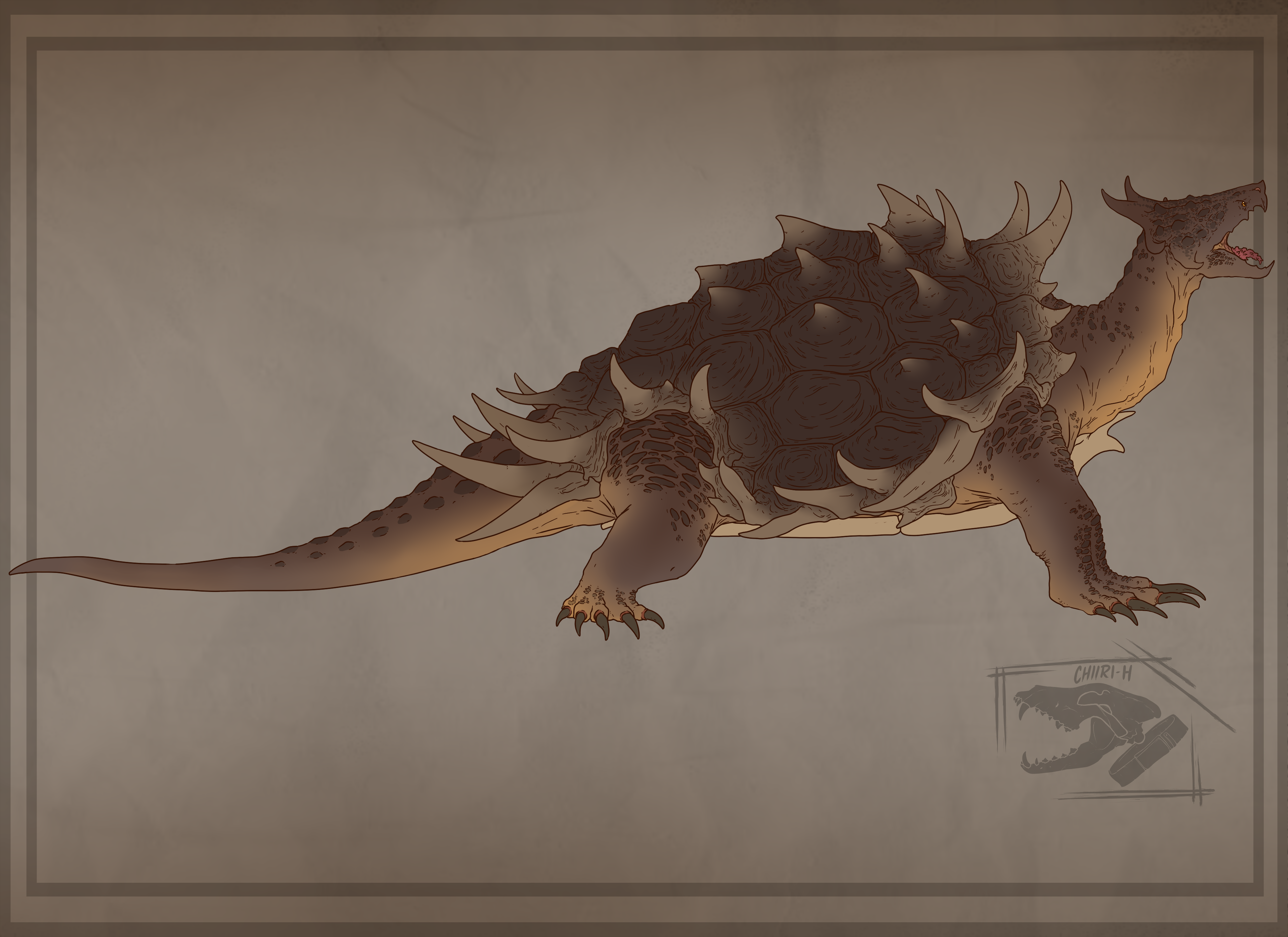
Diamondshell Terrapin
Basic Information
Anatomy
Diamondshell terrapins are a truly massive species of turtle, growing up to 10 feet long from beak to tail. Their shells are incredibly robust and covered in large spines, especially around their front, spine, and rim. These large robust spines drastically increase the animal's perceived size, and begin growing when they are quite young as a way of deterring predation, primarily by making the turtles too large for most predators to fit in their mouths.
The head of a diamondshell terrapin will frequently have large bony projections near the back of the skull, which aid in protecting their long and vulnerable necks. The necks of this species are so long that they cannot fully retract into their shells, however, they can tip their heads downward while retracted to cover them.
Genetics and Reproduction
Like many turtles, diamondshells reproduce in large batches, though are sexually mature at fairly young ages. Younger female turtles tend to lay fewer eggs than larger and older individuals, though those laid by younger females tend to have larger offspring with higher individual success rates of reaching adulthood. This reproductive strategy was initially puzzling to many researchers, but later studies conducted on the cause of death for the majority of specimens found that diamondshells are more likely to be killed and eaten as adults by dragons, and largely left alone as juveniles and subadults. Smaller turtles, although far easier to dispatch, were more likely to evade hunting and reproduce, seeing massive growth spurts later in life.
After mating, female turtles will dig burrows in clay soils that can be tightly packed and retain some moisture, but will quickly drain when wet. Burrows can be up to 8 feet deep to accomadate the nesting female, who will lay her eggs on the burrow floor, and fill in the tunnel to cover her eggs. In some areas, younger diamondshells have been known to dig up the burrows of larger and more aggressive females to lay their eggs within them, and become brood parasites. Once fully incubated, hatchling turtles are quick to dig to the surface and escape as far as possible from their nest to prevent being predated upon by birds of prey, lizards, mammals, and even other turtles.
Ecology and Habitats
These turtles are most common in Central America, but can be found as far north as the Republic of California and some parts of southern Appalachia, though these populations are highly limited and closely monitored. In the bulk of their range, diamondshell terrapins occupy a wide array of environments across central America around bodies of water. The species can be found in river basis, deserts, scrublands, forests, and even in tropical rainforest as long as there is some body of water nearby.
Although not fully aquatic like many other terrapin species, diamondshell terrapins spend a large portion of their time in and around water foraging and hunting, especially as juveniles. Juveniles are frequently mistaken for snapping turtles, and preyed upon by a wide array of animals, with their most frequent predators being birds of prey. Small juveniles commonly are harassed and sometimes killed by small carnivores such as foxes and coyotes, but are not frequently hunted. Once diamondshells reach subadult sizes, usually around 10 years old, they are generally too large for most predators in their environment other than dragons, and almost always too high risk of a prey item to be worth taking on. Dragons are considered the only predators of adult diamondshells.
Dietary Needs and Habits
The species is an omnivore capable of eating fruits, nuts, and soft plant material such as grasses and vegetables, but primarily known for their carnivorous diet. Diamondshell terrapins employ a variety of hunting tactics from ambushing, bullying other carnivores off their kills, to even pursuit predation of smaller animals due to their rather impressive speeds. Anything that can fit in their mouths, and that they can catch, is on the menu. Fish, small rodents, birds, other smaller turtle species, and a wide array of scavenged carcasses are all commonly eaten and they species has been observed to dig out burrows in order to attack rabbits, hares, and lizards.
Likely due to their impressively large shells as well as their extensive pyramiding and spines, the species requires a high amount of calcium in their diets which leads to periods of bone and shell eating during growth periods. Some diamondshells have been observed to eat the shells of their own kind, be they dead or alive, when there is food scarcity. Droughts and famines can also sometimes cause diamondshells to raid their own species' nests to eat their eggs.
Behaviour
Diamondshell Terrapins are oftentimes likened to snapping turtles in behavior, as they are known to be extremely temperamental, prone to biting, defensive, and at times even outright aggressive. Much of this behavior is thought to be attributed to the primary predators of the species being young dragons, who are not easily fended off and are quite intelligent. Diamondshells have been known to give chase to those who intrude on their personal space and bite at people's legs, which due to their incredibly powerful beaks and jaws, can do substantial damage and cause serious injuries.
Females will defend their nests from predators and others of their species alike. Nests are typically burrows in clay-type soils indistinguishable from ordinary patches of ground once covered, and likely a large part of the species' aggressive reputation. While guarding nests, female diamondshells will regularly patrol their nest sites in a wide berth and aggressively attack anything that attempts to come too close to the nest. Due to guarding behavior, the turtles oftentimes do not have much time to hunt or forage, and increasingly become dependent on whatever they can find at the nest.
Additional Information
Uses, Products & Exploitation
Diamondshell terrapins are a frequent target of illegal hunting and poaching due to their high meat yield per animal as well as use for their shells in jewelry, tools, and traditional medicine particularly in dragon territory. Ordinarily, hunting of diamondshell terrapins is regulated in the modern era due to past incidents where overhunting caused their populations to become threatened. Due to the species' reputation as being aggressive and highly demonized in some regions, hunting regulations are oftentimes ignored and the species seen as a pest. Most hunting regulations forbid hunting and trapping diamondshell juveniles and subadults entirely, with adult females being off-limits during their breeding seasons.
Due to their highly reactive nature, videos of substantially large diamondshell terrapins occasionally see surges in virality, particularly in cases where videos show the turtles attempting to (or actually) attacking the persons filming. A frequent habit in these videos is taking objects such as pipes, poles, or branches and trying to goad them into biting them. This has been known to result in injuries to both people and the turtles, with the latter oftentimes not being treated and getting infections due to splinters or metal shards.
Some tourist hotspots also see poaching of the species for the exotic pet trade, oftentimes with dedicated hunters disturbing diamondshell nests during breeding season to steal hatchlings for sale. Few diamondshell terrapins in private captivity as pets receive proper care due to their extremely varied diet, intense sizes, and need of UVB light. As a side effect of the massive sizes these turtles grow to, most taken as pets are also subsequently abandoned later in life, causing issues of introductions to non-native ranges. It's believed that the Appalachia population was started due to precisely this.
Origin/Ancestry
Natural
Conservation Status
Least Concern
Average Length
10-12 ft
Geographic Distribution

Comments