
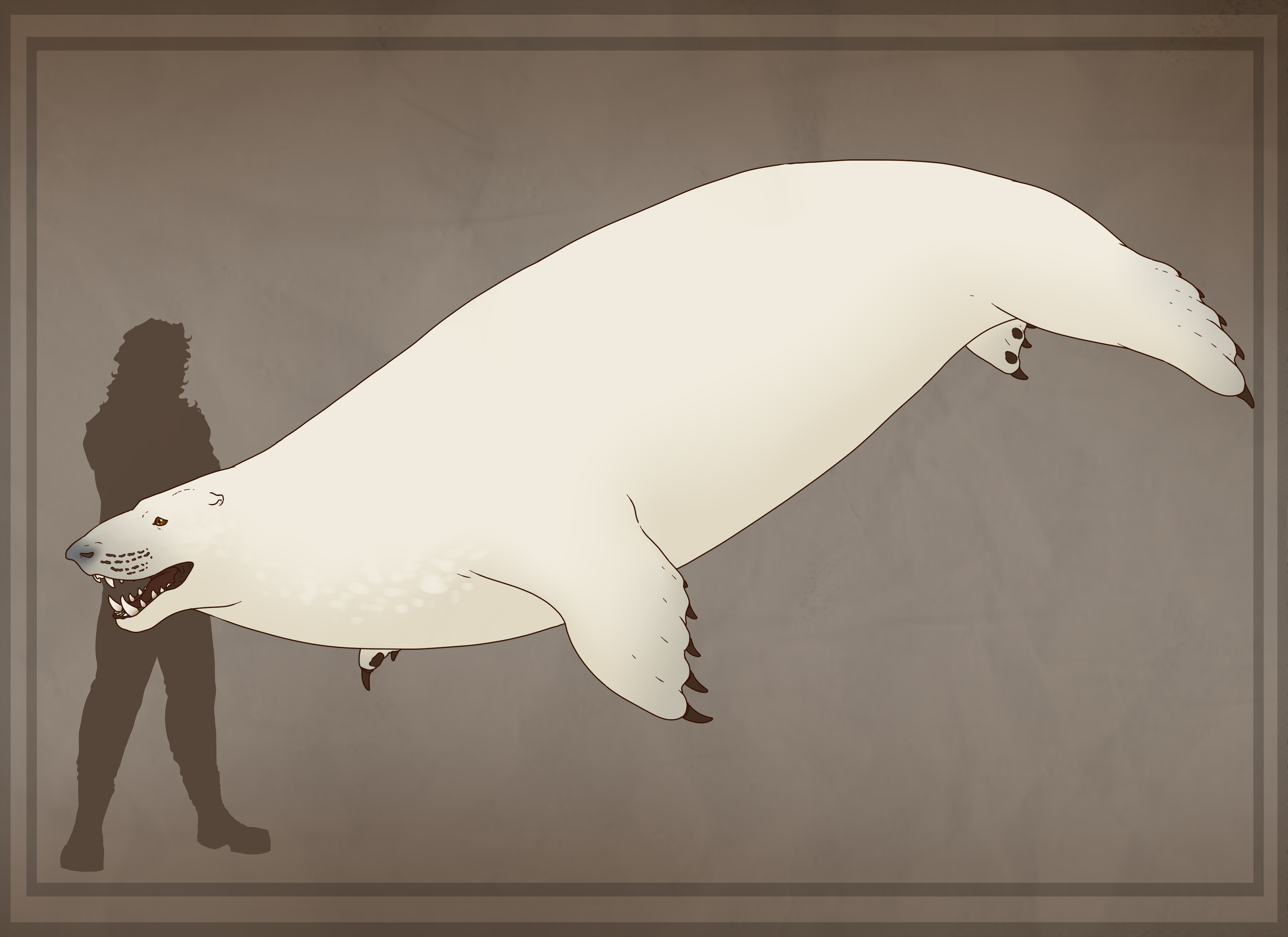
Arctic Bear Seal
Basic Information
Anatomy
The Arctic Bear Seal looks in many ways, like a white leopard seal with a larger head and longer snout. They are typically between 12 and 15 feet long, with short, waterproof fur over their entire bodies that is actually translucent, and they have stark black skin with a thick layer of fat underneath. Bear seals have replaced their limbs with powerful clawed flippers that retain a high degree of mobility and ability to grip onto surfaces such as rocks and icebergs. Due to their incredibly powerful jaws, bear seals are capable of crushing bone easily, which is thought to be their primary method of hunting to dispatch large prey such as true seals, large fish, and young cetaceans.
The Arctic bear seal, however, is not a true seal and actually quite closely related to bears, with genetic analysis suggesting that they are a direct descendant of the thought to be extinct polar bear.
Ecology and Habitats
As their name suggests, these seals are native to the Arctic. They primarily spend most of their lives in the freezing ocean water, coming on land to rest, mate, and give birth, or occasionally eat carrion. Bear seals have been known to take advantage of almost any hunting opportunity they are given, which is sometimes confused for aggression. In reality, due to living in an extremely unproductive and harsh environment, bear seals have become extreme opportunists that cannot afford to pass up any meal they can catch.
Although certainly a large predator in their environments, bear seals are not at the top of the food chain and have been known to be preyed upon by sharks, true seals, and toothed whales such as orcas. Most often, these predation attempts are upon juvenile and subadult individuals, though sharks and orcas are known to also attack adults. In particular, the latter oftentimes will hunt bear seals in the later summer and early fall, when the seals are at their fattest in preparation for winter. Orcas have been known to trap bear seals on icebergs, with some pods utilizing waves to knock them into the water.
Dietary Needs and Habits
Arctic Bear Seals are obligate carnivores, with fish making up the bulk of their diet. They will also feast on shellfish, seabirds, small dolphins and juvenile whales, or anything else that they can manage to kill. Due to their harsh environment, they are also known to scavenge and will eat any carrion available. In areas where their ranges cross, these seals will compete with Needlecoat Wolves, and feast on them as well should they kill one.
They primarily hunt by using speed and ambushing their prey, waiting on ice flows and icebergs for something to pass in the water below them, and will leap into the water and give chase. Land bound prey that comes too close to the water may be in for a surprise, as Arctic Bear Seals are known to lunge fully out of the water, and using their tremendous strength, pull the unsuspecting animal under and drown it. It's believed that bear seals primarily kill their prey by crushing or even severing the spine of prey items, in particular land based animals, causing them to be unable to swim and to drown below the ice. Smaller prey such as fish are often devoured whole after the seals bite and shake them in order to kill them, if not outright swallowed.
Additional Information
Social Structure
The bear seal is a solitary and highly competitive species that only come together in order to mate. Males are known to be highly competitive amongst one another, and in breeding season may suffer grievous injuries due to fighting in attempts to drive the other off from the territory of females. Outside of the breeding season, however, females are also highly highly territorial to their own kind, and especially males.
Young arctic bear seals typically stay with their mother for up to one year, at which point they are independent and will most often quickly leave her territory.
Uses, Products & Exploitation
Arctic Bear Seals are not commonly hunted for food, most often, those that are killed by people are done so because they are seen as a threat by fishermen and locals of small towns. This is done under the idea that they drive away the fish, and create poor catches. It is quite the opposite however, as the bear seals keep their populations in check, and keep other, smaller predators, from over hunting. Unfortunately, areas where fishermen killing them is common see much poorer catches and further blame the seals, keeping a constant cycle going.
Genetic Ancestor(s)
Origin/Ancestry
Natural
Conservation Status
Least Concern
Average Length
12 to 15 feet
Body Tint, Colouring and Marking
White, pale cream, or light grey, with black gums and noses
Geographic Distribution

Comments