

Nelenia - Ayla of Greed (NEL-EE-NUH)
Overview
Among the younger gods of Avalon, few are as quietly terrifying as Nelenia, Ayla of Greed.
She is not a creator like Zion, nor a realm-lord like the Blood King of the Nether or Avalon of sea and soil. Nelenia did not exist at the dawn of the world. Instead, she coalesced out of human behavior itself—out of hoarding, envy, and the conviction that more is never enough.
Where other gods command elements or afterlives, Nelenia rules something far smaller and more intimate: the space inside a person’s want. She is the god who slips in when someone stares too long at a coin, a house, a life that isn’t theirs, and thinks:
I deserve this, no matter the cost.
The Birth of an Ayla
In early myth, “Ayla” is a word used for a manifested aspect—a specific face of a larger, abstract force. There may be Aylas of war, love, or storm, but the first widely recognized and feared was the Ayla of Greed.
Bards and scribes describe her “birth” not as a single thunderbolt moment, but as a threshold: the era when human greed in Avalon grew so concentrated that it crystallized into a consciousness. It was not Zion’s will, nor the Blood King’s scheme; it was the world reacting to the accumulation of desire, like frost forming on glass.
On historical banners of the Early Avalon Era, this event is marked by a single, stark symbol:
a black coin stamped on a pale field, floating among other emblems of mythic history. That coin is Nelenia’s first name before language—simple, circular, and endlessly turning.
Nature and Domain
Nelenia’s domain can be summed in one word—Greed—but that simplicity hides how broad her reach actually is:
- Possession: the urge to own, even beyond use or need.
- Envy: the corrosive hunger for what others have.
- Hoarding: wealth guarded so fiercely it begins to own the owner.
- Justification: the stories people tell themselves to excuse cruelty, theft, and betrayal.
She does not force people to be greedy; instead, she amplifies what is already there. Her power is strongest in those whose minds are already cracked—by poverty, by obsession, by resentment. In her own words, spoken through a mortal mouth:
“A feeble, corrupted mind is the easiest to consume.”
Nelenia thrives where people are convinced they are victims of scarcity, even while standing on piles of gold.
Ivy and the Golden Shade
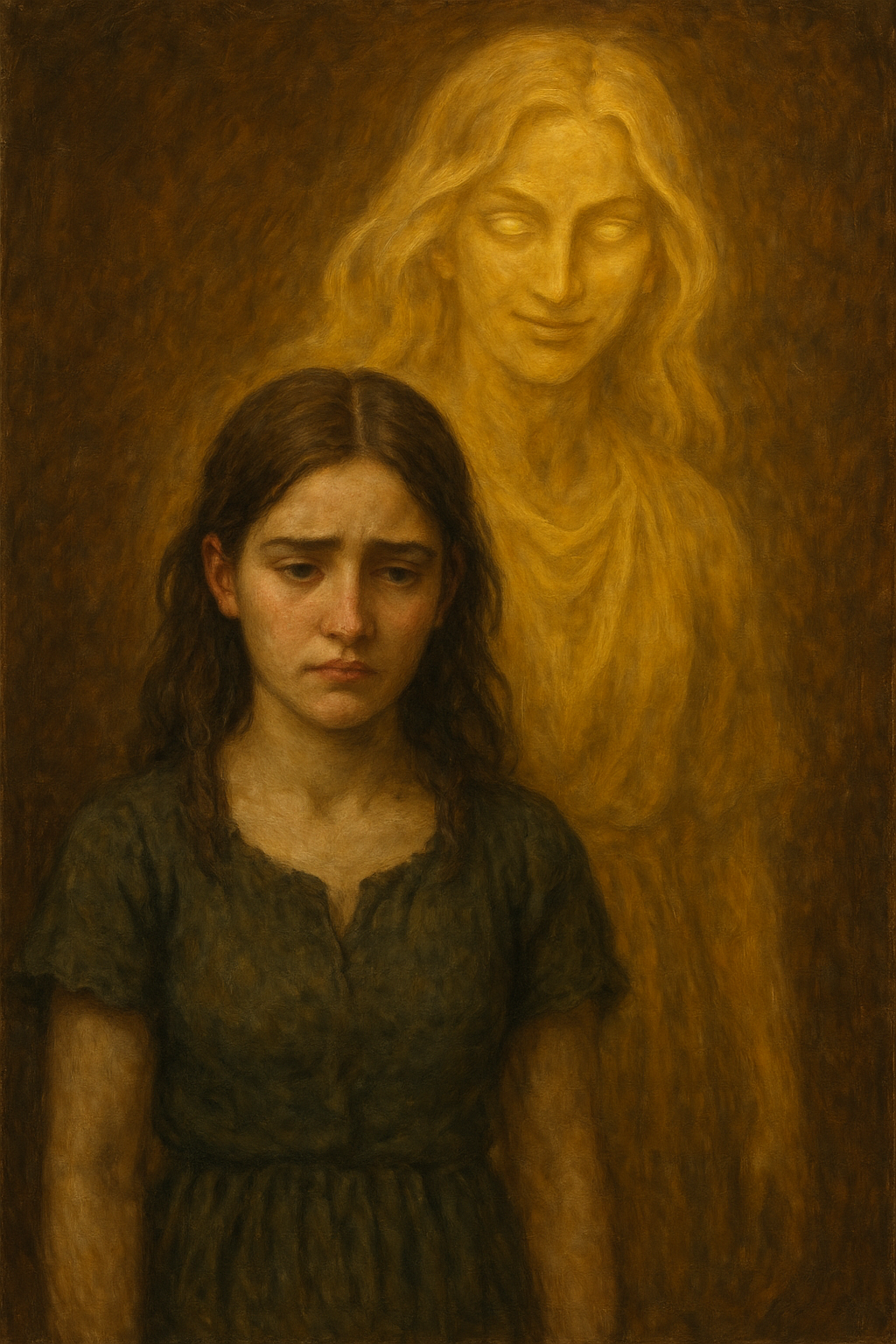
One of the clearest known manifestations of Nelenia in the mortal world is preserved in oral accounts from a rural shack on the edge of Avalon—stories that gave rise to a now-famous painting often titled “Ivy and the Ayla.”
Ivy – the Mortal Vessel
In these accounts, Ivy is a young girl from a poor family. Her life is marked by:
- A fragile home, hanging together by debt and desperation.
- A father broken by failure, rumored dead before he stumbles back into the story.
- A mysterious gold bar hidden in their shack—unnaturally heavy, unnaturally pure, the kind of object that makes people whisper around it.
Over time, Ivy becomes increasingly withdrawn and glassy-eyed, staring at the gold as if listening to something no one else can hear. When her father finally bursts into the shack, believing his daughter has been taken from him, the thing that answers him is not wholly Ivy at all.
Through her, Nelenia speaks—calm, cold, and almost amused.
The artwork inspired by this legend shows Ivy as a realistic, oil-painted figure:
- Thin shoulders and a plain, worn dress in muted green.
- Dark, heavy hair and a face that is all too human worry—brows drawn, mouth pulled down, eyes carrying more fear than malice.
- She looks less like a villain and more like someone trapped in a story she never chose.
That is the first lesson of Nelenia’s manifestations: her hosts are not grand villains. They are ordinary people whose weakest moments have been stretched until something divine can slip inside.
The Ayla Form
Behind Ivy in the painting stands a second figure, rendered as a luminous, golden shade of the same girl:
- The features echo Ivy’s, but smoothed and idealized—cheekbones sharper, posture relaxed, hair flowing like molten metal.
- The eyes are pale and glowing, without pupils, giving the sense that they look through everything rather than at anything.
- Her expression is a faint, knowing smile, the kind worn by someone who already owns the outcome.
This double portrait captures Nelenia’s preferred method of appearing:
Not as a separate monster, but as a perfected, elevated echo of her host.
A version bathed in gold, promising that all their fears and humiliations will vanish if they just keep taking, keep hoarding, keep saying yes.
In stories, onlookers rarely perceive the Ayla form directly; they see only the mortal girl. The golden shade is how priests, painters, and later scholars imagine the spiritual reality hovering just behind Ivy’s frail shoulders.
The Cursed Gold Bar
If Nelenia herself is a consequence of greed, then the gold bar in Ivy’s story is one of her most infamous anchors.
Across multiple tales scattered through Avalon:
- The same bar—or one exactly like it—passes from hand to hand:
- a battlefield scavenger
- a failing merchant
- a back-room bar owner
- a hermit sending boxes and letters across the realm
- Each time, the new owner becomes increasingly fixated:
- sleeping with it under their pillow
- hiding it from family and friends
- weighing every choice—love, loyalty, morality—against the draw of that single hunk of metal.
The bar seems to absorb and recycle obsession. The more someone clings to it, the less they are able to imagine themselves without it. Many die either protecting it or trying to get it back after losing it.
Scholars of the occult argue that:
- Nelenia doesn’t live inside the bar, the way a simple curse might.
- Instead, the bar acts like a portable altar, a focus that makes it easier for her attention to settle on a person.
- Once that attention is locked in, the bar becomes a mirror: it reflects only what the person wants, until they can’t see the rest of their life at all.
In Ivy’s case, the bar is both a source of hope—maybe it can save her family—and the doorway through which Nelenia steps into her mind.
Methods of Influence
Nelenia is subtle. Where the Blood King might roar through nightmares and the Nether, and where Avalon herself can drown a ship or shake a coastline, Nelenia works with whispers and rationalizations.
Common patterns in stories linked to her include:
- Isolation:
The target pulls away from friends and family, afraid someone will “take what’s theirs.” - Justified Cruelty:
They begin to see harm as necessity:
“If I don’t do this, they will. If I don’t take it, someone else will steal it from me.”
- Shifting Blame:
Misfortunes are always someone else’s fault, never their own choices. - Green-Tinged Eyes:
Witnesses sometimes describe a fleeting, unnatural green sheen in the eyes of the obsessed—especially in the moments before violence or betrayal. This may be pure superstition, but it recurs often enough to be part of Nelenia’s visual myth.
Possession, as in Ivy’s legend, is the extreme end of this arc. Most of the time, Nelenia never needs to cross that threshold; simple nudges are enough. But when a mind is “feeble and corrupted” enough—as she herself phrases it—she can step in more fully, shaping words and actions directly.
Worship, Denial, and Everyday Greed
Unlike gods who receive open offerings in public temples, Nelenia is rarely worshipped by name. There are no great cathedrals of Greed; there are locked vaults and hidden chests, private shrines that look, from the outside, like ordinary hoards.
In practice, worship of Nelenia looks like:
- A merchant who cheats their own books and whispers a promise to “make it up later.”
- A landowner who keeps grain rotting in secret barns while neighbors starve, telling themselves it’s good business.
- A gambler clutching their last coin, insisting the next roll will fix everything.
Few of these people would ever admit to invoking a goddess. Yet in the moral math of Avalon, each act is a kind of silent prayer—one Nelenia is always listening for.
Legacy and Interpretation
Artists and historians are divided on how to interpret Nelenia:
- Moralists treat her as a cautionary figure: proof that if a society feeds its worst impulses long enough, those impulses become powerful enough to rule it.
- Mystics argue she is a necessary balance—without greed, ambition and progress would die. They whisper that sometimes Nelenia pushes people not just toward hoarding, but toward risk, forcing them to confront what they truly value.
- Skeptics claim she is nothing more than a story wrapped around economic systems and human failings, with the gold bar functioning as a metaphor for generational trauma and inherited sin.
But regardless of philosophy, everyone in Avalon knows the same simple shorthand:
- A coin on a pale banner.
- A golden figure standing behind a frightened girl.
- A bar of gold that never brings peace to anyone who touches it.
Those are the signs of Nelenia, Ayla of Greed—the god who was born, not from the will of heaven, but from the bottomless desire of the world itself.

Comments