
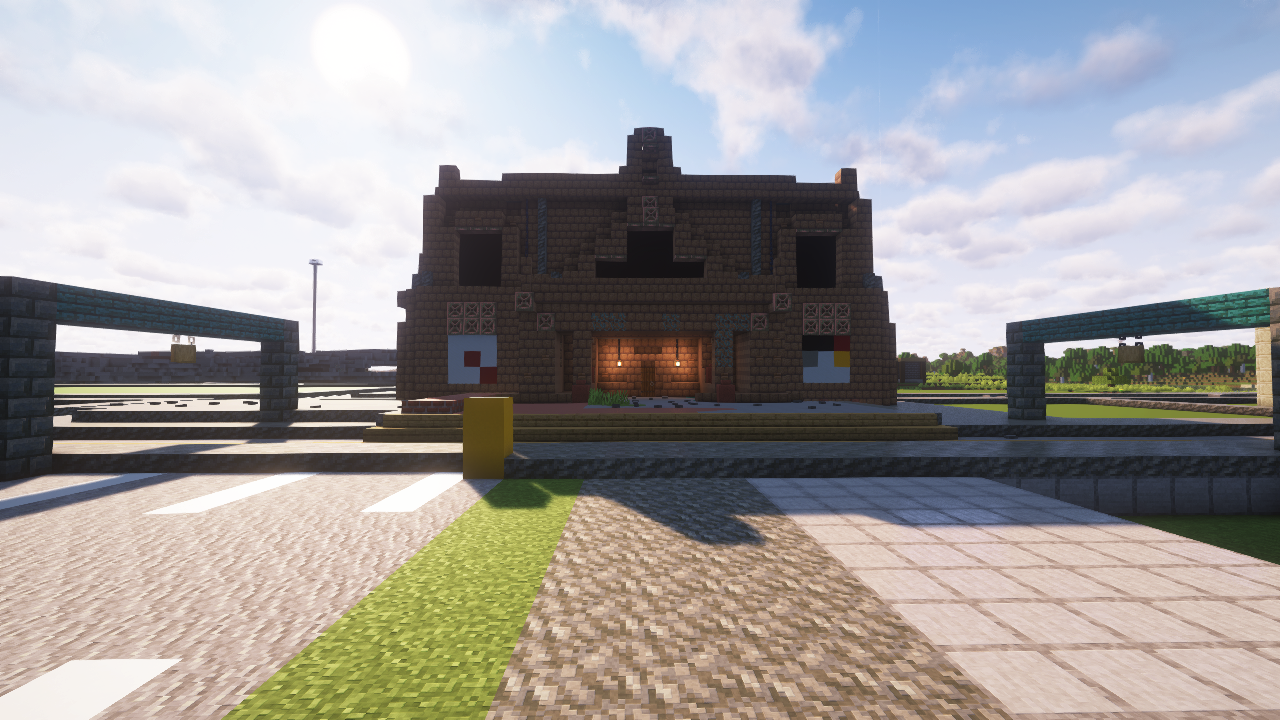
Lakeview
Lakeview is a young town wearing an old town’s skin.
Officially, it was founded on 10/09/2024, but almost everything about it—from the stonework to the lanterns—feels borrowed from somewhere older and rougher, especially Steel Port City. Add in a mysterious gray tree that might be tied to an unknown Ayla and a rail depot humming just north of town, and Lakeview becomes one of those “quiet” places that’s actually doing a lot more than it lets on.
Basics
- Town: Lakeview
- Founded: 10/09/2024
- Region: South Line corridor
- Nearby Landmarks:
- Lakeview Train Depot (15 minutes north, behind the Adrenalin sculpture)
- The gray tree with the pinkish-purple strip on a dirt mound
- Influences: Old districts of Steel Port City, trade routes to Riverton, and the Shade Rail network
Founding & Purpose
Lakeview started because the rails and the lake needed each other.
By 2024, traffic along the South Line had grown enough that Shade Rail and regional planners needed:
- A lakeside town to support docks, warehouses, and workers.
- A community close to the Lakeview Train Depot, where freight, documents, and long-term storage all intersected.
- A quieter alternative to Riverton and Steel Port City for rail workers and families who didn’t want a full-blown city life.
The founding date of 10/09/2024 marks when the town’s charter was formally recognized, plots were surveyed, and the first permanent streets were laid out. Before that, there were only shacks, work camps, and a few stubborn fishing cabins hugging the lake.
Lakeview grew outward from three core points:
- The lakeshore – docks, storage sheds, early houses.
- The road north – leading to the Adrenalin sculpture and the Lakeview Train Depot.
- The central square – planned from the start as a small but proud nod to old urban design.
Architecture: Steel Port’s Shadow on the Lake
Lakeview may be new, but it deliberately looks old.
A lot of its early builders either trained in, or flat-out came from, Steel Port City. Rather than clean, modern lines, they brought their memories of cramped stone streets and brick alleys and re-created them on a smaller, cozier scale.
Common Features
- Materials
- Stone bases with slightly “sooty” textures.
- Dark oak and spruce beams, sometimes stripped and framed with iron details.
- Brick trim used not just for chimneys, but for decorative bands around windows.
- Style
- Two- and three-story narrow facades facing the street, even when the buildings don’t strictly need the height.
- Overhanging upper floors supported by beams, giving alleys that feeling of being watched from above.
- Lanterns mounted on wrought-iron brackets extending over the road, mimicking Steel Port’s older districts.
- Street Feel
- Roads curve with the shoreline, but blocks are laid out in tight, almost urban clusters.
- Side alleys connect back to the main road like shortcuts, often just wide enough for a cart.
- From certain corners, you can see the gleam of the lake at one end of the street and, faintly, the hills hiding the depot at the other.
The result is a town that feels like a miniature, cleaned-up Steel Port ghost, transplanted to a softer, quieter place.
The Gray Tree on the Mound
On the edge of town, away from the docks and the busier streets, sits Lakeview’s strangest landmark:
- A gray tree, its bark almost colorless—as if it’s been bleached of life.
- Around its trunk runs a thin pinkish-purple strip, like a vein of color frozen mid-pulse.
- It grows out of a raised mound of dirt, as if the ground itself lifted just to hold it.
Grass around the mound grows, but somehow looks less vibrant the closer it is to the trunk. The tree doesn’t bloom or fruit like anything familiar. It doesn’t seem sick. It just… endures.
Rumors of an Unknown Ayla
Nobody agrees on what the tree actually is, but Lakeview has already spun a full web of rumors:
- Some say the tree marks a place where an Ayla once touched the land and pulled away:
- The gray bark is what’s left after the Ayla withdrew.
- The pinkish-purple strip is the last trace of emotion or power that refused to vanish.
- Others insist it’s connected to an Ayla no one has properly named yet:
- Not one of the known domains, but something in between—memory, regret, or unfinished love.
- They claim if you press your hand to the colored strip for long enough, you feel both calm and unsettled at the same time.
- A darker story whispers that the tree was once a person:
- Someone who bargained too close with an Ayla and was rooted in place.
- The mound is their buried body, and the tree is their transformed form, watching the town grow.
At dusk, a lot of people walk the long way home to avoid it. A smaller, braver group goes there on purpose—to sit on the edge of the mound and see if the world feels different for a few seconds.
The Adrenalin Sculpture & The Lakeview Train Depot
Fifteen minutes north of town, the road rises into low hills and gravel. Out there, the lake shrinks behind you—and a towering sculpture rises ahead.
Adrenalin
- A giant, chaotic structure of odd-colored materials that would’ve otherwise gone to waste.
- Built after an idea by Quiver and his team at BB Co., inspired by the song “Adrenalin” by James Blunt.
- Erected as a public art piece after Quiver spoke with the Mayor of Lakeview, who agreed to let it stand about 20 miles out of town along the line.
The sculpture is all angles, curves, and color—a frozen explosion leaning over the rail corridor. Travelers use it as a landmark. Locals use it as a story starter:
“You see that thing? That’s how you know you’re almost home.”
The Lakeview Train Depot
Directly behind Adrenalin, tucked into the stone and dirt, lies the Lakeview Train Depot.
- Built by the Shade Rail Road Company.
- Serves primarily to support the South Line by:
- Staging freight.
- Keeping stock and supplies.
- Storing important documents and records tied to South Line operations.
It’s partially carved into the hillside, with:
- Exterior loading platforms and tracks for trains to pull in and out efficiently.
- Interior storage galleries where crates, barrels (including a lot of beet wine shipments), and sealed boxes sit on labeled racks.
- A small cluster of offices where dispatchers, logistics staff, and clerks track cargo, routes, and long-term records.
Lakeview as a town is effectively the living space attached to this machine. The depot feeds the town, and the town, in return, provides bodies, food, and rest.
Ties to Riverton
Lakeview may not share borders with Riverton, but it is very much in Riverton’s orbit.
Rail & Trade
- The South Line and connected routes provide a direct lifeline between Lakeview and Riverton.
- Goods moving through Lakeview—especially:
- Beet wine from A-to-Z Winery and other agricultural products.
- Lake-caught fish and processed goods.
- Timber and stone from surrounding hills—
often pass through or head toward Riverton as a major internal hub. - Conversely, specialized materials and urban goods originate from Riverton and arrive in Lakeview:
- Construction supplies.
- Machinery for the depot.
- Finer tools, tech, or luxuries not made locally.
Trains that stop at the Lakeview depot are often scheduled with Riverton’s needs in mind, even if the people in Lakeview only see the final timetable posted on a notice board.
Political & Cultural Influence
- Riverton’s status as a major city and rail center gives it quiet leverage:
- Decisions about expansions along the South Line.
- Prioritization of which depots get what equipment or upgrades.
- Agreements about where certain high-value shipments are routed.
- Lakeview’s mayor and council are often in talks—directly or indirectly—with Riverton officials:
- Negotiating better service for the town in exchange for supporting broader projects.
- Balancing Lakeview’s desire to remain a small, character-rich town with the pull of being close to a larger city’s network.
- Culturally, many Lakeview residents:
- Have family or work history in Riverton.
- Travel there occasionally for business, bulk shopping, or city events.
- Bring back stories, fashions, and habits that slowly seep into Lakeview’s taverns and homes.
Lakeview is not a suburb, and it’s not a rival. It’s a partner town—a lakeside outpost that helps keep Riverton’s trade spine strong while developing its own identity.
Daily Life & Mood
On any given day, Lakeview feels like a town halfway between hard work and quiet ritual:
- Mornings
- Wagons roll toward the docks.
- Depot workers and clerks head north along the road toward Adrenalin and the yard.
- The lake mist lifts slowly off the water, giving the streets a soft, ghostly feel.
- Afternoons
- Shops in the Steel Port–style square open their doors.
- You can hear faint train horns from the north if the wind is right.
- Children dare each other to get closer to the gray tree mound, then sprint away laughing.
- Evenings
- Lanterns light up those stone-and-wood facades.
- Taverns fill with rail crews, lake workers, and locals comparing notes on rumors:
- New train schedules.
- Strange shipments.
- What someone’s cousin supposedly saw near the gray tree at dusk.
- The silhouette of the Adrenalin sculpture glows faintly in the distance when the depot lights are on behind it.
Government
Corrupted by a secret organization currently only known as "HR".
Industry & Trade
Trade partners with the somewhat close town of Riverton, the trade capital of Avalon.
Infrastructure
Old school structures. Near Trade Capital of Avalon

Comments