
Aldore (AL-)
Aldore
The Banished Tide, Keeper of Seadon, Ayla of the Ocean’s Depths and the Exiled
Overview
Aldore is an Ayla of Avalon associated with the ocean, exiles, and reconciliation. Once a mortal outcast from the cliff-top town of Cliffs Edge, Aldore’s transformation into a divine being began with his forging of the diorite sword Seadon and a fateful pact with the Avalon Sea.
Though his mortal lifetime is generally placed in the Late First Tide (c. Years 300–340 in the Avalon Calendar), Aldore’s influence has grown steadily across millennia. In modern times (post-2024), he is honored by a great monument along the South Line rail, making him both an ancient figure of myth and a living presence in contemporary Avalon.
Domains and Portfolios
- Primary Domains
- The Ocean & Tides
- Exiles, Outcasts, and the Wronged
- Reconciliation and Second Chances
- Secondary Aspects
- Patience and Endurance
- Craftsmanship born of necessity
- Listening to what others fear or refuse to hear
Among sailors, cliff-dwellers, and travelers, Aldore is invoked as a guardian of those who do not belong, those cast away by fear, and those standing on the edge of great change.
Titles and Epithets
- The Banished Tide
- Keeper of Seadon
- The Stone-Wave
- Watcher of the Cliffs
- Patron of the Cast Out
- Listener of the Deep
Appearance and Symbols
Common Depiction
Aldore is usually depicted as a tall figure with striking azure eyes, their color matching the deepest stretches of the Avalon Sea. His hair is often shown wind-tossed and dark, with sea-spray woven through it. He is almost always portrayed standing on a ledge or cliff edge, cloak whipped by unseen winds, Seadon held point-down like an anchor driven into the earth.
Symbols
- A diorite sword half-submerged in stylized waves
- A single azure eye above a rolling tide
- A cliff face divided by a wave, representing exile and return
- Polished sea stones and shells, often arranged in circles or spirals
Worshippers frequently carry a small stone, shell, or shard of diorite etched with a single line wave, as a personal token of Aldore.
Mortal Origins
- Era: Late First Tide, approx. Years 300–340
- Place of Birth: Cliffs Edge, an ancient town built high above the Avalon Sea
Aldore was born during a rare celestial alignment in which several bright stars formed an arc over the Avalon Sea. Local star-watchers considered the sign auspicious and unsettling. The child’s unusual azure eyes deepened these suspicions, and older traditions whispered that such eyes belonged more to the gods than to men.
From early childhood, Aldore could sense the ocean in ways others could not. He claimed to feel its moods like changing weather within his own chest. He would wander the cliff paths alone, listening to the waves, returning with strange insights or warnings: storms announced days in advance, shifting fish patterns, even changes in currents long before any sailor noticed.
What should have made him a treasured oracle instead stirred fear. The people of Cliffs Edge believed in respectful distance from the powers around them. Aldore’s closeness to the sea felt like trespassing on divine territory.
Exile from Cliffs Edge
As Aldore’s talents grew, so did the unease in town. The Council of Elders convened several times in secret to discuss him. Rumors painted him as a danger:
- Some claimed he could call storms.
- Others reported hearing him speak in a language of waves and wind.
- A few whispered that the ocean had “chosen” him in a way that would doom them all.
Eventually, the council accused Aldore of meddling with forbidden powers and disrupting the balance between town and sea.
On an overcast day in the Late First Tide (traditionally dated around c. 327), Aldore was publicly banished from Cliffs Edge—stripped of home, family ties, and all legal protection. He was forced to walk down the narrow switchback path leading from the town’s plateau down toward the wave-carved rocks below, watched in silence by the people he once called neighbors.
The Forging of Seadon
Rejected by his own people, Aldore wandered the harsh shoreline beneath the cliffs and eventually found a secluded cove ringed by walls of weathered stone. There, the roar of the Avalon Sea was constant and intimate, drowning out the memory of cruel words above.
In the cliff walls he discovered veins of cold, dense diorite—harder to work than common stone but resilient like the cliffs themselves. With simple tools and sheer determination, Aldore began to shape a weapon:
- He carved by hand, blow by blow, sleeping in shallow caves when the tide crept too high.
- He listened to the surf as if it were a teacher, mimicking its rhythm with each strike of his chisel.
- He poured his heartbreak, loneliness, and stubborn hope into the stone.
This process took weeks, then months, in what later myths compress into a symbolic “forty nights of toil.” By the end, the rough diorite block had become a distinct blade—angular, pale, and sharp, with subtle ripples in the grain reminiscent of frozen waves.
Aldore named it Seadon, a name later glossed as “Son of the Sea” or “Sea’s Edge Blade” in temple texts.
The Moonless Night and Apotheosis
The pivotal moment in Aldore’s story occurs on a moonless night (traditionally dated to c. 328, though some cults honor the first new moon of the fourth month as its symbolic anniversary).
On that night:
- Aldore walked into the sea with Seadon in both hands, wading until the waves reached his chest.
- He plunged the diorite sword beneath the surface, calling out not to any known god by name, but to the sea itself—to Avalon’s waters, to whatever consciousness had whispered in his mind since birth.
- Witnesses are rare, but later accounts describe a sudden eruption of cerulean light under the waves. The sea is said to have glowed from within, outlining Aldore and the sword in luminous blue.
According to Aldore’s later teachings, the ocean did not answer him with words, but with acceptance. The waves curled around Seadon, weaving ancient enchantments into the blade while a tide of power surged into Aldore’s own body.
That night is regarded as the moment Aldore crossed from mortal to Ayla. His lifespan lengthened beyond human measure, and his bond to the sea became permanent. From then on, he was no longer merely a man who heard the ocean—he was a living extension of it.
Immortality and the Hidden Shore
Following his apotheosis, Aldore did not return to Cliffs Edge. Instead he chose a hidden shoreline—a stretch of coast shrouded in mist and difficult to reach by ordinary paths. There he lived in quiet seclusion, watching ships pass in the distance and listening to the prayers of those who cried out over stormy waters.
Over centuries:
- He intervened subtly in shipwrecks, guiding a few survivors to shore.
- He appeared in dreams to exiles and wanderers, offering them not victory, but understanding and a path forward.
- He came to be known as the Ayla who listens when no one else will.
Though rarely seen directly, sightings are scattered throughout Avalon’s recorded history: a lone figure on a cliff during a tempest, azure eyes glinting; a stranger on a beach who speaks a single sentence that changes someone’s life, then vanishes with the receding tide.
Spread of the Cult and Changing Reputation
When stories of Aldore’s survival and growing power spread back to Cliffs Edge and beyond, opinions gradually shifted:
- Cliffs Edge, shamed by the legacy of its fear, slowly came to acknowledge that its treatment of Aldore had been a tragic error.
- Sailors and traveling mystics embraced him as a patron of the misjudged.
- Those who had been cast out of families, guilds, or towns found comfort in a god who had shared their experience.
By the Middle Age of Rails (c. 1500–1700), shrines to Aldore had appeared in several coastal towns, usually simple stone altars overlooking the sea. Offerings at these shrines are typically:
- Seashells
- Polished stones
- Short written confessions or prayers asking for second chances
The Aldore Monument (Modern Era)
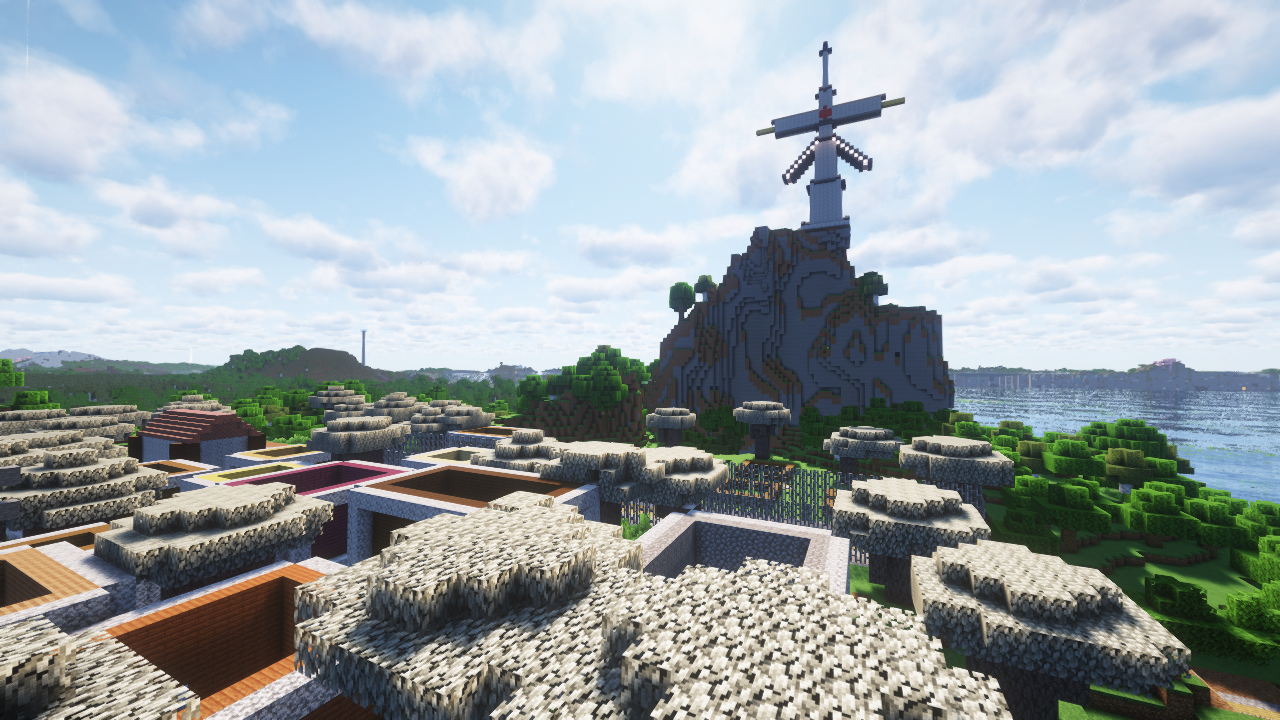
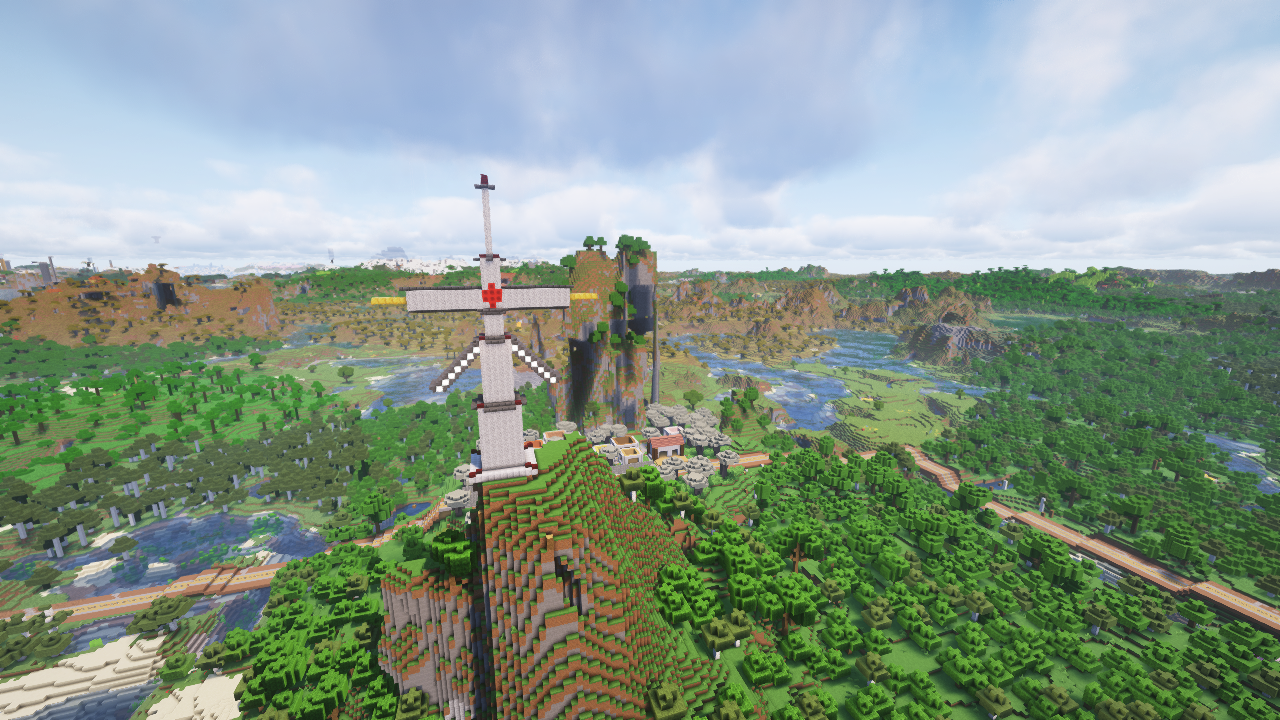
Location: A towering peak off the South Line in southern Avalon
Commissioned: Shortly after the completion of major South Line segments in 2024
Unveiled: Commonly commemorated on 06/06/2025
With the completion of the South Line railroad in 2024, access to remote coastal cliffs became easier. A circle of modern devotees from Spawntown, Lakeview, and several rail towns proposed a grand monument to Aldore:
- The monument depicts Aldore standing on a stone peak, Seadon held downward, its tip resting on the rock as if pinning the world in place.
- His gaze is fixed eternally toward the Avalon Sea, symbolizing both the source of his power and the place of his exile.
- The statue is carved from pale stone veined with dark specks, echoing diorite, and inlaid with faint cerulean fragments that catch the light at sunrise and sunset.
The site rapidly became a major pilgrimage destination. Travelers endure a steep climb from a small South Line stop to reach the summit, where:
- Offerings of shells, stones, and handwritten apologies or thank-you notes pile up around the monument’s base.
- Many pilgrims leave behind personal tokens tied to stories of exile—old uniforms, broken tools, or symbols of past identities they have chosen to move beyond.
In modern Avalon, the Aldore Monument is not only a religious site but also a cultural symbol of reconciliation with one’s past.
Seadon – The Stone-Wave Blade
Material: Hard diorite, magically altered by direct infusion with the Avalon Sea
Nature: A semi-living artifact that resonates with the sea’s power
Legends claim that Seadon:
- Can cut through both stone and water with equal ease.
- Causes nearby seas to calm or surge depending on the wielder’s intent.
- “Whispers” to those burdened by guilt, encouraging confession and healing rather than vengeance.
Some traditions insist Seadon remains with Aldore on a hidden shore. Others claim he occasionally lends the blade to mortals for brief, critical quests—particularly to those who have been unjustly cast out or are seeking to right ancient wrongs.
Personality and Worship
Personality
Aldore is described as:
- Patient but unyielding – like the tide, he wears down injustice slowly but relentlessly.
- Compassionate to individuals, but harsh toward cycles of fear and prejudice that cause repeated harm.
- Quiet, observant, and slow to anger, yet terrifying when finally roused—storms, cliff falls, and sudden rogue waves are sometimes attributed to his rare fury.
He is not a god of easy answers. Those who pray to Aldore often find themselves challenged to change themselves rather than their circumstances alone.
Worship Practices
Common devotions include:
- Sitting near water and listening in silence, mirroring Aldore’s own habit of listening to the sea.
- Leaving offerings at high, windy places—cliffs, tall towers, or peaks—symbolizing the path from exile to perspective.
- Writing down a memory of rejection or injustice, then casting it into the sea or burying it under a stone as a symbolic act of release.
Timeline (Key Milestones)
Dates use the Avalon Calendar, with early eras approximate (c. = circa).
- c. 300–305 – Approximate birth of Aldore in Cliffs Edge, under a rare celestial alignment over the Avalon Sea.
- c. 320–327 – Increasing tension between Aldore and the elders of Cliffs Edge; his oceanic gifts become widely known and feared.
- c. 327 – Aldore is formally banished from Cliffs Edge and forced to live along the rocky shoreline below the town.
- c. 327–328 – Aldore discovers a secluded cove and begins forging Seadon from diorite in the cliff walls.
- c. 328 (Moonless Night) – Aldore submerges Seadon in the Avalon Sea; the ocean responds with cerulean light. Aldore undergoes apotheosis and becomes an Ayla.
- c. 330+ – Early scattered reports of a mysterious figure on the cliffs and shores; the cult of Aldore quietly begins among sailors and exiles.
- 1500–1700 – Shrines to Aldore appear in multiple coastal towns; he is widely recognized as Ayla of the Ocean, Exiles, and Reconciliation.
- 10/19/2024 – Completion of key South Line sections, opening remote coastal peaks to easier access.
- 2024–2025 – The Aldore Monument is planned and constructed on a towering peak off the South Line.
- 06/06/2025 – Traditional date of the unveiling of the Aldore Monument, now a major site of pilgrimage and offerings.
Role in Avalon’s Wider Mythology
Within the broader tapestry of Avalon’s gods and Aylas, Aldore occupies a vital thematic niche:
- Where Zion represents creation and vast power, and Avalon (the land-sea goddess) embodies the living world itself, Aldore stands at the human edge between fear and understanding.
- His story is repeatedly used to teach that power misunderstood becomes fear, and fear left unchecked becomes cruelty—and that it is possible, though difficult, to heal those old wounds.
For players and storytellers in Avalon, Aldore offers rich grounds for narrative:
- Lost or exiled characters seeking a god who understands them.
- Journeys to the Aldore Monument along the South Line as pilgrimages or quest destinations.
- Rumors of Seadon resurfacing when the balance between fear and compassion tilts dangerously.
Once condemned as a threat, Aldore now stands in Avalon’s canon as a timeless beacon—a god who proves that being different is not a curse, but a tide, powerful and deep, waiting to be understood.

Comments