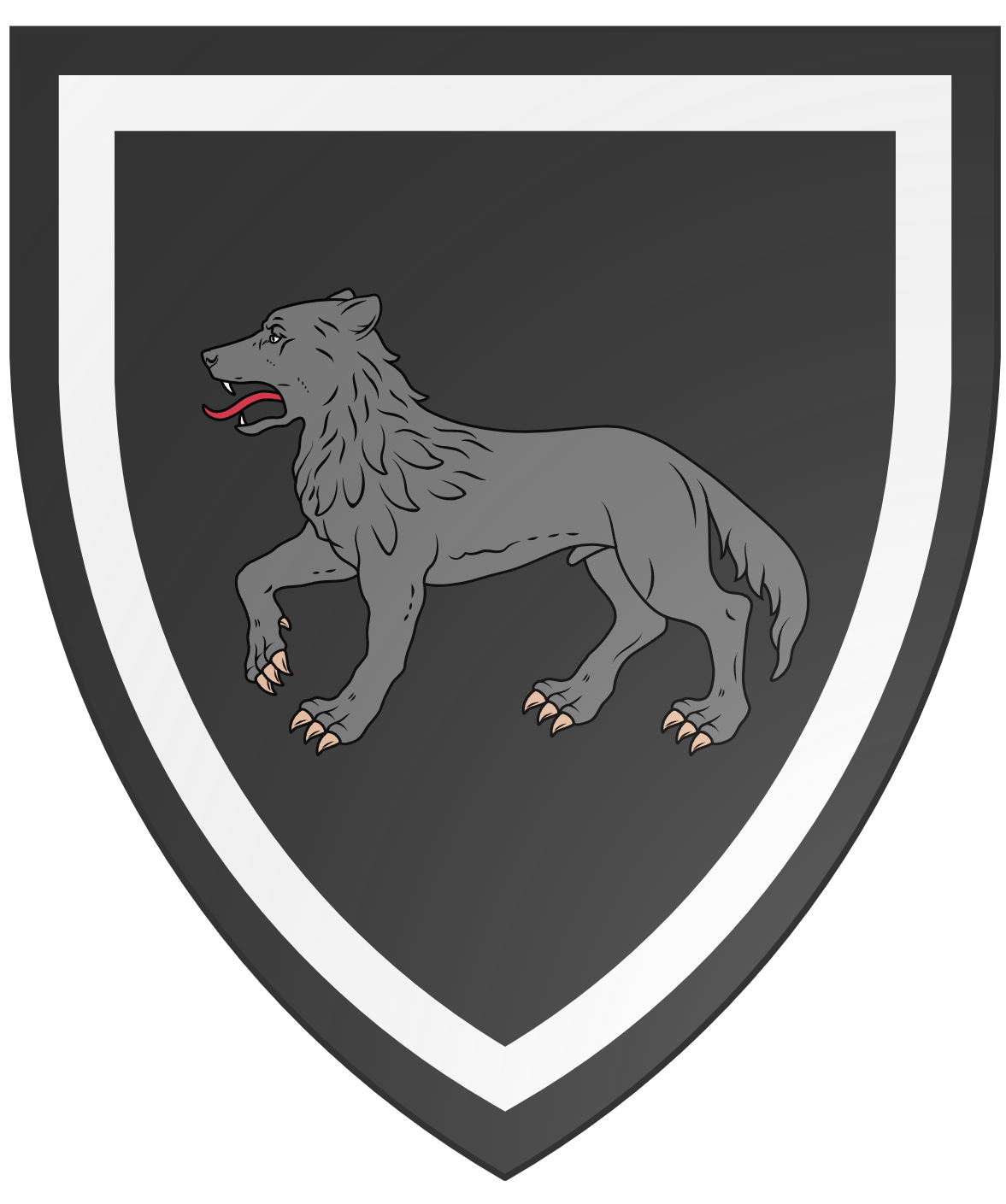
Oswulf
⚜ House Oswulf of Greywatch
Sigil: A grey wolf on a black field
Motto: “By Fang and Flame”
Faith: Apotheosic religion main gods Vandar, God of Death and Souls, Zennar, God of Glory and Duty, Raegon, god of dragons, Kiba, god of Warriors and Wolf
Seat: Greywatch Keep, southern Albion Coast
Origins (Late Age of Darkness, c. 550–600 PR)
House Oswulf rose from the northern marches of Albion, a wild and wind-torn land that bordered Jarlinton raiders and cultist incursions. Their founder, Lord Brand Oswulf, earned his nobility after the Siege of Greystone Pass (557 PR)—a brutal campaign where his small warband held back demonic remnants from Zelistra’s retreating host.
Brand was knighted by King Athelwulf Goldred, taking the wolf as his sigil to honour the pack of direwolves that hunted with his men during the siege. He built Greywatch Keep atop the cliffs of the western coast to guard the sea and road between Dragon Keep and Dovel.
The Age of Rebuilding (600–617 PR)
During the reigns of Leoric and later Wulfred Goldred, House Oswulf became one of the stabilizing northern families. They provided wardens, soldiers, and scouts to rebuild war-torn regions and police the borders against Jarlinton exiles and pirates from Devil Island.
- Lord Hadrin Oswulf, Brand’s grandson, was known as the “Grey Fang” for leading winter campaigns against the Frostblood Raiders from Fenris.
- The family gained a reputation for harsh justice and unshakable loyalty—wolves who bowed only to Albion’s crown.
The Tragedy of Greywatch (618 PR)
By 618 PR, House Oswulf’s prosperity turned to tragedy. Lord Garric Oswulf and Lady Eirena Oswulf perished mysteriously during the young heir’s eighteenth birthday feast—poisoned wine, later believed to have been sent by enemies from Nev-Tisk-Is, a small island kingdom south of Albion that had long resisted Albion’s expansion.
Their son, Ser Aldric Oswulf, became lord of the house at only eighteen. Known for his sharp discipline and cold pragmatism, Aldric swore vengeance for his parents’ deaths.
The War of the Wolf (620 PR)
Aldric raised the Greywatch Host, gathering banners from minor coastal barons and hiring mercenaries from Goffik and Norlan. Supported quietly by Albion’s nobles who saw Nev-Tisk-Is as a threat, he launched an unsanctioned invasion across the narrow channel south of Albion in early 620 PR.
The campaign was short and savage. Aldric’s troops landed at Blackglass Cove, burning through the island’s defences and forcing the local Nev-Tisk-Is lords into submission within three months. Before the Summer of 620 PR has ended, the island was under Oswulf control and renamed Greyfang Isle.
King Wulfred later legitimized Aldric’s conquest, granting him the title “Lord of Greyfang”—transforming his house from mere wardens into new island lords of Albion’s frontier.
Modern Era (Post-620 PR)
Today, Lord Aldric Oswulf rules from Greyfang Keep, overseeing both the mainland estate at Greywatch and his new island holding. His marriage to Lady Aravae Avalan, a High-Elf noble of House Avalan (one of Albion’s oldest elven lineages), has strengthened his house’s legitimacy and wealth.
Together, they have united human discipline and elven wisdom, blending Greywatch’s martial might with Avalan’s arcane traditions. Under their rule, Greyfang Isle is being rebuilt into a thriving stronghold, serving as Albion’s southern bastion and naval base.
Rumours persist, however, that Aldric’s conquest drew the ire of Nev-Tisk-Is’s sea-priests and that curses still haunt the island’s cliffs—grey wolves howling each night as if mourning something unseen.
Known Allies and Enemies
Allies:
- House Avalan – by marriage; Elven nobles with influence in Albion’s court.
- The Order of the Silverbrand – respects Oswulf discipline and valour.
Enemies:
- Nev-Tisk-Is’s remaining priest-lords – seeking vengeance for their lost homeland.
- Fenris raiders and Norlan pirates – traditional foes of Greywatch.
House Reputation
The Oswulfs are viewed as Albion’s wolves—fierce, loyal, and unrelenting. Their symbol, a grey wolf on black, represents both protection and predation. They are respected across Albion’s courts as soldiers of unbending resolve, though some whisper that Aldric’s ambition mirrors the very hunger of his sigil.
The War of the Wolf (620 PR)
A Saga of Blood, Steel, and the Grey Banner
Told in the Chronicles of Albion, Year of Reckoning 620 PR
The Night of Howls — The Death of Greywatch
“The feast was joy and ruin both; laughter turned to blood and silence.”
On the eve of his eighteenth birthday, Aldric Oswulf, heir to Greywatch Keep, stood beneath the great iron chandeliers of his ancestral hall. The wine was red, the torches golden, and the wolf banners hung proud above the tables. But before midnight’s bell had finished tolling, Lord Garric Oswulf and Lady Eirena lay dead, their cups foaming with poison.
The servants fled into the snow; the wolves of Greywatch howled through the cliffs as if mourning their masters. Aldric held his father’s cup, smelled the bitter almonds, and whispered the name that had been carved into the goblet’s base in runic script:
“Nev-Tisk-Is.”
That night, the young lord swore vengeance upon the island kingdom to the south—a haven of raiders, slavers, and Old God worshippers that had defied Albion’s law since the Age of Darkness.
He gathered his father’s captains beneath the moonlight and spoke:
“They have feasted upon our blood. Now we shall drink theirs.”
Thus began the War of the Wolf.
The Mustering at Greywatch
“From the cliffs came the call, from the halls came the host.”
In the first thaw of spring, Aldric called the banners. From the northern coast and the Fenris marches, knights, hunters, and mercenaries answered—the Greywatch Host.
- Lord Cedric Vale of Dawnsreach sent fifty mounted bowmen.
- Captain Rorik the Boar brought his band of Norlan mercenaries, famed for their brutality.
- Edda Wolfsister, priestess of Zennar and widow of an Oswulf knight, blessed the army beneath the black banner and anointed Aldric with silver ash, naming him the Grey Lord of Wrath.
Even House Avalan of the High Elves sent ships from Silvermere—Lady Aravae Avalan, a diplomat and mage of great renown, joined Aldric’s cause, sealing their alliance in both fire and faith.
By midsummer, 3,000 soldiers and 600 sailors stood ready. Their sigil—a grey wolf howling upon a black field—was carried across Albion’s coasts.
The Crossing of the Blood Channel
“The sea turned red before the dawn broke.”
Nev-Tisk-Is lay only thirty miles from Albion’s southern shore—a narrow but treacherous channel known as the Bloodrun, where reefs, fog, and pirates awaited any fleet daring to pass.
Aldric’s fleet set sail beneath stormlight, the Greywatch Flagship Fang’s Oath leading the line. Yet the enemy awaited them: The Scarlet Corsairs, sea-raiders sworn to Nev-Tisk-Is’s warlord, Darran the Drowned King.
At dawn, the fleets clashed amid crimson waves.
- The Fang’s Oath rammed the enemy flagship, its prow splitting the corsair hull in two.
- Lady Aravae Avalan stood upon the prow and cast storms from her palms, lightning raking the masts of the enemy ships.
- Aldric, sword in hand, led the boarding of the Drowned King’s vessel, slaying him with a strike to the throat.
By midday, the sea belonged to Greywatch. The corsair fleet burned, and the wolves of Albion howled over the foam.
The survivors called it the Battle of Redwake Bay, the first victory of the War of the Wolf.
The Ash March
“The land bled, and the wolves fed.”
Aldric landed his host upon Blackglass Cove, the northern shore of Nev-Tisk-Is, where obsidian sands met jagged cliffs. The enemy’s first line—the Boneguard of the Old Gods, fanatics sworn to Morrag and Settis—awaited them, wielding bone-forged weapons and howling curses.
The first three days were chaos but the next two months were devastating. The Greywatch Host fought without rest, pushing through storm and ambush. Aldric’s vanguard—led by Ser Toren Falric, called the Iron Wolf—broke the Boneguard at the Cliffs of Mourning, driving them into the sea.
Aldric himself slew their high priest, Vornas the Shrieker, atop the altar of black stone. The young lord tore down the crimson banners of the old Gods and raised the wolf upon their ruins. The island’s peasants began to surrender, whispering of “the pale-eyed wolf who devours kings.”
The Siege of Navor Keep
“For six nights the wolves circled, for seven they feasted.”
The last resistance stood at Navor Keep, the fortress of the island’s ruling family—the House of Navoris, half-blood descendants of yuan-ti's who once ruled Nev-Tisk-Is with iron and flame. The keep sat atop cliffs wrapped in mist, its towers shaped like fangs.
Aldric’s siege engines could not reach it. So he turned to cunning. Lady Aravae Avalan conjured illusions of retreat, while Rorik’s Norlans climbed the sea-cliffs under cover of fog. On the seventh night, the gates opened from within—betrayed by Captain Varis Navoris, cousin to the lord, who sought mercy. He received none.
The wolves poured through the halls, slaying every defender. Aldric himself fought Lord Kael Navoris, the self-proclaimed Drowned King’s heir, in the burning chapel of Settis. Their duel lasted until dawn. When it ended, Kael’s head hung from the battlements, and Aldric declared the island Albion’s by right of conquest.
The Siege of Navor Keep marked the end of the War of the Wolf.
The Blood Oath of Greyfang Isle
“The wolf stood alone upon the cliff, and the sea bowed to him.”
In late autumn of 620 PR, King Wulfred Goldred summoned Aldric to Dragon Keep. Though the conquest had been unsanctioned, Albion’s young king recognized its value—Nev-Tisk-Is had been a haven of pirates and cultists for generations. Aldric knelt before the throne, and Wulfred declared:
“By fang and flame, by blood and faith, the Isle of Wolves shall henceforth be Albion’s shield.”
Nev-Tisk-Is was renamed Greyfang Isle, its black cliffs crowned with a new stronghold: Greyfang Keep, seat of the Wolf Lord.
Aldric returned to the island beside Lady Aravae Avalan, now his wife, and together they swore to defend it against all that might come from the southern seas.
The Legacy of the Wolf
“The wolves remember. The sea does not forget.”
To this day, sailors swear that on stormy nights the wolves of Greyfang Isle can be heard howling across the waves—the voices of Aldric’s fallen calling out in triumph and warning both.
House Oswulf’s banner now flies over two keeps—Greywatch on the mainland and Greyfang upon the sea—its black field and grey wolf seen as a symbol of strength and vengeance.
Some call Aldric a hero, others a conqueror, but all agree on this:
the Wolf of Greywatch took his vengeance, and Albion gained a kingdom of its own teeth.