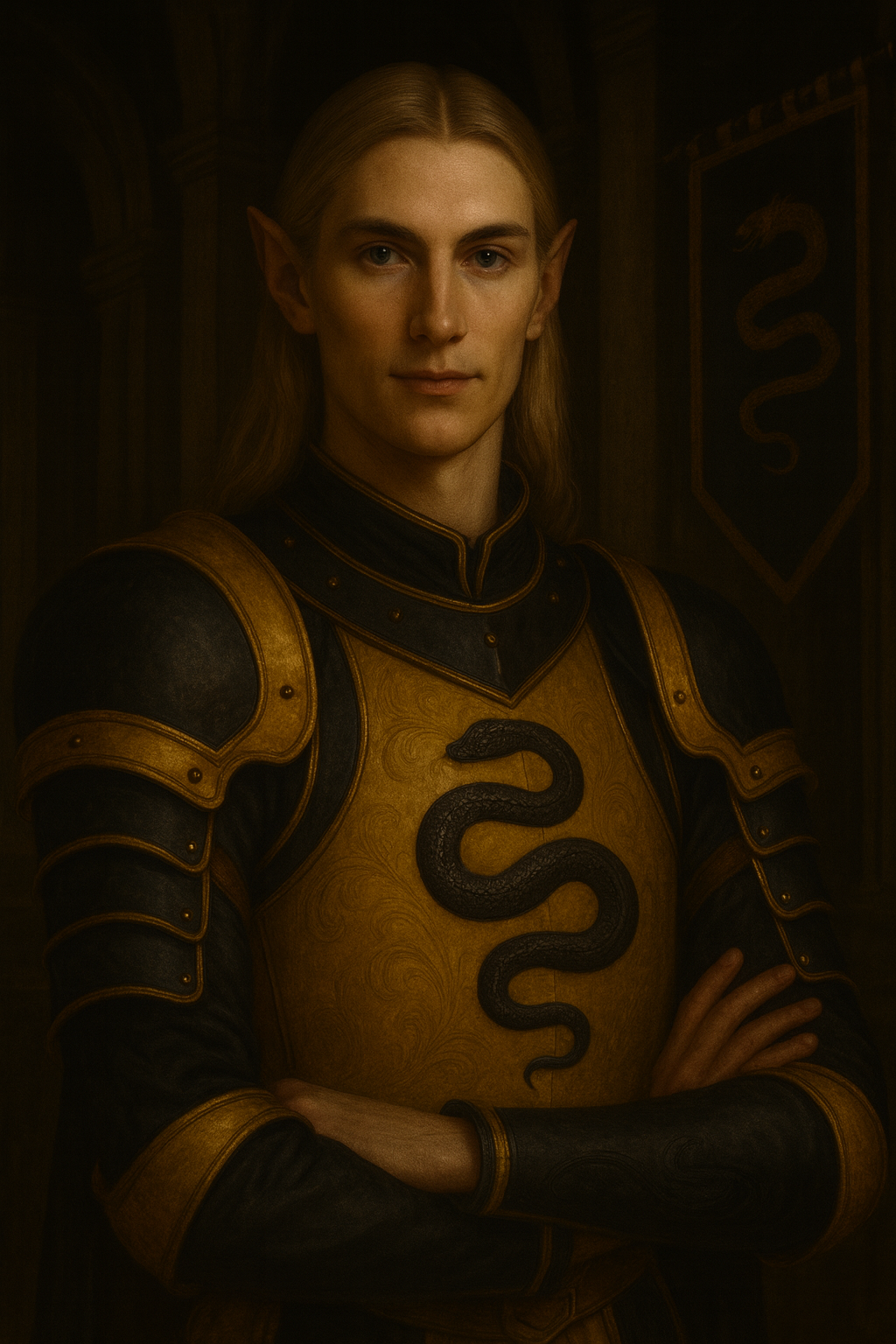
Noél Vipère
⚜️ Lord Noél Vipère
“The Gilded Fang”
Uncle of Lucien Vipère IV · Brother of Rhael Vipère II · General of the Venom Wars · Duelist of Dinkawal
Born 503 PR
Titles: Lord of Emberguard, Captain of the Black Venom Blades, Master Duelist of Dinkawal, Alchemist of the Third Circle
Faith: Drevrena, Goddess of Night and Shadows; minor devotion to Tymira for penance
Motto: “Beauty is the sharpest edge.”
The Poisoned Prodigy (503–570 PR)
Noél was born to Lord Lucen Vipère and Lady Morwen Dinkawal.
Where his elder brother Rhael II was scholarly and his younger sister, Lyssandra, devout, Noél was born restless — the Vipère child who could not sit still long enough to finish a brew, yet somehow mastered the art of poisoned steel before adulthood.
From an early age, he displayed two obsessions: alchemy and swordplay.
He fused them into one philosophy — “Venom through motion.”
At fourteen, he won his first duel by coating his blade with distilled manticore bile so refined it killed through a single scratch.
By seventeen, he was undefeated in Dinkawal’s dueling circuits, earning the title “The Gilded Fang.”
The Venom Wars (571–584 PR)
When the Tudor Empire clashed with the Fenraith tribes over the salt marshes, House Vipère raised its private armies — the Venom Blades.
Noél commanded them, leading with both elegance and brutality.
He developed new battlefield alchemies:
- Amberfire, a gel that clung to armor and burned for days.
- Veilwater, a vapor that blinded armies without killing — a weapon of terror and spectacle.
- Siren Oil, used to coat blades, whispering as it cut — making soldiers believe the dead screamed their names.
Noél’s campaigns were horrific but effective.
He earned the Emperor’s favor — and the hatred of the Church, who accused him of heresy for “using the souls of men as reagents.”
His reply:
“Every man bleeds the same. I simply choose to give that blood a purpose.”
By 584 PR, the Fenraiths surrendered their trade routes to Tudor. Noél was granted Emberguard Keep, a fortress overlooking the swamps.
The Duelist of Dinkawal (585–600 PR)
After the wars, Noél turned to dueling as political art.
He traveled between Embermoor, Leadenport, and Dinkawal, settling disputes with blade and wit alike.
His duels were public theater — he dressed in black and gold armor, his hair tied back with serpent-etched pins, his blade etched with scripture inlaid with mercury.
He never killed without purpose, but every duel ended in silence — his signature.
By thirty, he was considered the finest swordsman in the Tudor Empire.
He trained dozens of pupils, including:
- Rhael Vipère II, his ambitious brother and heir to Embermoor.
- Lucien Vipère IV, his nephew and protégé, whom he adored as a son.
- Kaedric Rongeur, briefly during diplomatic exchanges between Leadenport and Embermoor (607–610 PR).
Lucien’s journals note:
“He taught me to smile when striking. ‘If they see fear,’ he said, ‘they will believe you human.’”
The Council of Thorns and the Black Blades (601–620 PR)
When House Vipère founded the Council of Thorns, a shadow order of nobles, alchemists, and spies managing Tudor’s narcotic and assassination markets, Noél became its first Master of Steel.
He trained the Black Venom Blades, elite assassins who combined alchemy and swordsmanship, each sworn by blood to the Vipère crest.
Though a soldier, Noél detested needless cruelty.
His assassins were taught precision, not massacre.
He forbade killing without poetry — a lesson often misunderstood but obeyed.
“Every death must mean something. A corpse without a story is a wasted ingredient.”
He developed the Vipère code of honour that endures to this day:
“Strike once, speak never, leave beauty in your wake.”