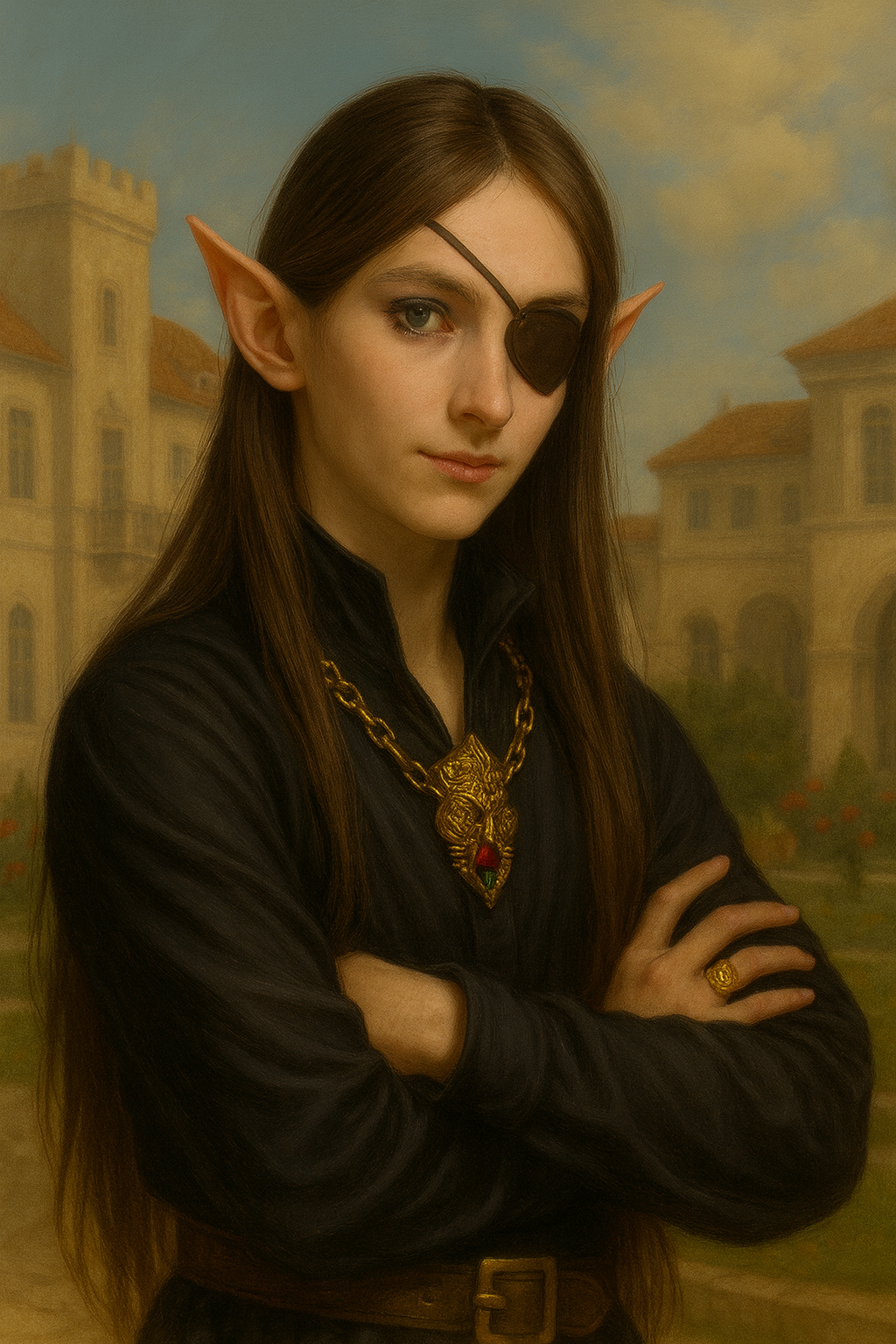
Eliseth Vipère
Eliseth Vipère — The Whisper in Silk
Spymistress of Blarget, the Thorn with a Smile
⚜️ Basic Details
- Full Name: Lady Eliseth Vipère of Embermoor
- Titles: The Spymistress of Blarget, Mistress of the Thorned Veil, Lady of the Night Courts
- Race: Half-Elf (¾ Elf by blood)
- Date of Birth: 577 PR
- Age (as of 620 PR): 43 years
- Faith: Drevrena, Goddess of Night, Shadows, and Secrets
Early Life (577–590 PR): The Spider’s Web in Silk
Eliseth was the second child of Rhael Vipère II, born in the final years of the Vipère ascendancy. Unlike her elder brother Lucien Vipère IV and her younger siblings, Eliseth’s birth was quiet—no celestial omens, no prophecies, only the silence that often precedes storms.
From her earliest years, she was a watcher. Eliseth lingered in doorways, memorizing the words others wished unsaid. The servants called her “the Shadow in Lace.”
By the age of twelve, Eliseth could make men confess treason in a whisper and thank her for their honesty.
Lucien, seeing her promise, assigned her to the Council of Thorns as an observer. She took to espionage as easily as breathing.
The Formation of the Thorned Veil (590–602 PR)
At fifteen, Eliseth was tasked with a dangerous experiment: infiltrating the capital’s pleasure district to gauge noble sentiment toward the Vipère house. She vanished for three months. When she returned, it was not as a spy—but as the mistress of the city’s most exclusive salon, the Thorned Veil.
The Thorned Veil became the nexus of gossip, secrets, and quiet power. Nobles, clerics, and mercenaries alike came seeking pleasure or reprieve, never realizing that every whisper was recorded and every glass of wine laced with subtle alchemic serum—one that heightened speech and loosened memory.
Through her salons, Eliseth constructed a web of informants stretching from Dinkawal’s poppy fields to the upper halls of Tudor’s Imperial Palace. Lucien made her the Spymistress of Blarget in 597 PR, the youngest to ever hold the post.
Her network became infamous: courtesans who carried knives in their hairpins, priests who traded confessions for gold, assassins who smiled before they killed. The common phrase in Tudor’s underworld—“a whisper from the Veil is a death sentence”—was coined in her honour.
The Scandal of the Velvet Archive (602–610 PR)
In 602 PR, Eliseth uncovered the greatest secret of her life—the Emperor’s consort, Lady Merena of Highfold, was an agent of the rival Bhrytyros Empire. Rather than expose her outright, Eliseth began a years-long game of manipulation, feeding Merena false intelligence while bleeding her of the Empire’s plans.
However, the operation collapsed in 610 PR when one of Eliseth’s couriers was intercepted by the Order of the Silverbrand. Under torture, the courier revealed portions of the Velvet Archive—Eliseth’s codex of incriminating correspondences and blackmail ledgers.
Rather than flee, Eliseth orchestrated a coup of silence:
- The inquisitors vanished within a week.
- The courier was found dead in his cell, his tongue and fingers missing.
- Lady Merena’s body was discovered in the palace gardens, her throat adorned with a serpent carved from silver.
The Emperor, desperate to bury the scandal, rewarded Eliseth publicly for her “loyal service.” Privately, he warned Lucien: “Keep your vipers leashed.”
Faith and Shadow (610–619 PR)
Though she was raised under Cyranel’s doctrine of divine diplomacy, Eliseth’s true devotion bloomed in the quiet hours of the Thorned Veil. There, in rooms lit by violet candles, she built altars to Drevrena, the goddess of night and secrecy.
Eliseth’s faith was not one of worship but of practice. She saw in Drevrena the reflection of her own existence—beauty and deception entwined. The prayers she whispered before bed were confessions, not pleas:
“I hide truth not to deceive, but to preserve the world from its own light.”
Her devotion deepened after an attempt on her life in 614 PR, when an assassin poisoned her chalice during a gathering of nobles. She drank the venom, smiled through the pain, and later had the man’s body hung upside down over the same table. She claimed to have seen Drevrena’s shadow that night—“a woman made of silence, sitting beside me, holding my cup.”
From that night onward, Eliseth signed all her letters with the glyph of a crescent moon over a serpent’s eye—the Sigil of the Silent Mother.
The Sister of Secrets (620 PR)
By 620 PR, Eliseth’s influence extended beyond the Vipère domains. Her informants operated in Whitestone, Sturvik, and even Vindhan. She controlled trade routes, assassins, and the flow of information like veins of living gold.
It was Eliseth who first warned Lucien of unrest among the poppy barons in Dinkawal and the quiet rise of God Hand sympathizers across Tudor. Her spies reported the names Zarlax, Ivar, and Kaelthys months before their agents ever reached Tudor soil.
Personality
Eliseth Vipère is grace sharpened to a blade. She smiles easily, but her warmth is measured, her laughter calculated. She loves secrets more than people, yet she keeps a private garden of white lilies—each planted for someone she has killed.
Her guiding belief, taught by Cyranel but made her own, is this:
“Information is mercy delayed.”
Eliseth rarely speaks in anger. Her punishments are quiet, poetic, and often unseen. A rival might wake to find every servant gone, every account emptied, every door locked—from the inside.
To her allies, she is a goddess of opportunity. To her enemies, a ghost that whispers their sins before they fall asleep.
Legacy and Rumors
- The “Serpent Choir”—a group of courtesans turned assassins—still operates under her direct command, leaving white masks upon their victims’ faces.
- Some say Eliseth carries a vial of venom mixed from her own blood and Lucien’s, said to kill any Vipère who betrays the family.
- The priests of Drevrena whisper that Eliseth’s shadow sometimes moves before she does—that she walks with the goddess’s reflection.
Predicted Fate
Cyris Vipère’s dream journals mention her only once, in a chilling prophecy:
“The sister of whispers dies not by blade or poison, but by the truth she tries to hide. When her shadow learns to speak, the serpent will weep.”
Whether that prophecy refers to betrayal, divine punishment, or her own reflection remains unknown.
Eliseth Vipère remains, as of 620 PR, the most powerful and least understood figure in Tudor’s network of intrigue—a woman who knows every secret, including her own death, and smiles as if she’s already made peace with it.