

Samyaza
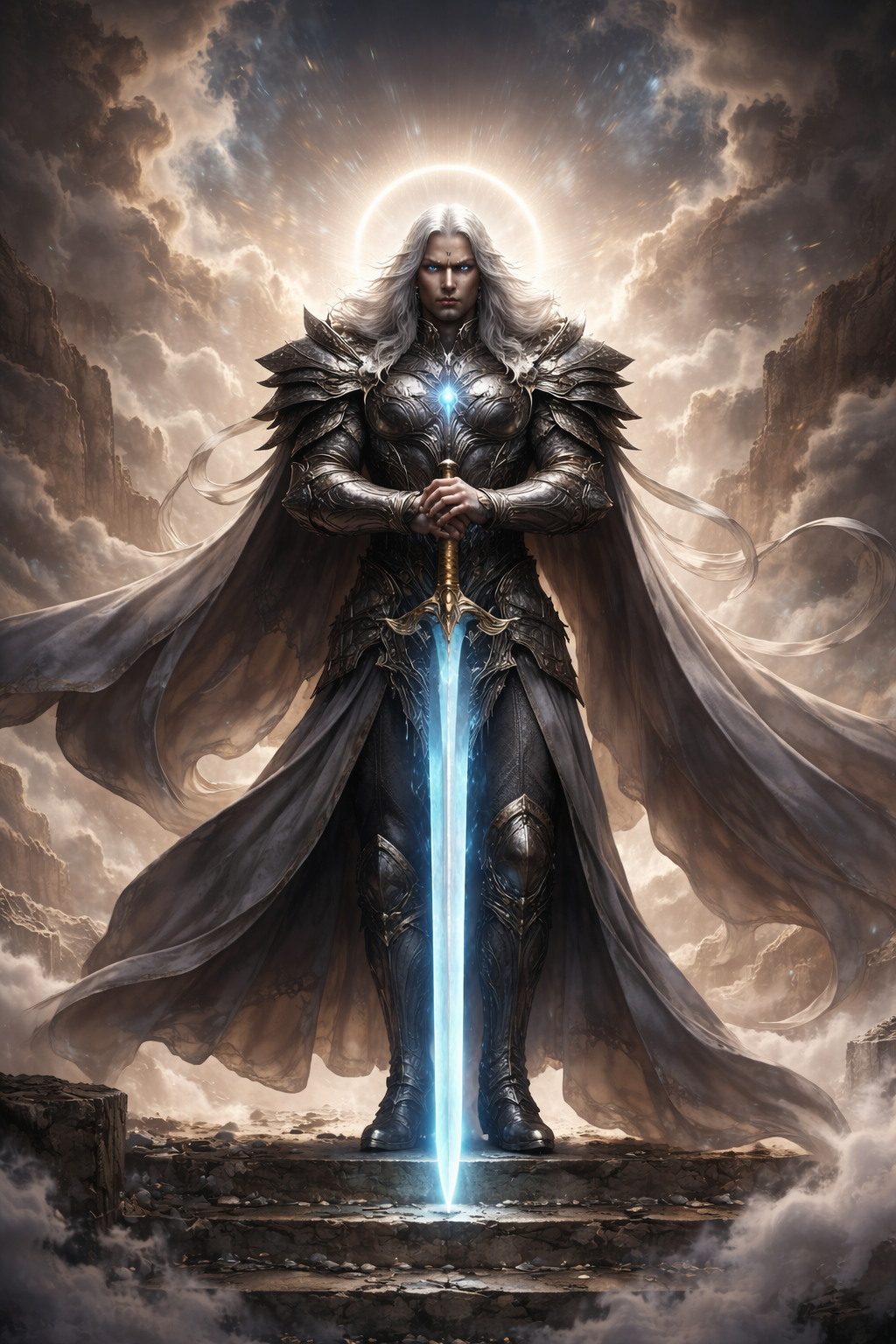
Samyaza — The Penitent Aspirant
Overview
Samyaza was a powerful celestial who sought ascension not through worship or decree, but through creation.
He believed the gods had erred in their design of mortals — not morally, but structurally. Mortals were fragile, fleeting, and prone to collapse. Samyaza believed that if he could create beings superior to mortals — stronger, enduring, self-sustaining — he could justify his place among the gods.
He was not commanded to create.
He chose to.
Creation was his petition.
The world was his argument.
The Precursor Myth — Ragnar
The existence of Ragnar is not accepted historical fact.
Unlike the Titans and Giants — whose remains, descendants, and ruins persist — Ragnar appears only in fragmentary myths, contradictory oral traditions, and disputed pre–First Fall texts. Most modern scholars classify Ragnar as apocryphal, referring to him as:
“The myth that Samyaza had a creation before the Titans.”
Accounts vary wildly. Some describe Ragnar as a singular walking cataclysm. Others treat the figure as allegorical — a cautionary tale meant to explain why Samyaza never again attempted perfection.
No physical evidence has ever been recovered.
No confirmed records place Ragnar in any battle.
No unified description exists.
Among some giant oral traditions, Ragnar is invoked as the First Shadow, though even these accounts treat the figure as symbolic rather than historical.
Whether Ragnar ever existed remains unresolved.
What is uncontested is that Samyaza feared something enough to fundamentally alter his approach to creation.
The Titans — The Favored Sons
Learning restraint, Samyaza created the Titans.
They were colossal, intelligent, and immensely powerful — yet constrained. Hierarchy, obedience, and metaphysical limits were woven into their nature. They could rival gods in might, but not in autonomy.
The Titans were Samyaza’s pride.
They were his proof that power could exist without rebellion.
Among them stood Magog, the Alpha — Titan of Titans, exemplar of command and loyalty. In Magog, Samyaza believed he had finally succeeded.
The Giants — The Forgotten Sons
Attempting refinement once more, Samyaza created the Giants.
They were smaller.
Weaker.
Lacking the overwhelming power of the Titans.
Samyaza dismissed them.
The Titans scorned them.
The world overlooked them.
Yet the Giants endured.
They formed cultures, bonds, and traditions without imposed hierarchy or divine oversight. They grew not by design, but by choice.
Samyaza did not recognize this as success — until catastrophe forced his sight.
The Corruption of Magog
When the First Necromancer corrupted Magog and the Titans, Samyaza was defeated spiritually before the first blow was struck.
His greatest creation — his proof of worth — turned against the world.
Everything Samyaza believed about control, loyalty, and superior design collapsed in an instant.
The Samyazan War
The Samyazan War was not a rebellion.
It was creation turned upon creation.
Titan against Giant.
Design against growth.
Power against will.
The Giants — the Children of the Sky-Blood — were the first to stand together in resistance. Grossly overpowered, they fought not because they could win, but because they refused to kneel.
Their defiance inspired others.
And finally — it inspired Samyaza.
For the first time, he saw the Giants not as failures, but as successes he had never intended.
He joined them.
The Defeat of Magog
In the defining moment of the war, Samyaza and the Giant Alpha confronted Magog.
The battle was apocalyptic in scale. Against expectation, Magog was defeated.
This moment is among the most consequential events in Palimar’s history.
Cosmic Consequences
Magog’s fall:
- Severed the First Necromancer’s steady flow of power
- Forced Voreth to channel greater divine essence to sustain the First
- Exposed Voreth to vulnerability
This vulnerability allowed the Twilight Queen to strike Voreth down.
With Voreth slain:
- The First was cut off from divine support
- A narrow window opened
- The Ancient Six shattered the First into the Six Aspect Skulls
Without Magog’s defeat, the First Fall would not have occurred.
Divine Law and Judgment
The gods of Palimar do not rule through morality.
They rule through ownership.
The Mortal Plane was never sacred — only possessed. A sandbox. A project that could be abandoned and rebuilt at will.
When Voreth empowered the First and destabilized the world, the other gods objected — but accepted it. If a god broke the world, that was the prerogative of godhood.
Samyaza was not a god.
When Samyaza directly intervened — fighting alongside mortals, altering history, and shaping the outcome of an age — the outrage was not legalistic.
It was personal.
The question was not what he had done, but:
“Who does this creature think he is?”
A non-god celestial had acted with consequence reserved for gods.
That could not be tolerated.
Punishment
Samyaza was not destroyed.
Destruction would have been mercy.
Instead, he was subjected to one of the harshest punishments conceivable to the divine:
- All divine and celestial power stripped
- Immortality preserved
- Imprisonment decreed until the Mortal Plane itself ceases to exist
This was not justice.
It was humiliation made eternal.
Samyaza would live forever knowing:
- His actions mattered
- His creations shaped history
- And he would never again be permitted to act
The gods did not regret his intervention.
They resented his presumption.
Legacy
Samyaza is remembered as:
- The celestial who sought ascension through creation
- The architect of a war between his own children
- The being whose defiance enabled the First Fall
- The creator who learned that will matters more than design
Among mortals, he is barely remembered.
Among Giants, he is remembered with conflicted reverence.
Among the gods, he is remembered as a mistake that dared to matter.
Comments