

Örókŋýï Bay
The Örókŋýï, Arhaŋa, or Aragnia Bay is a circular area of water that extends from the Ëriðorn Ocean and borders the Ürŋimrhýn continent. Alongside the Aragnia Mountains and Iagos River, it is one of three geographic features that define the boundary between the Blýfónic Valley and the Shattered Earth. It is the second-largest bay behind the Múhr-Ïúýkóš, and the largest to be formed solely through tectonic movement.
Geography
The Örókŋýï Bay is a large basin that borders the Blýfónic Valley to the northwest and the Shattered Earth to the northeast, east, south, and west. It serves as the boundary for both the Nuzowli Mountain Range and the Aragnia Mountains, both of whom fade in elevation and eventually combine to the north of the Bay. On the extreme southwest and west, the relatively-low elevation of the earth rises to a spear-like series of cliffs. These cliffs define the southernmost extent of the entrance to the Bay.
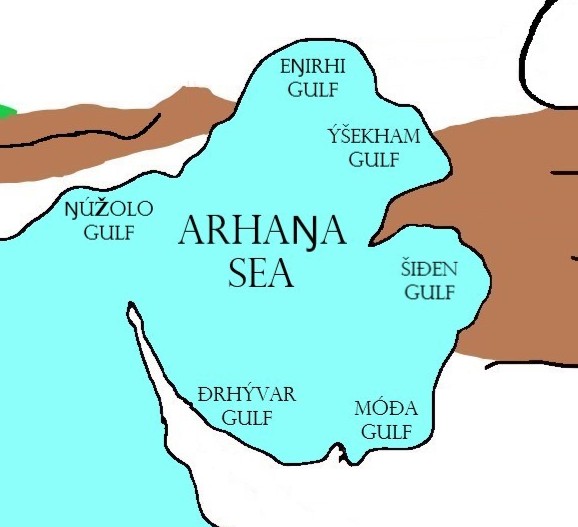
The Örókŋýï Bay has a characteristic shape that has been rendered highly irregular by the diverse terrain it borders. There are 6 prominent gulfs that each mark a marginal sea within the bay. They will be explored, one-by-one, starting from the northwest and going clockwise around the Bay.
Gulfs
Ŋúžolo Gulf
The Ŋúžolo Gulf represents two similarly-sized bodies of water that represent the eastern end of the so-called Southern passage, that is, the thin strip of land between the Nuzowli Mountain Range and the Ëriðorn Ocean. It also is the northern end of the thin entrance to the Bay itself, and most geologists hypothesize that the Örókŋýï Cliffs (the thin spear-like landmass that acts as the southern end of the passage) were once directly connected to the Ŋúžolo Gulf. It is located only around 15-20 kilometers from the Nuzowli Mountain Range.
The Gulf itself is characterized by the terrain of the Blýfonic Valley itself (which it is directly adjacent to). Unlike the soaring peaks of the Nuzowli Mountain Range itself, and even the cliffs that define the western ends of the Southern Passage, the Ŋúžolo Gulf actually sits below sea level, resulting in a height difference from the coast to the Mountain Range of more than 6,000 meters. It experiences a substantial cycle of low and high tides, one of the only gulfs to do so.
Eŋirhi Gulf
The Eŋirhi Gulf is the northernmost gulf of the 6. It is largely defined by the series of hills that result from the combination of the low-lying Nuzowli and Örókŋýï Mountains. It is largely supplied by rainfall, which are systematically funnelled there through these hills. In return, Eŋirhi Gulf, and its abundance of nutrients, gives rise to a field of grasses and other small plants in the hills. These hills, and the grasses that populate them, are seen as the boundary between the relatively-sparse grasses of the Ðýmóš Plains and the more lush grasses of the Shattered Earth.
Ýšekham Gulf
The Ýšekham Gulf is adjacent to the Örókŋýï Mountains, which render it the most shallow of the six gulfs. Like the Eŋirhi Gulf to the north, it is fed by rainfall that is directed westwards by these mountains, which carry bits of rock to the water itself. Unlike the southeastern and southern landmasses of the Ýšekham Gulf, that are all part of the Örókŋýï Mountains, the northeastern part is substantially more level and much closer to the grassy fields of Eŋirhi Gulf. However, it is not merely grassy but carries elements of the marshlands that inundate the Mountains. When there is excessively high rainfall, the water of both the Ýšekham Gulf and these surrounding marshlands can intermingle.
This makes the Ýšekham Gulf one of the most nutrient-rich parts of the Bay. This is corroborated by it being home to almost 60 different species in and around its waters.
Šiðen Gulf
The Šiðen Gulf is the only one of the 6 to be completely bordered by the Örókŋýï Mountains. It is the dominant factor behind the marsh-like nature of the Mountains themselves, as the porous rock between them allows the free transfer of water. This is helped by the Šiðen Gulf being the easternmost of the six; from the Gulf, the water has the ability to travel from the Mountains through several designated channels and streams to the Iagos River, where it thus empties into the Khamalov Ocean. Thus, the Šiðen Gulf serves as the main connecting point between the Ërïðorn and Khamalov Oceans in a cycle known as the Šiðen Process.
Móða Gulf
In terms of elevation, the land that borders the Móða Gulf takes on the role of a small valley, being bordered by the peaks of the Örókŋýï Mountains to the north and the Örókŋýï Cliffs to the west. Here, it is comparable in elevation to the Eŋirhi, which is similarly beset by hills; the water level is consistently around 7-8 meters below the land level. The intersection of these two biomes (the jagged Mountains and the unique geology of the cliffs) means that the land here is very mixed-up and irregular. At any given time, the land of the Gulf can take on certain patterns, formations, and even colors depending on a variety of factors, including the water content, the shifting microstructure of the rock itself, and the tides.
Ðrhývar Gulf
The Ðrhývar Gulf is the southernmost gulf of the six, and the longest. It stretches nearly 300 kilometers, and comprises a large sweeping curve in the walls of the Örókŋýï Cliffs that serves to greatly limit the width of these Cliffs and ultimately carves them to a spear-like point. The cliifs on these parts make the geology here very unique. The majority of the walls that border the Gulf are defined by striated lines that arise due to the structure of the rock itself; any cracks in the rock appear as vertical lines that encroach through and permeate the entire structure. As it grows thinner, the rock is more keen to become warped by persistent currents and other aqueous effects, and this brings forth roughly circular holes in the rock that are very common in the underwater sections of the Cliffs and which serve to allow free exchange of water between the Bay and the Ërïðorn Ocean at large.
Örókŋýï Peninsula
The Örókŋýï Peninsula, visible on the above map, is a spear-like protrusion into the Bay that separates the Ýšekham and Šiðen Gulfs. It is a highly mountainous land, and is considered much less an outgrowth but a remnant of a once-expanded Mountain Range. Geologists are of agreement that the Mountains were once much larger in area, having jutted out into the waters at least 100 meters more than that of the modern day. Over the course of millions of years, the water gradually eroded this excess until it became its present size, but the highest peaks of this now-reduced excess make up what are the Örókŋýï Peninsula. The eroded mass makes up the shallow beds of the surrounding gulfs, raising that part of the Bay over 20 meters above the rest of the seafloor.
The Peninsula consists of at least 40 individual peaks that have been rendered extremely thin due to the erosion. Estimates indicate that the majority of these peaks will be gone by 40,000 YMA, and the entire Peninsula by 60,000 YMA.

Comments